
The Bugatti Chiron is not just a faster Veyron. It is the car Bugatti built to prove that extreme speed, luxury, stability, and daily usability could still live in one machine at the highest end of the combustion-engine era. With an 8.0-liter quad-turbocharged W16, all-wheel drive, a carbon-fiber structure, and 1,500 hp, the Chiron turned impossible numbers into a polished grand-touring experience.
Built in Molsheim and sold in tightly limited numbers, the Chiron became a benchmark for modern hypercars because it made 400 km/h performance feel engineered rather than improvised. It also marked one of the final chapters for Bugatti’s W16 engine. For buyers and collectors, the Chiron’s appeal is not only its speed. Its value rests on provenance, configuration, factory support, maintenance history, and whether the car has been preserved as an original, usable, properly serviced example.
Table of Contents
- What the Chiron Represented for Bugatti
- W16 Specs, Chassis, and Performance Data
- Production Versions and Factory Identity
- Design, Aero, and Engineering Character
- How the Chiron Feels to Drive
- Maintenance Risks and Ownership Reality
- Buying a Chiron With Confidence
What the Chiron Represented for Bugatti
The Chiron was Bugatti’s answer to a difficult question: how do you replace the Veyron without simply repeating it? The answer was a more powerful, more refined, more advanced hyper-GT that kept the W16 formula but raised nearly every limit.
Introduced in 2016, the Chiron followed the Veyron 16.4, the car that had redefined production-car speed in the 2000s. Bugatti did not abandon the basic recipe: a mid-mounted 16-cylinder engine, four turbochargers, all-wheel drive, a dual-clutch gearbox, and a luxury cabin. Instead, it rebuilt the idea around greater output, stronger cooling, sharper aerodynamics, and a more mature driving experience.
The Chiron’s mission was broader than setting a top-speed number. It had to feel stable at speeds most cars will never reach, remain comfortable enough for long-distance road use, and deliver the craftsmanship expected from a multi-million-euro Bugatti. That combination is why the Chiron still matters. It is both an engineering object and a luxury product.
The car’s name honors Louis Chiron, the Monegasque racing driver closely linked with Bugatti’s prewar racing history. That connection gave the model more than a technical identity. It tied the modern W16 era back to Bugatti’s racing past, where elegance and performance were expected to sit together rather than compete.
Although the requested article scope is 2016–2023, it is worth noting that the Chiron story effectively closed with the final 500th car in 2024. For most buyers, however, the core market consists of earlier Chiron, Chiron Sport, Pur Sport, Super Sport 300+, Super Sport, and special-edition cars ordered and delivered during the main 2016–2023 period.
The Chiron’s reputation today is unusually strong because it sits at the end of a specific era. Before electrified hypercars became the default answer to extreme power, Bugatti achieved its numbers with displacement, turbocharging, transmission strength, cooling capacity, tire development, and aerodynamic discipline. That makes the Chiron feel like a final peak of one engineering philosophy.
W16 Specs, Chassis, and Performance Data
The Chiron’s defining hardware is its 8.0-liter quad-turbocharged W16 engine, rated at 1,500 hp in the standard Chiron and related 1,500 PS versions. The headline figures matter, but the way Bugatti supports those figures with cooling, traction, gearbox strength, and aero stability is what makes the car credible.
| Category | Specification |
|---|---|
| Engine | 8.0-liter quad-turbocharged W16 |
| Displacement | 7,993 cc |
| Power | 1,500 hp / 1,103 kW / 1,500 PS |
| Torque | 1,600 Nm / about 1,180 lb-ft |
| Transmission | 7-speed dual-clutch automatic |
| Drivetrain | Permanent all-wheel drive |
| Body structure | Carbon-fiber monocoque and carbon-fiber body construction |
| Layout | Mid-engine, two-seat coupe |
The W16 is often described simply as “huge,” but its real challenge is heat management. Four turbochargers, enormous combustion output, and sustained high-speed running create a thermal load that ordinary supercar packaging cannot handle. The Chiron uses large side intakes, carefully managed airflow, and multiple cooling circuits to keep the powertrain and charge air under control.
The engine’s power delivery is shaped by staged turbo behavior. At lower engine speeds, the car does not feel like an old-style laggy turbo monster. It builds force cleanly, then piles on torque with an almost unreal lack of drama. That character is central to the Chiron. It is violent in output but polished in delivery.
| Measurement | Figure |
|---|---|
| Length | 4,544 mm |
| Width | 2,038 mm |
| Height | 1,212 mm |
| Wheelbase | 2,711 mm |
| Curb weight | About 1,995 kg, depending on version and equipment |
The Chiron is heavy by track-car standards, but that weight has context. It carries a 16-cylinder engine, all-wheel drive, a reinforced dual-clutch transmission, luxury interior materials, active aero hardware, major cooling systems, and the structure needed for very high-speed stability. It is closer in character to a luxury high-speed missile than a stripped circuit special.
| Performance Measure | Figure |
|---|---|
| 0–100 km/h | About 2.4 seconds |
| 0–200 km/h | About 6.5 seconds |
| 0–300 km/h | About 13.6 seconds |
| Limited top speed | 420 km/h / 261 mph with the correct mode and key |
| 0–400–0 km/h record run | 41.96 seconds in Bugatti’s 2017 demonstration |
The 0–400–0 km/h run is important because it showed more than acceleration. It showed traction, gearbox calibration, aerodynamic stability, brake performance, tire integrity, and repeatable control at a speed where small errors become serious. For buyers, that matters because the Chiron’s value is tied to complete-system engineering, not just engine output.
Production Versions and Factory Identity
The Chiron family is not one single specification. Buyers should treat each version as a different expression of the same W16 platform, with meaningful differences in handling, aero, gearing, rarity, and collector appeal.
Bugatti limited total Chiron-family production to 500 cars. Within that number, the standard Chiron represents the cleanest original form of the model. Later versions made the car sharper, faster, rarer, or more visually distinctive.
The standard Chiron is the most balanced grand-touring version. It carries the full 1,500 hp output, the luxurious cabin, the dramatic C-line body form, and the broadest usability. For many collectors, it is the purest expression because it is the car that launched the generation.
The Chiron Sport, introduced in 2018, kept the same basic power output but focused on agility. It used lighter components, revised suspension settings, sharper steering calibration, and torque-vectoring behavior aimed at improving cornering response. It did not turn the Chiron into a lightweight track car, but it made the car feel more alert.
The Chiron Sport “110 Ans Bugatti” celebrated Bugatti’s 110th anniversary. Its appeal rests on limited production, French tricolor details, special trim, and its link to brand history. These cars tend to attract buyers who want both performance and a clear factory story.
The Chiron Pur Sport shifted the formula further toward handling. It used shorter gearing, higher-revving character, increased downforce, and chassis changes aimed at road and circuit response rather than maximum top speed. For drivers who care about mountain-road feel, the Pur Sport may be more engaging than the standard Chiron.
The Chiron Super Sport 300+ is tied to Bugatti’s 300 mph achievement. It uses the higher-output 1,600 PS development of the W16 and longtail-style aero influenced by high-speed stability. Its rarity and record connection make it one of the most desirable Chiron variants.
The Chiron Super Sport is the more luxurious high-speed longtail version. It shares the general direction of the 300+ but presents it as a grand touring car rather than a stripped record tribute. It is one of the strongest choices for buyers who want the ultimate road-focused W16 Chiron experience.
Special projects and one-offs, including cars such as the Profilée and other Sur Mesure commissions, require individual evaluation. Their value depends on provenance, specification, factory documentation, and whether their story has lasting collector relevance.
Identification matters
A serious Chiron inspection should confirm the exact variant, VIN, build sheet, factory configuration, special-order content, service records, warranty status, and any later factory work. Color, exposed carbon, interior materials, painted details, wheel type, and edition-specific badges can all affect value.
Authenticity is especially important because the Chiron’s market is collector-driven. A car with complete factory documentation, original finishes, low mileage, and correct service history will usually be far easier to sell than a car with unclear history, aftermarket changes, or missing records.
Design, Aero, and Engineering Character
The Chiron’s design works because it turns extreme cooling and speed needs into a recognizable shape. The body is not decoration placed over engineering; it is a visible map of airflow, cooling, identity, and stability.
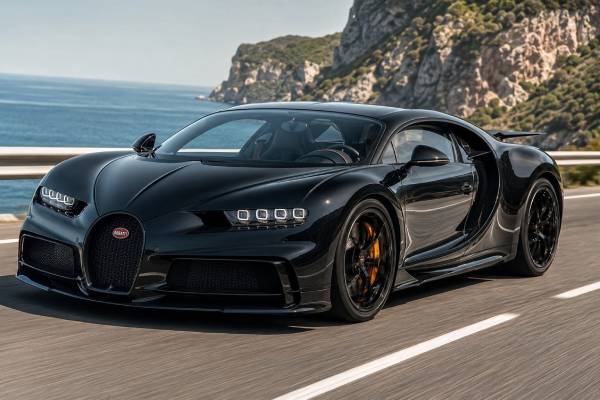
The most recognizable exterior feature is the sweeping side C-line. It frames the cabin visually, but it also helps define the side intake area that feeds the engine and cooling systems. This is typical of the Chiron’s design logic: a signature detail also performs a technical job.
At the front, the horseshoe grille connects the Chiron to Bugatti tradition. Around it, the front openings, splitter surfaces, and headlamp shapes manage cooling and pressure. The Chiron cannot rely on a simple low-drag shape because it must cool a massive engine while remaining stable at very high speed.
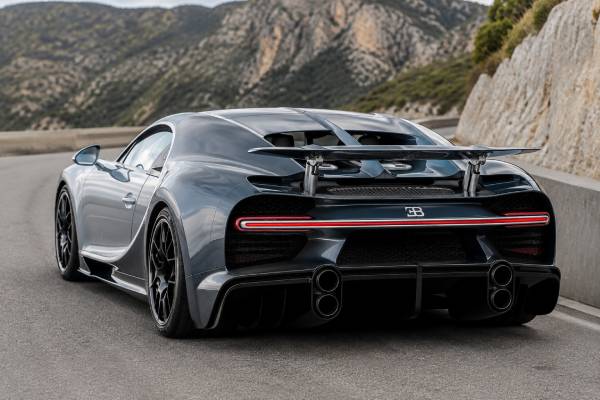
The rear of the car is dominated by heat rejection, exhaust presence, and active aerodynamic control. The active rear wing changes function depending on speed and driving mode. It can support stability, reduce drag, or act as an air brake under heavy deceleration.
The carbon-fiber structure is central to the car’s character. It provides the stiffness needed for precise suspension behavior and the strength required for the Chiron’s performance envelope. The body panels and monocoque also support Bugatti’s goal of combining low weight where possible with luxury and refinement where expected.
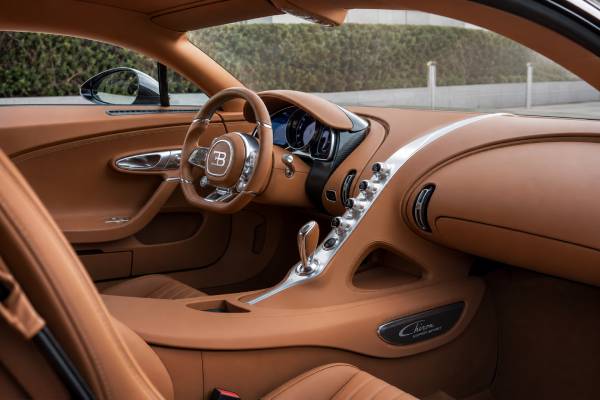
Inside, the Chiron is deliberately more restrained than many hypercars. The cabin does not chase a race-car fantasy. Instead, it uses a narrow center spine, high-grade leather, metal details, clear controls, and a driver-focused layout. The effect is important: the Chiron feels expensive, not stripped.
The sound is also part of the engineering character. The W16 does not sound like a flat-plane V8 or a high-revving V12. It has a deep, layered, turbine-like force, with turbocharger presence and immense intake and exhaust energy. At full load, the sound communicates mass and pressure more than delicate mechanical pitch.
The Chiron’s unusual engineering choices reflect its purpose. All-wheel drive is not there to make it easy in bad weather; it is there because 1,600 Nm of torque needs disciplined traction. The dual-clutch gearbox is not there only for quick shifts; it must survive torque that would overwhelm ordinary performance-car transmissions. The tires are not just wide; they are part of the car’s speed ceiling.
How the Chiron Feels to Drive
The Chiron’s biggest surprise is not that it is fast. The surprise is how calmly it delivers speed that should feel chaotic.
At normal road pace, the Chiron can feel more civilized than its numbers suggest. The engine has enormous reserve, the gearbox shifts cleanly, and the cabin shields the driver from much of the mechanical stress happening behind the seats. Visibility is not city-car easy, but the seating position and control layout make the car less intimidating than its size and value imply.
Acceleration is the defining event. The Chiron does not simply surge; it compresses distance. From low speed, all-wheel drive helps the car deploy power with little wasted motion. As speed rises, the car continues pulling with a force that makes ordinary fast cars feel like they have run out of breath.
The throttle response is smoother than many expect. Because the engine has so much torque, the car does not need a nervous pedal calibration to feel responsive. Small inputs produce serious speed, so Bugatti’s polished mapping is part of what makes the Chiron usable.
The gearbox is fast and strong, but its best quality is how invisible it can feel. In gentle driving, it behaves with luxury-car smoothness. Under full load, the shifts arrive quickly enough to keep the W16 in its strongest range without making the car feel crude.
Steering feel depends on version. The standard Chiron is stable and precise, with a grand-touring bias. The Chiron Sport and Pur Sport add sharper responses and a more alert front end. The Pur Sport, in particular, feels more interested in corners, though it gives up some of the standard car’s effortless high-speed grand touring character.
Ride quality is firm but not punishing in the way many track-focused hypercars can be. The Chiron’s weight and wheel size are always present, yet the suspension tuning gives it a composed, expensive feel. It is not a lightweight back-road car, but it does not feel fragile or nervous on real roads.
Braking performance is massive, helped by carbon-ceramic hardware and aerodynamic braking from the active rear wing. The key ownership point is that carbon-ceramic brakes must be inspected carefully. They are extremely capable, but replacement or refurbishment costs are significant.
On track, the Chiron is fast but not small. It can deliver astonishing lap speed in the right environment, yet it is happiest on wide, fast circuits rather than tight technical tracks. Tire temperature, brake temperature, and driver judgment matter. It rewards smooth inputs more than aggression.
On highways and open roads, the Chiron makes the most sense. It feels like a car designed to shrink continents. At very high speed, stability is the main impression. The car’s aero, weight, wheelbase, and drivetrain work together to create confidence where a lighter, more nervous hypercar might feel busy.
Maintenance Risks and Ownership Reality
Chiron reliability should be judged like exotic aircraft-grade ownership, not normal used-car ownership. The car can be robust when maintained correctly, but every major system is specialized, expensive, and dependent on factory-level knowledge.
The W16 engine is not a casual service item. Access, heat, turbocharging, cooling, and packaging make inspection and maintenance specialist work. A missed service, ignored leak, old fluid, weak battery, or unresolved warning light can become expensive quickly.
The cooling system deserves serious attention. The Chiron depends on controlled temperatures for engine oil, coolant, charge air, gearbox, and related systems. Any history of overheating, coolant loss, fan issues, damaged radiators, or debris-blocked openings should be investigated before purchase.
The transmission and all-wheel-drive system must be assessed through records and road behavior. The 7-speed dual-clutch gearbox is built for huge torque, but harsh engagement, warning messages, leaks, delayed shifts, or abnormal noises should be treated seriously. This is not a car where a buyer should “see what happens later.”
Carbon-ceramic brakes are a major inspection point. Buyers should confirm disc condition, pad life, heat checking, surface damage, and whether the car has been used heavily on track. A low-mileage car can still have costly brake needs if it has been driven hard.
Tires are another major cost and safety item. The Chiron’s tires are highly specialized and central to the car’s performance envelope. Age, heat cycles, storage conditions, and correct specification matter as much as tread depth. A car that has sat for years may still need tires before serious use.
The suspension and lift systems should operate smoothly and consistently. Any uneven ride height, warning light, hydraulic issue, or noise over bumps requires specialist diagnosis. Because the Chiron’s aerodynamic and suspension systems interact with driving modes, inspection should include more than a static visual check.
Electrical systems also matter. Hypercars that sit unused can suffer from battery, module, sensor, and software-related issues. A Chiron should be kept on the correct battery maintenance equipment, updated through proper channels, and exercised carefully enough to keep systems healthy.
Common ownership priorities
- Keep all scheduled service current through Bugatti-authorized or highly qualified specialist support.
- Maintain the battery correctly during storage.
- Replace tires based on age, condition, and approved specification, not only tread depth.
- Inspect carbon-ceramic brakes before purchase and after hard use.
- Verify software updates, service campaigns, and recall status by VIN.
- Document every service, tire change, inspection, and factory interaction.
The biggest mistake is treating low mileage as proof of low risk. With cars like the Chiron, inactivity can create its own problems. Seals, fluids, batteries, tires, and electronic systems all prefer proper care. The best cars are not always the lowest-mileage cars; they are the cars with the best care.
Buying a Chiron With Confidence
The best Chiron to buy is the one with the clearest identity, cleanest history, strongest factory documentation, and maintenance record that matches its value. Specification matters, but condition and provenance matter more.
Start by deciding which Chiron personality fits your goal. A standard Chiron suits collectors who want the original shape and balanced grand-touring character. A Chiron Sport suits buyers who want sharper response without leaving the standard 1,500 hp formula. A Pur Sport suits drivers who value handling and rarity. A Super Sport 300+ suits collectors chasing the record-linked story. A Super Sport suits buyers who want the high-speed longtail experience with more luxury usability.
Then inspect the paperwork before the car. The file should include original order details, factory build data, service records, warranty information, recall and campaign confirmations, tire records, battery history, and any paint-protection or cosmetic work. Missing records are not a small issue at this level.
A professional pre-purchase inspection is essential. It should include diagnostic scans, underbody inspection, brake measurement, tire age verification, suspension and lift operation, cooling-system checks, paint and carbon-fiber inspection, and confirmation that all keys, books, chargers, accessories, and factory documents are present.
| Area | What to Confirm |
|---|---|
| Identity | VIN, exact variant, build sheet, edition details, factory options |
| Service history | Annual maintenance, fluids, campaign work, authorized records |
| Powertrain | No leaks, warning lights, overheating history, or abnormal driveline behavior |
| Brakes | Carbon-ceramic disc condition, pad life, heat damage, replacement history |
| Tires | Correct specification, date codes, condition, storage and replacement records |
| Body and carbon | Paint quality, exposed carbon condition, repairs, panel alignment |
| Electronics | Battery health, module scans, infotainment function, software updates |
| Provenance | Ownership chain, market history, original accessories, factory correspondence |
Color and specification can change value significantly. Exposed carbon, rare paint, tasteful factory personalization, special interiors, and edition-correct details can make a car more desirable. However, extreme personalization can narrow the buyer pool unless it has a strong story or exceptional execution.
Mileage should be interpreted carefully. Very low mileage helps collectability, but a car that has never been properly exercised may require recommissioning. Moderate mileage with excellent service history can be attractive to a buyer who wants to drive the car.
Avoid cars with unclear accident history, missing factory records, unresolved warnings, neglected tires, overdue service, or unexplained paintwork. At Chiron values, a small uncertainty can become a large negotiation point.
For many collectors, the strongest long-term cars will be original, fully documented, low-owner examples with desirable factory specifications and uninterrupted maintenance. For drivers, the best car may be one that has been used lightly but regularly and kept in excellent mechanical condition.
References
- How Bugatti Crafted the Chiron, the World’s Last Truly Great Car 2016
- The Bugatti Chiron is the most powerful (and absurd) production car ever 2016
- Bugatti Unveils the World’s Fastest Production Car to the U.S.—and Only 30 Will Be Made 2019
- Bugatti unveils new sports car with 1,800 horsepower and a $4M price tag 2024
Disclaimer
This article is for informational purposes only and is not a substitute for professional diagnosis, repair, appraisal, or pre-purchase inspection. Specifications, torque values, service intervals, procedures, software status, and campaign requirements can vary by VIN, market, equipment, and production date. Always verify details against official Bugatti service documentation and a qualified Bugatti specialist.
If you found this guide useful, please consider sharing it on Facebook, X/Twitter, or your preferred enthusiast community to support our work.