
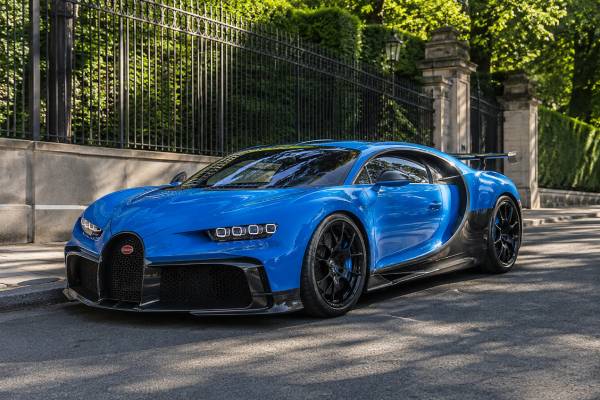
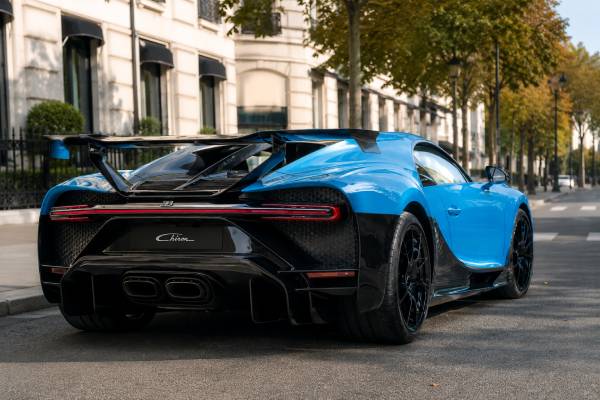
The Bugatti Chiron Pur Sport is the Chiron for drivers who care less about a maximum-speed headline and more about response, grip, and corner-exit force. It keeps the 8.0-liter quad-turbo W16 and the overwhelming 1,500 PS output of the standard Chiron family, but Bugatti retuned the package around agility: shorter gearing, a higher engine-speed ceiling, a fixed rear wing, revised suspension, special Michelin tires, and less weight. The result is not a stripped racing car. It is still a road-going, highly finished Bugatti, built in tiny numbers for clients who wanted the Chiron’s drama with sharper reactions. For buyers and enthusiasts, the Pur Sport matters because it shows how far Bugatti could move the Chiron away from grand-touring luxury without losing its identity. It is rare, expensive to run, and deeply dependent on specialist care, but it is also one of the most focused road cars of the W16 era.
Table of Contents
- What Makes the Pur Sport Important
- W16 Powertrain, Chassis, and Key Specs
- Production Numbers, Options, and Identification
- Aero, Suspension, and Special Engineering
- How the Pur Sport Drives
- Maintenance Risks and Ownership Reality
- Buying Guide for Collectors and Drivers
What Makes the Pur Sport Important
The Chiron Pur Sport is the handling-focused Chiron, not the top-speed Chiron. Its purpose was to make the huge W16 car feel more immediate on demanding roads and circuits while keeping the luxury, craftsmanship, and usability that define modern Bugatti.
Bugatti introduced the Pur Sport in 2020, near the later part of the Chiron’s life cycle. By then, the Chiron had already proved its speed credentials, and the Super Sport 300+ had pushed the platform into record-chasing territory. The Pur Sport went in the opposite direction. Instead of stretching the body for high-speed stability or raising power to 1,600 PS, Bugatti kept the familiar 1,500 PS output and changed how the car used it.
That makes the Pur Sport more interesting than a simple special edition. It is a different answer to the same engineering question: how do you make nearly two metric tons and sixteen cylinders feel alert, controlled, and precise? Bugatti’s answer was not to turn the Chiron into a noisy, bare, uncomfortable track car. Instead, it sharpened the platform through gearing, tire behavior, chassis calibration, aero balance, and weight reduction.
The Pur Sport also sits in an important place in Bugatti history. It belongs to the final generation of road cars built around the quad-turbo W16, an engine layout that became central to Bugatti’s modern identity from the Veyron through the Chiron. Later Bugatti development moved toward hybrid V16 power, so the Pur Sport now feels like one of the last pure expressions of the W16 road-car formula.
Its reputation today is built on three things:
- Rarity: production was limited to 60 cars.
- Focus: it was developed for response and lateral dynamics, not absolute top speed.
- Collectability: it combines a distinct mechanical character with a clear place in the Chiron family.
For casual readers, the Pur Sport can look like a Chiron with a big wing. For serious buyers, it is much more specific. The shortened gearing, 6,900 rpm engine-speed limit, special tires, and fixed aero package change the car’s attitude. It is still a Bugatti, but it is the Chiron that most directly answers the enthusiast complaint that hypercars can be too heavy, too insulated, and too focused on numbers rather than feel.
W16 Powertrain, Chassis, and Key Specs
The Pur Sport uses the Chiron’s 8.0-liter quad-turbo W16, but its calibration and gearing make the car feel more urgent. The headline number is commonly stated as 1,500 hp, though Bugatti’s European specification is 1,500 PS, equal to about 1,479 mechanical horsepower.
| Category | Specification |
|---|---|
| Production years | 2020–2024 |
| Body style | Two-door, two-seat coupé |
| Engine | 8.0-liter quad-turbocharged W16 |
| Displacement | 7,993 cc |
| Output | 1,500 PS / about 1,479 hp / 1,103 kW |
| Torque | 1,600 Nm |
| Engine-speed limit | Up to 6,900 rpm |
| Transmission | Seven-speed dual-clutch automatic |
| Gearing | 15 percent shorter overall ratio spread than standard Chiron |
| Drivetrain | All-wheel drive |
| Kerb weight | About 1,945 kg |
| Top speed | Electronically limited to 350 km/h |
| 0–100 km/h | 2.3 seconds |
| 0–200 km/h | 5.5 seconds |
| 0–300 km/h | Less than 12 seconds |
| WLTP combined fuel consumption | 25.2 L/100 km |
| WLTP combined CO2 | 572 g/km |
The engine is the centerpiece, but the transmission is what changes the Pur Sport’s character most. Bugatti revised much of the seven-speed dual-clutch gearbox and shortened the ratios by 15 percent. Shorter gearing does not increase peak power, but it keeps the engine in its strongest operating range more often. On road and track, that means harder response when the driver gets back on the throttle after a corner.
The Pur Sport also raises the usable engine-speed range to 6,900 rpm. That matters because a quad-turbo W16 with 1,600 Nm does not need to rev high to feel strong, but the extra rev range helps the car hold gears longer during fast, linked corners. It also gives the car a more urgent top-end feel than the standard Chiron.
The chassis is built around a carbon-fiber structure, adaptive suspension, carbon-ceramic brakes, all-wheel drive, and very large Michelin performance tires. The tire sizes are part of the car’s identity: 285/30 R20 at the front and 355/25 R21 at the rear. Those rear tires are enormous, but the Pur Sport is not simply about rear traction. Its front-end response, tire temperature behavior, and revised camber settings are central to how it turns.
The top-speed limit of 350 km/h may sound like a downgrade next to other Chiron variants, but it is the right choice for this model. The fixed wing, shorter gearing, and Cup 2 R tire focus are not optimized for maximum-speed running. The Pur Sport trades the last part of the speedometer for better reaction, downforce, and useable performance at real road and circuit speeds.
Production Numbers, Options, and Identification
The Pur Sport was limited to 60 units, which makes it one of the more clearly defined Chiron derivatives. Its value depends heavily on authenticity, specification, condition, documented service history, and whether the car remains in its original factory configuration.
The model was built at Bugatti’s Molsheim atelier, where each car was configured individually. That means no two examples are exactly alike. Paint, exposed carbon fiber, interior leather, Alcantara, contrast stitching, wheel finish, brake-caliper color, and special commission details can all affect desirability.
Important identification points include:
- the fixed rear wing, replacing the active rear wing arrangement of the regular Chiron;
- the wider, more aggressive front intake treatment;
- Pur Sport-specific wheels with aero blade elements;
- Michelin Sport Cup 2 R tires developed for the model;
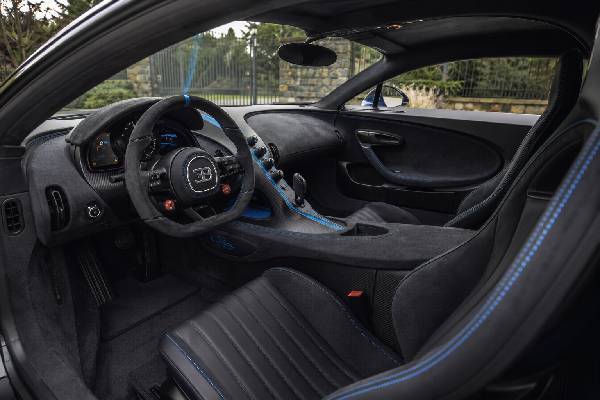
- a cabin that often uses Alcantara, anodized aluminum, and titanium details;
- model-specific badging and build documentation.
The first customer car was delivered in the United States in early 2021. Production had begun in late 2020, and the model remained part of the Chiron family through the final W16 era. Because production was so small, buyers should treat paperwork as part of the car, not as an accessory. A proper Pur Sport file should include factory order details, service records, warranty documentation, software-update history, tire and brake records, and any import or market compliance documents.
Factory options and configuration value
Bugatti clients often commission cars with unique color splits and exposed carbon combinations. On a Pur Sport, those choices can matter more than on a higher-volume exotic because the car’s market is collector-driven. A visually loud configuration may appeal strongly to one buyer and limit the pool for another. A subtle, historically inspired configuration may age better but may not create the same immediate auction excitement.
Sky View roof panels, special carbon finishes, unique leather or Alcantara colors, and one-off interior details can all add interest. The key is documentation. A feature is more valuable when it can be tied clearly to the original factory build rather than a later change.
For identification, buyers should be cautious with cars described only by generic terms such as “Chiron with Pur Sport parts.” A true Pur Sport is a factory-built derivative with its own chassis tuning, gearing, aero package, tire specification, and production identity. Because values are high, any uncertainty should be resolved through Bugatti or an authorized specialist before money changes hands.
Aero, Suspension, and Special Engineering
The Pur Sport’s engineering is about making a very powerful, very heavy hypercar respond faster to driver input. Bugatti changed the aero, gearing, tires, suspension, and weight package as a system, not as separate cosmetic upgrades.
The fixed rear wing is the most obvious change. It is about 1.9 meters wide and gives the Pur Sport a more permanent downforce bias than the standard car’s active wing arrangement. Removing the standard active rear-wing mechanism also saves weight. The tradeoff is speed. A fixed wing creates drag, so the Pur Sport is limited to 350 km/h instead of chasing the Chiron’s highest-speed territory.
The front of the car is also more aggressive. The wider horseshoe grille and revised front treatment help cooling and visual stance, but they also support the car’s stronger focus on airflow management. Around the wheels, the aero blade wheel design helps move turbulent air away from the wheel area and toward the side and rear diffuser zones. In a car this wide and powerful, wheel wake matters. Cleaner airflow helps stability and downforce consistency.
The suspension changes are just as important. The front springs are significantly stiffer, and the rear springs are also firmer. Bugatti revised damper control, camber settings, and anti-roll hardware, including carbon-fiber anti-roll bars. The point was not simply to make the car harder. It was to make the front axle respond more quickly and help the car hold a cleaner line when the driver loads the chassis.
Tires as a core engineering feature
The Michelin Sport Cup 2 R tire package is central to the Pur Sport. Tires are often treated as consumables, but here they are part of the vehicle concept. The tire compound, construction, and sizes influence steering response, braking confidence, warm-up behavior, and lateral grip.
That also means the car is sensitive to tire age, storage, and temperature. A Pur Sport on old or cold tires will not feel like the car Bugatti developed. Owners who intend to drive the car hard need to treat tires as a timed safety component, not only as tread-depth items.
Weight reduction without stripping the car
The Pur Sport is about 50 kg lighter than the standard Chiron. The savings come from items such as the titanium exhaust, wheel package, fixed wing arrangement, and material choices. This is not a race-car diet with exposed wiring and bare metal. The cabin remains luxurious, and the car still carries the refinement expected of the brand. That makes the engineering more difficult: Bugatti had to sharpen the car without making it feel unfinished.
How the Pur Sport Drives
The Pur Sport feels more immediate than a standard Chiron because it reaches strong acceleration sooner, turns in more sharply, and leans harder on its tires and aero. It is still a large, all-wheel-drive W16 hypercar, but it is tuned to feel smaller and more responsive than its weight suggests.
Acceleration is violent, but the character differs from a top-speed Chiron. The shorter gearing makes mid-range response feel more explosive. Instead of waiting for long ratios to build speed endlessly, the Pur Sport punches through the lower and middle speed ranges with more urgency. On a mountain road or circuit, that matters more than a 400 km/h capability.
The engine sound is part mechanical turbine, part deep exhaust pressure, and part intake rush. The W16 does not sound like a naturally aspirated V12 or a flat-plane V8. It is smoother, denser, and more industrial. In the Pur Sport, the titanium exhaust and higher operating range add edge, but the car remains polished rather than raw.
The gearbox behavior is quick and decisive. In automatic mode, it can still behave like a grand-touring gearbox when driven gently. In more aggressive modes, the shorter ratios keep the engine alert. Manual paddle use is more rewarding than in the standard Chiron because the driver reaches shift points more often.
Steering feel is the area where the Pur Sport most clearly separates itself. The standard Chiron is stable and accurate, but the Pur Sport adds more front-end urgency. The car feels more willing to rotate into corners, and the front tires communicate load more clearly. It is not delicate in the way a lightweight sports car is delicate, but it is more precise than its size and power suggest.
Braking performance is immense, but condition matters. Carbon-ceramic brakes need proper inspection, correct bedding, and enough temperature to work at their best. On road, they may feel firm and powerful but not always as talkative as steel brakes in lighter cars. On track, they must be managed carefully because vehicle mass and speed create enormous heat.
Ride quality is firm but not crude. Bugatti did not turn the Pur Sport into a punishment device. The car can still cover distance, and it remains usable in normal driving for an owner who accepts low ground clearance, tire cost, attention, and the practical limits of a multi-million-euro hypercar. The front lift system, where fitted, is more than a convenience; it protects expensive carbon bodywork.
On track, the Pur Sport is more convincing than the standard Chiron, but it is not a casual track-day tool. Speeds build too quickly, consumables are too expensive, and runoff requirements are serious. It works best with expert coaching, controlled conditions, fresh tires, and technicians who understand the platform.
Maintenance Risks and Ownership Reality
A Chiron Pur Sport is not maintained like a normal performance car. It needs factory-level knowledge, correct diagnostic equipment, approved parts, and technicians who understand the W16 platform.
The engine itself is strong when maintained correctly, but the systems around it are complex. Four turbochargers, intense cooling needs, high-pressure fuel delivery, dry-sump lubrication, all-wheel drive, a dual-clutch gearbox, adaptive suspension, active electronics, and carbon-ceramic brakes all increase ownership demands.
The biggest ownership checks include:
- Tire age and specification: old tires are a major risk, even with good tread.
- Brake condition: carbon-ceramic discs and pads are costly and must be measured, not guessed.
- Cooling-system health: heat management is central to W16 reliability.
- Gearbox behavior: shifts should be clean, consistent, and free of abnormal delay or harshness.
- Suspension and lift system: leaks, warning lights, or uneven ride height need specialist diagnosis.
- Battery and control modules: low-voltage issues can create misleading electronic faults.
- Software updates: Bugatti service history should show completed campaigns and updates.
- Body and undertray condition: carbon damage can be extremely expensive even when it looks minor.
Service history matters more than mileage
Low mileage does not automatically mean low risk. A Pur Sport that has sat for long periods may need tires, fluids, battery work, seals, and careful recommissioning. A car that has been driven but serviced correctly may be healthier than a static collector piece.
Because many Pur Sports live in collections, buyers should look for evidence of regular maintenance, not just odometer restraint. Fluid age, tire date codes, battery conditioning, and annual inspection records are essential. Any gap should be priced realistically.
Parts, labor, and warranty
Parts availability is specialized and expensive. Labor should be handled by Bugatti-authorized or deeply experienced hypercar specialists. Independent exotic-car experience is useful, but the Chiron is not just another supercar. Its systems, packaging, and costs make shortcuts dangerous.
Warranty or extended-service coverage can be valuable if available and transferable. Even wealthy buyers should care, not because they cannot pay for repairs, but because warranty-backed work helps keep the car inside Bugatti’s official service ecosystem. That matters later when selling.
Buying Guide for Collectors and Drivers
The best Chiron Pur Sport to buy is the car with the clearest history, the strongest factory documentation, the healthiest consumables, and the configuration you would still want ten years from now. Do not buy only on mileage or color.
| Area | What to verify | Why it matters |
|---|---|---|
| Identity | Factory Pur Sport build, VIN records, original specification | Confirms authenticity and collector value |
| Service file | Annual service, software updates, warranty work, campaigns | Shows the car has stayed inside the proper support network |
| Tires | Correct Michelin specification, date codes, storage history | Old or incorrect tires change safety and value |
| Brakes | Disc measurements, pad life, heat history | Carbon-ceramic replacement can be extremely expensive |
| Bodywork | Carbon panels, splitter, underbody, wing mounts | Minor damage can carry major repair cost |
| Electronics | Battery health, diagnostic scan, warning-light history | Electrical faults can be complex and costly |
| Usage | Track use, launch-control use, storage conditions | Helps estimate wear beyond mileage |
Buyers should also decide whether they want a collector car, a driving car, or the best blend of both. A delivery-mile example in a rare configuration may have strong collector appeal, but using it regularly may reduce the premium. A lightly driven, perfectly serviced example may be more satisfying for an owner who wants to experience the car properly.
Value factors
The strongest value drivers are originality, documented provenance, tasteful specification, low but credible mileage, official service history, and condition. Special colors or one-off details can help, but only when they fit the car. A loud configuration may bring attention, while a restrained specification may appeal to long-term collectors.
Avoid cars with unclear import history, missing records, expired tires, unexplained warning lights, accident repairs, non-factory modifications, or gaps in service. At this level, a small uncertainty can become a large negotiation issue.
Who should buy one?
The Pur Sport is ideal for the buyer who already understands hypercar ownership and wants the most driver-focused version of the 1,500 PS Chiron formula. It is less ideal for someone chasing the highest top speed, because the Super Sport line serves that purpose better. It is also not the right first exotic for a buyer who expects ordinary maintenance costs or easy independent servicing.
As a long-term collectible, the Pur Sport has a strong case. It is limited, clearly differentiated, mechanically meaningful, and tied to the final W16 era. As a driving machine, it is more engaging than the standard Chiron while keeping the comfort and presence that make a Bugatti different from a stripped supercar. That combination is why the Pur Sport remains one of the most important Chiron variants.
References
- Bugatti Chiron Pur Sport – Delivery to Customers begins 2021 (Manufacturer Press Release) ([Bugatti Newsroom][1])
- 1500-HP Bugatti Chiron Pur Sport Is a $3.6 Million Apex Hunter 2020 (Technical Overview) ([Car and Driver][2])
- Bugatti Chiron – Wikipedia 2026 (Model History and Specifications) ([Wikipedia][3])
Disclaimer
This article is for informational purposes only and is not a substitute for professional diagnosis, inspection, repair, valuation, or purchase advice. Specifications, torque values, service intervals, software requirements, campaign status, and repair procedures can vary by VIN, market, model year, equipment, and later factory updates. Always verify details against official Bugatti service documentation and have any Chiron Pur Sport inspected by an authorized Bugatti service center or a qualified specialist before purchase or repair.
If this guide helped you, please consider sharing it on Facebook, X/Twitter, or with other enthusiasts to support our work.