
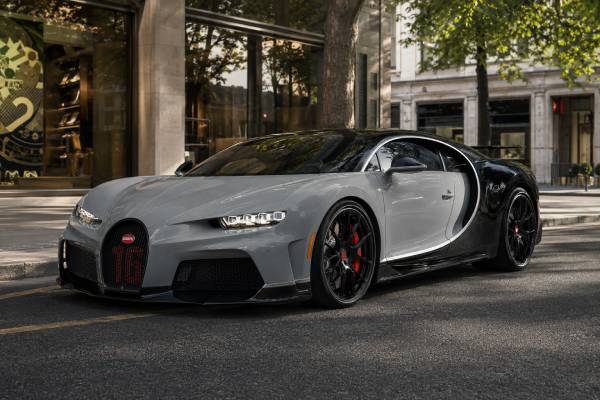
The Bugatti Chiron Super Sport is the grand-touring, high-speed expression of the Chiron family. It is not simply a louder Chiron or a softer version of the Chiron Super Sport 300+. It is the road-focused longtail Chiron built to combine 440 km/h capability, 1,600 PS W16 performance, exceptional stability, and the kind of cabin finish expected from Bugatti. Produced during the final years of the Chiron era, it sits at the point where the W16 reached its most mature road-car form.
This guide covers the 2021–2024 Bugatti Chiron Super Sport with the 8.0-liter quad-turbo W16 engine and 1,600 hp class output. It explains the car’s position in Bugatti history, its core specifications, engineering details, driving character, maintenance realities, and the buying checks that matter before serious collectors commit to one.
Table of Contents
- Why the Chiron Super Sport Matters
- W16 Powertrain, Chassis, and Key Specs
- Production Run, Variants, and Options
- Longtail Design and Engineering Details
- Road Feel, Speed, and Driver Character
- Ownership, Maintenance, and Known Risk Areas
- Buying a Chiron Super Sport Well
Why the Chiron Super Sport Matters
The Chiron Super Sport matters because it turns Bugatti’s extreme top-speed work into a more complete road car. It keeps the longtail body, 1,600 PS output, and high-speed focus, but presents them with more luxury, polish, and everyday usability than the record-themed Chiron Super Sport 300+.
Bugatti introduced the Chiron Super Sport in 2021 as a distinct member of the Chiron family. By then, the standard Chiron had already defined the modern W16 hypercar template: vast power, all-wheel drive, a carbon-fiber structure, and a cabin that felt more like a tailored luxury object than a stripped-out track car. The Super Sport took that foundation and aimed it at effortless speed rather than lap-time aggression.
Its closest conceptual relatives are the great Super Sport Bugattis. The Type 55 Super Sport of the 1930s mixed racing technology with road comfort. The EB 110 Super Sport brought carbon construction, all-wheel drive, and turbocharged performance into the 1990s. The Veyron Super Sport pushed the 16-cylinder era to new speed records. The Chiron Super Sport follows the same idea: the fastest version should still feel like a Bugatti, not a compromised competition special.
Within the Chiron line, the Super Sport is the calmer high-speed counterpoint to the Pur Sport. The Pur Sport is sharper, shorter-geared, lighter-feeling, and more focused on cornering response. The Super Sport is about stability, long-distance confidence, reduced drag, and acceleration that keeps building far beyond normal road speeds.
It also carries historical importance because the final Chiron, known as L’Ultime, was a Chiron Super Sport. That final car closed the 500-unit Chiron production era and helped mark the end of Bugatti’s W16 chapter as a regular road-car program. For collectors, that makes the Super Sport more than a performance trim. It is one of the last and most developed expressions of the quad-turbo W16 idea that began with the Veyron and reached its road-going peak here.
W16 Powertrain, Chassis, and Key Specs
The headline specification is simple: an 8.0-liter quad-turbo W16, 1,600 PS, all-wheel drive, and a 440 km/h top-speed capability. The deeper story is that Bugatti revised the engine, transmission, chassis, tires, bodywork, and aero balance to make that speed feel stable rather than dramatic.
The Super Sport’s W16 is the most important mechanical feature. Bugatti increased output over the 1,500 PS Chiron by 100 PS, using larger turbochargers, changes to the oil pump, cylinder head and valve train, and updates to the transmission and clutch. The engine also revs higher than the standard Chiron, reaching up to 7,100 rpm, with the full 1,600 Nm torque band available across a wider high-rpm range.
| Category | Specification |
|---|---|
| Model years covered | 2021–2024 |
| Body style | Two-seat coupe, longtail Chiron body |
| Engine | 8.0-liter quad-turbocharged W16 |
| Output | 1,176 kW / 1,600 PS |
| Torque | 1,600 Nm, available across a broad high-rpm range |
| Redline range | Up to 7,100 rpm |
| Transmission | Seven-speed dual-clutch automatic |
| Drivetrain | All-wheel drive |
| 0–200 km/h | 5.5 seconds |
| 0–300 km/h | 12.1 seconds |
| Top speed capability | Up to 440 km/h |
| WLTP combined fuel consumption | 21.5 l/100 km |
| WLTP combined CO2 emissions | 487 g/km |
A few figures deserve context. The 440 km/h top speed is not just a number placed on a brochure. The car’s body, tire package, chassis tuning, cooling, and aero load balance were designed around that operating window. Bugatti also lengthened seventh gear by 3.6 percent, helping the car continue accelerating at extreme speeds without running out of ratio too soon.
The Super Sport’s Michelin Pilot Sport Cup 2 tires were developed for very high-speed use, with reinforced belts and post-production X-ray inspection. That detail matters because the tire is one of the limiting parts of any car capable of more than 400 km/h. At these speeds, heat, pressure, centrifugal force, and road load become engineering problems, not just performance bragging points.
| Area | Super Sport change | Why it matters |
|---|---|---|
| Engine | 1,600 PS output with higher rpm ceiling | Stronger acceleration beyond the standard Chiron’s upper-speed range |
| Turbocharging | Larger, more efficient turbochargers | Maintains power at very high speeds and engine loads |
| Transmission | Adapted clutch and transmission with longer seventh gear | Supports high-load launches and sustained top-speed running |
| Body | Extended longtail rear section | Reduces drag and keeps airflow attached for longer |
| Chassis | Revised steering, dampers, springs, and control software | Improves stability and driver confidence at extreme speeds |
| Tires | High-speed Michelin Pilot Sport Cup 2 development | Supports the car’s unusually high operating envelope |
The result is a car that makes its numbers through integration. The Super Sport is not just a bigger-turbo Chiron. It is a package in which airflow, gear ratio, cooling, tire structure, and chassis control all serve the same purpose: stable speed with Bugatti refinement.
Production Run, Variants, and Options
The Chiron Super Sport was launched in 2021, customer deliveries began in 2022, and the model remained part of the final Chiron story through 2024. For buyers, the most important distinction is between the Chiron Super Sport and the Chiron Super Sport 300+, because they share the high-output W16 idea but differ in purpose and presentation.
The Chiron Super Sport 300+ came first as the record-inspired production model linked to Bugatti’s 304.773 mph achievement. It used the longtail visual language, exposed black carbon fiber, Jet Orange detailing, magnesium wheels, and a stronger focus on the 300 mph story. Production was limited to 30 units.
The Chiron Super Sport followed as the more luxurious and road-focused interpretation. It retained the 1,600 PS output and longtail engineering but used a richer interior, more conventional personalization freedom, and a top-speed limit of 440 km/h. It was still an extreme performance car, but its personality was grand touring rather than record homage.
| Variant | Main focus | Key identity point |
|---|---|---|
| Chiron | Core W16 hypercar | Original 1,500 PS Chiron formula |
| Chiron Pur Sport | Handling and agility | Sharper chassis, shorter gearing, cornering focus |
| Chiron Super Sport 300+ | Record-inspired speed edition | 30-unit tribute to the 300 mph achievement |
| Chiron Super Sport | High-speed luxury grand touring | Longtail 1,600 PS model with comfort and personalization emphasis |
| Chiron Super Sport L’Ultime | Final Chiron celebration | 500th and final Chiron, built as a Super Sport |
Personalization is central to any Chiron Super Sport. Bugatti’s Sur Mesure program allowed customers to create deeply individual cars, including hand-painted exterior treatments, bespoke color splits, unique cabin materials, and special historical references. That makes condition and documentation more important than on many other cars. A unique specification can raise desirability, but only when it is tasteful, well documented, and consistent with Bugatti’s factory records.
Factory wheel choices also matter. Bugatti created new aluminum wheels in a five-Y-spoke design for the Super Sport, with a diamond-cut option. Magnesium wheels associated with the Chiron Pur Sport were also available as an option to reduce unsprung mass. For a buyer, the wheel package affects appearance, originality, replacement cost, and sometimes how the car is perceived in the collector market.
The final Chiron, L’Ultime, adds special significance to the Super Sport family. It used a blue fading finish inspired by the original Chiron’s debut colors and carried handwritten references to important Chiron milestones. Because it was the 500th and final Chiron, it confirmed the Super Sport body as the closing shape of the production Chiron era.
Longtail Design and Engineering Details
The Chiron Super Sport’s shape is functional first. The longtail body, revised diffuser, repositioned exhaust outlets, front fender vents, and specialized tire package all exist to make very high speed stable, calm, and repeatable.
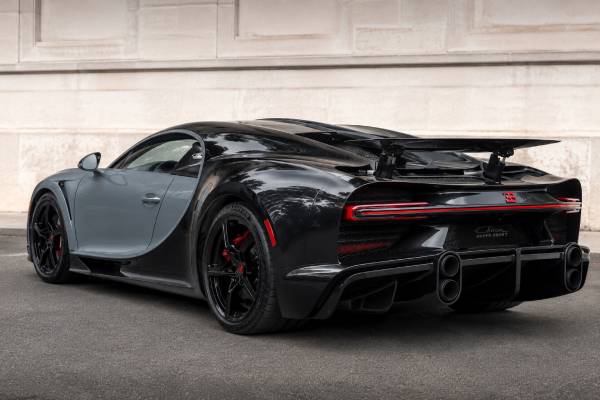
The most visible change is the rear body extension. Bugatti lengthened the rear by about 25 centimeters to keep airflow attached to the body for longer. In simple terms, the car tries to let air leave more cleanly, reducing drag and improving stability. At 440 km/h, tiny aerodynamic details become major forces. A shape that looks elegant at rest must also control lift, drag, heat extraction, and pressure changes at speeds few road cars can reach.
The rear diffuser is also important. Bugatti increased the diffuser cross-section and raised the trailing edge, reducing the rear’s trailing surface by 44 percent. That helps reduce drag and allows the rear wing to stay more retracted in Top Speed mode. A large raised wing can create useful downforce, but it also adds drag. The Super Sport tries to make the underbody and diffuser do more of the work.
The exhaust layout is one of the car’s signature details. Instead of the familiar central Chiron outlet arrangement, the Super Sport uses vertically aligned tailpipes pushed toward the sides. This gives the diffuser more room to function and creates a deeper, richer sound character. It also makes the Super Sport instantly recognizable from behind.
At the front, Bugatti used air curtains, reshaped intakes, and vents to manage pressure around the wheel arches. The nine round holes on each front fender are not only a tribute to the EB 110 Super Sport. They also release pressure from the front wheel wells and help generate cleaner front-axle aero behavior. Additional outlets behind the front wheel arches help balance aerodynamic loads.
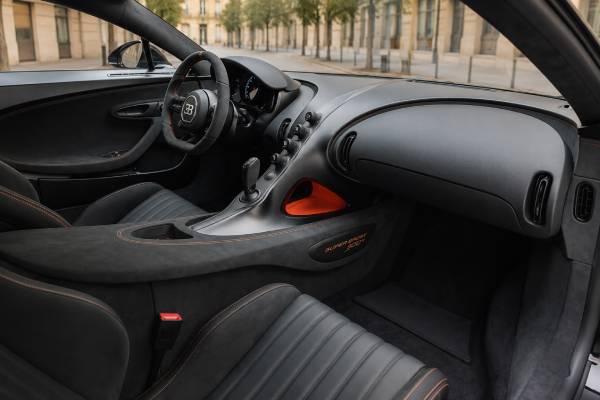
Inside, the Super Sport avoids the stripped-out mood of many high-speed specials. Leather, polished aluminum, and carbon-fiber elements create a cabin built for fast travel rather than bare competition. The driving environment is intentionally restrained: the car does not need oversized screens or theatrical controls to feel special. Its drama comes from materials, proportions, speed, and the knowledge that the W16 sits behind the seats.
Road Feel, Speed, and Driver Character
The Chiron Super Sport feels designed to reduce stress at impossible speeds. Its most important driving trait is not raw acceleration, although it has plenty, but the way it keeps the car calm when the speed keeps rising.
At low speeds, it is still a very wide, very valuable hypercar. The seating position is low, the nose demands care, and the driver must remain aware of wheel, tire, and carbon-body exposure. Yet the Chiron platform is known for being more usable than its numbers suggest. The dual-clutch gearbox manages traffic gently when driven with restraint, and the cabin feels more like a luxury GT than a track-day tool.
Under full throttle, the Super Sport is defined by sustained thrust. Many high-performance cars feel explosive at first and then soften as speed climbs. The Super Sport keeps pulling with unusual force deep into the upper range. The revised turbochargers, higher rpm limit, broad torque delivery, and longer seventh gear all support that feeling of uninterrupted acceleration.
The sound is also different from smaller, sharper supercar engines. The W16 does not have the delicate scream of a naturally aspirated V12 or the hard-edged bark of a racing V8. It has a dense, layered, turbine-like force, with the Super Sport’s exhaust layout adding more depth. The emotional effect is less about theatrical revving and more about mechanical inevitability.
Steering and chassis feel are tuned around stability. Bugatti revised the steering, dampers, springs, and electronic chassis control so the car remains composed at high speeds and through long, fast bends. The electronically controlled chassis reacts quickly, and the driving modes include EB, Handling, Autobahn, and Top Speed. The point is not to make the Super Sport feel small. It is to make a large, powerful, longtail hypercar feel predictable.
Tire temperature and condition matter. A car engineered for 440 km/h depends heavily on its tire package, and the Super Sport’s tires are specialized components, not ordinary performance tires. Cold tires, old tires, improper pressures, or non-approved replacements can change the car’s behavior. Serious owners treat tire management as part of the driving experience.
On track, the Super Sport is not the most natural Chiron variant. It can be driven quickly, but the Pur Sport is the one aimed more clearly at lateral response and cornering feel. The Super Sport is best understood as an ultra-fast road GT: devastating in a straight line, stable on fast sweepers, calmer on long trips, and more refined than its performance figures suggest.
Ownership, Maintenance, and Known Risk Areas
Chiron Super Sport maintenance is not normal performance-car maintenance scaled up. It is specialist hypercar stewardship, where tire age, software status, carbon-ceramic brake condition, hydraulic systems, cooling performance, battery health, and factory service documentation matter as much as mileage.
The W16 engine is a mature Bugatti design, but it is still an 8.0-liter, quad-turbo, sixteen-cylinder powertrain with complex cooling, oiling, boost control, and packaging. Heat management is central. A low-mileage car that has mostly sat still is not automatically better than a car that has been exercised and maintained properly. Long storage can create its own issues, especially with batteries, seals, fluids, tires, and electronic systems.
The transmission and clutch deserve careful attention. The seven-speed dual-clutch gearbox is built for enormous torque, but repeated hard launches, aggressive low-speed maneuvering, and poor servicing can still create wear. Any hesitation, warning message, unusual engagement behavior, or harsh shift should be treated seriously and checked by Bugatti-trained technicians.
Carbon-ceramic brakes are another major cost area. Buyers should inspect disc condition, pad life, surface damage, caliper condition, and service history. A car with low mileage can still have expensive brake needs if it has been used hard on high-speed events or stored poorly. Brake feel should be firm, consistent, and free from vibration or pulling.
Tires are both a performance item and a safety item. The Super Sport’s approved Michelin tires are part of the car’s high-speed engineering. Age, heat cycles, flat-spotting, sidewall condition, and correct specification matter. Any car offered with old tires should be budgeted as needing immediate replacement, even if the tread looks acceptable.
Electronic and software status should also be checked. Modern Bugattis use complex control modules for powertrain, chassis, infotainment, lift systems, stability systems, and vehicle modes. A pre-purchase inspection should confirm that all updates and campaigns have been completed, no warning history is hidden, and all keys, chargers, tools, manuals, and factory accessories are present.
| Inspection area | What to check | Why it matters |
|---|---|---|
| Service history | Official Bugatti records, invoices, campaign completion | Confirms proper specialist care and protects value |
| Tires | Age, approved specification, pressure history, flat spots | Critical for safety and high-speed behavior |
| Brakes | Carbon-ceramic disc and pad condition | Replacement costs can be very high |
| Transmission | Shift quality, clutch behavior, launch history if available | Repairs require specialist diagnosis and parts |
| Cooling system | Leaks, fan operation, temperature behavior, service records | W16 heat management is central to reliability |
| Suspension and lift | Ride height operation, warning lights, hydraulic function | Important for usability and repair cost control |
| Carbon bodywork | Paintwork, exposed carbon, repairs, panel alignment | Factory-quality repair evidence strongly affects value |
| Electronics | Control modules, infotainment, drive modes, battery condition | Low-use cars often reveal issues through electronics |
The safest ownership approach is simple: keep the car within the official Bugatti service network, maintain the battery and fluids, replace age-sensitive parts before they become problems, and document everything. A Chiron Super Sport with perfect records will always be easier to own and easier to sell than one with missing invoices, unclear storage history, or incomplete factory correspondence.
Buying a Chiron Super Sport Well
The best Chiron Super Sport to buy is not always the lowest-mileage example. The best car is the one with the strongest factory documentation, the cleanest condition, the most coherent specification, current servicing, approved tires, and a history that matches how the seller presents it.
Start with identity. Confirm the car is a Chiron Super Sport, not a standard Chiron with cosmetic upgrades, not a Pur Sport, and not a Super Sport 300+ unless that is what you intend to buy. Check the VIN, factory build sheet, original order details, options, exterior and interior specification, wheel package, and delivery history.
Next, study the specification. Bugatti personalization can create extraordinary cars, but market taste still matters. Elegant factory colors, exposed carbon, historic references, and tasteful Sur Mesure work can help desirability. Highly personal color combinations may be special to the first owner but narrower in resale appeal. There is no universal rule, but the best specifications feel intentional rather than random.
Then inspect the condition against the story. A 500-mile car should look, smell, and behave like a nearly new car, but it should also show evidence of proper storage and maintenance. A higher-mileage car should have service records that explain its use. Track events, top-speed events, transport history, paint protection film installation, wheel refinishing, and any body repairs should be disclosed clearly.
A professional pre-purchase inspection is essential. It should be performed by a Bugatti-authorized service point or a technician with direct Chiron experience. The inspection should include diagnostic scans, brake measurement, tire verification, suspension and lift operation, cooling-system checks, underbody inspection, paint-depth review, carbon-fiber inspection, and confirmation that all campaigns and updates are complete.
Budgeting should go beyond purchase price. Storage, insurance, transport, tires, annual servicing, detailing, paint protection, battery management, and occasional unexpected repair work all belong in the ownership plan. A buyer stretching to afford the car may find the maintenance ecosystem uncomfortable. The Super Sport rewards owners who can maintain it without hesitation.
| Buyer priority | Best choice | Be cautious with |
|---|---|---|
| Long-term collectability | Documented, low-mileage, tasteful factory specification | Missing build records or unclear ownership history |
| Driving enjoyment | Recently serviced car with fresh approved tires | Stored cars needing recommissioning |
| Visual impact | Strong Sur Mesure paint or exposed carbon with documentation | Aftermarket cosmetic changes |
| Value protection | Original parts, factory records, no unexplained repairs | Accident history, refinished carbon, incomplete accessories |
| Ease of resale | Recognizable, elegant colors and complete official servicing | Very personal interior or exterior combinations |
The Chiron Super Sport is most compelling for the buyer who wants the most polished high-speed Chiron rather than the most track-focused one. It has the presence of a record-era Bugatti, the comfort of a luxury GT, and the technical maturity of the final W16 years. For a collector, its appeal is obvious: it belongs to the last chapter of the Chiron and the near-final chapter of Bugatti’s quad-turbo sixteen-cylinder road cars.
References
- The Bugatti Chiron Super Sport – The Quintessence of Luxury and Speed 2021 (Press Release) ([Bugatti Newsroom][1])
- Bugatti Delivers First Chiron Super Sports to Customers 2022 (Press Release) ([Bugatti Newsroom][2])
- Bugatti Chiron Super Sport 300+ – a gift to celebrate the record 2019 (Press Release) ([Bugatti Newsroom][3])
- ‘L’Ultime’: celebrating the end of the incomparable Chiron era 2024 (Press Release) ([Bugatti Newsroom][4])
Disclaimer
This article is for informational purposes only and is not a substitute for professional diagnosis, repair, valuation, or pre-purchase inspection. Specifications, torque values, service intervals, software requirements, procedures, and approved parts can vary by VIN, market, equipment, and factory update status. Always verify details against official Bugatti service documentation and a qualified Bugatti service specialist before buying, servicing, repairing, or operating the vehicle at high speed.
If this guide helped you, please consider sharing it on Facebook, X/Twitter, or your preferred automotive community to support our work.