
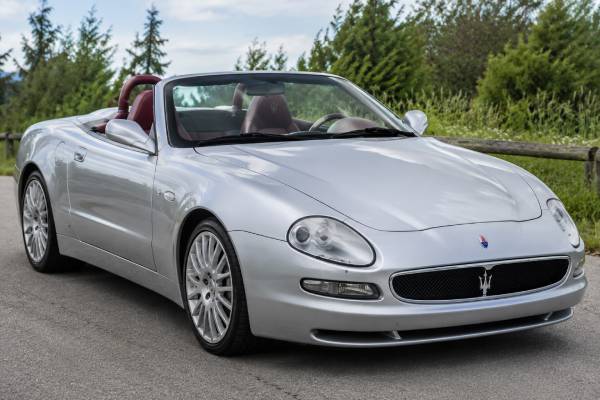
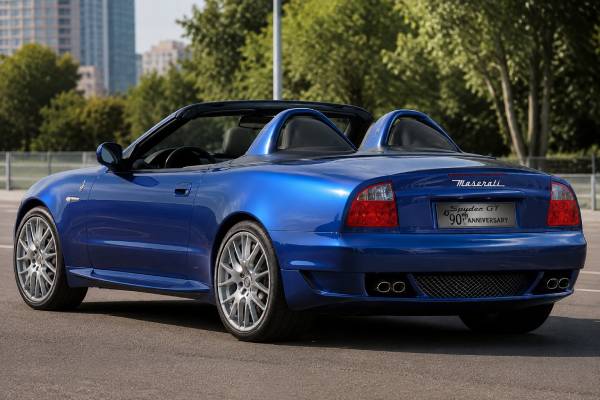
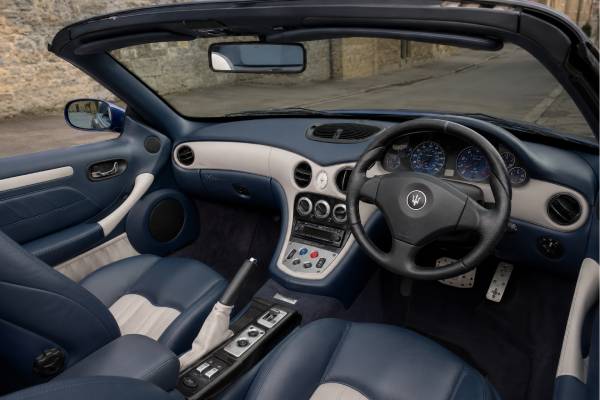
The Maserati Spyder GT 90th Anniversary is the rare manual-transmission version of the special open car created to mark nine decades of Maserati history. It combines the short-wheelbase M138 Spyder, a naturally aspirated 4.2-liter V8, and a conventional six-speed gear lever with distinctive anniversary trim. That combination matters because most surviving commemorative Spyders use the electrohydraulic Cambiocorsa transmission, while the GT lets the driver control the clutch and each shift directly. The result is not the fastest or most polished roadster of its period, but it is one of the most engaging modern Maseratis to drive at sensible speeds. Buyers must separate genuine anniversary cars from ordinary Spyders with cosmetic additions, and they must inspect the roof, clutch system, cooling circuit, suspension, and cabin materials with equal care. A verified, well-maintained example offers vivid V8 sound, elegant Giugiaro styling, and a genuinely unusual specification.
Table of Contents
- A Manual Anniversary Roadster
- V8, Chassis, and Key Specifications
- Production and Authenticity Details
- Anniversary Design and Engineering
- How the Spyder GT Drives
- Roof, Clutch, and Maintenance Risks
- Buying a Correct 90th Anniversary
A Manual Anniversary Roadster
The key appeal is simple: this is a short-wheelbase Maserati V8 roadster with a real clutch pedal, wrapped in a limited anniversary specification. It belongs to the first generation of Ferrari-era Maseratis that returned the marque to major markets with modern engineering while retaining a distinctly Italian grand-touring character.
The M138 Spyder appeared in 2001, before the related four-seat Coupé. Giorgetto Giugiaro’s Italdesign studio reshaped the proportions of the earlier 3200 GT idea into a compact two-seat convertible. The wheelbase was shortened substantially, the rear seats disappeared, and a power-operated fabric roof folded beneath a hard cover. Under the bonnet sat Maserati’s new F136 R V8, a dry-sump, all-aluminum engine developed during the company’s close technical relationship with Ferrari.
The 90th Anniversary version arrived for 2004, the year Maserati celebrated its founding in Bologna in 1914. It was not a major mechanical redesign. Instead, Maserati used a carefully chosen group of colors, trim pieces, badges, and cockpit details to make the commemorative Spyder immediately recognizable. The manual GT version retained the same 390 hp engine as the standard Spyder GT and the same rear-mounted six-speed transaxle, but its rarity gives it a special place within the M138 family.
This car sits at an interesting point in Maserati history. It predates the sharper 400 hp GranSport Spyder, yet it feels more intimate and traditional because the driver operates the clutch. It also avoids the learning curve and clutch-management concerns associated with the Cambiocorsa system, although a conventional manual car still has expensive clutch, hydraulic, and transaxle components of its own.
It is best understood as a sporting roadster rather than a stripped-out sports car. The cabin is richly trimmed, the steering is assisted, the roof is powered, and many cars have Skyhook adaptive dampers. Even so, the short chassis, rear transaxle, and manual gearbox make it involving in a way that later, faster luxury convertibles often are not.
V8, Chassis, and Key Specifications
The Spyder GT 90th Anniversary uses the standard 390 hp F136 R V8 and six-speed manual rear transaxle. Its performance is strong rather than extreme by modern standards, but the engine response, weight distribution, and compact wheelbase give the figures more personality than the raw numbers suggest.
| Item | Specification |
|---|---|
| Platform code | M138 |
| Engine code | F136 R |
| Engine | 4,244 cc naturally aspirated 90-degree V8 |
| Construction | Aluminum block and heads, dry-sump lubrication |
| Valve gear | DOHC, 32 valves, variable intake timing |
| Fuel system | Electronic multipoint injection |
| Maximum output | 390 hp at 7,000 rpm |
| Maximum torque | 451 Nm at 4,500 rpm |
| Transmission | Six-speed manual rear transaxle |
| Drivetrain | Rear-wheel drive with limited-slip differential |
| Suspension | Double wishbones front and rear; Skyhook adaptive damping on equipped cars |
| Brakes | Ventilated discs, approximately 330 mm front and 310 mm rear |
| Wheels | 18-inch alloy wheels |
| Tires | 235/40 ZR18 front; 265/35 ZR18 rear |
| Wheelbase | 2,440 mm |
| Length | 4,303 mm |
| Width | 1,822 mm |
| Height | 1,305 mm |
| Official dry weight | Approximately 1,620 kg for the Spyder GT |
| Top speed | Approximately 285 km/h |
| 0–100 km/h | About 5.0 seconds, depending on test conditions |
The F136 R differs in character from the turbocharged V8 in the preceding 3200 GT. It has no forced-induction surge. Instead, it responds cleanly to throttle input, pulls with useful strength in the middle of the rev range, and becomes urgent above roughly 5,000 rpm. A cross-plane crankshaft gives it a deep, uneven-edged exhaust note rather than the higher-pitched sound associated with a flat-plane Ferrari V8.
Dry-sump lubrication stores engine oil in a separate reservoir rather than relying on a deep pan beneath the crankshaft. That arrangement supports reliable oil supply during hard cornering and allows the engine to sit relatively low. It also adds hoses, unions, seals, and a larger oil circuit that must remain leak-free and be serviced correctly.
The transaxle places the gearbox at the rear, linked to the engine by a torque tube. This moves mass rearward and helps the Spyder approach balanced front-to-rear weight distribution. The manual transmission uses a conventional clutch pedal and shift lever, but it is not a light economy-car mechanism. The clutch can feel firm, the linkage has a long mechanical path, and rushed cold shifts may expose worn synchronizers or tired linkage joints.
Double-wishbone suspension controls wheel movement at all four corners. Many anniversary cars have Skyhook dampers, which use electronically controlled valves to vary damping according to body and wheel movement. The system gives the Maserati a useful spread between compliant touring and firmer body control, provided the dampers, accelerometers, wiring, and control unit remain healthy.
Production and Authenticity Details
A genuine 90th Anniversary Spyder should be identified through factory records, specification, and physical details together. Cosmetic resemblance alone is not enough, because paint, wheels, badges, and interior trim can be changed during two decades of ownership.
Maserati introduced the special Spyder during its 2004 anniversary celebrations. Contemporary descriptions often refer to a series of 90 cars, while later registries and market records commonly place total production around 180 or 181 when different regions and a possible pre-production or prototype car are counted. The exact division between manual GT and Cambiocorsa cars is not consistently published. That uncertainty makes chassis-specific documentation more useful than repeating a single global production figure as absolute fact.
The manual car is particularly uncommon because the automated Cambiocorsa transmission was heavily promoted and widely ordered. A seller should therefore be able to show that the car left the factory as a Spyder GT 90th Anniversary, not as an ordinary GT later repainted or retrimmed.
Expected anniversary identifiers
A correct car may include the following, with market differences possible:
- Blu Anniversary exterior paint, developed specifically for the commemorative model.
- Gray-finished headlamp surrounds rather than the usual body-color treatment.
- Small anniversary identification badges on the front wings or side areas.
- Carbon-fiber fairings behind the rollover hoops.
- Special blue and gray interior treatment, often combining leather and technical-looking trim.
- Titanium-colored brake calipers.
- Distinctive wheels and anniversary-specific cabin details.
- Factory paperwork, option codes, or a build record linking the VIN to the special series.
Cars supplied in Australia can create confusion because Maserati also promoted 90th Anniversary option packages there across Coupé and Spyder models, with a broader choice of exterior colors and regional equipment. A buyer should not assume that every Australian anniversary-badged car follows the Blu Anniversary global specification, nor should a regional car be dismissed merely because it differs from European or North American examples. The VIN, build sheet, delivery invoice, and importer records should establish which program the car belongs to.
Manual versus Cambiocorsa identification
The GT has three pedals and a conventional gear lever. The Cambiocorsa car has two pedals and steering-column shift paddles, using an electrohydraulic actuator to operate the same basic transaxle architecture. Conversions are theoretically possible but economically difficult and can create registration, wiring, software, and resale complications. A collector-quality GT should have matching factory documentation and unmodified control systems.
Service history can also help authenticate the car. Early invoices may record the exact model description, original registration number, selling dealer, paint code, and trim code. A continuous chain of records is especially valuable when exterior or interior restoration has occurred, because it shows whether the work returned the car to its original configuration.
Anniversary Design and Engineering
The anniversary car’s distinction comes from the way special visual details sit on an already unusual chassis. It is not simply a standard convertible with a badge; the short-wheelbase body, rear transaxle, dry-sump V8, and compact folding roof define the experience before the commemorative trim is considered.
The 90th Anniversary treatment adds contrast rather than visual clutter. Blu Anniversary changes with the light, moving between rich blue and lighter metallic highlights. Gray lamp surrounds sharpen the front view. Carbon-fiber rollover-hoop fairings give the rear deck a more technical appearance, and titanium-colored calipers sit behind the wheels without shouting for attention. Inside, blue and gray materials reinforce the exterior theme.
The powered soft top is tightly packaged behind the two-seat cabin. When lowered, it preserves the clean rear profile and leaves the occupants exposed to the V8’s exhaust note. When raised, rearward visibility narrows and wind noise becomes more noticeable, but the car remains usable for long trips. The roof relies on hydraulic operation, switches, latches, position sensors, elastic straps, and drainage paths. Every part must work in sequence; one weak sensor or low hydraulic pressure can stop the cycle.
The cabin is more grand tourer than minimalist roadster. Leather covers the dashboard, door panels, seats, and much of the console. Traditional oval shapes frame the instruments, and a small clock sits prominently in the center. The driving position can feel slightly offset, and storage is limited, but the low scuttle and open roof provide a strong sense of occasion.
Packaging the gearbox at the rear created both benefits and service consequences. The car turns in with less nose-heavy behavior than its front-engine layout might suggest, and traction is good when the limited-slip differential and rear tires are healthy. On the other hand, clutch replacement involves substantial labor, and driveline noises can travel through the torque tube. Correct diagnosis requires someone familiar with M138 cars rather than a general repair shop guessing at the source.
How the Spyder GT Drives
The manual Spyder feels best when driven smoothly and allowed to build rhythm. It rewards accurate clutch work, measured steering inputs, and progressive braking more than aggressive launches or abrupt mid-corner corrections.
At low engine speeds, the V8 is tractable enough for traffic, though the clutch can feel heavier than expected and the throttle may be sensitive until the driver adapts. The lever action is deliberate rather than rifle-bolt short. A healthy gearbox accepts shifts cleanly once warm; resistance, crunching, or a lever that refuses second gear deserves investigation rather than being dismissed as normal Italian character.
Above the midrange, the engine becomes the central event. It pulls harder as revs rise, and the sound changes from a subdued bass note to a layered metallic roar. The last 2,000 rpm are especially satisfying because there is no turbocharger flattening the response. The driver can hold a gear through a bend, balance the car with small throttle movements, and choose the exact moment to shift.
The short wheelbase makes the Spyder feel eager to rotate, but it also reduces the calm, long-legged stability of the Coupé. On a smooth road, the steering is quick and the chassis feels compact around the driver. On broken surfaces, scuttle shake and body movement remind the driver that this is an early-2000s convertible based on a steel structure. A worn example can feel loose or nervous; a properly sorted car feels supple, controlled, and coherent.
Skyhook’s normal setting suits touring and imperfect roads. Sport mode firms the dampers, sharpens body control, and allows less intervention from the stability system, depending on market calibration. Firmer is not always faster. On rough pavement, the softer setting can keep the tires in better contact and make the car easier to place.
The brakes provide strong road performance when the fluid, pads, discs, and calipers are in good condition. Pedal feel should be firm and consistent. Vibration under braking may point to disc variation, deposits, worn suspension joints, or wheel issues. Repeated track use can overwhelm road pads and heat old fluid, so any car presented as a track-day veteran warrants closer scrutiny.
With the roof down, wind management is acceptable for two adults, and the exhaust becomes far more present. The car works well on early-morning country roads and sweeping mountain routes where the driver can use third and fourth gears. In town, the low nose, wide body, limited rear visibility, heavy clutch, and dated navigation system make it less effortless. On a motorway, it settles into a relaxed cruise, but tire roar and fabric-roof noise remain part of the experience.
Tires influence the Spyder more than many owners realize. The original sizes are still available, but brand, age, and axle matching matter. Hard, old rear tires can make the short-wheelbase chassis abruptly oversteer, while mismatched front and rear compounds can confuse the balance. A quality set of four tires, followed by a specialist alignment, can transform a car that initially feels disappointing.
Roof, Clutch, and Maintenance Risks
The Spyder can be dependable when maintained proactively, but deferred work accumulates quickly and often crosses several systems at once. The most expensive mistake is buying a cosmetically attractive car without testing the roof, clutch, cooling, suspension, and electrical systems under real operating conditions.
Manual clutch and transaxle
A manual gearbox removes the Cambiocorsa pump, accumulator, actuator, and clutch-position calculations, but it does not make the driveline inexpensive. Check for clutch slip in a high gear under load, judder when moving away, bearing noise with the pedal pressed, fluid leakage, and inconsistent pedal return. The master and slave hydraulic circuits age, and a tired clutch may require extensive labor because of the transaxle layout.
The gearbox should be tested cold and fully warm. Worn synchronizers often reveal themselves during fast second- or third-gear shifts. Linkage bushings can create vagueness, while worn mounts or torque-tube components may produce clunks on throttle changes. Ask whether the clutch, release bearing, flywheel condition, seals, and related hardware were inspected together during previous work.
Engine, oiling, and cooling
The F136 R is robust when serviced correctly, but age creates leaks and heat-related failures. Inspect the cam-cover areas, front covers, dry-sump hoses, oil tank connections, and underside for fresh oil. Verify the proper oil level using the correct warm-engine procedure; overfilling and underfilling both create problems.
Cooling-system attention should include the radiator cores, fans, relays, thermostat, expansion tank, hoses, and evidence of dried coolant. Debris collects in the front heat exchangers, reducing airflow. An engine that creeps hot in traffic may have a fan-control fault rather than an internal problem, but repeated overheating can damage far more expensive components.
Listen for exhaust leaks and catalyst rattles. Failed oxygen sensors, aging catalytic converters, cracked exhaust joints, or misfires can illuminate the warning lamp. A diagnostic scan should be performed even when no light is showing, because recently cleared codes and incomplete readiness monitors can reveal hidden work.
Roof and water management
Operate the roof several times with the engine running and adequate battery voltage. It should unlatch, fold, stow, and close without assistance, hesitation, hydraulic noise, or warning messages. Inspect the fabric, rear window, seals, tension straps, cylinders, pump area, microswitches, and storage compartment. Look for damp carpet behind the seats and in the boot.
Blocked drains and failed seals can allow water into electronic areas or under carpets. A car that smells musty or has misted lamps deserves a moisture inspection, not merely deodorizing. Roof repairs range from simple adjustment to labor-intensive hydraulic or frame work.
Suspension, brakes, and electronics
Skyhook dampers are costly, and replacement availability can vary. Check each unit for leakage and confirm that no suspension warning appears. Worn ball joints, control-arm bushes, anti-roll-bar links, tie rods, and wheel bearings cause knocks, wandering, uneven tire wear, or imprecise steering. Many symptoms overlap, so a road test and lift inspection are both necessary.
Sticky interior switches are common because the original soft-touch coating breaks down. Leather can shrink around the dashboard, vents, and airbag areas. Seat motors, window regulators, climate controls, alarm functions, and the original audio system should all be tested. Low battery voltage can trigger misleading faults, so battery condition and charging voltage must be established before diagnosing modules.
A sensible ownership plan includes annual fluid and condition checks even when mileage is low. Brake fluid, coolant, gearbox oil, differential oil, power-steering fluid, filters, belts, and aging rubber components should be scheduled by time as well as distance. Detailed invoices are more useful than stamped boxes alone because they show what was actually replaced.
Buying a Correct 90th Anniversary
Buy the best documented and most mechanically complete car, not the one with the lowest advertised mileage. A low odometer reading does not preserve hydraulic seals, roof straps, tires, leather, coolant, or electrical connections, and long storage can create its own failures.
Start by confirming identity. Record the VIN, engine number where accessible, paint code, trim code, transmission type, and anniversary details. Obtain factory or recognized marque documentation if possible. Compare the current colors and equipment with early invoices, the build sheet, and period photographs. A missing badge is fixable; a car whose entire specification cannot be explained is a greater risk.
Pre-purchase inspection priorities
Use a Maserati specialist who knows the M138 platform and ask for these checks:
- Scan all control units, record current and stored faults, and check readiness status.
- Measure clutch behavior and inspect hydraulics, linkage, mounts, and transaxle operation.
- Pressure-test or closely inspect the cooling system and verify both fans operate.
- Run the roof through repeated full cycles and inspect for water entry.
- Examine Skyhook dampers, ball joints, bushes, steering joints, brakes, tires, and alignment wear.
- Inspect the dry-sump system and engine for leaks, noises, smoke, or poor hot oil pressure behavior.
- Measure paint depth and inspect the structure, underbody, wheel wells, and roof mechanism for repairs.
- Confirm anniversary trim and compare every identifying detail with the car’s records.
A cold start is essential. The engine should settle cleanly without persistent smoke, loud mechanical knocking, or a warning lamp. During the drive, test light and heavy throttle, every gear, high-load clutch behavior, braking from speed, tight turns, rough roads, climate control, and hot restart. Do not let a seller warm the car before arrival without explanation.
Budget beyond the purchase price. Immediate work often includes tires, fluids, battery, sticky-control refinishing, minor leaks, suspension joints, and roof adjustment. A clutch, Skyhook dampers, catalyst work, or neglected cooling overhaul can change the economics quickly. It is wise to keep a meaningful reserve rather than spend the full budget on the car itself.
Originality matters most on the anniversary-specific items that are difficult to replace: paint specification, carbon fairings, badges, special trim, wheels, and documentation. Reversible upgrades such as a carefully installed modern audio source may improve usability, but cut wiring, drilled panels, incorrect upholstery, or generic wheels reduce collector confidence. Retain any original parts removed from the car.
The best example is not necessarily concours perfect. A car with honest paint wear, a complete history, recent mechanical work, and a roof that functions correctly may be a better purchase than a freshly detailed garage ornament with no invoices. Manual cars appeal to a narrower but committed audience, and a verified GT can remain desirable because it combines rarity with direct driver involvement.
For the right owner, the Spyder GT 90th Anniversary is a compelling modern classic. It demands specialist care and patient inspection, yet it delivers something difficult to recreate: an open, naturally aspirated Maserati V8 with three pedals, compact proportions, and a commemorative identity rooted in the marque’s history.
References
- Model Spyder – Gran Turismo models | Maserati (Maserati Classic)
- 2004 Maserati Spyder 90th Anniversary 2004
- Maserati Spyder 2004 GT 90th Anniversary Pricing & Specifications – carsales 2004
- Receive the Certification of Authenticity for your car | Maserati (Maserati Classiche)
Disclaimer
This article is for informational purposes only and is not a substitute for professional diagnosis, inspection, or repair. Specifications, torque values, service intervals, procedures, and equipment can vary by VIN and market; verify every detail against the car’s official service documentation. Please share this article on Facebook, X/Twitter, or your preferred enthusiast community if it helped you.