
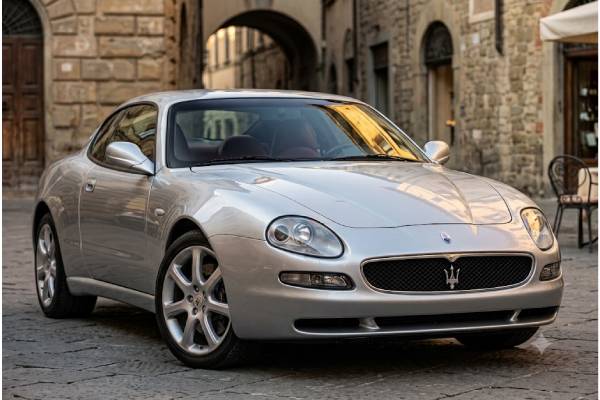
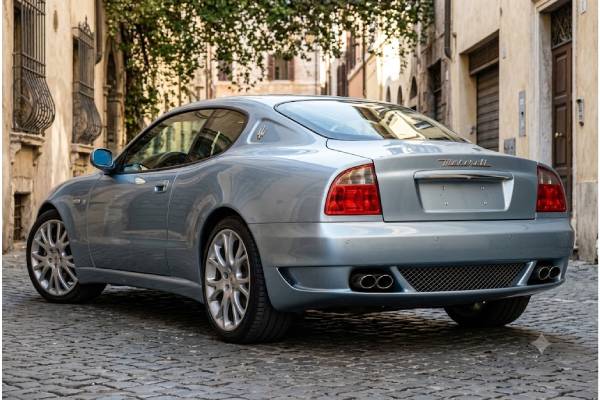
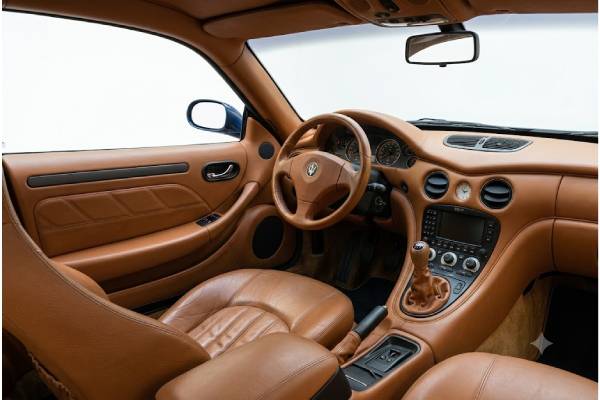
The Maserati Coupé GT is the manual-transmission version of the M138 four-seat grand tourer and one of the rarest ways to combine a naturally aspirated Italian V8 with everyday usability. Its 390 hp, 4.2-liter F136 R engine drives a rear-mounted six-speed gearbox through a torque tube, giving the car balanced weight distribution and a more deliberate character than the paddle-shift Cambiocorsa. The GT is not a lightweight sports car: it has leather-lined seating for four, a useful boot, climate control, and a composed long-distance ride. Yet its clutch pedal, mechanical gear change, hydraulic steering, and rising V8 power make it highly involving on a quiet road. Buyers should not assume that the manual eliminates expensive risks. Clutch and transaxle work remains labor intensive, synchronizers and linkage can wear, dry-sump oil leaks require attention, and Skyhook dampers, cooling components, leather, and electronics age like those of every M138. A sound example is a distinctive modern classic; a deferred one can consume its purchase price in corrective work.
Table of Contents
- The Manual Four-Seat Grand Tourer
- F136 V8 and GT Specifications
- Years, Options, and Manual Rarity
- Transaxle Layout and Cabin Design
- Three-Pedal Road Character
- Manual Driveline and Aging Systems
- How to Buy a Coupé GT
The Manual Four-Seat Grand Tourer
The Coupé GT matters because it combines Maserati’s new-generation V8 platform with a conventional manual transmission and genuine grand-touring accommodation. It arrived in 2002 as the closed companion to the M138 Spyder and succeeded the 3200 GT with a fundamentally different powertrain.
The earlier 3200 GT relied on twin turbochargers and placed its gearbox near the engine. The M138 Coupé introduced a naturally aspirated F136 R V8, dry-sump lubrication, and a rear transaxle. This shifted part of the driveline mass rearward, improved balance, and replaced boost-driven acceleration with a linear climb toward 7,000 rpm.
Maserati offered two transmission choices. Cambiocorsa used paddles and hydraulic controls, while the GT gave the driver three pedals and a center-console lever. Both transmissions were mounted at the rear, but the manual car eliminated the electrohydraulic pump, accumulator, actuator, and automated clutch logic. That simplification is valuable, although the conventional clutch hydraulics, flywheel, torque tube, and gearbox remain specialized components.
The car also challenged the idea that an exotic V8 coupé needed to be impractical. Its rear seats are usable for children and occasional adults, and the boot can take two golf bags or tailored luggage. The cabin has supportive seats, extensive leather, an analog clock, and the comfort expected of a premium grand tourer.
Manual production was lower than Cambiocorsa production in many markets because paddle shifting was heavily promoted when the car was new. Exact transmission totals are not consistently published. This relative scarcity has increased enthusiast interest, especially as later Maseratis abandoned manual gearboxes.
The GT’s value lies in the interaction between components rather than a single headline figure. The clutch has weight, the lever needs a positive hand, the steering provides hydraulic feedback, and the engine asks to be revved. A driver participates in the process without giving up air conditioning, luggage space, or a quiet sixth-gear cruise.
Its weaknesses are equally specific. Long periods of cheap used-car pricing led to deferred maintenance. Manual cars may have been spared Cambiocorsa hydraulic faults, but some received inexpensive clutch work, incorrect gearbox oil, neglected cooling systems, low-quality tires, and poorly installed electronics. Buying carefully is more important than assuming the rare transmission guarantees quality.
F136 V8 and GT Specifications
The Coupé GT uses the same 390 hp F136 R engine as the Cambiocorsa, but its six-speed manual transaxle changes how the performance is delivered. The driver controls launch, clutch engagement, shift speed, and rev matching directly.
| Category | Specification |
|---|---|
| Production period | 2002–2007 |
| Model code | M138 |
| Engine code | F136 R |
| Engine layout | Front-mounted 90-degree V8 |
| Displacement | 4,244 cc |
| Bore and stroke | 92 mm × 80 mm |
| Induction | Naturally aspirated, electronic fuel injection |
| Valve gear | DOHC, 32 valves, variable intake timing |
| Lubrication | Dry sump |
| Maximum power | 390 hp at 7,000 rpm |
| Maximum torque | 451 Nm at 4,500 rpm |
| Gearbox | Six-speed manual rear transaxle |
| Drive | Rear-wheel drive with limited-slip differential |
| Chassis | Steel load-bearing structure with subframes |
| Suspension | Independent double wishbones front and rear |
| Damping | Fixed-rate or optional Skyhook electronic damping |
| Brakes | Ventilated steel discs with Brembo calipers |
| Tires | 235/40 ZR18 front; 265/35 ZR18 rear |
| Wheelbase | 2,660 mm |
| Length | 4,523 mm |
| Width | 1,822 mm |
| Official dry weight | Approximately 1,580 kg |
| Top speed | Approximately 285 km/h |
| 0–100 km/h | Approximately 4.9–5.0 seconds |
The aluminum V8 uses a cross-plane crankshaft and four overhead camshafts. Its chain-driven cam system avoids a scheduled timing-belt replacement, though ancillary belts, tensioners, seals, and variable-timing hardware still require inspection. The engine produces usable torque well before the power peak and becomes progressively more energetic beyond the midrange.
Dry-sump lubrication separates the oil reservoir from the crankcase. Scavenge pumps return oil to the tank, helping maintain supply during cornering. The design requires a specific warm-level check. If a workshop fills to a cold dipstick reading, the engine may be overfilled once the oil circulates and expands.
The gearbox and limited-slip differential sit behind the cabin. A rigid torque tube transmits power from the engine and aligns the driveline. This setup contributes to balanced handling but increases labor for clutch and related work. Vibration or clunking can come from mounts, torque-tube components, differential wear, or excessive driveline clearance.
The manual shift uses cables or linkages across a long path to the rear transaxle, so it does not feel like a lever mounted directly into a front gearbox. A healthy system should still be precise. Excessive play, refusal to enter gear, crunching during normal shifts, or movement under load indicates wear or adjustment problems.
Acceleration numbers depend on launch skill and surface. The car is fast enough to match many period sports cars, but its real strength is effortless rolling pace. It can pass in one gear, then pull cleanly toward the red line without waiting for boost or an automated shift decision.
Years, Options, and Manual Rarity
The Coupé GT remained available across the M138 production run, but market supply varies widely. Buyers should establish the exact build date, original market, option specification, and factory transmission rather than trusting a generic model-year description.
Maserati made running improvements to electronics, software, trim, and service procedures. A later registration does not automatically mean every update is present, while an early car may have received factory revisions during dealer maintenance. Invoices showing campaigns, replacement part numbers, and specialist work are valuable.
Skyhook adaptive damping is the most consequential option for long-term ownership. It uses sensors and electronically controlled valves to vary damping. When healthy, it adds flexibility for rough roads and fast touring. When dampers leak or the control system faults, replacement can be costly and sourcing may require specialist solutions.
Other choices included xenon lighting, navigation, upgraded audio, heated and memory seats, parking sensors, colored calipers, different wheel finishes, wood or carbon cabin trim, and an unusually broad range of leather combinations. Maserati also offered bespoke color and stitching requests, so an uncommon interior is not automatically non-original.
The 2004 90th Anniversary Edition was offered with manual transmission in the Australian regional program. Its special details can include carbon trim, numbered identification, aluminum pedals, red calipers, specific wheels, Skyhook, rear parking sensors, and a defined color range. Verification requires build records because many standard Coupés have acquired similar accessories.
The GranSport replaced the standard car’s relaxed emphasis with 400 hp, Cambiocorsa only, 19-inch wheels, lower suspension, revised aerodynamics, and sport seats. There was no regular factory manual GranSport. A Coupé GT wearing GranSport bumpers or wheels remains a 390 hp manual Coupé and should be represented as such.
Why manual condition matters more than rarity
A rare transmission increases interest but does not excuse mechanical faults. A car with worn second-gear synchronization, a slipping clutch, and no documented transaxle service can be less desirable than a common Cambiocorsa with recent comprehensive work. Manual-specific problems can also take time to diagnose because fewer workshops have experience with them.
Original books, tools, keys, sales invoices, option records, and period service stamps help establish provenance. For special colors or anniversary claims, factory or Classiche documentation can reduce uncertainty. Keep in mind that a repaint may be high quality while still changing collector value.
Transaxle Layout and Cabin Design
The Coupé’s engineering serves its dual role: a balanced driver’s car at speed and a comfortable four-seat tourer over distance. The rear transaxle, fixed roof, and long wheelbase relative to the Spyder create a stable, cohesive structure.
Giugiaro’s body has a low oval grille, rounded front wings, a smooth roofline, and a compact tail. The design is less flamboyant than many Italian exotics, which helps it age gracefully. It also makes panel mismatch obvious. Door gaps, bonnet alignment, bumper fit, lamp position, and paint texture should be uniform.
The fixed roof provides useful torsional rigidity. Suspension loads can be managed without the flex seen in open cars, improving steering precision and reducing rattles. A Coupé that creaks heavily, feels loose over diagonal bumps, or shows unusual door movement may have worn mounts or structural repair.
The rear transaxle allows the V8 to sit forward without placing the gearbox beside it. Weight distribution is closer to neutral, and the car’s steering feels lighter than its long bonnet suggests. Packaging the torque tube through the center creates a substantial tunnel but leaves room for four individual seating positions.
The cabin reflects Maserati’s blend of old and new. An analog clock, oval vents, leather dashboard, and rich color choices provide tradition. Digital climate and navigation systems represent the period and can appear dated today. The manual gear lever restores a clear mechanical focal point in the center console.
Rear-seat access depends on the front-seat folding and sliding mechanisms. Test both sides, including electric memory return where fitted. Inspect rear leather, headlining, parcel shelf, and seat-belt hardware; these areas may reveal water entry, sun damage, or previous disassembly.
The boot is large enough for touring, but check its seals, trim, tools, battery area, and evidence of moisture. Poorly installed amplifiers or battery cables are common sources of electrical drains and damaged trim.
Front cooling modules are low and exposed. Leaves and grit lodge between the air-conditioning condenser and radiator. Removing debris and preserving the air guides improves cooling and reduces corrosion. Cars with repaired front bumpers should be checked for missing ducts and distorted mounts.
Three-Pedal Road Character
The Coupé GT rewards smooth, deliberate inputs more than aggressive technique. Its manual shift makes the driver responsible for the pace of every transition, while the engine supplies a broad and predictable response.
The clutch should feel moderately heavy but not jerky. First gear is tall enough that a careless driver can over-slip the clutch during parking. A small amount of throttle and a clean release work better than prolonged balancing. On hills, use the handbrake rather than holding the car on the clutch.
The gear lever has more travel than a compact roadster’s and may feel firm when the oil is cold. Once warm, shifts should be clean and consistent. Rev matching on downshifts reduces driveline shock and helps the rear axle remain settled before a corner.
At low revs, the V8 is smooth enough for traffic and quiet cruising. From about 4,000 rpm, the engine begins to dominate the experience. The induction hardens, the exhaust note gains a metallic layer, and the acceleration continues to build toward 7,000 rpm. There is no turbo lag and no sudden torque spike.
Hydraulic steering gives a natural increase in effort as cornering load builds. The front tires respond accurately when alignment and joints are correct. The longer wheelbase makes the Coupé calmer than the Spyder and more tolerant of mid-corner surface changes.
The limited-slip differential helps deploy power but requires matched rear tires. A worn or hardened pair can produce abrupt wheelspin, while mixed tire brands front to rear change the handling balance. Correct pressures and a specialist alignment are inexpensive compared with chasing suspension symptoms caused by poor rubber.
Skyhook cars can cover broken roads with surprising comfort in the softer setting. Sport mode firms damping and sharpens the car’s attitude on smooth pavement. A very harsh ride is often a fault—old low-profile tires, seized bushes, failed dampers, or incorrect springs—not proof of sporting setup.
The steel brakes have a progressive pedal and enough capacity for fast road use. Vibration may come from disc thickness variation, pad deposits, wheel problems, or worn suspension. Track sessions require fresh fluid and appropriate pads, and they accelerate wear on a car designed primarily for grand touring.
On a motorway, the GT settles into sixth gear with low wind noise, supportive seats, and useful luggage space. In a city, the clutch, turning circle, long doors, and low front bumper require more effort. The car’s best environment is a long route that combines fast open sections with destinations where its four-seat practicality matters.
Manual Driveline and Aging Systems
The GT’s maintenance advantage is the absence of Cambiocorsa hydraulics, not the absence of expensive work. The clutch, gearbox, cooling system, suspension, brakes, oil system, and electrical equipment still need age-aware care.
Clutch, gearbox, and torque tube
Test for clutch slip in a high gear under full load. Watch for engine speed rising faster than road speed. Judder, a very high engagement point, bearing noise, or slow pedal return can indicate friction, flywheel, release, or hydraulic problems.
Inspect the clutch master and slave circuits for leakage. Ask whether previous clutch work included the release bearing, flywheel assessment, seals, mounts, and proper alignment. Because labor is substantial, replacing only the obvious worn disc can be false economy.
Evaluate every gear cold and hot. Second and third gear often expose synchronization wear. Linkage bushes and adjustment can produce vagueness, while worn mounts can make the lever move under acceleration. Gearbox oil type matters; an unsuitable lubricant may worsen cold shifting.
Torque-tube or transaxle noises need informed diagnosis. A whine that changes with gear, a clunk on throttle take-up, or vibration at certain speeds may come from several connected components. A workshop familiar with M138 architecture is essential.
Engine, oil, and cooling
The F136 R should start promptly, idle steadily, and pull without hesitation. Inspect for oil around cam covers, front covers, dry-sump pipes, and tank fittings. Verify that the engine has not been overfilled and that service records show regular oil changes.
Cooling-system checks should include radiator and condenser cleanliness, fan operation, relays, thermostat, expansion tank, cap, and hose condition. Observe the temperature in traffic with the air conditioning on. Dried coolant marks or a sweet smell require pressure testing.
Misfires can damage expensive catalysts. Coils, plugs, injectors, intake leaks, and oxygen sensors are possible causes. Read current and pending codes, and check whether emissions monitors are complete after previous warning-light clearing.
Suspension, cabin, and electrical systems
Inspect ball joints, control-arm bushes, tie rods, anti-roll-bar links, dampers, wheel bearings, and brake hoses. Skyhook units can leak internally or externally and trigger warning lights. Tire wear patterns help identify geometry and joint problems.
Interior leather shrinks near vents and airbags, soft-touch coatings become sticky, and headlining can release. Test seat motors, rear-seat access, windows, locks, alarm, climate control, audio, navigation, parking sensors, and the instrument display.
A weak battery can generate misleading gearbox, ABS, suspension, or alarm faults. Confirm battery capacity, alternator output, and parasitic draw before replacing modules. A quality maintainer is useful for occasional use, but it should not conceal a failing battery.
Service by time as well as distance. Brake fluid, coolant, gearbox and differential oils, filters, belts, hoses, and tires age while parked. Regular full-temperature drives are healthier than monthly five-minute starts.
How to Buy a Coupé GT
Buy the car that proves its condition through records, diagnostics, and a long road test. Manual rarity is a benefit only after the clutch, gearbox, and factory identity have been verified.
Confirm that the VIN corresponds to a GT from new. Check the pedal box, gear lever, console, wiring, and build information. A manual conversion is possible in theory but should not be valued as a factory car without complete engineering and registration documentation.
Commission an inspection from a Maserati specialist with manual M138 experience. Request:
- Cold start and hot restart, with engine fault scan and leak inspection.
- Clutch slip, hydraulic function, release noise, gearbox synchro, linkage, and mount tests.
- Cooling-system evaluation during idle, traffic, and sustained load.
- Lift examination of transaxle, torque tube, suspension, brakes, exhaust, wheels, and underbody.
- Paint-depth readings and checks for structural or front-end repair.
- Tire date and matching-brand inspection.
- Complete electrical, climate, seat, window, and security-system testing.
- Comparison of the actual car with its build data, options, and invoices.
Drive far enough to warm the gearbox fully. Use each gear under light and heavy load, make several downshifts, and listen during acceleration and overrun. Brake from speed, cross rough surfaces, and verify that steering remains centered.
Plan a reserve even after a favorable inspection. Baseline fluids, tires, battery, alignment, sticky-control refinishing, and small leaks are common. A clutch and flywheel, gearbox repair, Skyhook dampers, radiator stack, catalysts, or leather restoration can be major expenses.
Prioritize reversible and documented upgrades. Modern audio connectivity, correct replacement tires, improved battery support, or specialist damper solutions can enhance use. Avoid cut wiring, oversized wheels, missing emissions parts, or poorly fitted body kits.
A strong Coupé GT delivers an unusually complete package: the sound and response of a high-revving Italian V8, the participation of a manual transaxle, real passenger space, and long-distance comfort. Its best qualities appear only when every system is maintained as part of one integrated car.
References
- Coupé Model – Gran Turismo models | Maserati (Maserati Classic)
- 2002 Maserati Coupe – Road Test & Review – Automobile Magazine 2002
- Tested: 2004 Luxury Sports Coupe Comparison 2004
- Receive the Certification of Authenticity for your car | Maserati (Maserati Classiche)
Disclaimer
This article is for informational purposes and does not replace professional inspection, diagnosis, or repair. Specifications, torque values, service intervals, procedures, and equipment can vary by VIN, production date, and market; verify them in the official service documentation for the specific vehicle. Please share this guide on Facebook, X/Twitter, or your preferred automotive community if it was useful.