
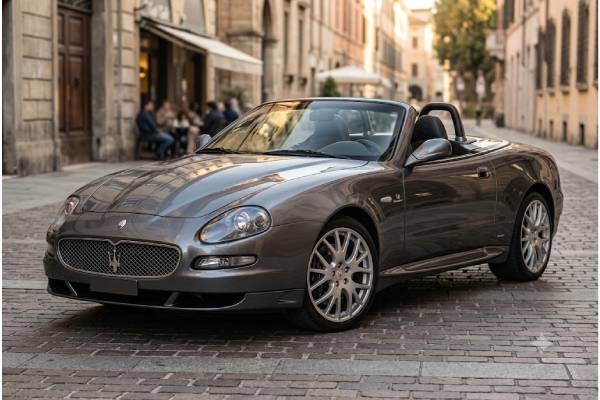
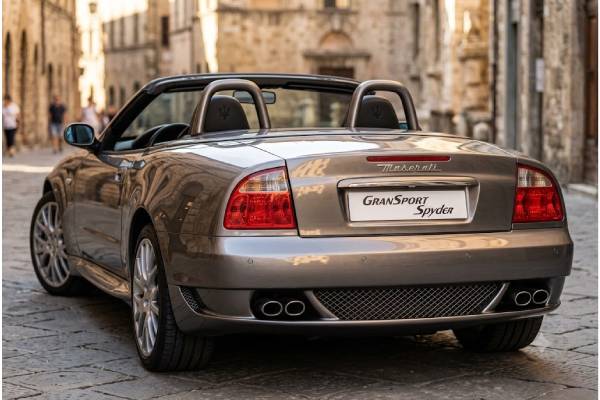
The Maserati GranSport Spyder is the rare open version of the final, fastest development of the M138 platform. Produced from 2005 to 2007 in only 473 examples, it combines the short-wheelbase two-seat Spyder body with the 400 hp F136 RB V8, quicker Cambiocorsa transmission, 19-inch wheels, lowered Skyhook suspension, revised bodywork, and a more vocal exhaust. It is not simply a regular Spyder with GranSport badges. The engine calibration, gearing, aerodynamics, damping, cabin trim, and exterior hardware create a sharper car with a 290 km/h claimed top speed. The compact wheelbase and open roof make its reactions and soundtrack more intense than those of the GranSport coupé, but they also expose structural flex and place greater importance on tires, alignment, and suspension condition. Buyers must inspect the single-clutch transmission and roof mechanism as separate high-cost systems, then verify that scarce GranSport-specific seats, wheels, bumpers, carbon trim, and exhaust parts remain. A correct, maintained example is one of the most characterful modern Maserati roadsters.
Table of Contents
- The Rare Open GranSport
- 400 hp Spyder Specification
- Production, Equipment, and Identification
- Short-Chassis GranSport Details
- Open-Air Performance Character
- Roof, Transmission, and Chassis Upkeep
- Buying One of 473
The Rare Open GranSport
The GranSport Spyder is a genuine factory performance derivative and the rarest regular-production body style in the M138 range. Maserati introduced it at the Frankfurt Motor Show in 2005 and built 473 cars before production ended in 2007.
Its foundation is the original two-seat Spyder, not the longer four-seat GranSport coupé. The wheelbase is 2,440 mm rather than 2,660 mm, and the powered fabric roof folds behind the cabin. Maserati applied the GranSport’s 400 hp engine, faster transmission logic, lower suspension, 19-inch wheels, aerodynamic treatment, exhaust, and cabin revisions to that compact structure.
This created a car with a distinct role. The normal Spyder emphasized elegant open-air touring, while the GranSport Spyder added sharper responses and more aggressive visual cues. It retained power seats, leather, climate control, and a folding roof, so it did not become a lightweight track roadster. The appeal lies in combining comfort with a more immediate mechanical personality.
Only Cambiocorsa transmission was offered. The absence of a factory manual is important when assessing modified cars and advertisements. A three-pedal conversion may be an interesting engineering project, but it is not an original GranSport Spyder and should not command the same collector value without extraordinary documentation.
The car arrived late in the platform’s life. Maserati had already refined the F136 engine family and improved its paddle-shift calibrations, yet the underlying technology remained a hydraulically operated single clutch. Modern drivers often expect dual-clutch smoothness, which can lead them either to criticize normal behavior or to miss genuine wear.
Its 473-car production total gives every surviving example some rarity, but condition still varies. Some were treated as special weekend cars and stored carefully; others were exposed to coastal weather, urban traffic, deferred service, or cosmetic modification. Low mileage can preserve paint and leather while allowing roof seals, hydraulic components, tires, and dampers to age.
The model’s place in Maserati history is secure. It was the final open expression of the compact Giugiaro M138 before the company moved to the larger four-seat GranCabrio concept. Later cars are faster and more refined, but few combine such a short wheelbase, hydraulic steering, naturally aspirated V8, and open two-seat cabin.
400 hp Spyder Specification
The GranSport Spyder uses the F136 RB 4.2-liter V8 and six-speed Cambiocorsa rear transaxle. Its 400 hp output matches the coupé, while the short wheelbase and approximately 1,630 kg official weight give the open car a more compact feel.
| Item | Specification |
|---|---|
| Production period | 2005–2007 |
| Number produced | 473 |
| Model code | M138 |
| Engine code | F136 RB |
| Engine | 4,244 cc naturally aspirated 90-degree V8 |
| Construction | Aluminum block and heads |
| Valve system | DOHC, 32 valves, variable intake timing |
| Lubrication | Dry sump |
| Maximum power | 400 hp at 7,000 rpm |
| Maximum torque | Approximately 452 Nm at 4,500 rpm |
| Transmission | Six-speed Cambiocorsa automated manual transaxle |
| Drive | Rear-wheel drive with limited-slip differential |
| Body | Steel two-seat convertible with front and rear subframes |
| Suspension | Double wishbones with lowered Skyhook adaptive damping |
| Steering | Hydraulically assisted rack and pinion |
| Brakes | Ventilated steel discs with Brembo calipers |
| Wheels | 19-inch Trofeo-style alloys |
| Tires | 235/35 ZR19 front; 265/30 ZR19 rear |
| Wheelbase | 2,440 mm |
| Length | Approximately 4,303 mm |
| Width | Approximately 1,822 mm |
| Official weight | Approximately 1,630 kg |
| Top speed | Approximately 290 km/h |
| 0–100 km/h | Approximately 4.9 seconds |
The F136 RB gains ten horsepower over the standard Spyder’s F136 R. Changes to intake flow, valve seats, engine management, and exhaust breathing improve high-rpm performance. The engine remains flexible at normal road speeds, with peak torque at 4,500 rpm and increasing urgency toward 7,000 rpm.
A cross-plane crankshaft produces the characteristic deep Maserati V8 sound. The open cabin and valve-controlled exhaust make that sound more prominent than in the coupé. Dry-sump lubrication supports oil control under cornering, but the separate tank and hose network require correct servicing and careful leak checks.
The transmission and differential sit at the rear. The torque-tube arrangement moves driveline mass away from the nose and helps the short car turn readily. It also makes clutch replacement and driveline diagnosis more specialized.
Cambiocorsa uses a pump, accumulator, actuator, sensors, and control unit to operate a dry clutch and six-speed gearbox. GranSport calibration shortens shifts at high throttle, but the system still interrupts torque. Drivers should minimize low-speed creep and use the brake rather than clutch slip to hold the car on an incline.
The lower suspension and 19-inch wheels improve response but reduce compliance. The thin tire sidewalls offer little protection against potholes. A slightly bent wheel or hardened tire can cause vibration, tramlining, or abrupt breakaway that is wrongly blamed on the chassis.
Steel brakes provide progressive road performance and are more economical to renew than carbon-ceramic equipment. They still need fresh fluid, free-moving calipers, suitable pads, and sound discs to cope with the car’s speed and weight.
Production, Equipment, and Identification
A real GranSport Spyder should match factory data in its engine, transmission, body equipment, wheels, interior, and option specification. With only 473 produced, missing model-specific parts can materially affect value.
The production run covered 2005 through 2007, though first registration may not match build year in every market. Cars were distributed globally in small numbers, so local rarity claims should state the region and evidence. The worldwide factory total is more reliable than an unsupported national count.
GranSport exterior features generally include deeper bumpers, a larger mesh grille, side skirts, a rear lip treatment, lower ride height, and 19-inch trident-spoke wheels. The Spyder adapts these details to the short body and roof cover. A normal Spyder with wheels and badges is not equivalent because the engine, gearbox calibration, suspension, and full aerodynamic package differ.
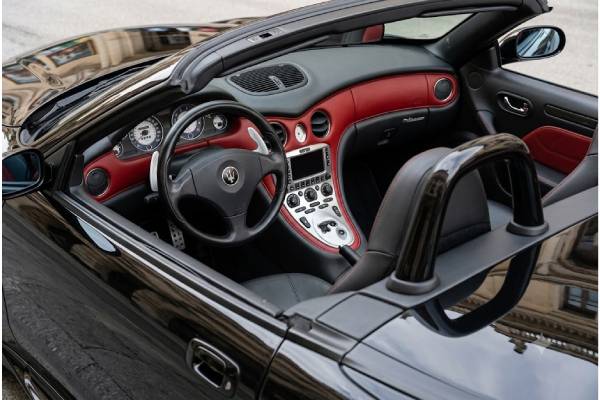
Inside, the open car typically uses full leather rather than the technical-cloth combinations common in the coupé. Carbon trim, a thicker steering wheel, a narrower console, and deeply shaped seats provide the GranSport identity. Upholstery colors and stitching vary, so build records should be consulted before judging an unusual cabin.
Factory options can include navigation, upgraded audio, parking sensors, xenon lighting, power seating, colored calipers, and personalized leather. The roof fabric color is part of the original specification and should coordinate with paint and interior records.
Parts that deserve authenticity checks
- Correct 19-inch wheels and center caps.
- GranSport bumpers, skirts, grilles, and rear treatment.
- Carbon console and dashboard trim.
- Model-specific front seats and steering wheel.
- Valve-controlled exhaust and associated hardware.
- F136 RB engine identification and Cambiocorsa controls.
- Original roof color and interior material pattern.
- Books, tools, keys, option records, and early invoices.
Wheel replicas, generic carbon overlays, and standard Spyder seats can make a car look close while reducing originality. Compare weave, surface finish, stitching, and mounting details with documented examples. If rare parts were replaced after damage, retain the originals and invoices.
The GranSport Spyder did not receive the MC Victory’s numbered specification. Sellers should not imply an MC12 connection beyond the general GranSport era unless the car has verifiable factory special equipment. Likewise, anniversary badges added later do not create a limited edition.
Short-Chassis GranSport Details
The defining engineering challenge was applying GranSport performance hardware to the shortest M138 body while retaining a fully powered roof. The result is visually compact and dynamically responsive, with more structure and mechanism concentrated behind the seats.
Giugiaro’s basic Spyder form has a low oval grille, smooth flanks, and a rounded tail. GranSport bumpers and mesh make the nose more aggressive without changing the underlying proportions. The side skirts visually lower the body, and the rear treatment balances the deeper front.
The roof folds beneath a rigid tonneau cover. Its operation requires hydraulic pressure, correctly adjusted linkages, working microswitches, healthy elastic straps, aligned latches, and coordinated window movement. The GranSport’s lower, firmer chassis does not simplify this mechanism; roof service remains the same separate concern found on other M138 Spyders.
Removing the fixed roof reduces torsional stiffness. Maserati reinforced the steel structure, but some scuttle movement over broken pavement is inherent. A well-kept car still feels cohesive. Severe shaking, rattles, door misalignment, or movement through the rear deck can indicate worn braces, suspension issues, loose roof hardware, or previous structural repair.
The short wheelbase places the rear axle close to the occupants. This contributes to quick rotation and makes the driver more aware of rear-tire grip. It also means alignment errors and mismatched tires can produce a more immediate response than in the longer coupé.
The cockpit is intimate. Deep seats hold the body, but their bolsters can make entry difficult with the roof raised. The steering wheel, pedals, and fixed paddles should suit the driver’s size before purchase. Seat adjustment, door clearance, and rollover-hoop position cannot be judged from photographs.
Carbon trim and leather create a purposeful but still luxurious environment. Inspect carbon clear coat for haze or cracking and leather for shrinkage around vents and airbags. The soft-touch coating on switches and trim frequently deteriorates into a sticky surface.
Cooling components remain exposed behind the low nose. The GranSport bumper’s ducts and underbody panels must be present and correctly mounted. Accident repairs that omit air guides can reduce cooling efficiency even when the exterior looks straight.
Open-Air Performance Character
The GranSport Spyder feels more intense than the coupé because its short wheelbase reacts quickly and the open roof removes the sound barrier between occupants and exhaust. It rewards measured inputs and a smooth understanding of the Cambiocorsa system.
At parking speed, clutch management sets the tone. Select gear, let engagement complete, and avoid inching forward on throttle. Reversing uphill generates substantial clutch heat. A burning smell after ordinary maneuvering suggests either poor technique or a clutch already near the end of its useful life.
In normal driving, a small accelerator lift during upshifts reduces head movement. Sport mode speeds the change, firms the damping response, alters stability-control thresholds, and opens the exhaust more readily. The shift remains physical, with a clear pause before the next gear drives.
The V8 delivers immediate response and a broad power curve. At moderate rpm it is flexible enough for relaxed touring. Above the torque peak, it becomes louder and more urgent, and the final approach to 7,000 rpm supplies the car’s strongest acceleration.
Hydraulic steering is quick and communicative. The front end changes direction with little delay, and the driver can sense grip building through the wheel. If the car follows road grooves aggressively or shakes through the steering, inspect wheels, tires, alignment, ball joints, and tie rods.
The short rear-biased layout makes corner exit entertaining. The limited-slip differential helps put power down, but cold or old rear tires can break traction quickly. Stability control is an important safeguard. Tire age matters as much as tread because hardened compound cannot deliver designed grip.
Skyhook’s softer setting is often preferable on rough roads. Sport works best on smooth surfaces where the lower body movement improves precision. A car that bounces, crashes, or takes several movements to settle likely has damper or bush problems rather than simply “firm Italian suspension.”
The steel brakes have good modulation and sufficient road endurance. Mountain driving requires fresh fluid and healthy pads. Repeated track use can overheat road components, and the open body’s rarity makes accident damage especially costly.
With the roof down, wind is manageable at touring speeds and the exhaust is always present. With the roof raised, the car can handle motorway trips, although fabric noise, restricted rear vision, and the firm 19-inch ride remain. Storage is limited compared with the coupé, so soft luggage works best.
Roof, Transmission, and Chassis Upkeep
The GranSport Spyder has two independent high-cost systems that must be proven: Cambiocorsa and the powered roof. A car that passes one test can still need major work in the other, so both require repeated operation from cold to full temperature.
Cambiocorsa diagnosis
Use marque-capable software to record clutch wear estimates, clutch closed and engagement positions, hydraulic pressure, pump cycle duration, actuator faults, and adaptation values. The calculated wear percentage is useful only when calibration is credible.
Listen to pump priming and observe how often it cycles. A weak accumulator or pressure leak can make the pump run frequently. Slow gear selection, blinking indicators, unexpected neutral, inconsistent reverse, or hot-shift deterioration require immediate investigation.
Clutch life reflects use more than mileage. Open roads are relatively gentle; congested streets and difficult parking are not. A proper clutch replacement should assess the flywheel, release bearing, seals, mounts, and related components before completing electronic setup.
Roof and water control
Run several complete opening and closing cycles with good battery voltage. The roof should not pause, strain, collide with the cover, or require hand assistance. Inspect hydraulic cylinders and lines, pump fluid, frame joints, straps, fabric edges, rear window, seals, latches, and switches.
Check behind the seats, beneath carpets, around the roof storage area, and in the boot for moisture. Blocked drains or failed seals can damage trim and electrical connectors. Musty odor, water marks, corroded fasteners, and fogged lamps require investigation.
Engine, cooling, and suspension
Inspect the dry-sump system for leaks at cam covers, front covers, hoses, tank fittings, and lower panels. Confirm the correct oil service and warm-level procedure. Misfires, smoke, warning lamps, or abnormal noises should be resolved before purchase.
Clean the radiator and condenser stack and test fans, relays, thermostat, expansion tank, cap, and hoses. Temperature must remain stable in traffic with the air conditioning operating. Catalysts and oxygen sensors suffer from heat, so read fault memory and emissions readiness.
On a lift, check Skyhook dampers, control-arm ball joints and bushes, anti-roll-bar links, steering ends, wheel bearings, brake hoses, wheel straightness, subframes, exhaust mounts, and underside damage. The low front bumper and side skirts are vulnerable to ramps.
Cabin problems include sticky controls, shrunken leather, worn seat bolsters, window regulator faults, weak air conditioning, alarm problems, and battery-related warnings. Test every switch after confirming charging voltage.
Annual, time-based service is appropriate. Coolant, brake fluid, gearbox and differential oils, filters, belts, battery condition, hoses, and tire age should not be judged only by distance traveled.
Buying One of 473
The best purchase is a complete, factory-correct car with recent mechanical use and evidence that both roof and transmission have been maintained. Rarity should narrow the search, not lower inspection standards.
Confirm the VIN and build details before discussing value. Match paint, roof color, interior, wheels, calipers, options, engine designation, and body equipment with factory or historical records. Claims about national rarity should be supported by registration or importer data.
A specialist pre-purchase inspection should include:
- Cold start, hot restart, engine scan, and oil-leak inspection.
- Full Cambiocorsa pressure, pump, clutch, actuator, and calibration report.
- Repeated roof operation plus water-ingress examination.
- Cooling-system test in traffic and after sustained road load.
- Lift inspection of suspension, steering, wheels, tires, brakes, exhaust, and underbody.
- Paint-depth measurement and checks for low-nose, sill, and rear-quarter repair.
- Function test of Skyhook, exhaust valves, windows, seats, climate, alarm, and electronics.
- Verification of GranSport-specific parts, books, tools, keys, and service chronology.
Drive the car long enough for hydraulic fluid, gearbox oil, engine oil, and coolant to reach full operating temperature. Test gentle and rapid shifts, reverse, rough pavement, firm braking, and a hot restart. Roof testing should not be limited to one demonstration.
Set aside a meaningful reserve. Four correct tires, wheel repair, fluids, battery, alignment, sticky-control restoration, and roof adjustment are common. A clutch, hydraulic actuator, set of Skyhook dampers, cooling overhaul, catalysts, or roof cylinders can be substantially more expensive.
Protect originality where it matters. The wheels, body kit, seats, carbon trim, exhaust, and roof specification are costly to return to factory form. Reversible audio or battery improvements can be sensible, but cut wiring, generic body panels, or improvised suspension reduce confidence.
A sound GranSport Spyder is worth the effort because it offers a combination no later Maserati repeated in quite the same way: two seats, a very short wheelbase, open-air 400 hp V8 sound, hydraulic steering, and a paddle shift with clear mechanical involvement. Its rarity adds collector interest, while its dynamic character gives owners a reason to keep driving it.
References
- GranSport, GranSport Spyder – Gran Turismo models | Maserati (Maserati Classic)
- Maserati GranSport 2004
- Guide: Maserati 4200 Spyder & GranSport Spyder 2023
- Receive the Certification of Authenticity for your car | Maserati (Maserati Classiche)
Disclaimer
This article is for informational purposes and is not a substitute for professional inspection, diagnosis, or repair. Specifications, torque values, procedures, service intervals, and equipment vary by VIN, production date, and market; verify every detail in the official service documentation for the individual car. Please share this article on Facebook, X/Twitter, or your preferred automotive community if it was helpful.