
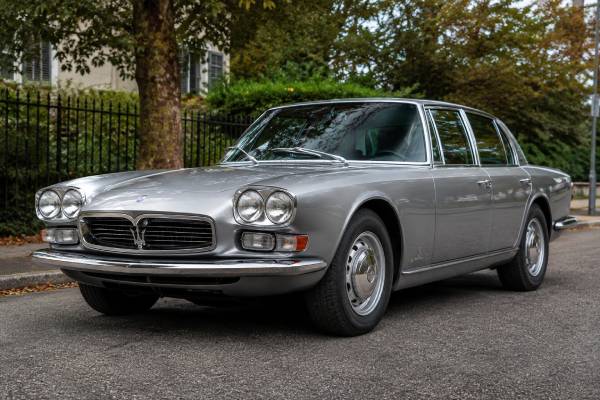
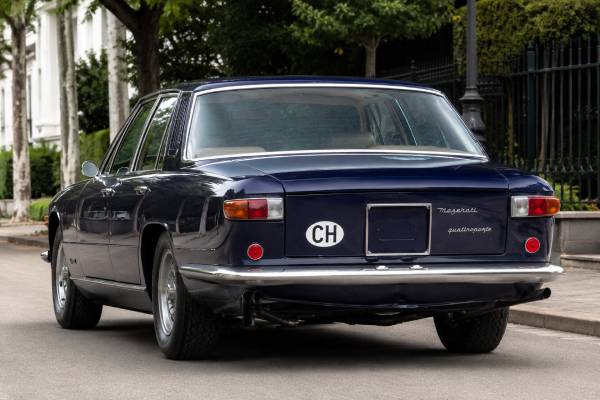
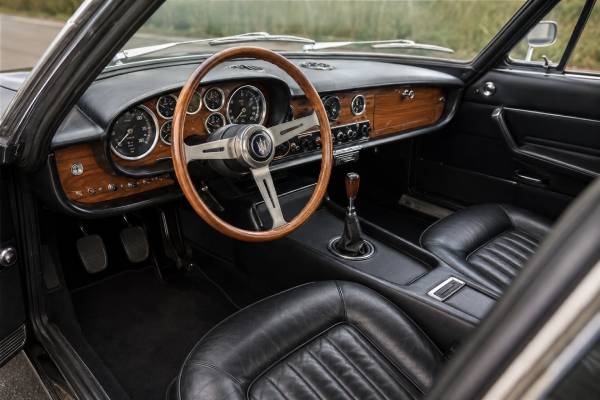
The Maserati Quattroporte 4700 is the rare, high-output conclusion to the first-generation Quattroporte story. Offered during the final part of AM107 production, it placed Maserati’s 4,719 cc four-cam V8 into the revised Series II saloon and raised output to 290 hp. The result was one of the fastest four-door cars of its era, with effortless high-speed ability, a richly finished cabin, and the visual restraint of Pietro Frua’s original design.
Only a small number were built. Maserati’s current heritage material identifies 64 second-series cars with the 4.7-liter engine, although other historical totals differ because early special cars, later conversions, and record classifications are not always counted in the same way. That rarity makes identity and originality unusually important. A 4.2-liter AM107 upgraded with a larger engine may be enjoyable, but it is not automatically equivalent to a factory 4700.
The 4700 also carries every ownership demand of a handmade 1960s Maserati. Cooling, carburetion, wet-liner engine assembly, body corrosion, scarce trim, and aging brakes can produce major bills. Buyers should therefore judge documentation and structural condition before paint shine or claimed performance.
Table of Contents
- The Rare Peak of the First Quattroporte
- Larger V8, Chassis, and Performance Data
- Factory 4700 Production and Identification
- Frua Body With Extra Maserati Muscle
- The 4700 From City Streets to Autostrada
- Keeping a Four-Cam 4700 Healthy
- How to Buy the Right Quattroporte 4700
The Rare Peak of the First Quattroporte
The Quattroporte 4700 was built for customers who wanted the most powerful version of Maserati’s pioneering luxury saloon. It preserved the comfort and discretion of the 4.2-liter car but added displacement, torque, and stronger high-speed performance at a time when 290 hp in a four-door automobile was exceptional.
Maserati had introduced the AM107 Quattroporte at the 1963 Turin Motor Show. The car combined a steel monocoque, a V8 derived from the company’s grand-touring engines, and a Frua-designed body constructed by Vignale. It established a format that later became familiar—the high-performance luxury saloon—but was highly unusual in the early 1960s.
The Series II revision arrived in 1966. It brought twin round headlamps, a redesigned wood-trimmed dashboard, improved cabin refinement, and a live rear axle on leaf springs in place of the early De Dion arrangement. Most Series II cars retained the 4,136 cc engine. The larger 4,719 cc version appeared near the end of the run and is generally associated with 1968 and 1969 production.
The larger engine was not merely a marketing badge. It increased bore and stroke within Maserati’s established aluminum V8 architecture and delivered approximately 290 hp with about 410 Nm of torque. Period claims placed top speed as high as 230 to 255 km/h, depending on source, gearing, test method, and specification. Even the lower figures made the 4700 a serious motorway machine.
The car’s appeal today is wider than speed. It represents the most developed factory expression of the original four-door Maserati concept. The twin-lamp front, broad wood fascia, air-conditioning integration, and quieter Series II cabin made it more mature than the first cars. At the same time, four Weber carburetors, a large steering wheel, a mechanical gearbox, and minimal electronic assistance preserve a raw grand-touring character.
Rarity must be described carefully. Maserati’s heritage page states that 64 second-series cars received the 4.7-liter unit, while specialist histories sometimes publish slightly different totals or include earlier 4.7-liter examples. Buyers should not rely on a sales advertisement’s production claim. Factory records, chassis markings, engine type, and build history are the decisive evidence.
A genuine, complete 4700 attracts collectors because it combines low production with an important place in Maserati history. Yet the market also punishes compromised cars. Incorrect engines, missing trim, poorly repaired rust, and undocumented mechanical conversions can reduce both value and usability.
Larger V8, Chassis, and Performance Data
The 4700’s central advantage is its 4,719 cc V8, which provides more torque and stronger acceleration than the standard 4.1-liter engine without changing the Quattroporte’s basic front-engine, rear-wheel-drive layout. The engine remains a complex, all-aluminum, four-cam unit fed by four twin-choke Weber carburetors.
| Item | Specification |
|---|---|
| Model family | AM107, commonly identified as AM107/1 or 4700 |
| Production period | 1968–1969 assignment coverage |
| Engine | 90-degree aluminum V8, double overhead camshafts per bank |
| Displacement | 4,719 cc |
| Induction | Four twin-choke Weber carburetors |
| Maximum output | 290 hp at approximately 5,200 rpm |
| Maximum torque | Approximately 410 Nm at about 3,500 rpm |
| Transmission | Five-speed ZF manual; three-speed automatic available |
| Drivetrain | Rear-wheel drive |
| Body | Steel monocoque with front subframe |
| Front suspension | Independent, coil springs, dampers, anti-roll bar |
| Rear suspension | Live axle, semi-elliptic leaf springs, locating link |
| Brakes | Four-wheel Girling discs with servo assistance |
| Wheelbase | 2,750 mm |
| Length | Approximately 5,000 mm |
| Dry weight | Approximately 1,810 kg |
| Period top-speed claims | Approximately 230–255 km/h |
The engine uses wet cylinder liners, chain-driven camshafts, hemispherical combustion chambers, and two valves per cylinder. Its apparent simplicity compared with a modern engine is misleading. Four camshafts must be timed accurately, valve clearances must be correct, and the cooling and lubrication systems must protect a large aluminum assembly that can be costly to repair after overheating.
Carburetor specification can vary by build date. Sources associate the 4700 with Weber 40 DCNL units and, on late production, 42 DCNF carburetors. The exact type matters when assessing originality and sourcing jets, floats, gaskets, and linkage parts. Regardless of model, all four carburetors must receive clean fuel and open in synchronization.
The five-speed ZF manual makes best use of the engine. It gives the driver close control over revs and creates a direct mechanical connection that suits the 4700’s character. The three-speed automatic is rarer in some markets and softens the sporting edge, but it matches the luxury-saloon mission and can work well when fully healthy.
Unlike the early Quattroporte, the 4700 uses the Series II live rear axle rather than the De Dion system. The simpler arrangement reduces servicing complexity and places the rear discs outboard. It also increases unsprung mass, so spring, damper, bush, and tire condition strongly influence ride and axle control.
Published acceleration figures are inconsistent, and few period tests used identical methods. A sound manual car should feel decisively stronger than a 4.2 at medium and high speeds, but condition matters more than brochure numbers. An engine with weak compression, retarded ignition, mismatched carburetors, or restrictive exhausts may deliver far less than its nominal output.
Factory 4700 Production and Identification
A genuine 4700 should be identified through records and mechanical evidence, not by badges alone. Because AM107 engines are related and many cars have been restored or modified, a larger-displacement engine in the bay does not by itself prove factory 4700 status.
The first step is to record every number before discussing value. Photograph the chassis stamping, identification plate, engine number, gearbox markings, and body numbers where accessible. Compare them with registration papers and obtain factory archive information when possible. A continuous chain of ownership, period service records, and old photographs can resolve changes that occurred decades ago.
The following points deserve special attention:
- The chassis designation should agree with the car’s claimed 4.7-liter identity and build period.
- Engine markings should match the correct Tipo 107 family and the factory record.
- Bore and stroke data should be confirmed if the engine’s internal specification is uncertain.
- Carburetor type, intake manifold, air cleaners, exhaust manifolds, and ignition equipment should be plausible for the build date.
- Twin headlamps, Series II dashboard, live rear axle, and outboard rear brakes should be present on a normal late-production car.
- Color and trim should be compared with factory information rather than assumed from current appearance.
Maserati’s low-volume production allowed customer-specific combinations. Leather colors, carpets, radios, air conditioning, power steering, electric windows, and automatic transmission may differ. Variations are not automatically incorrect, but undocumented replacements should not be presented as rare factory options.
A common gray area is the period engine replacement. A car may have received a genuine Maserati 4.7-liter engine when the original was damaged. That can create a strong driver, especially if the work was done long ago and documented, but it remains different from a matching factory-built 4700. Value should reflect that distinction.
Another issue is title year. The model debuted, was built, completed, shipped, and registered on different dates. A car described as a 1968 or 1969 example should be judged by chassis and factory completion data, not only the date printed on modern registration documents.
Original equipment is scarce enough that completeness has major financial weight. A missing grille piece, unique instrument, interior switch, hubcap, lamp surround, or seat fitting can take months to locate. Reproduction parts vary in quality. Buyers should inventory the entire car before purchase and assign realistic costs to every absent component.
Frua Body With Extra Maserati Muscle
The 4700 looks discreet because Maserati did not advertise its extra power with aggressive bodywork. Its formal Frua shape, slim pillars, long hood, and clean flanks remain nearly identical to the 4.2-liter Series II, making the performance available without visual excess.
Pietro Frua developed the Quattroporte’s shape from themes seen on his 5000 GT work. Vignale built the body over a steel monocoque with a front subframe. The structure allowed four proper doors, a useful rear compartment, and a large trunk while supporting a wide V8 and high-speed suspension hardware.
The Series II front uses four round headlamps flanking the wide Maserati grille. Compared with the early rectangular-lamp design, it appears more assertive and was easier to adapt to export-market lighting rules. The cabin received a broad wood dashboard and improved climate-control integration. Maserati also worked to reduce noise at cruising speed, a meaningful improvement for a car intended to cover long distances quickly.
Packaging reflects priorities that differ from a pure sports car. The engine sits ahead of the cabin, maximizing passenger space but placing significant mass over the front axle. The long 2,750 mm wheelbase improves stability. Thin pillars give excellent outward vision by modern standards, although the car’s length and rear corners require care when parking.
The interior should feel rich without being flashy. Leather covers the seats and much of the trim, while wood and chrome provide structure. Correct grain, stitching, switchgear, instruments, and carpeting are important because an inaccurate retrim can erase much of the car’s period atmosphere. Overstuffed seats, glossy modern veneers, and generic hardware may look expensive yet be historically wrong.
Under the hood, the 4700 is visually unmistakable. Wide cam covers, four carburetors, complex linkages, and tightly routed hoses create an engine bay that rewards careful preservation. Neatness also has practical value: fuel stains, improvised wiring, missing heat shields, and poorly supported hoses are easier to detect in an uncluttered bay.
The exhaust and induction sounds define the driving experience. At low speed the V8 can be restrained, but opening the throttles brings a harder intake note and a deep exhaust tone. Correct silencers maintain long-distance comfort. An excessively loud system may hide mechanical noises and make the cabin tiring.
The 4700 From City Streets to Autostrada
The Quattroporte 4700 is at its best once warm and moving, where its torque, long gearing, and stable chassis make high-speed travel feel natural. In town it can feel large, heavy, and heat-sensitive, but an open road reveals why the model was so remarkable in 1968.
Starting technique depends on temperature and carburetor setup. A healthy car should build oil pressure quickly and settle into an even idle without persistent smoke or fuel leakage. The driver should allow oil and coolant to warm before using substantial throttle. Four carburetors can produce hesitation when cold, but a fully warm engine should respond cleanly.
The larger V8’s main benefit appears in the middle of the rev range. It accelerates the heavy saloon with less effort than the 4.2 and delivers stronger passing performance. Power builds progressively rather than arriving as a sudden surge. The car feels muscular, not frantic.
The ZF manual requires deliberate shifts. Synchromesh is not as forgiving as a modern gearbox, and cold oil can increase resistance. Once warm, a good unit should accept changes without grinding. The clutch should be firm but progressive; judder can point to contamination, warped surfaces, mounts, or linkage problems.
Steering is slow and weighty at parking pace, especially without assistance. On the road it becomes more informative, and the car tracks well when alignment, tires, steering joints, and rear-axle location are correct. Excessive wandering is not an unavoidable vintage trait.
The live rear axle can move over rough surfaces, yet good dampers and correct leaf springs keep it controlled. Abrupt throttle changes in a bend should be avoided because the car has substantial mass and no electronic stability system. Smooth braking, early turn-in, and measured power produce the best results.
Four-wheel discs were advanced for the period. The pedal should be firm and progressive, but stopping distances remain longer than those of modern performance cars. Old tires, glazed pads, contaminated discs, or boiling fluid can quickly consume the available margin.
At motorway speed the 4700 settles into its intended role. Wind noise, tire balance, driveline vibration, and cooling behavior become important. A road test should include at least 20 minutes at sustained speed, followed by traffic, to reveal problems that a short urban drive will miss.
Keeping a Four-Cam 4700 Healthy
Preventive maintenance is far cheaper than repairing a damaged 4.7-liter V8. The most important habits are controlling temperature, maintaining oil pressure, keeping fuel delivery clean, and addressing small leaks or noises before they become internal engine work.
Engine and fuel system
Check hot oil pressure, cold-start smoke, compression balance, coolant condition, and evidence of combustion gases in the cooling system. Timing-chain noise, valve-train clatter, low hot idle pressure, or repeated overheating calls for specialist diagnosis. A rebuild must address liner height, head flatness, bearings, oil passages, valve guides, cam timing, and cooling cleanliness as one system.
The Weber carburetors need synchronized throttle linkage, correct fuel level, clean jets, secure mounts, and suitable fuel pressure. Ethanol can damage old hoses and seals. Replace questionable flexible lines with compatible material and route them away from heat. Any raw-fuel odor requires immediate inspection.
Radiators can look clean externally while being restricted inside. Verify thermostat operation, fan direction, fan relays, water-pump condition, hose integrity, and ignition timing. An electric-fan upgrade can be sensible if installed reversibly with proper fusing and relays.
Gearbox, axle, and brakes
Manual gearboxes may develop worn synchros, bearings, and leaks. Automatic cars should engage promptly without flare or slipping. Differential whine, axle-bearing noise, broken leaf springs, and tired bushes affect both safety and refinement.
Brake calipers often seize after storage. Flexible hoses can collapse internally, and old fluid absorbs moisture. Inspect the master cylinder, booster, hard lines, calipers, discs, and wheel bearings rather than replacing pads alone.
Structure and cabin systems
Rust can exceed the cost of mechanical work. Inspect sills, floors, jacking points, wheel arches, door bottoms, window surrounds, trunk floor, front subframe mounts, and suspension attachments. Poor repairs may hide under underseal or new paint.
Electrical faults often come from grounds, corroded fuse contacts, overheated fan circuits, weak charging systems, and added accessories. Air conditioning, electric windows, instruments, wipers, and heater controls should all be tested. Correct trim is difficult to source, so protect original wood, leather, switches, and brightwork even when cosmetically imperfect.
How to Buy the Right Quattroporte 4700
The best 4700 is the car with verified identity, sound structure, complete trim, stable temperatures, and documented specialist care. A lower purchase price cannot compensate for uncertain provenance and a body that needs reconstruction.
Begin with a cold inspection. Confirm that the engine has not been warmed before arrival, then observe startup, oil pressure, exhaust smoke, idle, and fuel behavior. Drive the car until fully hot. Test low-speed maneuvering, hard acceleration, every gear, braking from different speeds, and cooling after the road test.
A specialist inspection should include:
- Chassis, engine, and registration number verification.
- Factory-record comparison and review of ownership history.
- Compression or leak-down testing when engine condition is unclear.
- Cooling-system pressure test and radiator-flow assessment.
- Lift inspection of the monocoque, subframe mounts, floors, and suspension points.
- Carburetor balance and fuel-leak inspection.
- Gearbox, clutch, differential, axle, and wheel-bearing evaluation.
- Brake hydraulic and friction-component inspection.
- Electrical-load test with fans, lights, windows, and air conditioning operating.
- Complete inventory of rare trim and included spare parts.
Manual cars usually carry the strongest enthusiast appeal, but an original automatic should not be rejected if its history and condition are superior. Likewise, a documented period engine replacement may be a better driver than a nominally matching car assembled from poorly rebuilt parts. Decide whether the goal is concours originality, touring use, or a balanced collector car.
Budget for immediate baseline service after purchase. Replace unknown fluids, aged tires, deteriorated hoses, and unsafe brake components. Verify ignition timing, carburetor setup, cooling operation, and valve clearances before long high-speed trips. Keep removed original parts when installing sensible reliability upgrades.
Avoid cars advertised with vague phrases such as “only needs tuning” when they also overheat, smoke, smell of fuel, or show weak oil pressure. Tuning cannot repair worn rings, incorrect liner assembly, damaged bearings, or blocked cooling passages. Equally, do not assume a fresh restoration is correct. Demand photographs, invoices, measurements, and the names of the shops involved.
A genuine Quattroporte 4700 rewards this discipline. It offers the elegance of the first Quattroporte, the maturity of the Series II revision, and the strongest factory engine normally associated with the model. Few classic saloons combine such rarity, speed, and understated presence.
References
- Quattroporte I – Second series | Maserati 2026 (Manufacturer Heritage Specifications)
- Maserati Quattroporte Anniversary: The Luxury Italian Sedan Turns 60 | Maserati 2023 (Manufacturer History)
- Quat… – Classiche Masters, the finest workshops for classic Maseratis. 2026 (Model History)
Disclaimer
This article is for informational purposes only and is not a substitute for professional diagnosis, repair, or restoration advice. Specifications, torque values, service intervals, and procedures vary by VIN, market, build date, and equipment. Verify all work against official service documentation and consult a qualified Maserati specialist.
Please share this article on Facebook, X/Twitter, or your preferred enthusiast community if it was useful. Sharing supports the creation of more detailed collector-car guides.