
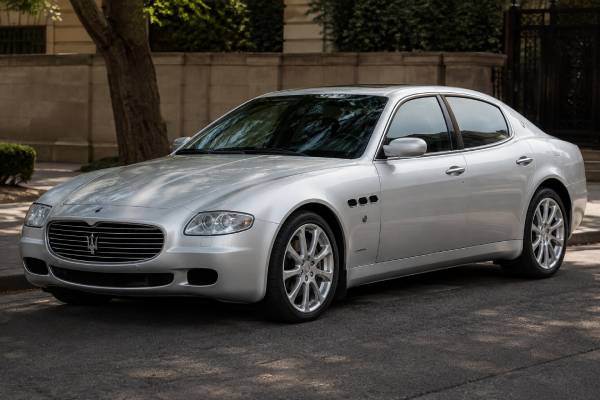
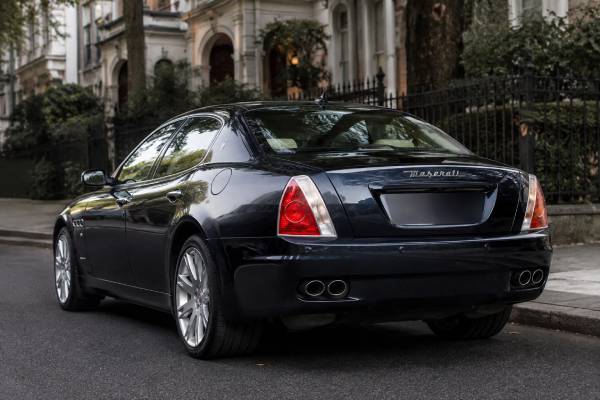
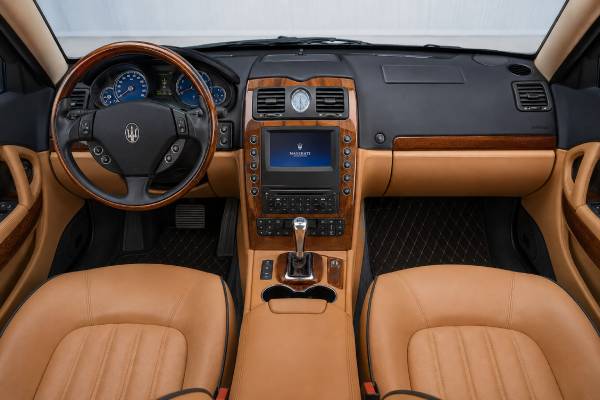
The 2006–2008 Maserati Quattroporte Automatica Sport GT combines the Sport GT’s sharper chassis and visual identity with the smooth six-speed ZF automatic introduced for the pre-facelift M139. Its wet-sump F136UC V8 produces 400 hp, the transmission sits behind the engine, and a propeller shaft drives a separate rear limited-slip differential. Factory sporting equipment includes steering-column paddles, 20-inch seven-spoke wheels, low-profile tires, drilled Brembo discs, braided brake lines, dark mesh, red Trident details, aluminum pedals, a sports steering wheel, and carbon-fiber trim.
The model is easy to misidentify because the Sport GT name first appeared on the dry-sump DuoSelect car. This version retains much of the appearance and chassis intent but uses a fundamentally different driveline. It is smoother in traffic, easier to park, and less dependent on clutch-wear management, while its ZF shifts lack the dramatic clutch-open character of DuoSelect. Buyers must verify the F136UC and automatic layout rather than relying on paddles or badges. They should also budget for fluid service, cam-variator noise, cooling, suspension wear, drilled brakes, bent wheels, old tires, and carbon-trim deterioration.
Table of Contents
- The Everyday Sport GT
- F136UC, ZF, and Sport Chassis Specifications
- Factory Sport GT Details and Identification
- Engineering a Sharper Automatic Quattroporte
- Paddle-Shifted Road Manners and Performance
- Automatic Sport GT Maintenance Priorities
- Buying the Correct Sport GT Automatica
The Everyday Sport GT
The Automatica Sport GT is the version for drivers who want the visual and chassis focus of the Sport GT without the low-speed compromises of DuoSelect. Its character is quick and controlled rather than harsh or theatrical.
Maserati introduced the Sport GT trim in 2005 on the original dry-sump, rear-transaxle Quattroporte. That car used revised DuoSelect software to shorten shifts and firmer Skyhook mapping to control body movement. When the ZF automatic arrived, Maserati offered the same broad model hierarchy with standard, Executive GT, and Sport GT versions.
The automatic car required extensive redesign. The wet-sump F136UC engine and ZF 6HP26 formed a conventional powertrain unit at the front, while a two-piece shaft led to the rear differential. Weight distribution changed from the DuoSelect’s 47:53 to approximately 49:51, still slightly rear-biased.
Sport GT trim gave the new drivetrain an enthusiast-facing identity. Paddles behind the steering wheel were standard on this version, allowing manual gear choice without reaching for the console. Twenty-inch wheels, drilled discs, braided lines, sport trim, and carbon emphasized the driver’s role.
This version existed only briefly before the Sport GT S replaced it as the most focused automatic Quattroporte. The pre-facelift Sport GT S gained lower fixed-rate suspension, wider rear tires, and larger dual-cast front brakes. The ordinary Sport GT should not be misrepresented as the S, and the 4.2-liter S should not be confused with the later 4.7-liter facelift car.
The Automatica Sport GT also differs from the base automatic in feel. Wheel and tire choices transmit more surface texture, the sport settings reduce body movement, and the cabin’s carbon and aluminum create a more purposeful atmosphere. Engine power remains 400 hp, so its advantages come from response and presentation rather than a large straight-line gain.
Used prices can make the model appear inexpensive, but its original role was high-end. The 20-inch tires and brakes are costly, replacement carbon is scarce, and deferred engine or transmission work quickly exceeds the price difference between a poor and excellent example.
A healthy car should feel cohesive. It should not crash over bumps, wander on the motorway, hesitate into gear, flare between shifts, rattle badly at startup, overheat in traffic, or show suspension warnings. Sport specification is no excuse for neglect.
F136UC, ZF, and Sport Chassis Specifications
The core specification is a 4,244 cc naturally aspirated F136UC V8, six-speed ZF automatic, rear-wheel drive, and a 49:51 weight split. Sport GT hardware adds 20-inch wheels, drilled brakes, and driver-focused equipment without changing the 400 hp rating.
| Item | Specification |
|---|---|
| Platform | M139 |
| Engine code | F136UC |
| Engine | 90-degree all-aluminum V8, DOHC, 32 valves |
| Displacement | 4,244 cc |
| Induction | Naturally aspirated with electronic multipoint injection |
| Lubrication | Wet sump |
| Maximum power | 400 hp at 7,000 rpm |
| Maximum torque | Approximately 460 Nm at about 4,250 rpm |
| Transmission | ZF 6HP26 six-speed torque-converter automatic |
| Manual control | Console selector and steering-column paddles |
| Drive | Rear-wheel drive with limited-slip differential |
| Weight distribution | Approximately 49 percent front, 51 percent rear |
| Construction | Steel monocoque with revised front and rear subframes |
| Suspension | Unequal-length double wishbones front and rear |
| Damping | Skyhook adaptive damping with sport-oriented calibration |
| Brakes | Cross-drilled ventilated Brembo discs with braided lines |
| Steering | Hydraulic power-assisted rack and pinion |
| Wheels | 20-inch seven-spoke Sport GT alloys |
| Wheelbase | 3,064 mm |
| Length | 5,052 mm |
| Width | 1,895 mm |
| Kerb weight | Approximately 1,970 kg, depending on market equipment |
| Fuel capacity | Approximately 90 liters |
| 0–100 km/h | Approximately 5.6 seconds |
| Top speed | Approximately 270–275 km/h |
The F136UC uses an aluminum block and heads, a cross-plane crankshaft, four camshafts, 32 valves, chain-driven timing, and variable intake-cam phasing. Wet-sump lubrication distinguishes it from the F136S dry-sump engine used with DuoSelect.
The ZF 6HP26 contains a torque converter with lock-up, planetary gearsets, and electronically controlled clutch packs. It provides smooth launch and can change under load without opening a single dry clutch. The paddles request ratios, but the control system still protects the transmission and may override an unsuitable command.
Sport GT brake specifications should be confirmed physically because markets and replacement history can create variation. Drilled 330 mm-class discs and four-piston calipers are commonly associated with the version. Later Sport GT S dual-cast front discs and six-piston calipers are not automatically original on a Sport GT.
The 20-inch wheels improve response but reduce tire sidewall. This increases sensitivity to potholes, pressure, construction, and alignment. A bent inner barrel can create vibration without obvious outer damage.
Factory Sport GT Details and Identification
A correct Automatica Sport GT should combine the wet-sump ZF driveline with the complete factory sport package. Added wheels, paddles, or badges do not prove authenticity.
The most visible identifier is the seven-spoke 20-inch wheel design. Check casting marks, widths, offsets, finish, and matching set. Tires should be the correct staggered sizes and load ratings, with comparable brand, model, and age across each axle.
Exterior cues include dark mesh in the main grille and side vents, red accents on Trident emblems, and model-specific trim. Finish details can vary by region, so build records are more reliable than expecting every car to match one press photograph.
Inside, carbon-fiber trim replaces traditional wood in prominent areas. The weave should remain consistent and the clearcoat should be intact. Aluminum pedals and a sports steering wheel reinforce the theme. The steering-column paddles are important because they were a standard engagement feature on the automatic Sport GT.
Cross-drilled discs and braided brake lines belong to the dynamic package. Inspect the actual parts rather than assuming any drilled rotor is factory. Cheap replacement discs may use different hole patterns, dimensions, metallurgy, or balance.
Documents and markings to collect
Useful evidence includes:
- Factory build sheet and option codes.
- Original invoice or window sticker naming Sport GT Automatic.
- Engine and transmission identification.
- Wheel casting and brake-part information.
- Original carbon, steering wheel, pedals, grilles, and badges.
- Suspension and software service history.
- Books, keys, tools, and market-specific documentation.
A car may have received genuine Maserati upgrades later. Those can improve performance but should be disclosed. A Sport GT S brake conversion, fixed-damper kit, or later wheel set changes originality and may affect parts compatibility.
Carbon trim suffers heat and ultraviolet damage. Clouding, cracks, delamination, lifting edges, and mismatched replacement panels are common. A high-quality refinish can preserve an original set, but hydro-dip or vinyl wrap is not equivalent.
Dark mesh can corrode or bend, while red badge details can fade. Restored components should match the original finish rather than becoming excessively glossy or bright.
Engineering a Sharper Automatic Quattroporte
The Sport GT’s sharper behavior comes from how the tires, dampers, brakes, steering, and transmission controls work together. None of the individual changes makes sense if worn chassis parts or poor tires prevent the car from using them.
The automatic gearbox and engine sit behind the front axle as far as packaging allows. Though the front carries more weight than the DuoSelect car, the 49:51 balance remains favorable. A separate limited-slip differential helps deliver power through the rear tires.
Unequal-length wishbones control camber and maintain tire contact through suspension travel. Skyhook varies damper force according to body motion and driver selection. The Sport GT calibration reduces roll and pitch, but it remains adaptive rather than the fixed Bilstein-style arrangement of the later Sport GT S.
Low-profile tires sharpen initial turn-in by reducing sidewall movement. They also transfer more impact into wheels, bearings, arms, and the cabin. Correct alignment is critical; excessive toe or worn ball joints can destroy expensive tires quickly.
Hydraulic steering supplies natural information about front-tire load. The wheel should move smoothly without pump groan, dead spots, looseness, or severe kickback. Rack leaks, old fluid, hose seepage, worn tie rods, and incorrect geometry can spoil the system.
Cross-drilled discs provide a direct visual link to performance and can handle repeated fast-road braking when the pads and fluid are right. Holes also concentrate stress. Small surface marks require monitoring, while cracks joining holes or reaching edges demand replacement.
The Pininfarina body needed no large aero additions. Its low nose, long shoulder, short rear deck, and discreet dark details preserve elegance. Underneath, cooling ducts and undertrays guide air through heat exchangers. Missing panels can affect both temperature and high-speed stability.
The wet-sump engine reduces external oil plumbing compared with the dry-sump car. It does not remove oil-pressure, leak, timing, or temperature requirements. Sporty use increases heat, so correct oil, full warm-up, and cooling health matter.
Paddle-Shifted Road Manners and Performance
The automatic Sport GT feels less dramatic than a DuoSelect Sport GT during shifts, but it is faster to use smoothly and far easier in traffic. Its strength is consistent pace rather than gearbox theater.
From rest, the torque converter provides progressive movement. Parking and reversing require no special clutch technique. Under light throttle the ZF shifts early and quietly; heavier throttle prompts quick downshifts and lets the V8 reach its upper range.
The fixed steering-column paddles allow manual ratio selection. They remain easy to find on sweeping roads because they do not turn with the wheel. In tight bends, the console lever may be easier. The gearbox should respond promptly without banging, flaring, or ignoring repeated reasonable commands.
The F136UC builds power linearly. It produces more useful low- and mid-range response than its high 7,000 rpm power peak suggests, then changes character as the revs rise. Its cross-plane exhaust note is deeper than a flat-plane Ferrari V8 and suits the sedan.
The Sport GT turns in accurately for a car of its size. The front feels slightly more settled and less delicate than the rear-transaxle car, while the automatic’s uninterrupted delivery makes corner exits smooth. A limited-slip differential supports traction, but stability control should remain active on public roads.
The 20-inch setup communicates road texture and gives crisp steering. On rough surfaces it can feel busy. Harshness should still be controlled; crashing, repeated bounce, or lateral movement indicates wheel, tire, damper, mount, or arm problems.
Brake pedal feel should be firm and consistent. A vibration under light braking can come from deposits or runout, while vibration only at speed may be wheel-related. Test the brakes after warming and compare wheel temperatures for a dragging caliper.
On the motorway, the ZF selects a tall ratio and the chassis tracks securely. A wandering car needs tire, alignment, suspension, or steering inspection. Wind roar, door-glass noise, bearing hum, or driveline vibration is not simply a sport trait.
The model remains heavy. Repeated hard acceleration and braking consume fuel, tires, and pads. It is best on fast public roads and long journeys where the automatic can exploit the engine without the compromises of track use.
The automatic Sport GT should be judged as a coordinated chassis package. Its drilled discs, braided lines, wheel-and-tire combination, damping calibration, transmission software, and paddle controls were intended to work together. Replacing one element with the cheapest available substitute may keep the car mobile while dulling the factory response. Check rotor dimensions and drilling pattern, caliper condition, hose provenance, wheel offsets, tire sizes, and damper part numbers against the VIN and build data.
On a road test, compare gentle Drive operation with firmer paddle use. The gearbox should leave smoothly, downshift without a long pause, and hold converter lock-up without shudder. The chassis should take a set cleanly rather than bobbing after a steering input. Repeated brake vibration, a steering wheel that kicks over bumps, or a rear end that changes direction under throttle can indicate more than tire wear; inspect control arms, tie rods, bearings, differential mounts, and alignment together.
Owners should resist treating “Sport GT” as permission for indiscriminate modification. Oversized wheels, very stiff coilovers, spacers, aggressive exhausts, and generic transmission tuning can increase noise and reduce the balance that distinguished the factory car. Reversible changes with documented original parts are easier to evaluate and generally protect collector appeal.
Automatic Sport GT Maintenance Priorities
Prioritize the ZF transmission, F136UC cold-start behavior, 20-inch wheels, drilled brakes, Skyhook system, and steering. Those areas determine whether the car feels like a Sport GT or an exhausted luxury sedan.
ZF and driveline
Inspect the transmission pan and filter assembly, electrical connector sleeve, cooler lines, seals, and mounts. Fluid service requires the correct specification, temperature, and level method. Avoid indiscriminate high-pressure flushing on a troubled unit.
Delayed Drive or Reverse, harsh downshifts, converter shudder, rpm flare, or limp mode can involve fluid, adaptation, valve body, solenoids, torque converter, wiring, mounts, or internal wear. Inspect the propshaft, center support, differential, and rear mounts for vibration and thump.
Engine and cooling
Listen from a true cold start for cam-variator rattle, chain-related noise, accessories, exhaust leaks, and knock. Check cam-cover and timing-area leaks, oil pan, filter housing, cooler, engine mounts, belts, pulleys, coils, plugs, and catalysts.
Verify hot oil pressure and stable coolant temperature. Clean the radiator-condenser pack and test fans, relays, thermostat, expansion tank, cap, hoses, coolant, and air conditioning.
Sport chassis and cabin
Inspect all wheels inside and out, measure runout, and date the tires. Check drilled discs around every hole, pad thickness, caliper operation, braided lines, fluid, parking brake, ABS, and stability control.
Examine Skyhook dampers, sensors, wiring, wishbones, ball joints, bushings, links, tie rods, wheel bearings, springs, subframes, and steering leaks. Confirm applicable recall work by VIN.
Test battery, alternator, grounds, windows, locks, seats, climate, parking sensors, infotainment, paddles, suspension modes, and all warning lamps. Inspect carbon, leather, headliner, switches, and aftermarket wiring.
Keep a record of chassis measurements after repairs. Ride height, alignment, wheel runout, tire dates, disc thickness, and damper condition provide a useful baseline for future diagnosis. They also help distinguish gradual wear from a sudden change after a pothole impact, tire replacement, or suspension job.
Buying the Correct Sport GT Automatica
The best purchase is an authenticated automatic Sport GT whose original hardware remains intact and whose mechanical condition supports its appearance. Do not let 20-inch wheels distract from engine, gearbox, or chassis evidence.
Request the VIN, build sheet, production date, window sticker, engine and transmission details, wheel markings, brake photographs, carbon panels, grilles, badges, paddles, and full service history. Confirm that it is not a DuoSelect Sport GT or a base automatic with added trim.
Commission a specialist to perform:
- Cold-start observation and full control-module scan.
- F136UC and ZF identification.
- Transmission leak, adaptation, converter, and hot-shift checks.
- Oil-pressure, timing-noise, cooling, mount, and exhaust inspection.
- Wheel runout, tire age, and four-wheel alignment assessment.
- Brake measurement and crack inspection around drilled holes.
- Skyhook, wishbone, tie-rod, bearing, rack, and subframe checks.
- Authentication of carbon, pedals, paddles, grilles, wheels, and badges.
- Body structure, paint depth, underside, recall, and corrosion review.
- Function testing of every cabin and safety system.
Walk away from transmission slip, severe startup rattle, overheating, low oil pressure, cracked or welded wheels without disclosure, unsafe disc cracks, mixed old tires, failed adaptive suspension, structural damage, or a large collection of warning lights.
A modified example can be worthwhile when the work is engineered and documented. Sport GT S brakes, fixed dampers, or a modern head unit may suit an owner, but price and parts planning must reflect the departure from factory specification.
After purchase, establish a baseline before adding power or louder exhausts. Service the fluids, correct cooling, renew unsafe tires and brakes, repair steering and suspension play, align the car, and preserve original components.
The Automatica Sport GT is not the most extreme M139, but it may be the easiest sporting version to enjoy regularly. It keeps the Pininfarina shape and naturally aspirated V8, adds paddles and sharper hardware, and avoids a consumable automated-manual clutch. Its value lies in balance—and a buyer should demand that the car still possesses it.
References
- Quattroporte V Automatica – Quattroporte models | Maserati 2026 (Manufacturer Heritage Specifications)
- Maserati TechInfo 2026 (Manufacturer Technical Information)
- Maserati Quattroporte Sport GT 2007 Review | CarsGuide 2007 (Period Driving Review)
- Maserati Quattroporte: PH Buying Guide – PistonHeads UK 2014 (Model Buying Guide)
Disclaimer
This article is for informational purposes only and does not replace factory workshop information, professional diagnosis, authentication, valuation, or a pre-purchase inspection. Specifications, brakes, software, recalls, options, and service procedures vary by VIN, market, build date, and previous modification. Use official records and qualified Maserati and ZF specialists.
Please share this article on Facebook, X/Twitter, or your preferred enthusiast community if it was useful. Sharing supports the creation of more detailed specialist-car guides.