
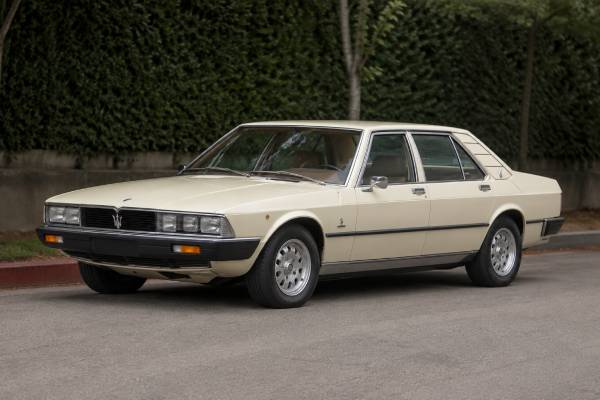
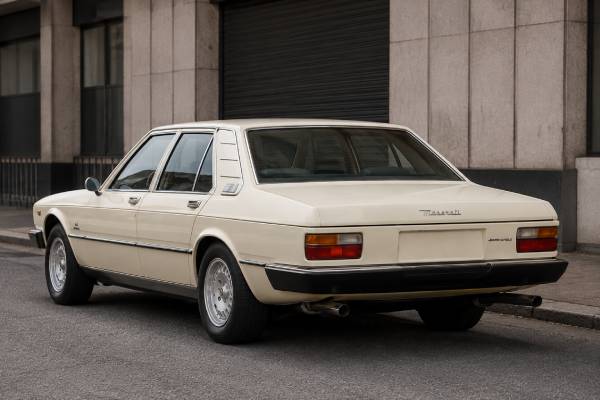
The Maserati Quattroporte II is the most unconventional Quattroporte ever built. Developed while Citroën controlled Maserati, the AM123 replaced the first generation’s front-engine, rear-drive V8 formula with a 3.0-liter V6, front-wheel drive, hydropneumatic suspension, high-pressure hydraulic controls, and a stretched platform closely related to the Citroën SM. Marcello Gandini designed the body for Bertone, giving the car a restrained, angular shape that concealed some of the most unusual engineering found in a 1970s luxury saloon.
It was also a commercial failure shaped by circumstances beyond the car itself. The oil crisis, Citroën’s financial collapse, delayed approval, and Maserati’s 1975 change of ownership stopped the project before normal production began. Maserati lists only 13 examples, including prototypes and production cars, making the Quattroporte II far rarer than almost any other four-door car from the marque.
That rarity changes the buying equation. An AM123 is less a conventional used classic than a museum-grade technical artifact. Condition, completeness, hydraulic expertise, and documented identity matter more than ordinary market comparisons. Owners must be prepared to maintain both Maserati mechanical components and Citroën hydraulic systems with specialists who understand how the two were integrated.
Table of Contents
- Maserati’s Most Radical Quattroporte
- V6, Hydraulics, and AM123 Specifications
- Thirteen Cars, Prototypes, and Production History
- Gandini Design on a Citroën Foundation
- How the Quattroporte II Behaves on Road
- Maintaining the V6 and Hydraulic Systems
- Buying and Preserving an AM123
Maserati’s Most Radical Quattroporte
The Quattroporte II matters because it broke nearly every rule established by the original model. It was the only front-wheel-drive Quattroporte, the only one built around Citroën hydropneumatic technology, and one of the rarest production-intended Maseratis of the postwar era.
Citroën acquired control of Maserati in 1968 and sought to combine French technical innovation with Italian engines and prestige. That partnership had already produced the Maserati-powered Citroën SM and influenced the Bora, Merak, and Khamsin. For a new luxury saloon, Maserati used a lengthened SM-derived platform and the 2,965 cc version of the compact 90-degree V6.
The AM123 appeared publicly in 1974, with major show appearances in Paris and Turin. It was meant to succeed the V8 AM107 Quattroporte and compete with large European executive cars. Instead of repeating the first car’s long-hood grand-touring arrangement, the new model placed the engine longitudinally behind the front axle line with the transmission ahead of it, driving the front wheels.
This layout produced a spacious cabin and allowed the use of Citroën’s self-leveling suspension and hydraulic steering technology. It also changed the car’s personality. The Quattroporte II emphasized ride quality, directional stability, and technical sophistication rather than the muscular, rear-driven feel that Maserati buyers expected.
The timing was disastrous. The 1973 oil crisis reduced demand for large, expensive cars. Citroën entered severe financial difficulty, and Maserati lacked the funds and stability to complete normal European homologation. Alejandro de Tomaso took control of Maserati in 1975 and favored more conventional rear-wheel-drive products. A proposed V8 program was abandoned, and the AM123 was built only in tiny numbers for markets where approval barriers could be managed.
Maserati’s heritage information gives a total of 13 cars. Some accounts distinguish one or more prototypes from 12 customer cars; others describe the entire run as prototypes or special-order production. The uncertainty reflects the project’s interrupted development and the different stages at which individual chassis were completed.
The Quattroporte II was criticized for lacking the performance of its predecessor, yet that judgment can obscure its real strengths. It offered remarkable ride comfort, advanced steering, six-lamp frontal lighting with directional inner lamps, and a unique fusion of Italian design with French systems engineering. Seen today, it is less a failed replacement than an alternate path Maserati explored and then abandoned.
V6, Hydraulics, and AM123 Specifications
The AM123 combines a high-revving Maserati V6 with front-wheel drive and a central high-pressure hydraulic system. Its 210 hp output was respectable, but the car’s size and approximately 1,600–1,700 kg weight meant that refinement and road holding were more impressive than outright acceleration.
| Item | Specification |
|---|---|
| Model code | Tipo AM123 |
| Engine code | Tipo AM114.56.30 |
| Engine | 90-degree V6, aluminum construction, double overhead camshafts per bank |
| Displacement | 2,965 cc |
| Fuel system | Three twin-choke Weber carburetors |
| Maximum output | 210 hp at 6,500 rpm |
| Transmission | Five-speed manual; an automatic configuration is reported for at least one specification |
| Drivetrain | Longitudinal front-mid engine, front-wheel drive |
| Chassis | Steel platform chassis derived from the Citroën SM concept |
| Suspension | Independent hydropneumatic, self-leveling |
| Steering | Hydraulically powered, self-centering DIRAVI-type system |
| Brakes | Four-wheel discs operated by the high-pressure hydraulic system |
| Wheelbase | Approximately 3,070 mm |
| Length | Approximately 5,130 mm |
| Width | Approximately 1,870 mm |
| Height | Approximately 1,370 mm |
| Dry weight | Approximately 1,700 kg |
| Claimed top speed | Approximately 200 km/h |
The V6 belongs to the engine family developed by Giulio Alfieri for the Citroën SM and later used in the Maserati Merak. Its unusual 90-degree bank angle allowed a compact, low installation but required careful firing and induction design. Four overhead camshafts, chain drive, aluminum castings, and three carburetors make it sophisticated and sensitive to setup.
The five-speed transaxle sits ahead of the engine. That arrangement concentrates the powertrain within the front half of the car and sends drive through unequal-length half-shafts. Front-wheel drive gives excellent traction in ordinary conditions, but the steering and suspension geometry must be correct to prevent torque effects, wandering, or tire wear.
Hydropneumatic suspension replaces conventional steel springs with gas-filled spheres and hydraulic fluid. The system automatically maintains ride height as passengers or luggage are added. It also permits a soft primary ride while controlling body movement through hydraulic damping. Ride height is not merely a comfort feature; incorrect height changes suspension geometry, driveshaft angles, and braking behavior.
The steering is derived from Citroën’s DIRAVI concept. Hydraulic pressure provides assistance and an artificial centering force that increases with speed. The wheel can return rapidly toward center when released. Drivers unfamiliar with the system may initially overcorrect, but a properly adjusted car feels exceptionally stable in a straight line.
The brakes use the same high-pressure hydraulic network rather than a normal vacuum booster. Pedal travel is very short, and braking force is controlled mainly by pressure. The system can feel abrupt until the driver adapts. Stored hydraulic pressure provides limited braking reserve if the engine or pump stops, but warning lights, accumulator condition, and system pressure must be correct.
Thirteen Cars, Prototypes, and Production History
Every Quattroporte II must be treated as an individual historical object because production was too small and irregular for normal model-year assumptions. Chassis history, completion stage, market destination, and later restoration may differ substantially from one car to another.
Maserati identifies 1974–1978 as the production period and 13 as the number produced. The first public cars were development or show examples. Customer cars were completed later, often to order, and reportedly went mainly to Spain and Middle Eastern destinations where the lack of full European type approval created fewer obstacles.
The small run explains why published specifications conflict. Some sources quote 190 hp, others 200 or 210 hp. Weight figures range around 1,600–1,700 kg. Transmission descriptions differ, and some cars may have been completed with equipment not shared by the others. The factory heritage figure of 210 hp at 6,500 rpm is the best standard reference for the assignment, but inspection should document the actual car.
A buyer should establish the following:
- The exact AM123 chassis number and its place in the known sequence.
- Whether the car was a show prototype, development chassis, or customer-delivered example.
- Its original engine and transmission specification.
- Original exterior color, interior trim, market, and delivery date.
- Period hydraulic configuration and any later Citroën-component substitutions.
- Restoration history, including body reconstruction and parts sourced from donor cars.
- Whether unique instruments, wheels, lights, glass, badges, and interior fittings remain present.
The prototype status of some cars can be valuable rather than negative, provided it is accurately described. A motor-show car may carry special trim or engineering details not found on later examples. Conversely, a partially completed chassis finished decades later should not be represented as an untouched factory production car.
Documentation may include Maserati archive records, old registration books, customs papers, period photographs, auction catalogs, correspondence, and specialist reports. Because the population is so small, known-owner networks and marque historians can often trace individual chassis more effectively than generic vehicle-history databases.
Authenticity is complicated by the close relationship with the Citroën SM. Many mechanical and hydraulic components are shared or related, and using correct service parts is sensible. However, visible substitutions, modified pipework, nonstandard wheels, altered lighting, or replacement instruments should be documented. A functioning car with well-engineered updates can be more usable, but originality and preservation value must be assessed separately.
Gandini Design on a Citroën Foundation
The AM123’s exterior is deliberately restrained. Marcello Gandini avoided the dramatic wedge forms associated with some of his sports cars and created a formal saloon with a low beltline, broad glass area, and clean, nearly horizontal surfaces.
Bertone’s body is longer and more spacious than the first Quattroporte, but it does not advertise its technical complexity. The front carries six lamps behind a structured fascia: four fixed units and two directional lights linked to steering movement. This arrangement echoes the Citroën SM while remaining visually distinct through the Maserati grille and more upright saloon proportions.
The long 3,070 mm wheelbase provides generous passenger space. The engine and transmission occupy the front, yet the compact V6 and platform layout allow a relatively open cabin. Large windows and slim pillars improve visibility. The rear compartment reflects the model’s intended executive role, with broad seating, quality materials, and a calm ride environment.
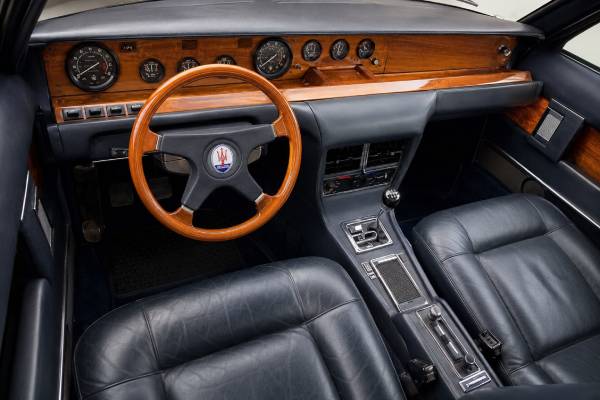
The cabin combines wood, leather, square-edged 1970s instruments, and Citroën-influenced controls. Some cars reportedly used unusual electronic or digital displays during development, while others received more conventional instrumentation. Because individual variation is possible, restorers should rely on chassis-specific photographs rather than copying another AM123.
The underlying steel platform is a major departure from the first Quattroporte’s structure. Hydraulic pipes run through and beneath the car, connecting the engine-driven pump, pressure regulator, accumulators, suspension units, steering, and brakes. Their routing must protect them from heat, corrosion, vibration, and road damage.
Engineering priorities shaped the body:
- A low engine installation supports a relatively low hood.
- Front-wheel drive eliminates a conventional rear differential and propeller shaft.
- Self-leveling suspension keeps the body at a consistent attitude under load.
- Hydraulic steering permits a highly assisted system without a large steering wheel.
- Directional lamps improve night visibility through bends.
- The long wheelbase favors ride comfort and rear-seat space over agility.
The AM123 is visually subtle enough that casual observers may not recognize its rarity. That understatement is part of its appeal. It looks like a thoughtful executive car, yet almost every major system underneath follows a path Maserati never used again.
How the Quattroporte II Behaves on Road
The Quattroporte II drives more like a highly developed Citroën grand tourer than a traditional Maserati saloon. Its strongest qualities are ride comfort, straight-line stability, and low-effort control; its limitations are modest low-speed torque, substantial mass, and unfamiliar hydraulic responses.
The V6 needs revs. It should start cleanly, maintain oil pressure, and pull without carburetor hesitation once warm. Below the middle of the rev range, the engine can feel restrained in a car of this size. Above that point it becomes smoother and more energetic, with the mechanical induction sound expected from a four-cam Maserati V6.
The manual gearbox uses a long, unusual powertrain layout. Shift quality depends on linkage adjustment, clutch hydraulics, mounts, and internal synchros. A good car should not jump out of gear, grind during ordinary changes, or produce loud bearing noise on overrun.
The suspension provides the defining experience. When spheres, ride-height correctors, pressure regulator, and dampers are healthy, the body floats over long undulations while remaining level under load. A hard, choppy ride usually indicates depleted spheres or incorrect pressures, not inherently poor suspension design. Continuous rising and falling, delayed leveling, or rapid pressure cycling indicates hydraulic problems.
DIRAVI steering feels very light near center and returns toward straight ahead with unusual force. At speed, the system adds centering and isolates road kickback. Drivers should keep both hands relaxed and avoid releasing the wheel abruptly. Excessive looseness, pulsing, uneven assistance, or failure to center correctly needs expert adjustment.
The high-pressure brakes have little conventional pedal travel. A small input can produce strong deceleration, and the driver meters pressure rather than moving the pedal through a long arc. The system should respond consistently without warning-light activation, pump cycling during every application, or delayed pressure build after startup.
Front-wheel drive gives secure traction and predictable understeer when pushed. The car is not a sharp mountain-road machine, and aggressive throttle in a tight bend can load the front tires heavily. Smooth steering and early speed adjustment suit it better. On a fast, flowing road, the long wheelbase and stable steering make the car composed.
A proper road test must last long enough to warm the engine and exercise the hydraulic system repeatedly. Check ride height after loading passengers, steering at parking and motorway speeds, braking after several applications, cooling in traffic, and fluid leaks after shutdown.
Maintaining the V6 and Hydraulic Systems
The AM123 is reliable only when its Maserati V6 and Citroën-derived hydraulics are serviced as one integrated system. General classic-car knowledge is not enough; the workshop must understand correct hydraulic fluid, pressure testing, sphere charging, pipe materials, steering adjustment, and the V6’s timing and cooling requirements.
Hydraulic system priorities
Identify the exact fluid specification used by the car and never mix incompatible fluids. Inspect the reservoir, filters, pump, regulator, accumulator spheres, suspension spheres, height correctors, steering components, brake valve, and every pipe and return hose. Old rubber returns can leak heavily even when high-pressure lines appear sound.
Warning lights should extinguish promptly after startup. Frequent regulator clicking suggests a weak accumulator or internal leak. A car that sinks quickly after shutdown is not necessarily unsafe, but rapid pressure loss can indicate tired components. Hard ride points to flat spheres, while uneven height may come from sticky correctors or bent linkages.
Corroded high-pressure pipes are a safety issue. Replacement lines must use correct material, flare type, routing, and supports. Improvised plumbing can fail without warning.
V6, fuel, and cooling
The 2,965 cc engine needs correct timing-chain tension, valve clearances, ignition advance, carburetor synchronization, and cooling-system condition. Listen for chain noise and inspect for coolant contamination, oil leaks, smoke, and low hot oil pressure. The compact engine bay can trap heat, so radiator cleanliness, fan performance, thermostat operation, and hose condition matter.
Three Weber carburetors require balanced airflow and secure fuel connections. Ethanol-resistant hoses and clean filters are essential. Fuel odor, staining, or damp unions must be corrected before driving.
Body and irreplaceable components
Rust inspection should cover floors, sills, suspension mounts, front structure, windshield surrounds, door bottoms, trunk floor, hydraulic-pipe channels, and points where moisture sits beneath trim. A structurally weak shell is difficult to repair because dimensions affect suspension and drivetrain alignment.
Unique glass, lamps, magnesium wheels, instruments, dashboard pieces, seats, switches, and exterior trim may be nearly impossible to replace. Preserve damaged originals and seek restoration before substitution. Parts common with the SM can help keep the car operational, but one-off AM123 pieces must be treated as archival material.
Buying and Preserving an AM123
Buying an AM123 begins with provenance, not price. With only 13 cars recognized by Maserati, the first question is exactly which chassis is being offered and how its current specification relates to its factory history.
Commission a written report from both a Maserati historian or specialist and a Citroën hydraulic expert. One person may not cover both sides of the car. The inspection should include:
- Chassis and engine-number verification against factory records.
- Identification of prototype, show-car, or customer-car status.
- Complete hydraulic pressure and leak-down testing.
- Suspension-sphere, accumulator, height-corrector, and steering evaluation.
- Brake pressure, warning system, pipe, and return-hose inspection.
- Engine compression, oil pressure, cooling, timing, and carburetor checks.
- Structural measurement and corrosion inspection on a lift.
- Inventory of every unique lamp, wheel, instrument, switch, trim piece, and glass panel.
- Review of restoration photographs and donor-component records.
- A long road test after full warm-up.
Do not assume a non-running car is a simple recommissioning project. Stored hydraulic systems can need spheres, seals, pipes, pumps, correctors, and steering work at once. A stationary engine may have chain, corrosion, carburetor, liner, or cooling damage. Missing one-off parts can delay a restoration indefinitely.
The best ownership strategy emphasizes preservation and controlled use. Establish baseline fluids, filters, pressures, valve clearances, ignition, and cooling before touring. Exercise the suspension, steering, and brakes regularly. Store the car in a dry, stable environment and inspect for hydraulic drips after every drive.
Upgrades should be reversible and documented. Modern hose materials, improved electrical protection, discreet cooling-fan relays, and safer tires can support use without erasing history. Cutting the body, replacing unique instruments, or redesigning the hydraulic system may harm both significance and value.
Market price is difficult to generalize because sales are rare and individual cars differ greatly. A prototype with exceptional history, a complete original customer car, and an incomplete project are not comparable. Restoration cost can exceed the value suggested by ordinary Quattroporte guides.
The right buyer accepts that the Quattroporte II is not the fastest, easiest, or most conventional Maserati saloon. Its value lies in scarcity, design, and technical audacity. Preserved correctly, it documents a brief moment when Maserati and Citroën attempted to reinvent the luxury performance car through hydraulics and front-wheel drive.
References
- Quattroporte II – Classic Cars | Maserati 2026 (Manufacturer Heritage Specifications)
- Maserati Quattroporte Anniversary: The Luxury Italian Sedan Turns 60 | Maserati 2023 (Manufacturer History)
- Cars That Time Forgot: Maserati Quattroporte II | Hagerty UK 2022 (Historical Overview)
Disclaimer
This article is for informational purposes only and is not a substitute for professional diagnosis, repair, hydraulic-system service, or restoration advice. Specifications, torque values, fluid requirements, intervals, and procedures vary by chassis, market, development stage, and equipment. Verify all work against official service documentation and consult qualified Maserati and Citroën hydraulic specialists.
Please share this article on Facebook, X/Twitter, or a relevant collector community if it helped you. Sharing supports the production of more detailed automotive guides.