
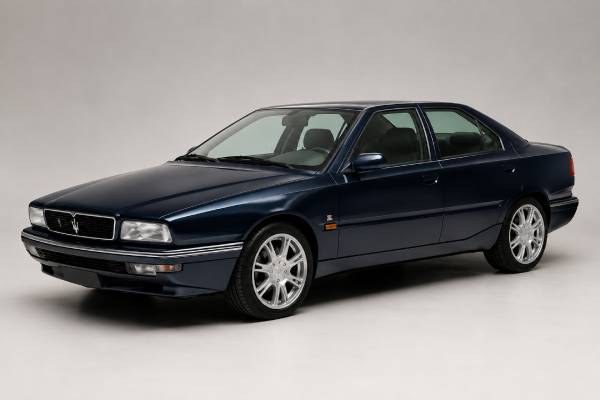
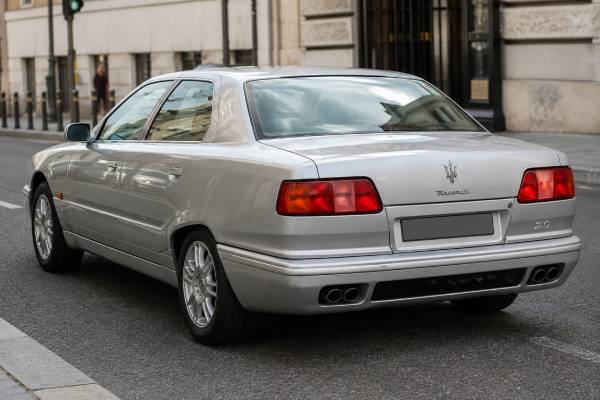
The Maserati Quattroporte seicilindri 2.0 is the most highly stressed and distinctly Italian-market version of the fourth-generation AM337. Its 1,996 cc AM573 V6 used twin turbochargers, four valves per cylinder, electronic fuel injection, and intercooling to produce 287 hp—an exceptional specific output for a luxury saloon launched in 1994. A six-speed manual gearbox, rear-wheel drive, and a limited-slip differential completed a compact package capable of approximately 260 km/h.
The small displacement was shaped by Italy’s tax system, which historically penalized engines above two liters. Maserati answered not by detuning the car, but by using boost and revs to deliver performance comparable with much larger engines. The result is fast and engaging, yet less forgiving of poor maintenance than a low-output saloon. Timing-belt age, turbo condition, oil quality, cooling efficiency, fuel delivery, and correct boost control all matter.
Only 587 examples were built from 1994 to 1998. The 2.0 disappeared when Ferrari-led production improvements created the Evoluzione range, making it a short-lived snapshot of pre-Evoluzione Maserati engineering. Buyers should seek documented specialist care and resist cars that have been modified for more boost without supporting engine, fuel, and cooling work.
Table of Contents
- Italy’s Two-Liter Performance Saloon
- AM573 Twin-Turbo V6 and Key Specifications
- Production, Equipment, and Original Configuration
- Gandini Packaging and Biturbo-Era Engineering
- Driving a 287 hp Two-Liter Quattroporte
- Timing Belts, Turbos, and Ownership Risks
- Buying the Right AM573 Quattroporte
Italy’s Two-Liter Performance Saloon
The Quattroporte 2.0 exists because Maserati turned a tax constraint into an engineering challenge. Rather than fit a modest engine below Italy’s two-liter threshold, it created a 287 hp twin-turbo V6 that made the compact AM337 one of the fastest saloons of its period.
The fourth-generation Quattroporte debuted at the 1994 Turin Motor Show after Fiat acquired full control of Maserati. It replaced the large, formal AM330 with a much smaller car based on an extensively developed and lengthened version of Biturbo-era architecture. Marcello Gandini shaped the body, giving it a wedge profile, clipped overhangs, and his characteristic angled rear wheel openings.
The Italian-market 2.0 sat beside the export-oriented 2.8-liter V6. Both were twin-turbocharged, but the smaller engine used revs and boost to compensate for displacement. Its 287 hp at 6,500 rpm exceeded the nominal output of the 2.8 by a few horsepower, although the larger engine delivered more torque lower in the range.
Maserati called the model “seicilindri,” Italian for six cylinders. Badges on the front fenders identified the engine family, distinguishing it from the later ottocilindri V8. All 2.0 cars used a six-speed manual transmission; the automatic option offered on larger-engined versions was not part of the normal 2.0 specification.
The model was intended as a real luxury performance car, not a stripped tax special. It retained leather, wood, climate control, electric equipment, and rear seating. Its compact exterior dimensions made it unusually usable in European cities, while the 2,650 mm wheelbase provided acceptable passenger space.
Factory heritage figures list 587 cars from 1994 to 1998. Production ended when Ferrari, then controlling Maserati, introduced the heavily revised Evoluzione. The 2.0 was dropped rather than updated, partly because the new 3200 GT and a simplified Quattroporte range changed market priorities.
Collectors now value the 2.0 for its technical intensity and rarity, but it remains less widely understood than the 2.8 or V8. A sound example feels sharp and special. A neglected one can require engine, turbo, differential, suspension, electrical, and body work that exceeds its market price.
AM573 Twin-Turbo V6 and Key Specifications
The AM573 is a 1,996 cc, 90-degree V6 with two turbochargers, intercooling, electronic injection, and 24 valves. It produces 287 hp at 6,500 rpm and approximately 362 Nm at 4,250 rpm, sending power through a six-speed Getrag manual gearbox to the rear wheels.
| Item | Specification |
|---|---|
| Model code | Tipo AM337 |
| Engine code | AM573 |
| Engine | 90-degree V6, 24 valves, double overhead camshafts |
| Displacement | 1,996 cc |
| Induction | Twin turbochargers with intercooling |
| Fuel system | Electronic multipoint injection |
| Maximum output | 287 hp at 6,500 rpm |
| Maximum torque | Approximately 362 Nm at 4,250 rpm |
| Transmission | Six-speed Getrag manual |
| Drivetrain | Rear-wheel drive with limited-slip differential |
| Front suspension | MacPherson struts, coil springs, anti-roll bar |
| Rear suspension | Independent tubular trailing arms on a subframe |
| Brakes | Four-wheel ventilated discs with ABS |
| Wheelbase | 2,650 mm |
| Length | Approximately 4,550 mm |
| Width | Approximately 1,810 mm |
| Dry weight | Approximately 1,543 kg |
| 0–100 km/h | Approximately 5.9 seconds |
| Top speed | Approximately 260 km/h |
The compact V6 traces its layout to Maserati’s Biturbo family but represents a much more developed stage. Four-valve heads improve breathing, while two small turbochargers reduce response delay compared with one large unit. Intercoolers lower intake temperature before the compressed air reaches the cylinders.
The high specific output means the engine depends on correct control systems. Boost pressure, wastegate operation, intake sealing, fuel pressure, ignition timing, knock control, and coolant temperature all influence safety. A small vacuum leak or weak fuel pump can cause lean running under boost even when the car idles well.
Power delivery differs from a modern turbo engine. Below boost, the two-liter V6 can feel modest. As exhaust flow rises, torque builds strongly and the engine becomes urgent. The six-speed gearbox allows the driver to keep it in the effective range, but frequent shifting is part of the experience.
The limited-slip differential improves traction, especially when boost arrives during corner exit. It needs the correct lubricant and healthy mounts. Chatter, clunks, or one-wheel spin can indicate wear, incorrect oil, or internal problems.
The chassis uses MacPherson struts at the front and independent tubular trailing arms at the rear. The differential and rear suspension are carried by a dedicated tubular subframe. This arrangement is more sophisticated than the old Biturbo layout suggests and gives the compact saloon good balance when bushes, dampers, alignment, and tires are correct.
Production, Equipment, and Original Configuration
The 2.0 was built only in pre-Evoluzione form, so a genuine car should match the visual and mechanical details of the 1994–1998 AM337 rather than later Ferrari-directed changes. Correct badges, mirrors, wheels, interior clock, gearbox, and engine management all contribute to authenticity.
The car evolved through minor running changes. Early examples can differ in wheels, mirror details, electrical components, and trim from later cars. Eight-spoke wheels and revised aerodynamic mirrors appeared during the pre-Evoluzione period. The oval Maserati clock remained part of the original dashboard and was deleted on Evoluzione models.
Standard and optional equipment commonly included:
- Leather upholstery and wood dashboard trim.
- Automatic climate control.
- Electric windows, mirrors, seats, and central locking.
- Anti-lock brakes and a limited-slip differential.
- Six-speed manual transmission.
- Market-specific alarm, audio, and immobilizer systems.
- Different wheel and interior combinations by model year.
Because these cars were inexpensive for many years, modifications are common. Boost controllers, nonstandard chips, open air filters, blow-off valves, large exhausts, altered wastegates, lowered springs, and oversized wheels may have been installed without proper calibration. Such changes can improve performance only when matched by fuel, ignition, cooling, and monitoring upgrades.
Authenticity checks should include the AM337 chassis number, AM573 engine number, gearbox identity, turbocharger type, engine-management hardware, intake plumbing, intercoolers, exhaust manifolds, wheels, seats, instruments, badges, and paint codes. Factory information and original manuals help resolve detail differences.
A replacement engine is not automatically unacceptable. The AM573 may have been replaced after belt failure, overheating, or turbo damage. What matters is the correct engine type, rebuild quality, documentation, and current compression and oil pressure.
The 587-car production figure makes every surviving example uncommon, but condition creates the real hierarchy. A complete original car with ordinary cosmetic wear can be more valuable than a glossy example with an unknown engine map and mixed parts.
Gandini Packaging and Biturbo-Era Engineering
Gandini made the AM337 look compact, aggressive, and unmistakably Italian. The short body, low hood, steep windshield, crisp trunk, and slashed rear wheel arches give it tension without relying on large spoilers or decorative vents.
At about 4.55 meters long, it is the smallest Quattroporte generation. The proportions are closer to a compact executive saloon than a limousine, yet the upright cabin and long wheelbase provide four usable doors and a proper rear seat. The design trades the ceremonial presence of the AM330 for agility and discretion.
The steel monocoque is based on older architecture but extensively reinforced and reworked. The front engine is mounted longitudinally. A driveshaft runs to the rear differential, where the tubular subframe supports the independent trailing-arm suspension. Packaging is dense, particularly around the turbos, exhaust manifolds, steering, cooling hoses, and air-conditioning equipment.
Heat management is a defining engineering issue. Each turbocharger and exhaust manifold generates substantial temperature near wiring, hoses, mounts, and body panels. Factory heat shields, undertrays, ducting, and fan controls must remain intact. Removing them for easier access can create secondary failures.
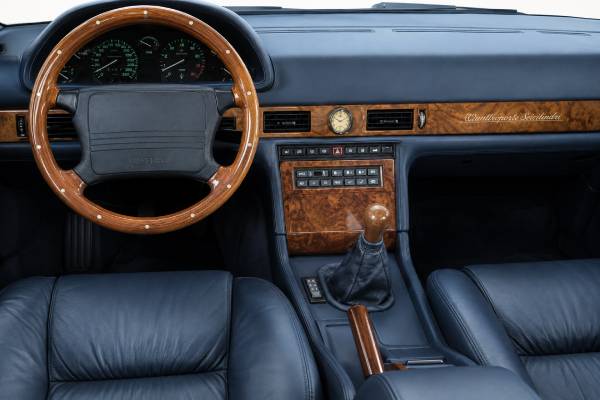
The cabin combines traditional Maserati materials with 1990s Fiat-group components. Wood, leather, an analog clock, and a simple instrument cluster give warmth, while switches and electronics reveal the production era. Seat comfort is good, but rear space is less generous than in other Quattroportes.
Visibility is generally useful because the body is compact, though the high rear deck and thick pillars create blind spots. The driving position is more sporting than the AM330’s, with a smaller steering wheel, closer pedals, and a short reach to the gear lever.
The twin-turbo V6’s sound is layered rather than traditionally sonorous. Mechanical valvetrain noise, intake hiss, turbo whistle, wastegate activity, and a hard-edged V6 exhaust combine as revs rise. A standard exhaust preserves refinement; very loud systems can drone and disguise bearing or boost noises.
Driving a 287 hp Two-Liter Quattroporte
The 2.0 rewards an active driver. It feels light on its feet for a Quattroporte, but its strongest acceleration arrives only when the engine is warm, the correct gear is selected, and both turbochargers are operating evenly.
A cold engine should start promptly and settle without prolonged tapping, smoke, or unstable idle. The driver should avoid boost until oil temperature rises. Turbochargers spin at extreme speed and rely on clean, flowing oil; hard use immediately after startup shortens their life.
Below roughly the mid-range, response is controlled but not forceful. The car then gathers speed rapidly as boost builds. This transition should be progressive and repeatable. Surging, abrupt cutout, detonation sounds, smoke, or a large difference between gears indicates a fault in boost control, fueling, ignition, or turbo condition.
The Getrag six-speed has relatively close ratios. A healthy linkage feels precise, though not light. Second-gear synchro wear, clutch drag, or tired mounts can cause baulking. The clutch must transmit substantial torque despite the engine’s small displacement; slipping often appears first during full boost in a high gear.
Steering is quick enough to make the car feel smaller than it is. Correct alignment and equal tires are essential because the chassis reacts to mismatched grip. Worn front strut mounts or rear subframe bushes create vagueness and can make the car unstable during boost transitions.
Ride quality is firm but acceptable on appropriate 16- or 17-inch period-style tires. Oversized wheels and very low-profile rubber produce harshness and tramlining. The rear limited-slip differential helps traction but can make wet-road throttle application demanding.
Brakes provide strong performance for the car’s weight, with ABS as a safety net. Old brake fluid, seized rear calipers, tired hoses, or poor tires reduce confidence. The pedal should remain consistent during repeated stops.
On a highway, the car cruises quietly enough and has strong passing ability once the correct gear is chosen. On mountain roads, keeping the engine in boost while making smooth steering inputs is the challenge. In city traffic, the manual gearbox, turbo lag, heavy clutch, and cooling fans require more attention than a modern automatic saloon.
The 2.0’s tax-driven engineering makes setup quality unusually important. A standard engine already produces roughly 144 hp per liter, so an aftermarket boost controller or undocumented chip can remove the safety margin built into fuel delivery, ignition, and charge cooling. During inspection, compare boost hoses, wastegate plumbing, pressure sensors, injectors, engine-management hardware, and exhaust components with known factory configuration. Evidence of detonation, melted plugs, cracked manifolds, or repeated head-gasket work deserves a deeper compression and leak-down assessment.
Driving technique also affects durability. Allow oil temperature to rise before sustained boost, avoid loading the engine heavily at very low rpm, and cool the drivetrain with several minutes of light running after hard use. These habits do not replace correct oil, clean intercoolers, sound water cooling, and healthy turbo oil feeds, but they reduce thermal shock. A buyer who plans mostly slow city use may find the 2.8 automatic easier; the 2.0 manual is at its best when regularly exercised on open roads and serviced by someone familiar with Maserati’s late Biturbo systems.
Timing Belts, Turbos, and Ownership Risks
The AM573 must be maintained by time as well as mileage. Timing-belt history, tensioner condition, turbo lubrication, cooling health, fuel delivery, and electrical reliability are more important than a low odometer reading.
Timing system and engine health
Treat an undocumented timing belt as overdue. Replace related tensioners, idlers, seals, and accessible water-pump or drive components according to the correct service procedure. Belt failure can cause valve-to-piston contact and major cylinder-head damage.
Measure hot oil pressure, compression, and leak-down. Listen for bottom-end knock, valvetrain noise, and turbo-related whine. Check coolant for oil, oil for fuel dilution, and the expansion tank for combustion gases. Overheating can damage heads and gaskets.
Use the correct oil grade and change it frequently when the car is used for short trips or hard driving. Allow a short low-load period after sustained boost so turbo temperatures stabilize before shutdown.
Turbo, intake, and fuel systems
Inspect compressor inlets for oil, shaft play, damaged blades, split hoses, loose clamps, and intercooler leaks. Blue smoke after idling or during boost can indicate turbo seals, though valve guides and engine wear must also be considered.
Fuel pumps, filters, injectors, regulator, and electrical supply must support full-load demand. A lean condition under boost can damage pistons quickly. Verify the engine-management calibration before accepting any boost modification.
Chassis, electrics, and body
Rear subframe mounts, trailing-arm bushes, differential mounts, front struts, ball joints, steering components, and wheel bearings wear with age. The Getrag gearbox and limited-slip differential need correct fluids.
Electrical faults can involve grounds, fuse boxes, relays, fans, immobilizers, window motors, climate control, warning lights, and aging connectors in hot areas. Diagnose voltage supply before replacing control units.
Inspect sills, floor seams, wheel arches, windshield surrounds, door bottoms, trunk floor, jacking points, and suspension mounts for rust. Check previous accident repairs carefully because the compact shell’s alignment affects drivetrain and suspension geometry.
Parts planning should begin before purchase. Timing components, turbo oil lines, sensors, damper electronics, and model-specific trim may require advance sourcing rather than same-day ordering. A specialist who can identify acceptable original-equipment equivalents and rebuildable components is often more valuable than a workshop that responds to every fault by replacing assemblies.
Buying the Right AM573 Quattroporte
The best 2.0 is a mostly standard car with recent belt service, healthy turbos, stable cooling, correct boost, and a complete history. A modified car can be excellent, but only when calibration and supporting work are documented.
Ask for timing-belt invoices with dates and mileage, turbo replacement or rebuild records, oil specifications, cooling-system work, clutch history, and engine-management details. Confirm the AM573 engine and six-speed manual configuration.
A specialist inspection should include:
- Cold start and fully hot oil-pressure check.
- Compression or leak-down testing.
- Timing-belt, tensioner, and seal inspection.
- Turbo shaft-play, smoke, boost, and intake-leak tests.
- Fuel-pressure and injector evaluation under load.
- Diagnostic scan and verification of standard or modified software.
- Clutch-slip and gearbox-synchro testing.
- Differential, rear-subframe, suspension, steering, and brake inspection.
- Cooling-fan, radiator, hose, and hot-restart tests.
- Lift examination for rust and accident repair.
During the road test, boost should arrive consistently without spikes or hesitation. Accelerate in several gears, then watch for smoke on overrun and after idling. Test the clutch in a high gear at moderate revs. Confirm that temperature remains stable in traffic with the climate control operating.
Budget immediately for a belt service if evidence is incomplete, regardless of seller assurances. Replace aged tires and brake fluid, establish baseline oils, inspect every hose near heat, and verify the fuel system before repeated full-boost use.
Avoid cars with uncontrolled boost, unknown chips, audible detonation, low oil pressure, coolant pressurization, heavy turbo smoke, severe gearbox crunching, structural rust, or disabled warning systems. These are not minor tuning issues.
The 2.0 is ideal for an owner who enjoys turbocharged engines and manual gearboxes and is willing to monitor condition closely. Its combination of 287 hp from two liters, compact Gandini styling, and 587-car production gives it a character no later Quattroporte repeated.
References
- Quattroporte IV – Quattroporte models | Maserati 2026 (Manufacturer Heritage Specifications)
- Maserati TechInfo 2026 (Manufacturer Technical Information)
- Maserati Quattroporte IV – Fahrbericht, Preis, Daten / Oldtimer DB 2026 (Model and Market Overview)
- Overview of popular models of the Maserati Quattroporte 1963-present 2026 (Technical Overview)
Disclaimer
This article is for informational purposes only and is not a substitute for professional diagnosis, repair, tuning, or restoration advice. Specifications, torque values, belt intervals, boost settings, and procedures vary by VIN, market, production date, and equipment. Verify all work against official service documentation and consult a qualified Maserati specialist.
Please share this article on Facebook, X/Twitter, or your preferred enthusiast community if it was useful. Sharing supports the creation of more detailed performance-car guides.