
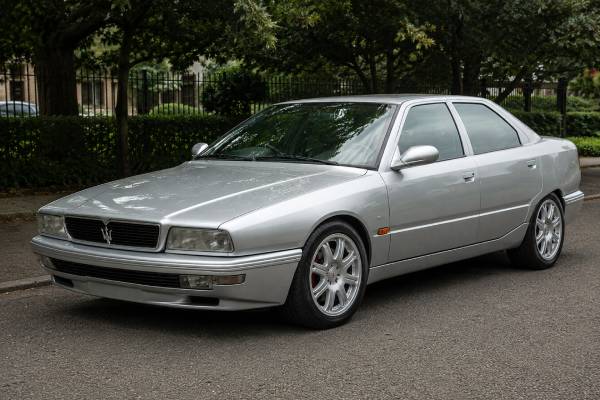
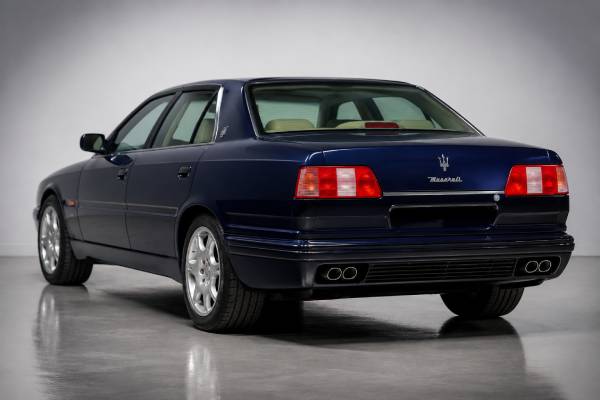
The Maserati Quattroporte seicilindri 2.8 is the export-focused V6 version of the fourth-generation AM337, and it is arguably the most rounded pre-Evoluzione model. Its 2,790 cc AM574 engine combines twin turbochargers, intercooling, four valves per cylinder, and electronic fuel injection to produce 284 hp at 6,000 rpm and approximately 413 Nm at 3,500 rpm. Unlike the Italian-market 2.0, the 2.8 could be ordered with either a six-speed manual gearbox or a four-speed ZF automatic, making it both a serious driver’s saloon and a more relaxed long-distance car.
Built from 1994 to 1998, the 2.8 sits at the heart of the compact Marcello Gandini-designed Quattroporte IV range. It offers stronger low- and mid-range response than the highly strung 2.0 while remaining lighter and mechanically simpler than the later V8. Maserati produced 668 examples, so survival, originality, and service history matter more than ordinary used-car mileage. A good car feels fast, discreet, and unusually intimate for a luxury saloon. A neglected one can demand expensive work involving timing belts, turbochargers, cooling, fuel delivery, adjustable dampers, rear suspension, electrics, and corrosion.
Table of Contents
- The Export V6 That Defined Quattroporte IV
- AM574 Engine, Chassis, and Performance Data
- Manual, Automatic, and Production Details
- Gandini Style with Biturbo-Era Hardware
- How the 2.8 Drives on Real Roads
- Belt, Turbo, Suspension, and Electrical Care
- Buying a Sound AM574 Quattroporte
The Export V6 That Defined Quattroporte IV
The 2.8 was the broadly usable six-cylinder Quattroporte IV: fast enough to challenge contemporary German performance saloons, compact enough for European roads, and available with an automatic for buyers who wanted luxury without constant shifting. It represented Maserati’s attempt to turn the hard-edged Biturbo formula into a mature four-door grand tourer.
Maserati introduced the AM337 at the 1994 Turin Motor Show under Fiat ownership. It replaced the stately, long-running AM330 Quattroporte III and Royale with a car that was shorter, lower, and much more sporting. The platform evolved from the Biturbo and second-generation Ghibli architecture, but Maserati lengthened the wheelbase, strengthened the shell, revised the suspension, and mounted the rear suspension and limited-slip differential on a dedicated tubular subframe.
Marcello Gandini gave the body a crisp wedge profile, a high tail, a low nose, and angled rear wheel openings. The shape did not imitate the large executive saloons of the time. Instead, it looked like a four-door relative of a compact Italian coupé. That visual compactness matched the mechanical character: a front-mounted twin-turbo engine, rear-wheel drive, close control weights, and a cabin arranged around the driver.
The 2.8 was primarily aimed at markets where displacement-based Italian taxation did not dictate a two-liter limit. Although its 284 hp rating was slightly lower than the 2.0’s 287 hp, the larger engine produced much more torque at lower engine speed. That difference transformed everyday use. The driver did not have to chase the upper rev range as often, and the car accelerated more confidently in a tall gear once the turbos were working.
Maserati used the “seicilindri” badge—Italian for six cylinders—to distinguish V6 cars from the ottocilindri V8 introduced in 1996. The pre-Evoluzione 2.8 remained in production until Ferrari-led revisions reshaped the range in 1998. Its successor retained the same basic displacement but received extensive changes to production quality, wiring, trim, calibration, and many mechanical components.
Factory heritage figures list 668 pre-Evoluzione 2.8 cars. That makes it the most numerous single early AM337 variant, yet it is still rare by normal performance-saloon standards. Many examples have been lost to corrosion, deferred maintenance, accidents, engine failure, or low values that once made major repair uneconomic.
AM574 Engine, Chassis, and Performance Data
The AM574 is a 2,790 cc, 90-degree V6 with twin turbochargers, twin intercoolers, double overhead camshafts, and four valves per cylinder. It develops 284 hp at 6,000 rpm and about 413 Nm at 3,500 rpm, giving the 2.8 stronger real-world flexibility than the smaller 2.0.
| Item | Specification |
|---|---|
| Model code | Tipo AM337 |
| Engine code | AM574 |
| Engine layout | 90-degree V6, 24 valves, double overhead camshafts |
| Displacement | 2,790 cc |
| Induction | Twin turbochargers with intercooling |
| Fuel system | Electronic multipoint fuel injection |
| Maximum output | 284 hp at 6,000 rpm |
| Maximum torque | Approximately 413 Nm at 3,500 rpm |
| Manual transmission | Six-speed Getrag |
| Automatic transmission | Four-speed ZF 4HP22 |
| Drivetrain | Rear-wheel drive with limited-slip differential |
| Front suspension | MacPherson struts, coil springs, anti-roll bar |
| Rear suspension | Independent tubular trailing arms on subframe |
| Brakes | Four-wheel ventilated discs with ABS |
| Steering | Power-assisted rack and pinion |
| Wheelbase | 2,650 mm |
| Length | Approximately 4,550 mm |
| Width | Approximately 1,810 mm |
| Height | Approximately 1,380 mm |
| Dry weight | Approximately 1,556 kg |
| Fuel capacity | Approximately 80 liters |
| 0–100 km/h | Approximately 5.9–6.0 seconds, depending on transmission and test |
| Top speed | Approximately 260 km/h manual; 255 km/h automatic |
The V6 belongs to Maserati’s long-developed Biturbo engine family, but the AM574 is far removed from the simplest early carbureted units. Its 24-valve heads improve airflow, and two relatively small turbochargers serve the cylinder banks. Intercoolers reduce the temperature of compressed intake air, helping power and detonation resistance.
The manual gearbox is a six-speed Getrag unit. It gives the driver enough ratios to keep the engine above the softest off-boost zone while maintaining relaxed highway cruising. The optional ZF 4HP22 automatic uses a torque converter and four forward speeds. It reduces driver workload and suits the engine’s broad torque, although its widely spaced ratios make the car feel less urgent than the manual.
Both transmissions drive a limited-slip rear differential. The differential and rear suspension attach to a tubular subframe, an important structural feature that isolates loads and improves geometry. Worn mounts can allow the whole assembly to move, causing clunks, unstable alignment, and poor traction.
The suspension combines MacPherson struts in front with independent tubular trailing arms at the rear. Many cars use electronically adjustable dampers with four settings. When healthy, the system gives a useful range from controlled touring to firm body control. When failed, it can trigger warning lights and leave the car with inconsistent damping.
Performance figures vary with transmission, tires, test conditions, and vehicle condition. A healthy manual can reach 100 km/h in roughly six seconds and continue to around 260 km/h. The automatic is generally quoted at about 255 km/h. These numbers remain impressive, but boost leaks, tired turbos, weak ignition, low fuel pressure, or a slipping clutch can reduce performance dramatically without making the car obviously undriveable at light throttle.
Manual, Automatic, and Production Details
The most important production distinction is transmission choice. The six-speed manual delivers the sharpest, most collectible version of the 2.8, while the ZF automatic makes the car easier in traffic and better suited to calm grand touring. Condition matters more than either label.
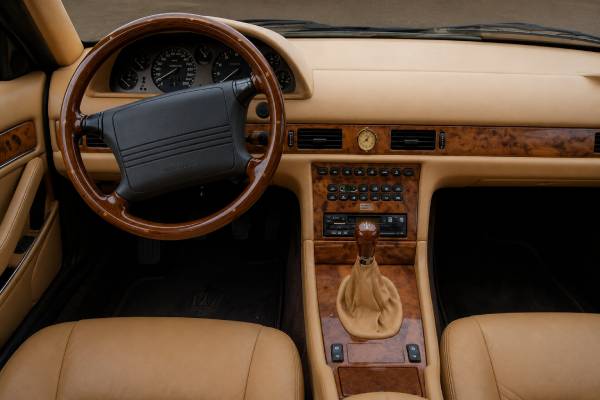
Early cars retained the first AM337 exterior details, including original mirror designs and wheel patterns. Later pre-Evoluzione cars adopted revised aerodynamic mirrors and updated wheels. Interior trim, alarm systems, audio equipment, and electrical components varied by year and market. The oval Maserati dashboard clock is a recognizable pre-Evoluzione feature.
Typical factory equipment included:
- Leather upholstery with contrasting piping or inserts on some cars.
- Wood veneer across the dashboard and center console.
- Electric front seats, windows, and mirrors.
- Automatic climate control.
- Anti-lock braking and limited-slip differential.
- Electronically adjustable damping on many examples.
- Market-specific alarm, immobilizer, and audio systems.
- Six-speed manual or four-speed ZF automatic transmission.
The manual is not automatically the better purchase. A worn clutch, tired hydraulics, damaged synchros, noisy bearings, or a loose linkage can produce a substantial repair bill. The automatic can be durable when serviced, but neglected fluid, overheating, worn seals, valve-body faults, and poor electrical supply can create delayed engagement, flare, harsh shifts, or loss of drive.
Originality is complicated because the model spent years at low values. Owners often installed larger wheels, lowering springs, boost controllers, nonstandard engine chips, free-flow exhausts, aftermarket alarms, modern radios, and improvised cooling repairs. Some changes are reversible; others hide damage or create calibration problems.
A correct car should carry an AM337 chassis identity and AM574 engine. Confirm the transmission type against documentation rather than assuming a later conversion is original. Inspect engine-management components, turbo plumbing, intercoolers, exhaust manifolds, wheels, badges, instruments, trim colors, and paint code.
Production records and individual histories can be imperfect, especially for cars that moved between countries. A change of engine or gearbox does not necessarily ruin a car, but the reason matters. Replacements following overheating, timing-belt failure, detonation, or accident damage should be supported by invoices and evidence of competent work.
The 2.8’s desirability does not depend on one rare option. Buyers generally prioritize structural condition, complete trim, correct mechanical specification, a working adjustable suspension, documented timing service, and evidence that specialists—not general repair shops learning on the car—performed major work.
Gandini Style with Biturbo-Era Hardware
The Quattroporte IV’s distinction comes from compressing genuine Maserati performance into an unusually compact luxury saloon. Gandini’s body, the driver-centered cabin, and the twin-turbo rear-drive layout make it feel closer to a four-door coupé than a conventional executive car.
The exterior uses hard creases and controlled surfaces instead of soft bulk. The low hood and narrow glasshouse create a purposeful stance. Gandini’s slanted rear wheel openings are the most recognizable signature, echoing details seen on several of his other designs. Short overhangs help the car look agile, while the formal grille and Trident retain Maserati identity.
The steel monocoque is compact by luxury-car standards. At roughly 4.55 meters long, the AM337 is much shorter than later Quattroportes. The 2,650 mm wheelbase allows four adults to travel reasonably, but rear knee room and door openings are not limousine-like. The trunk is practical, and the car’s width makes it easy to place on narrow roads.
Cooling receives air through the low nose for the radiator, oil system, air conditioning, and two intercoolers. Every duct, seal, shroud, and fan matters. Missing undertrays or improvised hoses can disturb airflow. Heat also affects wiring, rubber lines, turbo oil feeds, and nearby connectors, so an apparently tidy engine bay still needs close inspection.
The engine sits longitudinally ahead of the passenger compartment. Although front-engined, the car uses compact dimensions and a rear subframe to achieve balanced responses. The limited-slip differential helps convert turbo torque into acceleration, but it also increases the importance of matched rear tires and correct suspension geometry.
Inside, leather and wood create a rich atmosphere that contrasts with the angular exterior. The dashboard places primary instruments directly ahead of the driver, with the clock and secondary controls centrally arranged. Switchgear can feel idiosyncratic, and some plastic parts have not aged as well as the hides and veneer.
Compared with the earlier AM330, the AM337 is far smaller and more agile. Compared with the later M139, it is simpler, lighter, and more visibly linked to the Biturbo era. That position gives it appeal but also explains its quirks: it combines ambitious output with low-volume components and hand-finished details that demand attentive ownership.
How the 2.8 Drives on Real Roads
The 2.8’s defining quality is its mid-range surge. It does not need the constant high revs of the 2.0, yet it still delivers an old-school turbo transition that asks the driver to plan throttle, gear, and available grip.
A healthy engine starts cleanly, settles into a steady idle, and pulls smoothly before boost. The turbos should build pressure together without a sudden spike, hesitation, detonation, or exhaust smoke. The strongest acceleration arrives from the middle of the rev range, where the AM574’s 413 Nm gives the car confident passing ability.
In the six-speed manual, the driver can choose a lower gear before a corner or overtaking maneuver and keep both turbochargers responsive. The shift action should feel deliberate and reasonably precise. It is not a light economy-car gearbox, but it should not grind or resist second and third gears when warm. A dragging clutch or worn synchros can make the lever feel worse than it should.
The ZF automatic changes the personality. The torque converter softens the first movement and reduces the sense of lag in gentle use. Under full throttle, four widely spaced gears cannot keep the V6 in its strongest range as effectively as the manual, but the engine’s extra displacement compensates. Smooth, prompt engagement is essential; long delays when selecting Drive or Reverse are warning signs.
Steering is quick enough to make the AM337 feel compact. Good tires, correct pressures, sound front strut mounts, and accurate alignment produce clear turn-in. Worn rear subframe bushes or mismatched tires can make boost arrival feel like rear-steer, especially on wet roads.
The adjustable dampers should create noticeable but sensible changes. Even the softer setting should control the body, and the firmest setting should not make the car bounce. A warning triangle, stuck setting, oil leakage, or unequal response across the axle deserves diagnosis before purchase.
Ride quality depends heavily on wheels and tires. Standard-size or period-correct tires preserve compliance and steering feel. Very large wheels increase tramlining, impact harshness, and stress on suspension joints. Old tires can look unworn yet have little wet grip, a serious risk in a turbocharged rear-drive car.
The brakes are strong when the discs, pads, calipers, hoses, fluid, and ABS are healthy. The pedal should remain firm after repeated stops. Pulling, pulsation, warning lights, or a sinking pedal require investigation.
The car is most satisfying on flowing roads rather than a racetrack. Its strength lies in combining speed, steering response, leather-lined comfort, and four-door usability. Smooth inputs matter because the turbo torque can overwhelm old or poor tires before the chassis reaches its limits.
Belt, Turbo, Suspension, and Electrical Care
The 2.8 is reliable only when treated as a low-volume high-output Maserati. Timing-belt age, oil quality, cooling efficiency, fuel pressure, turbo health, automatic or clutch condition, and electrical voltage all deserve scheduled attention rather than repair after failure.
Timing drive and internal engine condition
An undocumented timing belt should be considered overdue. Replace the belt with the correct tensioners, idlers, seals, and related drive components specified by the service procedure. Calendar age matters even when mileage is low. Belt failure can allow pistons and valves to collide, turning routine maintenance into a major engine rebuild.
Before purchase, check compression and leak-down, hot oil pressure, coolant integrity, and crankcase breathing. Listen for lower-end knock, persistent valvetrain noise, exhaust manifold leaks, and abnormal turbo whine. Oil in coolant, combustion gases in the expansion tank, or repeated overheating requires careful diagnosis.
Use the correct oil and change it frequently enough for the car’s use. Short journeys create moisture and fuel dilution; hard boost generates heat. Allow the engine to warm before using full load, and give it a period of low-load running after sustained speed so turbo temperatures can stabilize.
Turbos, boost, ignition, and fuel
Inspect both turbochargers for shaft play, damaged compressor blades, oil leakage, and unequal output. Check every hose and clamp between the air filters, turbos, intercoolers, throttle body, wastegates, and pressure sensors. A small leak can cause weak performance, over-speed a turbo, or confuse boost control.
Fuel pumps, filters, injectors, pressure regulation, and wiring must supply enough fuel under full boost. A car can idle perfectly but run dangerously lean at high load. Aging coils, plug leads or ignition modules, sensors, and grounds can also create misfire that appears only when cylinder pressure rises.
Any nonstandard chip, boost controller, wastegate setting, or exhaust should be documented. More boost without verified fueling, charge temperature, ignition control, and engine condition is a reason to walk away.
Transmission, chassis, and body
Manual cars need inspection for clutch slip, hydraulic leaks, synchro wear, linkage play, gearbox noise, and mount failure. Automatic cars need clean fluid, correct level, prompt engagement, smooth shifts, and evidence of sensible servicing. A neglected ZF unit can be rebuilt, but the expense changes the economics of the car.
Check rear subframe mounts, trailing arms, differential mounts, front struts, ball joints, steering rack, wheel bearings, brakes, and adjustable damper operation. Replacement dampers and model-specific joints can be costly, so a red warning triangle should not be dismissed as a harmless sensor.
Electrical problems often begin with low voltage, corroded grounds, aging relays, fuse-box heat, or aftermarket alarm installations. Test charging output, battery condition, cooling fans, windows, seats, central locking, instruments, climate control, ABS, immobilizer, and every damping setting.
Rust inspection should cover sills, floor seams, jacking points, wheel arches, door bottoms, windshield and rear-window surrounds, trunk floor, suspension pickup points, and subframe areas. Poor accident repair can be more serious than visible surface corrosion because drivetrain alignment depends on a straight shell.
Parts availability varies. Consumables can often be sourced through specialists, but trim, electronics, dampers, glass, lamps, and model-specific castings may require patience. A complete car with tired service items is usually a safer project than a dismantled or cosmetically incomplete bargain.
Buying a Sound AM574 Quattroporte
Buy the best-documented 2.8 you can find, not the cheapest running example. A recent timing service, healthy cooling, standard boost, sound turbos, a quiet rear subframe, and functioning electronics are worth more than low mileage or polished paint.
Begin by deciding whether manual involvement or automatic convenience matters more. The manual is faster and more engaging, but its clutch and gearbox must be healthy. The automatic suits relaxed touring, yet it needs clear servicing evidence and a thorough hot road test.
Ask for records covering:
- Timing-belt, tensioner, idler, seal, and water-pump-related work.
- Oil type and change frequency.
- Turbocharger repair or replacement.
- Radiator, fan, hose, thermostat, and coolant service.
- Fuel pump, filter, injector, and ignition work.
- Clutch and gearbox history, or automatic fluid and repair history.
- Adjustable damper, subframe, differential, and suspension work.
- Rust repair, accident repair, and repainting.
- Alarm, immobilizer, engine-management, or boost modifications.
A specialist pre-purchase inspection should include a true cold start, fully hot oil-pressure check, compression or leak-down test, cooling-system pressure test, diagnostic scan, boost test, fuel-pressure verification, turbo inspection, and lift examination. The specialist should know the AM337 rather than only later Maseratis.
During the road test, use light throttle first and confirm clean off-boost running. Once temperatures are stable, accelerate through several gears. Boost should build smoothly and repeatedly. Watch for hesitation, overboost cut, smoke, clutch slip, transmission flare, rear-end movement, or rising coolant temperature.
For an automatic, select Reverse and Drive several times when cold and hot. Engagement should be prompt and controlled. Test kickdown and full-throttle upshifts without repeated flare. For a manual, test second gear from cold and warm, then apply full boost in a high gear to reveal clutch slip.
Inspect all four tires for matching make, model, size, age, and wear. Uneven rear wear can expose subframe movement or poor alignment. Examine the adjustable dampers for leaks and confirm each setting. Test every electrical item long enough for heat-related faults to appear.
Avoid cars with coolant pressurization, low hot oil pressure, uncontrolled boost, heavy blue smoke, structural corrosion, disabled warnings, severe gearbox problems, or unexplained engine-management modifications. Cosmetic imperfections are easier to solve than a damaged AM574 or crooked shell.
After purchase, establish a baseline. Replace fluids and filters, verify belt age, inspect fuel and coolant hoses, confirm tire age, test charging voltage, and measure boost before enthusiastic driving. Keep a reserve for model-specific components rather than spending the whole budget on the purchase price.
The right 2.8 is a compelling alternative to more familiar 1990s performance saloons. It combines rarity, Gandini styling, genuine 160-mph ability, and a cabin full of Italian character. Its ownership demands are real, but a carefully maintained example delivers a blend of torque, intimacy, and discretion that later, larger Quattroportes do not duplicate.
References
- Quattroporte IV – Quattroporte models | Maserati 2026 (Manufacturer Heritage Specifications)
- Maserati TechInfo 2026 (Manufacturer Technical Information)
- Buying Guide: 1994–2001 Maserati Quattroporte IV | Hagerty UK 2025 (Buying Guide)
Disclaimer
This article is for informational purposes only and is not a substitute for professional diagnosis, repair, tuning, or restoration advice. Specifications, torque values, service intervals, transmission procedures, and boost settings vary by VIN, market, production date, and equipment. Verify all work against official service documentation and consult a qualified Maserati specialist.
Please share this article on Facebook, X/Twitter, or your preferred enthusiast community if it was useful. Sharing supports the creation of more detailed specialist-car guides.