
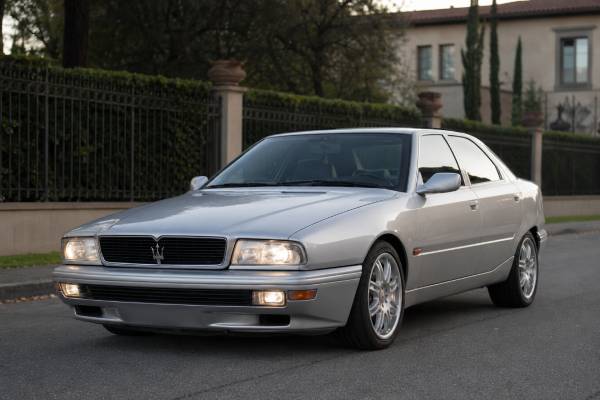
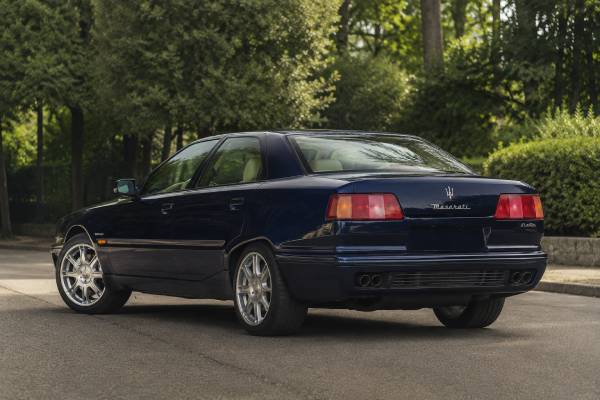
The Maserati Quattroporte V8 Evoluzione is the final and most developed version of the compact AM337 flagship. Produced from 1998 to 2001 after Ferrari assumed operational control of Maserati, it combines Marcello Gandini’s angular four-door body with the 3,217 cc AM578 twin-turbo V8, a six-speed manual or four-speed BTR automatic, rear-wheel drive, and approximately 335 hp. Claimed top speed remained about 270 km/h, placing this discreet saloon among the fastest four-door cars of its era.
The “Evoluzione” name matters because the late model incorporated extensive changes to manufacture, wiring, trim, component quality, and chassis detail. Ferrari’s review reportedly replaced or modified around 400 of 800 principal parts, yet the car retained the intense mechanical personality of the earlier ottocilindri. Just 340 V8 Evoluzione examples were built, including some of the last 50 Cornes Serie Speciale cars for Japan. Rarity alone does not make one safe to buy. The AM578’s timing belts, twin turbos, fuel system, cooling, four-cam valvetrain, BTR automatic or manual clutch, rear subframe, adjustable dampers, and aging electronics all require specialist inspection. A fully sorted car is a uniquely compact V8 grand tourer; a neglected one can consume restoration money at supercar speed.
Table of Contents
- The Final Development of the Compact V8 Quattroporte
- AM578 Powertrain and Evoluzione Chassis Data
- Production Rarity, Options, and Correct Identification
- Ferrari-Era Detail with Gandini Proportions
- What the V8 Evoluzione Feels Like
- Preventive Care for the AM578 and AM337
- Buying the Best of 340 Cars
The Final Development of the Compact V8 Quattroporte
The V8 Evoluzione is the ultimate factory version of the fourth-generation Quattroporte: not the most spacious or polished Maserati saloon, but the rarest combination of compact dimensions, late production quality, and twin-turbo V8 performance.
The AM337 Quattroporte began in 1994 under Fiat ownership, using a stretched and strengthened development of Biturbo-era architecture. Early cars had twin-turbo V6 engines, and the 3.2-liter V8 joined the range for 1996. When Ferrari took a controlling stake in Maserati in 1997, it inherited a charismatic model built with methods and components that needed modernization.
Ferrari’s answer was the Evoluzione, unveiled at Geneva in 1998. Work at the Modena factory went beyond a cosmetic facelift. Tooling, assembly procedures, supplier control, wiring, interior finish, component specifications, and inspection were revised. Contemporary accounts describe approximately half of the car’s major parts as new or modified.
The V8 remained the AM578, an evolution of the engine used in the Shamal and closely related to the early 3200 GT’s twin-turbo architecture. Its 335 hp and 450 Nm figures were essentially unchanged. The engineering focus was therefore consistency and durability rather than a headline power increase.
Ferrari-era changes also clarified the range. The two-liter V6 disappeared, leaving a 2.8 V6 and 3.2 V8. Fender badges identified “V6 evoluzione” or “V8 evoluzione.” New mirrors, revised cabin details, improved trim, and the deletion of the traditional oval dashboard clock visually separated the late cars.
Production ended in May 2001 after 2,400 Quattroporte IVs of all versions. Of those, 730 were Evoluzione cars, with 340 V8 examples generally recorded. The number is small enough that each surviving car’s originality and history affect the population meaningfully.
The V8 Evoluzione is now valued as a bridge between two Maserati eras. Its body and chassis remain rooted in the independent Biturbo period, while its production standards reflect Ferrari control. It is also the last compact Quattroporte; the Pininfarina-designed M139 that followed was dramatically larger and used a naturally aspirated V8 with a rear transaxle.
AM578 Powertrain and Evoluzione Chassis Data
The AM578 is a 3,217 cc, 90-degree V8 with four overhead camshafts, 32 valves, twin turbochargers, twin intercoolers, and electronic fuel injection. It sends approximately 335 hp and 450 Nm to the rear wheels through either a Getrag six-speed manual or BTR four-speed automatic.
| Item | Specification |
|---|---|
| Model code | Tipo AM337 |
| Engine code | AM578 |
| Production years | 1998–2001 |
| Engine layout | 90-degree V8, 32 valves, four overhead camshafts |
| Displacement | 3,217 cc |
| Bore and stroke | Approximately 80 mm × 80 mm |
| Induction | Twin turbochargers with twin intercoolers |
| Fuel system | Electronic multipoint injection |
| Maximum output | 335 hp at approximately 6,400 rpm |
| Maximum torque | Approximately 450 Nm at 4,400 rpm |
| Manual transmission | Six-speed Getrag |
| Automatic transmission | Four-speed electronically controlled BTR |
| Drivetrain | Rear-wheel drive with limited-slip differential |
| Front suspension | MacPherson struts, coil springs, anti-roll bar |
| Rear suspension | Independent tubular trailing arms on subframe |
| Brakes | Four-wheel ventilated discs with ABS |
| Wheelbase | 2,650 mm |
| Length | Approximately 4,550 mm |
| Width | Approximately 1,810 mm |
| Dry weight | Approximately 1,647 kg |
| 0–100 km/h | Approximately 5.8 seconds for a healthy manual |
| Top speed | Approximately 270 km/h manual; about 265 km/h automatic |
The square bore and stroke support a blend of revs and torque. Low compression suits the boosted application, while two turbochargers divide exhaust flow by bank. The system can respond quickly when correctly sealed, but it creates two sets of wastegates, oil feeds, return paths, pressure pipes, and heat sources to maintain.
The six-speed Getrag is the enthusiast configuration. Close ratios help keep the engine above the strongest part of the boost threshold, and sixth gear allows relaxed high-speed cruising. The clutch must absorb 450 Nm, so wear often reveals itself first under full boost in a high gear.
The BTR automatic uses a torque converter and electronic control. It gives smooth initial response and suits the executive-car role, but four ratios produce larger rpm drops than the manual. Its behavior depends on hydraulic condition, fluid temperature, electrical voltage, sensors, selector inputs, and control wiring.
The front suspension uses MacPherson struts. At the rear, tubular trailing arms and the limited-slip differential attach to a separate subframe. This layout gives the AM337 stable traction in a compact package, provided the mounts and alignment remain correct.
Electronic adjustable dampers were fitted to many cars. Four settings allow the driver to change firmness, but the system cannot compensate for worn ball joints, tired bushes, damaged wheels, or mismatched tires. A warning triangle or one dead damper can represent a significant parts bill.
The ventilated disc brakes and ABS were capable for period road use. Modern tire quality can improve stopping and wet grip, but only if the wheels are straight and tire sizes match the suspension calibration. Old, hardened rubber is especially dangerous because the V8 can overwhelm rear grip suddenly as boost arrives.
Production Rarity, Options, and Correct Identification
A V8 Evoluzione should be verified through its complete specification rather than one badge. The AM578 engine, late body details, revised dashboard, transmission, chassis identity, and documented production history should all agree.
Exterior identifiers include V8 evoluzione fender scripts and the late mirror design. Wheel designs varied, including 17-inch options, and market specifications could differ. Panel fit was generally better than on earlier cars, though repainting and accident repair now have more influence than factory build.
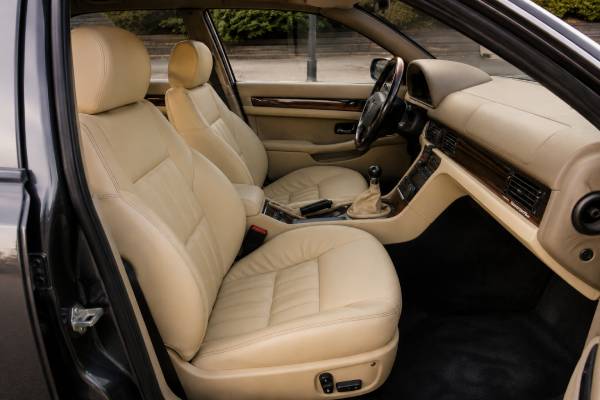
The interior no longer carries the oval analog clock traditionally placed in the center of a Maserati dashboard. A Trident emblem or revised audio/navigation treatment occupies the area instead. Leather, wood, electric equipment, and climate control remain prominent.
Typical equipment could include:
- Connolly leather seating and leather-trimmed cabin surfaces.
- Burl wood on the dashboard, console, and doors.
- Electric front seats, windows, and mirrors.
- Automatic climate control.
- Adjustable electronic dampers.
- Anti-lock brakes and limited-slip differential.
- Market-specific navigation, audio, alarm, and immobilizer systems.
- Six-speed manual or four-speed BTR automatic transmission.
The 340-car production figure covers both transmission types and all markets. Right-hand-drive examples are especially scarce. The final 50 Quattroporte IVs were Cornes Serie Speciale cars commissioned by the Japanese importer; they included V6 and V8 versions, all with automatic transmission. A normal 2001 V8 is not automatically a Cornes edition.
Manual cars generally attract stronger enthusiast demand, but an excellent automatic can be rarer, more original, and less abused. Evaluate clutch, synchros, and differential condition on the manual; evaluate engagement, shift quality, heat behavior, and control electronics on the BTR.
Factory color combinations were often rich and individual. An uncommon paint or leather shade can be genuine, but proof should come from paint labels, build information, invoices, and untouched hidden areas. Redyed leather and re-veneered wood can look attractive while obscuring original materials.
Performance modifications require evidence. The AM578 can produce more power, but altered chips, wastegate settings, exhausts, or intake systems increase stress on pistons, turbochargers, fuel delivery, cooling, and transmission components. A standard engine with measured health is usually more valuable than an undocumented tuned one.
Check completeness closely. Correct mirrors, lamps, wheels, switchgear, glass, interior panels, badges, tools, books, and keys may be harder to source than common service parts. A mechanically tired but complete example can be a better restoration base than a running car missing rare pieces.
Ferrari-Era Detail with Gandini Proportions
The V8 Evoluzione’s visual appeal comes from contradiction: it has the performance of an exotic coupé, the cabin of a hand-finished luxury car, and the footprint of a modest family saloon. Ferrari-era improvements sharpened the details without changing Gandini’s essential shape.
The exterior remains a crisp wedge with a low nose, flat surfaces, high tail, and diagonal rear wheel openings. Those rear arches are a clear Gandini signature. The grille is formal rather than aggressive, and the V8 identity is communicated by small scripts rather than large aerodynamic additions.
At roughly 4.55 meters long, the car is shorter than most later premium saloons. The compact dimensions improve visibility and placement on narrow roads. Rear passengers receive proper doors and usable seating, but legroom and entry are not limousine-grade. The trunk is useful for touring.
The engine bay is densely packed. A V8, two turbochargers, intercoolers, radiator, condenser, fans, oil plumbing, fuel lines, and electrical harnesses occupy limited space. Air guides, heat shields, undertrays, and fan operation are functional components rather than cosmetic details.
The Evoluzione’s tighter build can be felt in door fit, trim attachment, controls, and reduced squeaks when the car has remained sound. Yet leather shrinks, veneer cracks, headliners sag, and switches age. Restoring the cabin correctly requires craft skills as well as replacement parts.
The driver sits relatively low, with clear analog instruments and close controls. Manual cars feel like four-door grand-touring coupés. Automatic cars preserve the same seating position but emphasize the V8’s broad performance rather than gear selection.
Sound is an important part of the car’s identity. The AM578 does not deliver the high-pitched response of a naturally aspirated Ferrari V8. At idle it is restrained and mechanical. Under load, a dense eight-cylinder exhaust note combines with intake roar and turbo whistle. The effect is purposeful, not theatrical.
The Evoluzione differs from its predecessor more in execution than appearance. New mirrors and dashboard details are visible, but revised wiring, fasteners, seals, controls, and production methods are the deeper story. This makes originality difficult to judge from photographs; a proper inspection must look beneath the finish.
What the V8 Evoluzione Feels Like
The V8 Evoluzione feels far faster than its discreet shape suggests. It combines strong mid-range thrust with quick steering and a relatively compact body, but its power delivery and limited electronic assistance demand smooth inputs.
A healthy AM578 starts cleanly and settles into an even idle. Blue smoke, heavy tapping, repeated misfire, or long cranking needs explanation. The engine and turbochargers should be warmed fully before hard acceleration.
At small throttle openings, the V8 is flexible and refined enough for normal traffic. As exhaust flow rises, boost arrives and the car accelerates with serious force. The build should be consistent across repeated runs. Surging, detonation, a sudden fuel cut, warning lights, or smoke indicates a fault rather than character.
The six-speed manual gives the driver control over that transition. Choosing a lower gear before passing keeps the engine responsive and prevents lugging at high boost. The gearshift should be deliberate but clean, and the clutch should hold peak torque without flare.
The BTR automatic makes the experience less demanding. The torque converter smooths departure, and kickdown moves the engine toward its boost range. Because there are four speeds, it cannot maintain the same urgency as the manual. Smoothness should not be confused with slippage; engine revs should not rise without matching acceleration.
Steering response is unusually immediate for a luxury saloon. Fresh front suspension parts and correct alignment produce clear turn-in. The V8 adds weight over the nose compared with the V6, but the body remains compact enough to feel agile.
Rear traction is strong on dry, warm tires, helped by the limited-slip differential. In cold or wet conditions, boost can exceed available grip abruptly. The absence of a modern stability-control safety net means tire age and throttle discipline matter.
Damping settings should change the car from controlled touring to firm road use. A healthy softer mode still restrains body motion; the firmest mode should not create bouncing or axle hop. Harshness often comes from oversized wheels, aged tires, or seized joints rather than intentional tuning.
The brakes provide useful confidence when fully serviced, though repeated track-style stops can expose heat. The car is best on fast roads and motorways, where it can cruise quietly and deploy power for overtaking. Stop-start city traffic tests fans, climate control, charging, and automatic behavior more than outright performance.
Preventive Care for the AM578 and AM337
Preventive maintenance determines whether a V8 Evoluzione remains usable. Timing belts, hot oil pressure, twin-turbo health, fuel delivery, cooling, transmission, rear-subframe mounts, adjustable dampers, and electrical supply all need documented attention.
Timing belts and engine condition
Assume an undocumented timing service is due. The AM578’s valves and pistons can meet if belt control fails. Correct work includes the belt system, tensioners, idlers, seals, and related components specified by official procedures.
Check compression and leak-down across all eight cylinders, then measure oil pressure with the engine fully hot. Pressure-test the cooling system and inspect for combustion gases. Compare both banks for plug color, temperature, noise, and exhaust behavior.
Oil leaks can develop at cam covers, seals, turbo feeds, returns, and crankcase connections. Use the correct oil, maintain the level, and avoid long intervals. Warm the engine before boost and allow lower-load operation after sustained speed.
Turbos, fuel, ignition, and cooling
Inspect both turbochargers for shaft movement, oil contamination, damaged blades, and balanced boost. Pressure-test intake plumbing and intercoolers. Check wastegate actuators, vacuum lines, pressure controls, and any nonstandard calibration.
Fuel pressure must remain stable at full load. Pumps, filters, injectors, regulators, relays, connectors, and grounds age. Coils, plugs, and sensors may fail only under boost, when cylinder pressure is highest.
Radiators and fans are known age-related concerns. Verify the radiator core, hoses, thermostat, pressure cap, both fans, relays, and airflow shrouds. A car that stays cool on an open road can still overheat in traffic or with the air conditioning operating.
Transmission, chassis, and electrics
Manual cars need clutch, hydraulics, synchro, bearing, and mount checks. BTR automatics need fluid assessment, prompt cold and hot engagement, smooth changes, and correct electronic control. Transmission problems can be hydraulic, mechanical, electrical, or a combination.
Inspect the rear subframe, differential mounts, tubular arms, front struts, ball joints, steering rack, wheel bearings, brakes, and damper system. Uneven tire wear often reveals movement or alignment faults.
Electrical diagnosis begins with the battery, alternator, and grounds. Test every switch, fan, light, window, seat, lock, instrument, ABS function, climate-control mode, immobilizer, and damping setting. Poorly installed alarms and stereos can damage otherwise improved Evoluzione wiring.
Rust inspection should cover sills, floors, jacking points, wheel arches, door bottoms, windshield and rear-window surrounds, trunk floor, and suspension pickups. Structural corrosion or poor crash repair threatens geometry and safety.
Buying the Best of 340 Cars
Buy a V8 Evoluzione only after a specialist proves that its rarity is supported by condition. A complete history, recent timing service, stable cooling, correct boost, healthy transmission, sound subframe, and functioning electronics matter more than mileage.
Confirm the AM337 chassis, AM578 engine, V8 evoluzione badges, late mirrors, revised dashboard without the oval clock, correct transmission, and market specification. Verify any Cornes Serie Speciale claim through a numbered identity and Japanese importer documentation.
The history file should cover:
- Timing belts, tensioners, idlers, seals, and related work.
- Oil changes, oil-pressure tests, and internal engine repairs.
- Turbocharger rebuilding, intercooler, hose, and wastegate service.
- Radiator, fan, thermostat, coolant, and hose replacement.
- Fuel pumps, filters, injectors, coils, plugs, and sensors.
- Clutch and gearbox work or BTR automatic maintenance.
- Rear subframe, differential, steering, dampers, and brakes.
- Alternator, battery, alarm, immobilizer, and wiring repairs.
- Corrosion treatment, glass, paintwork, and collision repair.
Arrange a true cold start and a fully hot examination. Compression or leak-down tests, mechanical oil-pressure measurement, cooling-system pressure testing, diagnostic scanning, boost testing, and fuel-pressure verification should be part of a serious pre-purchase inspection.
On the road, begin without boost. Confirm smooth fueling, steady temperature, charging voltage, steering alignment, and brake feel. Once fully warm, use several gears and loads. The engine should pull evenly with no smoke, surge, detonation, or warning lamps.
Manual cars require high-load clutch testing and careful synchro evaluation. Automatic cars require repeated cold and hot selection of Drive and Reverse, then light- and full-throttle shifts. Any flare, delay, harshness, or limp mode changes the purchase calculation.
Operate all damper settings and every cabin feature. Check matched tire age, wheel condition, rear alignment, and subframe movement. Inspect the underbody for leaks, rust, crushed jacking points, and impact repairs.
Walk away from coolant pressurization, low hot oil pressure, heavy turbo smoke, uncontrolled boost, major transmission faults, structural corrosion, or hacked wiring unless the price and restoration plan are exceptionally realistic. A rare broken car is still broken.
After purchase, establish a conservative baseline before modifying or driving hard. Verify the timing system, replace questionable fluids and filters, inspect all pressure hoses, test fuel delivery, confirm boost calibration, service brakes, and fit fresh matched tires.
The V8 Evoluzione rewards an owner who appreciates engineering history and accepts specialist upkeep. It is not merely a faster Quattroporte IV. It is the final expression of the compact Gandini saloon, built during Maserati’s transition to Ferrari control and powered by one of the marque’s last twin-turbo V8s. Few production saloons offer such concentrated character in so little road space.
References
- Quattroporte IV Evoluzione – Quattroporte models | Maserati 2026 (Manufacturer Heritage Specifications)
- Maserati TechInfo 2026 (Manufacturer Technical Information)
- Buying Guide: 1994–2001 Maserati Quattroporte IV | Hagerty UK 2025 (Buying Guide)
- 1999 Maserati Quattroporte V8 Evoluzione for Sale – Cars & Bids 2023 (Auction Specification)
Disclaimer
This article is for informational purposes only and is not a substitute for professional diagnosis, repair, tuning, or restoration advice. Specifications, torque values, belt intervals, boost settings, and procedures vary by VIN, market, production date, and equipment. Verify all work against official service documentation and consult a qualified Maserati specialist.
Please share this article on Facebook, X/Twitter, or your preferred enthusiast community if it was useful. Sharing supports the creation of more detailed specialist-car guides.