
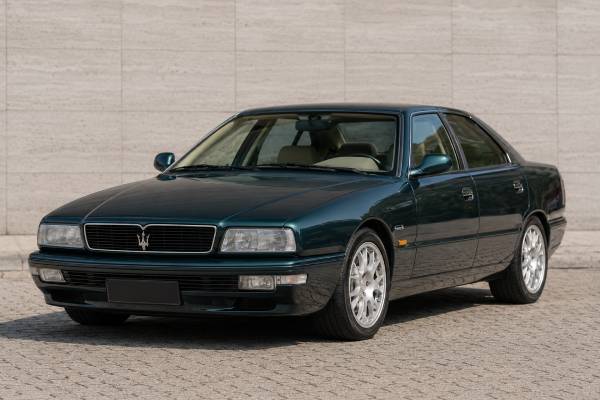
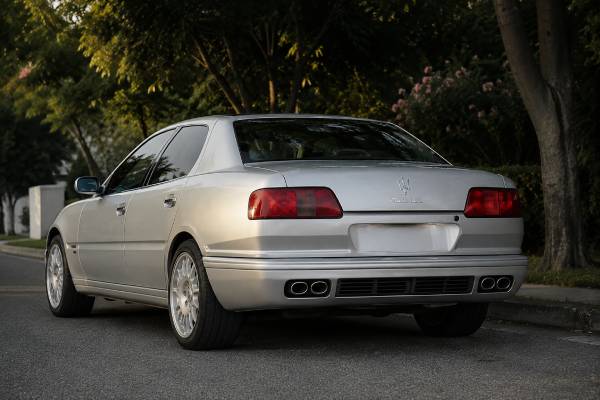
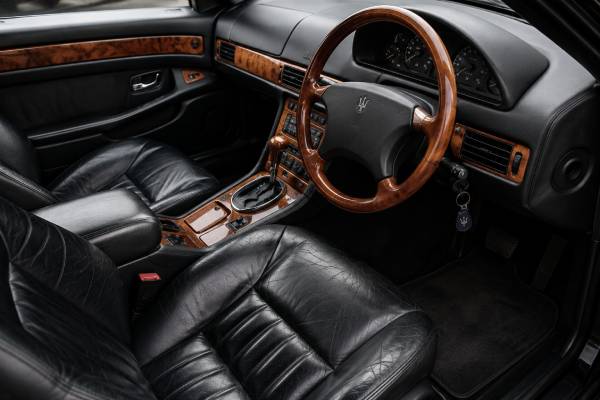
The Maserati Quattroporte Cornes Serie Speciale V8 Evoluzione is a numbered Japanese-market farewell to the AM337. Cornes & Co. commissioned 50 Quattroporte IV Evoluzione cars for 2001, combining V6 and V8 versions; the precise V8 share must be established from factory or importer records rather than guessed. Every car was left-hand-drive and used the electronically controlled four-speed BTR automatic. The V8 model carries Maserati’s 3,217 cc AM578 twin-turbo engine, rated at approximately 335 hp and 450 Nm.
Its distinction comes from provenance and final-series detail, not extra engine output. Reported identifying features include numbered-edition documentation, C-pillar Trident emblems, and retention of the traditional oval dashboard clock, but individual cars should be checked against their build records. Mechanical condition remains as important as authenticity. Timing belts, turbochargers, cooling, oil pressure, fuel delivery, the BTR automatic, adjustable dampers, rear subframe, rust, and aging electronics can all demand specialist work. The best example is a documented Cornes car whose numbered identity, AM578 powertrain, special trim, and maintenance history agree with one another.
Table of Contents
- Maserati’s Numbered V8 Farewell to the AM337
- AM578 Twin-Turbo V8 and Automatic Specifications
- Identifying a Genuine Cornes V8
- Special-Edition Details over Evoluzione Engineering
- How the Automatic V8 Performs
- Maintaining a Numbered Twin-Turbo V8
- Collector Purchase Checks for the Cornes V8
Maserati’s Numbered V8 Farewell to the AM337
The Cornes V8 represents a farewell rather than a conventional model-year update. It was created for an important Japanese distributor after the AM337 had reached its most developed Evoluzione form and just before the compact Quattroporte disappeared.
The fourth-generation Quattroporte began in 1994, using a lengthened and strengthened development of Maserati’s Biturbo-era platform. Marcello Gandini designed the angular body, and the range initially used twin-turbo V6 engines. A Shamal-derived 3.2-liter V8 joined in 1996.
Ferrari gained operational control of Maserati in 1997 and introduced the Evoluzione in 1998. The factory revised assembly methods, component quality, wiring, trim, calibration, and numerous chassis details. Approximately 400 of 800 principal components were described as new or modified, although the basic body, engine family, and suspension architecture remained.
Cornes & Co. then commissioned the final numbered batch for Japan. Cornes had a long history as an importer of prestigious European marques and understood the value of a limited final edition. All 50 cars used the automatic transmission, matching Japanese luxury-market expectations and making the edition distinct from manual V8 Evoluziones.
The combined 50-car total included both V6 and V8 versions. Public records do not provide a universally accepted engine split. A seller’s claim that a car is “one of only” a smaller number should be supported by a recognized register or factory-linked evidence.
The V8 Cornes is particularly appealing because it combines the special-edition identity with the fastest powertrain offered in the Quattroporte IV. The standard V8 Evoluzione was already limited to about 340 cars, and the Cornes subset is smaller still.
Its Japanese-market history can be an advantage. Many cars covered modest mileage and received careful cosmetic treatment. It can also conceal long storage, infrequent belt service, aging fluids, underbody corrosion, nonfunctional Japanese electronics, or auction repairs.
Collector status should not turn the car into a static object. The AM578, automatic transmission, seals, pumps, turbochargers, dampers, and electrical systems benefit from regular controlled use. Preservation means documented maintenance and sympathetic operation, not simply keeping the odometer low.
AM578 Twin-Turbo V8 and Automatic Specifications
The Cornes V8 uses the 3,217 cc AM578, a 90-degree, 32-valve, four-cam V8 with twin turbochargers and intercooling. It develops approximately 335 hp and 450 Nm, driving the rear wheels only through the BTR four-speed automatic in Cornes specification.
| Item | Specification |
|---|---|
| Model code | Tipo AM337 |
| Version | V8 Evoluzione Cornes Serie Speciale |
| Model year | 2001 |
| Engine code | AM578 |
| Engine layout | 90-degree V8, 32 valves, four overhead camshafts |
| Displacement | 3,217 cc |
| Bore and stroke | Approximately 80 mm × 80 mm |
| Induction | Twin turbochargers with twin intercoolers |
| Fuel system | Electronic multipoint injection |
| Maximum output | Approximately 335 hp at 6,400 rpm |
| Maximum torque | Approximately 450 Nm at 4,400 rpm |
| Transmission | Four-speed electronically controlled BTR automatic |
| Drivetrain | Rear-wheel drive with limited-slip differential |
| Front suspension | MacPherson struts with coil springs |
| Rear suspension | Independent tubular trailing arms on subframe |
| Brakes | Four-wheel ventilated discs with ABS |
| Wheelbase | 2,650 mm |
| Length | Approximately 4,550 mm |
| Width | Approximately 1,810 mm |
| Japanese-market curb weight | Approximately 1,730 kg, depending on specification |
| Top speed | Approximately 265 km/h with the automatic |
| Special-edition production | Part of 50 combined V6 and V8 numbered cars |
The AM578’s square bore and stroke support both torque and upper-rpm power. A low compression ratio accommodates boost. Each bank has its own exhaust and turbo path, which improves response but doubles the number of components that can leak oil, air, exhaust, or vacuum.
The BTR automatic uses a torque converter to move the car smoothly from rest. Its four ratios suit the V8 better than they suit a smaller, peakier engine because 450 Nm can bridge larger rpm drops. It should still deliver decisive kickdown and clean full-throttle changes.
A lazy automatic V8 is not necessarily normal. Transmission slip, low boost, intake leaks, ignition breakdown, fuel-pressure loss, blocked catalysts, or tired turbochargers can each reduce acceleration. Diagnosis should compare engine speed, boost, shift behavior, and road speed.
The limited-slip differential and rear suspension attach to a tubular subframe. The design gives good traction and helps the compact body handle V8 torque. Worn mounts allow movement that can produce clunks, rear steer, and driveline shock.
Many cars use electronically adjustable dampers with four settings. A numbered special edition may retain original dampers for authenticity, but originality is not useful if one corner has no damping. Rebuilding correct units is preferable to fitting unverified substitutes.
The ventilated brakes and ABS provide strong road performance when the fluid, calipers, discs, pads, sensors, and tires are healthy. The car’s speed demands recent matched tires; tread depth alone does not make old rubber safe.
Identifying a Genuine Cornes V8
A genuine car should present an unbroken chain from AM337 chassis and AM578 engine to the numbered Cornes identity and Japanese-market paperwork. No single badge, clock, color, or seller description is enough.
Examine the numbered plaque or identifier closely. Its finish, font, mounting, and aging should match known examples. Search for evidence that the surrounding trim has been replaced or modified. Photograph the identifier and compare it with register information before purchase.
Japanese records can be highly useful. Registration certificates, periodic inspection sheets, service books, dealer stamps, auction reports, export certificates, and Cornes literature can establish mileage and ownership. Professional translation is worthwhile.
Reported edition features include:
- Individual numbering within the 50-car series.
- Left-hand drive and BTR automatic transmission.
- V8 Evoluzione badging and AM578 engine.
- Trident emblems inserted into the C-pillars.
- Retention of the oval dashboard clock on many documented cars.
- Late Evoluzione mirrors, controls, airbags, and trim.
- Japanese-market audio, navigation, alarm, and convenience equipment.
Blue Sebring Metallic and Quarzo Dolomite Metallic are frequently seen, but the edition was not authenticated by color alone. Paint labels, hidden original surfaces, and delivery records should support any claimed factory finish.
The traditional clock is an interesting distinction because ordinary Evoluzione cars generally replaced it with a Trident or revised center treatment. Confirm that the clock and surrounding panel are original rather than retrofitted from an earlier AM337.
Import conversions deserve careful review. Radios, navigation, lighting, tires, speedometer markings, emissions equipment, and alarm systems may have been changed. Correct reversible modifications are acceptable; cut wiring and damaged trim are not.
Matching numbers can influence value, but a replacement AM578 or BTR transmission does not automatically make a car unusable. Documentation should explain the failure, replacement source, specification, and quality of installation. Retaining the original unit, even for rebuilding, is valuable.
Because the V8 share of the 50 cars is uncertain in broad public sources, avoid unsupported production claims. The defensible description is that the car is one of 50 combined V6 and V8 Cornes Serie Speciale Quattroportes, with its own numbered position.
Special-Edition Details over Evoluzione Engineering
The Cornes V8 is mechanically an Evoluzione beneath its special details. That means it benefits from Ferrari-era manufacturing improvements while retaining the compact steel body, twin-turbo layout, and rear suspension concepts introduced earlier.
Gandini’s shape remains the main visual statement. The low nose, crisp roofline, high tail, and slanted rear wheel openings make the car look fast without obvious aerodynamic add-ons. Small Cornes and V8 details reward close inspection instead of changing the silhouette.
At around 4.55 meters long, the car is remarkably compact for a 335 hp luxury saloon. Its 2,650 mm wheelbase provides usable rear seating, though not limousine space. The size is particularly appropriate for Japanese roads and parking structures.
The AM578 fills the engine bay tightly. Cooling air must serve the radiator, air-conditioning condenser, intercoolers, oil system, and underhood heat extraction. Correct shrouds, seals, undertrays, and heat shields are essential.
The Evoluzione program improved wiring routes, connectors, assembly, trim, and quality control. A well-preserved late car often feels more solid than an early AM337. However, heat and time still damage insulation, hoses, seals, veneer, headlining, seat motors, and switch contacts.
The cabin blends leather and wood with compact ergonomics. The automatic selector reinforces the luxury role, while analog gauges and the reported retained clock preserve traditional Maserati atmosphere. Japanese-market accessories can date the interior but are part of its provenance.
The V8’s sound is dense and layered. It is quieter than many modern performance sedans at idle. Under load, a deep exhaust note mixes with turbo whistle and intake rush. A standard exhaust preserves touring comfort and makes abnormal bearing, manifold, or turbo noises easier to hear.
Special-edition stewardship should prioritize reversibility. Modern tires, upgraded relays, rebuilt dampers, renewed hoses, and hidden electrical repairs can improve safety. Cutting panels, deleting original equipment, or installing large wheels can diminish both function and historical integrity.
How the Automatic V8 Performs
The automatic V8 delivers effortless-looking speed rather than the constant interaction of a manual Evoluzione. Its torque converter smooths low-speed behavior, then the AM578 produces a strong, sustained surge once both turbochargers are active.
Cold starting should be clean, with no heavy smoke, extended rattling, or unstable idle. The engine requires gentle use until oil temperature rises. A low-mileage collector car that has sat for months may need more preparation than a regularly exercised example.
At low throttle, the V8 is flexible and civilized. Kickdown should select a lower gear promptly and move the engine toward boost. Once on boost, acceleration is substantial. The car should not hesitate, detonate, surge, or trigger warning lamps.
The four-speed transmission changes more slowly than a modern dual-clutch unit, but it should be decisive. A flare is a rise in engine speed without matching acceleration and indicates slip or control problems. A harsh bang may point to mounts, pressure control, sensors, or internal wear.
Steering response remains a highlight. The car feels smaller than its performance suggests, and the front tires communicate useful information. The V8’s extra nose weight compared with the V6 appears in tight turns, but correct dampers and alignment preserve balance.
The limited-slip differential supports traction on dry roads. In rain, turbo torque can arrive faster than old tires can accept it. There is no modern stability-control system to correct an abrupt slide, so tire age and progressive throttle use are critical.
The adjustable damper system should provide useful variation. Comfort mode should remain controlled, while firm settings reduce body movement. A car that bounces, crashes, or changes direction over bumps likely has hardware or tire problems.
Brakes need a firm, consistent pedal. Cars stored for long periods often develop disc corrosion, sticky calipers, degraded hoses, and moisture-laden fluid. ABS warning lights must be diagnosed rather than hidden.
On a motorway, the Cornes V8 is quiet, stable, and very fast. In city traffic, watch coolant temperature, fan operation, transmission heat, charging voltage, and air conditioning. Its special-edition status does not excuse poor hot-weather behavior.
Maintaining a Numbered Twin-Turbo V8
The maintenance plan should preserve the AM578’s mechanical safety and the car’s irreplaceable special-edition details. Timing, oil pressure, turbo condition, cooling, fueling, transmission, chassis, electrics, rust, and trim all need documented management.
Timing belts and internal engine checks
Treat an undocumented timing belt as overdue. Correct service includes the belt system, tensioners, idlers, seals, and related components specified by Maserati. Calendar age matters even on a low-mileage car.
Measure hot oil pressure, compression, and leak-down. Pressure-test the cooling system and check for combustion gases. Compare both banks for spark-plug color, exhaust temperature, compression, and noise.
Oil leaks can develop around cam covers, front seals, turbo feeds, returns, and crankcase hoses. Maintain the level with the correct lubricant. Avoid full boost when cold and immediate shutdown after sustained high load.
Turbos, fuel, ignition, and cooling
Inspect both turbochargers for shaft play, oil, blade damage, and equal response. Pressure-test intercoolers and hoses. Verify wastegate movement, vacuum routing, sensors, and standard boost calibration.
Fuel pumps, filters, injectors, pressure regulation, coils, plugs, relays, and grounds must support full-load operation. A misfire or lean condition under boost can damage pistons and valves quickly.
Inspect radiator condition, fan speeds, relays, thermostat, cap, coolant, hoses, and airflow guides. A car that runs cool at cruise may still overheat in urban traffic.
BTR automatic, chassis, and rare components
Service and diagnose the BTR with the correct fluid procedure and specialist knowledge. Delayed selection, flare, harsh shifts, limp mode, or hot deterioration require investigation of hydraulics, electronics, cooling, and internal wear.
Check rear-subframe and differential mounts, trailing arms, front struts, steering joints, wheel bearings, brakes, and damper controls. Preserve original wheels and use correct-size matched tires.
Test the battery, alternator, grounds, fuse boxes, windows, seats, locks, mirrors, lights, instruments, climate control, ABS, immobilizer, alarm, audio, and adjustable damping. Imported electronics and nonstandard radios are common sources of cut wiring.
Inspect sills, floors, jacking points, arches, doors, glass surrounds, trunk, and suspension pickups for corrosion. Store the car dry, but also keep drains clear and inspect hidden cavities.
Catalog the numbered plaque, C-pillar emblems, clock, tools, books, keys, labels, audio units, wheels, and removed Japanese parts. Photograph their condition before any restoration and avoid replacing recoverable original pieces.
Japanese provenance can add useful evidence, but imported paperwork must be translated and reconciled with the chassis. Auction sheets, export certificates, Cornes service stamps, shaken inspection records, and mileage declarations should form one timeline. Gaps do not automatically condemn the car, yet conflicting odometer entries or a replacement identity plate require specialist investigation before purchase.
Collector Purchase Checks for the Cornes V8
A Cornes V8 should pass both a provenance audit and a full mechanical pre-purchase inspection. Paying a premium for numbering is sensible only when the car is authentic, complete, and capable of being maintained without a major undisclosed rebuild.
Gather photographs and documents before traveling. Confirm the numbered identity, chassis, AM578 engine, BTR transmission, Japanese papers, Cornes delivery history, clock, C-pillar emblems, badges, paint, trim, and export records.
Use a specialist checklist:
- Verify edition number and market provenance.
- Start the engine completely cold and inspect smoke and pressure behavior.
- Measure hot oil pressure, compression, and leak-down.
- Confirm timing-belt date, parts, and labor scope.
- Test both turbos, boost control, intake sealing, fuel pressure, and ignition.
- Pressure-test cooling and verify fan operation in traffic.
- Test BTR engagement and every shift cold and hot.
- Inspect rear subframe, differential, dampers, steering, brakes, and tires.
- Test every electrical and Japanese-market accessory.
- Inspect rust, accident repair, export conversions, and rare trim.
The road test should last long enough to heat the engine, transmission, brakes, and cabin electronics. Boost must build evenly, the automatic must not flare, and coolant temperature must remain stable with the air conditioning on.
Verify mileage through Japanese inspection records and auction sheets rather than relying only on the odometer. A low reading with worn pedals, seat bolsters, steering wheel, and door hardware deserves explanation.
Avoid cars with questionable numbering, missing history, structural corrosion, coolant pressurization, low hot oil pressure, heavy turbo smoke, severe automatic faults, or damaged special trim. A restoration can be worthwhile, but the price must reflect the cost and loss of originality.
Before importing, confirm legal registration, emissions, lighting, speedometer, and tax requirements. Secure transport that protects a low, rare car and document its condition at collection and delivery.
After purchase, create a baseline service record. Keep every invoice, removed part, measurement, photograph, and fluid specification. Do not add boost or cosmetic modifications until the car has proven reliable through repeated heat cycles and road use.
The V8 Cornes Serie Speciale is valuable because it concentrates several endings: the last AM337s, the last compact Gandini Quattroporte, the final development of Maserati’s twin-turbo V8 saloon, and a numbered Japanese commission. Its 335 hp is impressive, but provenance and preservation are what turn it from a fast old Maserati into a genuine collector artifact.
References
- Quattroporte IV Evoluzione – Quattroporte models | Maserati 2026 (Manufacturer Heritage Specifications)
- Maserati TechInfo 2026 (Manufacturer Technical Information)
- 1999 Maserati Quattroporte 3.2 V8 Biturbo (Cornes Serie Speciale) For Sale By Auction 2026 (Auction Example)
- MASERATI QUATTROPORTE, EVOLUZIONE V8 CORNES SERIE SPECIALE catalog – reviews, pics, specs and prices | Goo-net Exchange 2026 (Japanese-Market Specifications)
Disclaimer
This article is for informational purposes only and is not a substitute for professional diagnosis, repair, authentication, import advice, or restoration work. Specifications, torque values, intervals, procedures, and special-edition details vary by VIN, market, equipment, and surviving documentation. Verify all work against official service documentation and authenticate each car with a qualified Maserati specialist.
Please share this article on Facebook, X/Twitter, or your preferred enthusiast community if it was useful. Sharing supports the creation of more detailed specialist-car guides.