
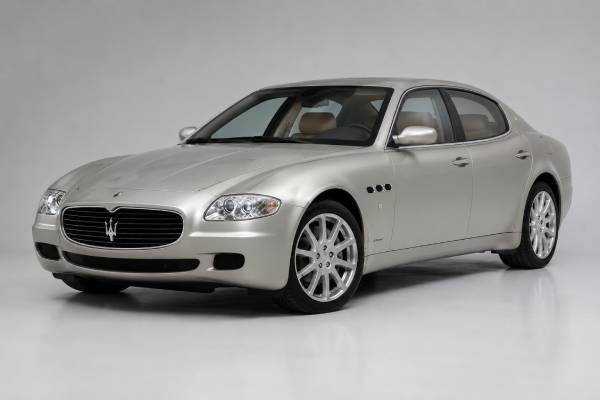
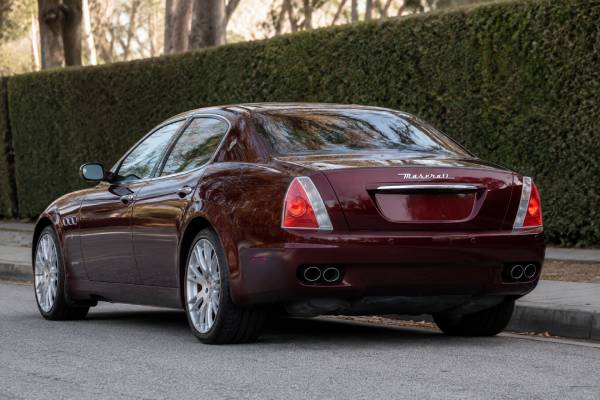
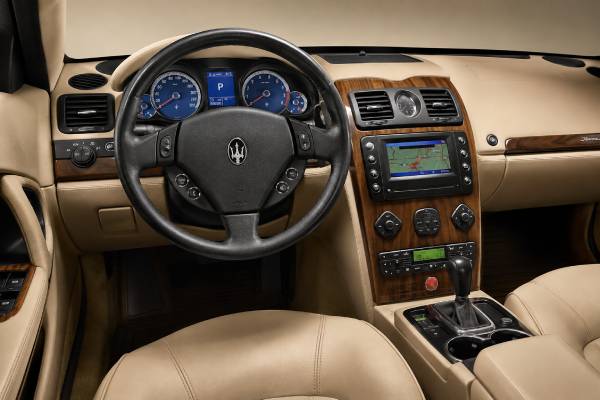
The 2004 Maserati Quattroporte Neiman Marcus Limited Edition is a 60-car U.S.-market commission based on the first-generation M139 DuoSelect sedan. It paired the standard 400 hp, 4.2-liter F136S dry-sump V8 and rear transaxle with a carefully defined color-and-trim package created for the 2004 Neiman Marcus Christmas Book. Every example was finished in Bordeaux Pontevecchio metallic, with polished 19-inch wheels, chrome mesh grilles and vents, ivory Poltrona Frau leather, Bordeaux piping, mahogany trim, and a personalized plaque. The cars were advertised at $125,000 and the allocation sold within minutes when telephone orders opened.
Although the assignment year is 2004, buyers will often encounter these cars titled or advertised as 2005 model-year Quattroportes because the catalog offer occurred late in 2004 and U.S. registration conventions followed the delivery car’s model year. That distinction should be documented, not treated as evidence of a fake. What matters is whether the chassis, factory specification, plaque, color, interior, wheels, books, and Neiman Marcus provenance agree. Mechanically, it remains a DuoSelect M139, so clutch wear, hydraulic shift hardware, cooling, suspension, electronics, and deferred service matter as much as rarity.
Table of Contents
- The Christmas Book Quattroporte That Sold Out
- F136S V8, Transaxle, and Core Specifications
- The Sixty-Car Neiman Marcus Specification
- Pininfarina Form and Rear-Biased Engineering
- How the Limited Edition Drives
- DuoSelect Service and Preservation Priorities
- Buying an Authentic Neiman Marcus Car
The Christmas Book Quattroporte That Sold Out
The Neiman Marcus Quattroporte is important because it turned Maserati’s new flagship into a tightly specified American collectible at the moment the brand was rebuilding its U.S. presence. It was not a higher-output model, but a documented 60-car design commission with a memorable retail story.
The fifth-generation Quattroporte had appeared in 2003 as a clean-sheet luxury sedan designed by Pininfarina. It replaced the compact, angular Quattroporte IV with a much larger four-door that combined formal passenger space with a Ferrari-related V8, a rear-mounted transaxle, and near-rear-biased weight distribution. The model was intended to make Maserati credible again against established German and British performance sedans while retaining a distinctly Italian shape and sound.
Neiman Marcus selected the Quattroporte as the featured automobile in its 2004 Christmas Book. The offer was limited to 60 cars at $125,000 each. Orders opened by telephone on October 14, 2004, and the allocation was reported sold within about three minutes. That result became part of the edition’s identity and is one reason the car is discussed separately from ordinary early M139s.
The catalog vehicle was described as a 2005 Quattroporte, even though the commission and sale event belong to 2004. A surviving car may therefore carry a 2005 model-year VIN or title while collectors refer to it as the 2004 Neiman Marcus edition. Buyers should reconcile the catalog, sales paperwork, build data, and registration rather than forcing every date into one label.
The edition’s appeal is strongest when the car remains visually complete. Bordeaux Pontevecchio paint, chrome mesh, polished wheels, ivory leather, dark red piping, mahogany, and the personalized plaque create the package. Remove several of those elements and the car becomes harder to distinguish from a repainted or retrimmed standard Quattroporte.
Rarity does not make every example valuable. Some accumulated damage, wear, or incomplete histories. A lower-mileage car with neglected fluids and a slipping clutch can be a worse purchase than a higher-mileage example with continuous specialist care.
F136S V8, Transaxle, and Core Specifications
The mechanical specification is the same compelling but maintenance-sensitive package used by the early Quattroporte DuoSelect: a 4,244 cc dry-sump V8 in front, a six-speed electrohydraulic manual transaxle at the rear, and rear-wheel drive. Its headline figures are 400 hp, approximately 451 Nm, and a top speed near 275 km/h.
| Item | Specification |
|---|---|
| Model code | M139 |
| Engine code | F136S |
| Engine | 90-degree all-aluminum V8, DOHC, four valves per cylinder |
| Displacement | 4,244 cc |
| Lubrication | Dry-sump system with external reservoir |
| Fuel and induction | Naturally aspirated, electronic multipoint injection |
| Maximum power | 400 hp at 7,000 rpm |
| Maximum torque | Approximately 451 Nm at 4,500 rpm |
| Transmission | Six-speed DuoSelect electrohydraulic automated-manual rear transaxle |
| Clutch | Electrohydraulically operated dry clutch |
| Drivetrain | Rear-wheel drive with limited-slip differential |
| Construction | Steel monocoque with front and rear subframes |
| Front suspension | Independent unequal-length double wishbones |
| Rear suspension | Independent unequal-length double wishbones |
| Damping | Skyhook electronically controlled adaptive dampers |
| Brakes | Four-wheel ventilated Brembo discs with ABS |
| Steering | Hydraulic power-assisted rack and pinion |
| Special-edition wheels | 19-inch polished alloy wheels |
| Wheelbase | 3,064 mm |
| Length | Approximately 5,052 mm |
| Width | Approximately 1,895 mm |
| Height | Approximately 1,438 mm |
| Kerb weight | Approximately 1,970 kg, depending on equipment and market method |
| Fuel capacity | Approximately 90 liters |
| 0–100 km/h | Approximately 5.2 seconds |
| Top speed | Approximately 275 km/h |
| Edition production | 60 cars |
The F136S is mounted behind the front-axle line as far as the sedan’s packaging permits. A rigid torque tube connects it to the rear transaxle. This separates the engine and gearbox mass, producing a quoted front-to-rear distribution around 47:53. The layout is more elaborate than a conventional front-engine automatic sedan, but it is central to the car’s steering response and high-speed composure.
Dry-sump lubrication stores oil in a separate reservoir and uses scavenging pumps to return oil from the crankcase. The arrangement helps maintain oil supply under cornering and lets the engine sit lower. It also adds hoses, unions, pumps, and a reservoir that must remain leak-free and correctly serviced.
DuoSelect is not a torque-converter automatic. Inside is a conventional six-speed manual gearbox and dry clutch; hydraulic actuators operate the clutch and select gears under electronic control. The driver chooses automatic operation or commands shifts with steering-column paddles. At low speed the system must slip the clutch to creep, so driving technique directly affects clutch temperature and life.
Skyhook uses electronically adjustable dampers and body sensors to balance comfort with control. Sport mode changes both damping and shift behavior. The chassis still depends on ordinary wear parts—bushes, ball joints, links, mounts, tires, and alignment—so electronic adjustment cannot compensate for looseness or aged rubber.
Performance figures vary slightly by source, test method, temperature, and launch technique. The useful conclusion is not that every car will reproduce a precise sprint time. A healthy example should feel genuinely fast above 3,500 rpm, pull cleanly to 7,000 rpm, shift without flare or warning messages, and remain stable under repeated braking.
The Sixty-Car Neiman Marcus Specification
Authentication depends on the complete commission specification, not on one badge. The strongest car combines factory records and original sales documents with the correct paint, brightwork, wheels, cabin, plaque, and untouched identity numbers.
The defining exterior color was Bordeaux Pontevecchio metallic, a deep wine-red finish that changes character with light. The front grille and side vents used chrome mesh rather than the darker treatment seen on some sporting versions. Polished 19-inch wheels added another bright visual element and were an explicit part of the offer.
Inside, Neiman Marcus specified ivory Poltrona Frau leather with Bordeaux piping. Mahogany veneer replaced the colder technical trim used in sport-oriented Quattroportes. The contrast between pale upholstery, red edging, and dark wood is central to the commission’s character and should appear consistently across seats, door panels, dashboard, and associated trim.
A personalized plaque is especially important. Contemporary descriptions state that it carried the owner’s name along with signatures associated with Neiman Marcus and Sergio Pininfarina. Plaques can be lost when dashboards are repaired, cars are resold, or interiors are changed. A missing plaque does not prove the chassis was never part of the run, but it removes one of the clearest pieces of original evidence and should affect confidence and price.
Evidence that should travel with the car
Useful provenance may include:
- Original Neiman Marcus order or allocation correspondence.
- Purchase invoice showing the special-edition description and price.
- Christmas Book material or a period catalog retained by the first owner.
- Window sticker, build sheet, dealer delivery record, and warranty booklet.
- Photographs of the personalized plaque before any restoration.
- Factory or importer confirmation matching the VIN to the limited run.
- Service records that carry the same owner, VIN, mileage, and color details.
- Receipts for any wheel refinishing, leather repair, paint correction, or plaque work.
Check the paint code, hidden jambs, engine bay edges, trunk channels, underside overspray, glass dates, panel labels, and fasteners. A quality repaint is not automatically undesirable, but the seller should explain why it was performed and provide photographs. Poor masking, uneven metallic orientation, filler, or inconsistent panel gaps points to work that deserves deeper inspection.
The interior should be evaluated as a matched set. New ivory leather on one seat may look cleaner than the rest but reduce visual consistency. Bordeaux piping should follow the original pattern. Mahogany veneer should match in grain and tone across panels; sun fading, cracks, lifting clearcoat, or replacement pieces are common on cars that spent time outdoors.
Because every original car was personalized, the plaque can raise privacy and restoration questions. Preserve it rather than replacing it with a new owner’s name. The first owner’s identity is part of the object’s history. Any reproduction plaque should be clearly documented and never represented as original.
Pininfarina Form and Rear-Biased Engineering
What makes the car special on the road is not the cosmetic package alone; it is the M139’s unusual combination of elegant Pininfarina proportions and a transaxle chassis closer in concept to a grand tourer than a normal chauffeur sedan.
The double-wishbone suspension controls wheel movement accurately through cornering. Skyhook varies damper force according to sensor input and selected mode. In its normal setting the car can absorb motorway undulations with a supple, expensive feel. In Sport, body movement tightens and the transmission uses more assertive shifts.
The hydraulic steering is one of the car’s lasting strengths. It provides natural effort and a progressive build-up of load that later electric systems often filter. Healthy front control arms, correct tire pressures, matched tires, and accurate alignment are essential; worn joints can make the steering wander, tramline, or knock.
Brembo brakes use ventilated discs at all four corners. Their capability suits the performance, but the sedan’s mass means neglected fluid, old tires, seized sliders, cracked hoses, or uneven pads quickly reduce confidence. A long pedal or steering pull under braking is a fault, not period character.
The cabin is a mix of hand-finished luxury and early-2000s electronics. Poltrona Frau leather and wood create warmth, while the center stack, navigation system, switches, and display reveal the car’s age. That contrast is acceptable when everything functions. Missing pixels, sticky surfaces, failed seat controls, sagging headliner, broken vents, or improvised audio wiring can turn a special interior into an expensive restoration project.
The F136S V8 contributes the emotional element. Its cross-plane architecture produces a deep idle and a harder metallic voice as revs rise. Dry-sump plumbing and the rear transaxle make the drivetrain feel purposeful. The system is not silent or seamless like a modern turbocharged automatic sedan, and that mechanical character is a major reason enthusiasts still seek it.
How the Limited Edition Drives
A sorted Neiman Marcus Quattroporte drives like an early M139 DuoSelect with added visual theater: balanced, vocal, fast once revved, and more involving than its formal body suggests. The gearbox rewards deliberate inputs but exposes poor technique and poor calibration immediately.
The V8 is responsive because it is naturally aspirated. At low rpm it is smooth rather than overwhelming. The strongest acceleration arrives through the middle and upper range, where the engine pulls with increasing urgency toward 7,000 rpm. There is no turbo delay, and the throttle provides a direct relationship between pedal movement and engine response.
DuoSelect works best when the driver treats it as the automated manual it is. In manual mode, a slight easing of the throttle during an ordinary upshift can reduce head movement and clutch shock. In Sport, shifts become faster and more forceful. Full-throttle changes should be crisp, but a violent bang, long pause, slipping flare, or gearbox warning requires diagnosis.
Automatic mode is convenient but can feel indecisive in slow traffic. It chooses clutch engagement and shift timing according to software, throttle position, speed, and temperature. Repeated creeping in a queue asks the clutch to slip constantly. Holding the car on an incline with the accelerator does the same. Use the brake, allow a gap to open, and move decisively rather than inching forward every few seconds.
Reverse deserves care because it often requires more clutch slip than forward motion. Long uphill reversing into a garage is a severe operating condition. When possible, arrange parking so the car can reverse downhill or enter the difficult slope in a forward gear.
Once moving, the transaxle layout becomes the reward. The nose changes direction willingly for a large sedan, and the rear feels planted under power. The car is not light, but its mass is distributed in a way that makes steering and corner entry more natural than the dimensions suggest.
Skyhook in normal mode allows controlled movement rather than a brittle ride. Sport mode improves body control on a smooth road, though aged low-profile tires and tired dampers can make it harsh. A crashy front end is more likely to indicate worn suspension, excessive tire pressure, bent wheels, or incorrect tire construction than an inherent trait.
The ideal test drive includes a cold start, low-speed maneuvering, stop-and-go traffic, open-road shifts, high-rpm acceleration, rough pavement, firm braking, and a hot restart. A five-minute loop cannot reveal clutch behavior, hydraulic pressure loss, cooling weakness, or heat-related electrical faults.
DuoSelect Service and Preservation Priorities
The largest ownership risk is deferred maintenance across several connected systems, not one universally fatal defect. A specialist inspection should measure clutch condition, test hydraulic operation, examine the dry-sump and cooling circuits, scan every control module, and assess the chassis before purchase.
Clutch and electrohydraulic shifting
Clutch life varies enormously with use. Urban creeping, hill holding, parking maneuvers, poor calibration, and repeated automatic-mode crawling can consume it quickly. Open-road manual-mode driving can be much kinder. Mileage alone therefore does not predict remaining life.
A Maserati-capable diagnostic system can read the calculated clutch-wear value and help evaluate engagement parameters. The number is useful but should be interpreted alongside clutch thickness data, bite-point setup, engagement quality, service history, and actual road behavior. A recently reset or incorrectly calibrated value can mislead.
The hydraulic pump, pump relay, accumulator, actuator, position sensors, lines, and electronic control all affect shifting. Frequent pump cycling may indicate pressure loss or a tired accumulator. Delayed engagement, inability to select a gear, neutral warnings, or changes that worsen hot should be investigated before replacing parts by guesswork.
A proper clutch replacement includes more than installing friction material. The flywheel, release components, pilot hardware, seals, sensor readings, actuator condition, alignment, and calibration should be checked. Labor is significant because the transaxle and torque-tube arrangement complicate access.
F136S engine, oil, and cooling
Start the engine from cold and listen for abnormal metallic rattle, chain or accessory noise, bearing knock, and exhaust leaks. Observe smoke, warning lights, oil pressure behavior, idle stability, and charging voltage. A seller-warmed engine removes valuable evidence.
Inspect the dry-sump reservoir, hoses, clamps, unions, pumps, cooler, filter area, and undertrays for oil. Verify the correct checking procedure because dry-sump oil level is temperature- and procedure-sensitive. Overfilling can be as undesirable as running low.
Cooling must remain stable in traffic with the air conditioning operating. Check radiators, condenser blockage, fans, relays, thermostat, expansion tank, cap, hoses, coolant age, and evidence of dried residue. Debris trapped between heat exchangers can reduce airflow without an obvious external leak.
Investigate misfires, rough idle, or loss of power through plugs, coils, injectors, intake leaks, airflow measurement, fuel pressure, exhaust restriction, and control faults. Do not accept an illuminated warning lamp simply because the car still feels fast.
Chassis, brakes, and electronics
Inspect front and rear wishbones, ball joints, bushings, anti-roll-bar links, wheel bearings, dampers, springs, steering rack, tie rods, subframe mounts, and alignment. Uneven inner-edge tire wear can reveal geometry or worn-joint problems.
Certain U.S. Quattroportes from the broader early production period were included in a rear tie-rod corrosion safety recall. Eligibility must be checked by VIN and market rather than assumed from the edition name. Confirm completion documentation and inspect current hardware.
Measure brake discs and examine pads, calipers, hoses, fluid, ABS operation, and parking brake. A car that sat for years may have more corrosion and seal problems than a regularly exercised example.
Electrical checks should cover battery age, charging, grounds, windows, locks, mirrors, seats, memory, heaters, ventilation, climate control, parking sensors, navigation, audio, instruments, warning lamps, alarm, immobilizer, trunk release, lighting, and suspension modes. Low voltage creates cascading faults, but repeated warnings should not be dismissed without finding the cause.
For preservation, retain every special-edition component removed during repair. Store original wheels, trim, audio parts, plaque hardware, books, keys, and even damaged recoverable pieces. Photograph markings before refinishing. A reversible repair protects value better than an undocumented modernization.
Buying an Authentic Neiman Marcus Car
The right purchase is a fully documented Neiman Marcus chassis with a healthy DuoSelect drivetrain and complete special trim. Do not pay the limited-edition premium first and investigate authenticity or mechanical condition later.
Begin remotely by requesting the VIN, plaque photographs, paint code, wheel markings, interior details, underhood labels, trunk labels, title, original invoice, catalog paperwork, build information, and a continuous service timeline. Compare dates carefully. The 2004 sale event and a 2005 model-year title can coexist legitimately.
Ask for high-resolution images in daylight. Bordeaux metallic can conceal mismatched panels in indoor photographs. Inspect reflections along each side, panel gaps, lower bumpers, wheel arches, door edges, trunk floor, front structure, jacking points, and underside. Obtain paint-depth readings across the body.
A specialist pre-purchase inspection should include:
- Confirming the VIN and limited-edition provenance.
- Verifying original color, chrome mesh, wheel type, interior pattern, wood, and plaque.
- Reading all control modules and saving a fault-code report.
- Measuring or interpreting clutch wear and engagement setup.
- Testing hydraulic pump cycle, pressure retention, gear selection, and hot shifts.
- Inspecting the dry-sump oil circuit and checking hot oil behavior.
- Pressure-testing cooling and verifying both fan stages.
- Examining suspension joints, rear tie rods, steering, tires, brakes, and alignment.
- Testing every cabin function and looking for modified wiring.
- Reviewing recall completion, invoices, mileage evidence, and accident history.
The road test must begin cold. Confirm that first and reverse engage without excessive delay, shudder, or warning. Drive slowly without forcing the car to creep, then test normal and Sport shifts. Use enough time to bring the engine, clutch, gearbox, and cabin fully to temperature.
Budget a baseline service even for a strong car. Engine oil and filter, coolant, brake fluid, gearbox and differential fluids where due, filters, battery testing, tires by age, belt and hose inspection, alignment, and diagnostic calibration create a known starting point. Follow the official schedule and specialist guidance for the VIN and market.
Avoid examples with doubtful provenance, missing identity evidence, structural damage, severe corrosion, persistent gearbox warnings, slipping clutch, low hydraulic pressure, unstable coolant temperature, heavy oil leaks, unexplained smoke, or hacked electronics. A discount rarely covers several of these at once.
Modifications require judgment. A modern head unit, upgraded relay, improved battery maintainer connection, or carefully documented service improvement can make the car easier to use. Non-original wheels, altered suspension, loud exhausts, color changes, retrimmed cabins, and removed plaques reduce the very qualities that justify buying this edition.
The Neiman Marcus Quattroporte succeeds as a collectible because its story is easy to understand and its appearance is genuinely distinctive. It also remains a sophisticated 400 hp Italian sedan whose mechanical condition can change the ownership experience completely. Verify the 60-car identity, inspect it as rigorously as any DuoSelect, and preserve the parts that make the commission recognizable.
References
- Quattroporte V Duoselect – Quattroporte models | Maserati 2026 (Manufacturer Heritage Specifications)
- Maserati TechInfo 2026 (Manufacturer Technical Information)
- Maserati Quattroporte NM 2004 (Period Special-Edition Report)
- 2005 Neiman Marcus Maserati Quattroporte Races to Sell-Out in Record Time 2004 (Period Sales Announcement)
- Maserati Quattroporte V buyer’s guide: what to pay and what to look for | Classic & Sports Car 2026 (Model Buying Guide)
Disclaimer
This article is for informational purposes only and is not a substitute for professional diagnosis, repair, valuation, authentication, or restoration advice. Specifications, model-year records, equipment, recalls, service needs, and limited-edition details can vary by VIN and market. Verify every car against official documents and commission a qualified Maserati specialist before purchase or repair.
Please share this article on Facebook, X/Twitter, or your preferred enthusiast community if it was useful. Sharing supports the creation of more detailed specialist-car guides.