
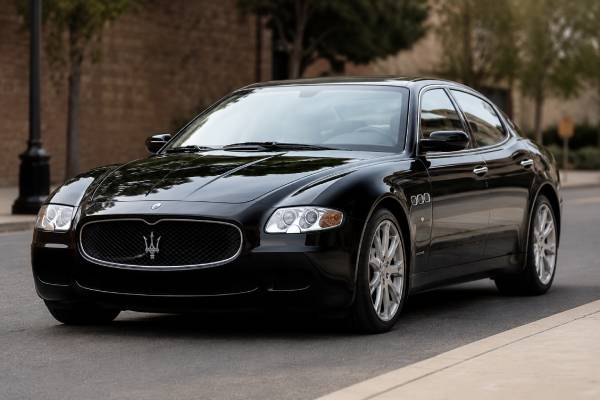
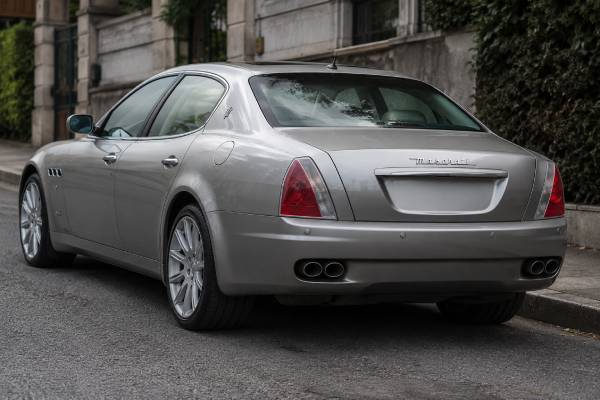
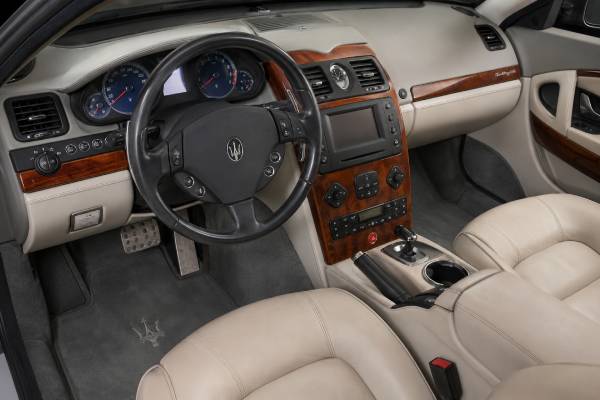
The 2003–2008 Maserati Quattroporte DuoSelect is the original and most mechanically distinctive form of the fifth-generation M139 sedan. Pininfarina shaped a five-meter luxury car around a 400 hp, 4.2-liter F136S V8, then Maserati placed its six-speed gearbox and differential at the rear. That transaxle arrangement produced a quoted 47:53 front-to-rear weight distribution and gave the Quattroporte unusually eager handling for a large four-door. It also introduced the feature that defines ownership: DuoSelect is an electrohydraulically operated manual transmission, not a conventional automatic.
That distinction explains both the car’s appeal and its reputation. The paddles, dry clutch, fast Sport-mode shifts, hydraulic steering, Skyhook dampers, and high-revving naturally aspirated V8 make the early M139 feel like a grand tourer with rear doors. In heavy traffic, however, the control system must slip the clutch whenever the car creeps, and poor technique or neglected calibration can shorten clutch life sharply. A good example is charismatic, balanced, and still special. A bad one can combine clutch, hydraulic, suspension, cooling, and electrical bills. The right buying approach is therefore simple: verify the exact transmission, inspect it with Maserati diagnostics, and judge the whole car rather than its low purchase price.
Table of Contents
- Why the First M139 Still Matters
- Dry-Sump V8 and Rear-Transaxle Specifications
- Model Years, Trims, and Factory Choices
- The Engineering Behind the DuoSelect Layout
- Driving a Large Sedan Like a Manual
- Clutch, Hydraulics, and M139 Maintenance
- Choosing a Sorted DuoSelect Quattroporte
Why the First M139 Still Matters
The DuoSelect is the purest expression of the original M139 concept: front-mid-mounted V8, rear transaxle, rear-biased balance, and luxury-sedan space. It matters because the later ZF automatic improved everyday smoothness but changed the architecture that made the launch car so unusual.
Maserati unveiled the fifth-generation Quattroporte in 2003, during the period when Ferrari controlled the company’s engineering and production renewal. The new sedan replaced the compact Marcello Gandini-designed Quattroporte IV with a larger, more internationally competitive flagship. Pininfarina gave it an elegant body with an oval grille, three side vents, a low nose, a long wheelbase, and a tightly tapered rear.
The mechanical brief was more adventurous than the body suggested. The F136S engine sat behind the front axle line, while a torque tube connected it to a Graziano six-speed transaxle at the rear. Suspension used unequal-length double wishbones at all four corners. Hydraulic steering and electronically controlled Skyhook dampers supported the aim of making a chauffeur-capable sedan respond like a sports car.
Maserati built 10,639 DuoSelect Quattroportes across the 2003–2008 production period, according to the company’s heritage data. The range began as a single model and later expanded into luxury-focused Executive GT and performance-focused Sport GT derivatives, followed by the sharper Sport GT S. A 60-car Neiman Marcus edition also appeared in the United States. All retained the dry-sump engine and rear transaxle while the separate Automatica family adopted a wet-sump engine and front-mounted ZF torque-converter transmission.
The car’s market reputation became dominated by the gearbox. Some early buyers expected an automatic that would creep smoothly and mask every shift. DuoSelect instead behaves like a manual clutch operated by software and hydraulics. When driven as designed, it can be direct and engaging. When forced to inch through traffic or held on hills with the accelerator, it creates heat and wear.
That misunderstanding pushed used prices down and gave the model a “cheap exotic” image. Purchase price is only the entry point. A clutch job, actuator or selector repair, dampers, control arms, tires, brakes, interior electronics, and cosmetic restoration can exceed the cost of an inexpensive car.
Enthusiasts now value the same traits that once caused complaints. The naturally aspirated V8 has immediate response, the steering is rich in feedback, the rear-biased chassis rotates naturally, and the paddle transmission makes every change deliberate. The DuoSelect is less convenient than the ZF version, but it offers a clearer connection to the Ferrari-era Maserati coupes and their Cambiocorsa systems.
A good car should not be excused for faults simply because it is Italian or old. It should start cleanly, maintain temperature, hold hydraulic pressure, select gears promptly, shift consistently, track straight, absorb bumps without crashing, and operate every major cabin function. Character and malfunction are not the same thing.
Dry-Sump V8 and Rear-Transaxle Specifications
The essential specification is a 4,244 cc naturally aspirated V8 producing 400 hp at 7,000 rpm and approximately 451 Nm at 4,500 rpm. Power reaches the rear wheels through a six-speed automated-manual transaxle and limited-slip differential.
| Item | Specification |
|---|---|
| Production | 2003–2008; 10,639 examples across DuoSelect derivatives |
| Body | Four-door, five-seat sedan designed by Pininfarina |
| Construction | Steel monocoque with front and rear subframes; aluminum hood and trunk lid |
| Engine code | F136S |
| Engine | 90-degree aluminum V8, 32 valves, dual overhead camshafts |
| Displacement | 4,244 cc |
| Induction and fuel | Naturally aspirated with electronic multipoint injection |
| Lubrication | Dry sump with external oil reservoir |
| Maximum power | 400 hp at 7,000 rpm |
| Maximum torque | Approximately 451 Nm at 4,500 rpm |
| Transmission | Six-speed DuoSelect electrohydraulic automated manual |
| Transmission position | Rear transaxle connected by torque tube |
| Drivetrain | Rear-wheel drive with limited-slip differential |
| Weight distribution | Approximately 47 percent front, 53 percent rear |
| Front suspension | Unequal-length double wishbones with coil springs |
| Rear suspension | Unequal-length double wishbones with coil springs |
| Dampers | Skyhook electronically controlled adaptive damping on core models |
| Brakes | 330 mm ventilated discs with four-piston calipers |
| Steering | Hydraulic power-assisted rack and pinion |
| Wheelbase | 3,064 mm |
| Length | 5,052 mm |
| Width | 1,895 mm |
| Height | Approximately 1,438 mm |
| Kerb weight | Approximately 1,970 kg, depending on market specification |
| Fuel capacity | Approximately 90 liters |
| 0–100 km/h | Approximately 5.2 seconds |
| Top speed | Approximately 275 km/h |
The all-aluminum F136S belongs to the Ferrari-Maserati engine family but uses Maserati-specific tuning and a cross-plane crankshaft. Four camshafts operate four valves per cylinder, with variable timing on the intake side. The cross-plane layout creates a deeper, uneven exhaust character than a flat-plane Ferrari V8 and delivers smooth torque suitable for a heavy sedan.
Dry-sump lubrication scavenges oil from the crankcase and stores it in a separate reservoir. It supports reliable oil pickup during hard cornering and permits low engine placement. Service must follow the correct temperature and checking procedure; treating it like an ordinary wet-sump engine can lead to a misleading level reading or overfill.
DuoSelect contains conventional gears and a dry clutch. An electric-hydraulic pump creates pressure, an accumulator stores it, and actuators operate clutch and shift mechanisms. The transmission control unit decides how quickly to engage the clutch and change ratios. The rear transaxle also contains the differential, concentrating driveline mass over the driven axle.
The braking hardware is substantial, but nearly two tonnes of car creates heat. Disc thickness, pad condition, fluid age, caliper operation, tire grip, and wheel alignment all determine real stopping performance. Published acceleration and speed numbers assume a healthy engine, correctly operating transmission, suitable tires, and favorable test conditions.
Model Years, Trims, and Factory Choices
The base DuoSelect remained mechanically consistent, but equipment, trim, software, market specifications, and special derivatives changed through the run. Buyers should identify the actual version by VIN and equipment rather than relying on a seller’s badge description.
Early cars established the standard specification: chrome horizontal-slat grille, Skyhook dampers, Brembo brakes, leather cabin, wood veneer, and extensive color customization. Maserati offered numerous exterior paints, leather colors, contrast piping, stitching choices, woods, wheel designs, and convenience options through its personalization program.
The Executive GT arrived for the 2006 model year in many markets as the comfort-oriented interpretation. It could include chrome mesh grilles, polished 19-inch wheels, richer wood, an Alcantara headliner, rear climate controls, rear blinds, veneered picnic tables, and ventilated or massaging rear seating. Exact standard and optional equipment varied by country.
The Sport GT took the opposite direction. It used revised transmission and Skyhook software for quicker shifts and firmer damping, 20-inch wheels, cross-drilled brake discs, braided lines, darker mesh, red Trident details, aluminum pedals, a sports steering wheel, and carbon-fiber cabin trim.
The pre-facelift Sport GT S intensified the concept with lower ride height, single-rate dampers in place of Skyhook, wider rear tires, and upgraded front brakes with dual-cast discs and six-piston calipers. It remained a 400 hp 4.2-liter car during the 2007–2008 period covered by this assignment; it should not be confused with the later facelifted 4.7-liter Sport GT S.
The Neiman Marcus Christmas Book edition was a 60-car U.S. commission with Bordeaux Pontevecchio paint, ivory leather with Bordeaux piping, mahogany, chrome mesh, polished wheels, and personalized plaques. Its provenance should be proved independently rather than inferred from color.
From 2007, Maserati also sold the Quattroporte Automatica. It retained 4.2-liter displacement and 400 hp but used the wet-sump F136UC engine and a conventional six-speed ZF automatic attached to the engine. Its 49:51 distribution, smoother low-speed behavior, and different service needs make it a separate model, not merely a DuoSelect with another gear selector.
Identification details worth recording
Before ordering parts or valuing a car, document:
- Complete VIN, market, build date, and model year.
- F136S engine identity and rear-transaxle layout.
- Base, Executive GT, Sport GT, Sport GT S, or special-edition equipment.
- Wheel casting numbers, size, and original finish.
- Brake-disc and caliper specification.
- Skyhook presence or fixed-damper conversion.
- Paint, leather, piping, veneer, and headliner codes.
- Original radio, navigation, telephone, and audio equipment.
- Campaign and recall completion records.
Options can make two apparently similar cars feel different. Nineteen-inch wheels generally provide more compliance and lower replacement cost than 20-inch Sport GT wheels. Rear comfort equipment adds luxury but also motors, fans, switches, and trim that can fail. Carbon trim is less prone to wood-grain mismatch but can crack or delaminate.
Modifications are common because low resale values once encouraged experimentation. Aftermarket suspension, wheels, exhausts, stereos, immobilizers, and transmission software need careful assessment. A reversible, documented improvement is different from cut wiring, poor offsets, deleted warning systems, or an uncalibrated clutch installation.
The Engineering Behind the DuoSelect Layout
Maserati accepted extra complexity to move mass rearward and make a large sedan turn with unusual neutrality. The transaxle, torque tube, engine placement, wishbone suspension, and hydraulic steering operate as one system, so wear in any part can spoil the intended balance.
Placing the engine within the wheelbase reduces the tendency of the nose to resist direction changes. Moving the gearbox and differential to the back increases rear traction and helps distribute braking load. The quoted 47:53 static split does not mean the car is tail-heavy in motion; acceleration, braking, passenger load, and cornering continually transfer weight.
The torque tube aligns the engine with the transaxle and contains the connecting shaft. Mounts at the engine, tube, gearbox, and rear subframe control vibration. Deteriorated mounts can cause thumps, resonance, harsh engagement, or movement that is mistaken for internal gearbox damage.
Double-wishbone suspension lets engineers control camber and tire contact through travel. Forged aluminum arms and hub carriers reduce unsprung mass, while anti-roll bars limit body lean. The layout needs accurate alignment and sound ball joints. Worn components often reveal themselves through inner-edge tire wear, braking instability, steering knock, or a nervous rear axle.
Skyhook reads body movement and adjusts damper valves. In normal operation it should broaden the car’s range, not produce a dramatic on-off transformation. A failed damper, broken wire, bad sensor, weak mount, or mismatched replacement can create a hard ride or warning message. Some owners convert to fixed dampers; that may reduce future electronic cost but changes originality and must be engineered as a matched set.
The steering remains hydraulically assisted and relatively quick. Healthy cars provide a smooth build-up of effort and clear information through the wheel. Tramlining can come from wide old tires, wrong pressures, bent wheels, excessive toe, or worn arms rather than the steering rack alone.
Driving a Large Sedan Like a Manual
The DuoSelect becomes smooth and satisfying when the driver anticipates clutch engagement and shift timing. It feels awkward when treated as a modern torque-converter automatic that should crawl indefinitely without consequence.
At startup, the hydraulic pump usually runs to build pressure. First gear should engage without an excessive pause or warning. The car then moves as the automated clutch closes. There is no torque converter to multiply torque or absorb slip, so the initial take-up feels more deliberate than in a normal automatic.
In manual mode, use the paddles and make small throttle adjustments during moderate upshifts. The system can change at full throttle without lifting, especially in Sport mode, but relaxed driving often becomes smoother when the driver briefly reduces load as the gear engages. Downshifts should be prompt and accompanied by controlled rev matching.
Automatic mode is useful on open roads but may choose a ratio or shift point a human driver would not. Its behavior adapts to driving style and clutch setup, so two cars can feel different. Persistent skipped gears, neutral selection, shudder, or slow hot changes requires investigation rather than adaptation by the driver.
Clutch-friendly low-speed technique matters:
- Do not hold the car on an incline with the accelerator.
- Avoid moving a few centimeters at a time in queues.
- Let space open and then move in one clean action.
- Minimize long uphill reversing.
- Use the brake while stopped rather than balancing clutch slip.
- Allow engagement to finish before demanding heavy throttle.
The V8’s delivery suits manual control. It is tractable at low rpm, becomes urgent in the middle range, and sounds increasingly hard-edged near 7,000 rpm. The absence of turbocharging makes throttle response linear and allows the driver to meter power precisely on corner exit.
The chassis is the car’s greatest dynamic surprise. The steering initiates a turn cleanly, the long wheelbase keeps responses stable, and rear-biased mass helps the car rotate without feeling nose-led. Stability control provides a safety layer, but old or mismatched tires can overwhelm the calibration.
Clutch, Hydraulics, and M139 Maintenance
The service plan should prioritize diagnosis and preventive work rather than waiting for a failure message. Clutch measurement, hydraulic pressure behavior, fluid condition, cooling efficiency, suspension wear, and battery health are the central ownership indicators.
DuoSelect clutch and hydraulic system
Use Maserati-capable SD2, SD3, or equivalent specialist diagnostics to read clutch-related parameters, fault history, actuator positions, and hydraulic data. The reported wear percentage is not infallible; it must be interpreted with engagement feel, setup values, records, and physical condition.
A clutch can wear quickly in city use and last far longer on open roads. Claims based only on mileage are unreliable. Ask who calibrated the clutch, whether the flywheel and release components were inspected, and whether the invoice includes setup work after installation.
Pump relays can overheat or stick, pumps can weaken, accumulators can lose pressure, and actuator or selector components can leak or bind. Repeated pump operation, a long delay before gear selection, unexpected neutral, or deterioration after warming are warning signs. Replacing the clutch without testing the pressure system can leave the actual fault untouched.
Engine and cooling system
The F136S uses timing chains rather than a routine timing belt, but that does not make it maintenance-free. Listen for abnormal startup rattle, accessory noise, exhaust leaks, and knock. Check for oil around the dry-sump reservoir, hoses, cooler, cam covers, filter housing, and undertrays.
Service the engine with the specified oil and the correct dry-sump level procedure. Inspect belts, tensioners, pulleys, engine mounts, intake boots, vacuum lines, coils, plugs, injectors, and fuel pressure. Misfires under load can damage catalysts and should not be ignored.
The cooling system must hold stable temperature in traffic with air conditioning active. Clean debris from heat exchangers and test fans, relays, thermostat, cap, expansion tank, hoses, and coolant concentration. A highway-only test may hide weak low-speed cooling.
Suspension, brakes, tires, and body
Inspect wishbone ball joints and bushings, anti-roll links, tie rods, wheel bearings, dampers, springs, steering rack, subframes, and driveline mounts. Confirm any applicable rear tie-rod recall by VIN and inspect the current parts even when completion is recorded.
Measure brake discs, examine calipers and hoses, and replace aged fluid. Use matched premium tires of the correct load and speed rating. Tire age and construction affect steering and stability as much as tread depth.
Check door bottoms, wheel arches, sills, jacking points, subframe areas, trunk well, and repaired panels for corrosion or poor accident work. The steel structure is durable when protected, but drainage, coastal use, winter salt, and bad lifting practices create localized problems.
Cabin and electrical systems
Test every switch and motor. Common age-related issues include window regulators, sticky coatings, sagging headliner, worn seat bolsters, cracked or lifting veneer, parking sensors, navigation screens, climate-control faults, and battery-sensitive warning lights. Inspect aftermarket audio and alarm wiring carefully.
Maintain a strong battery with the correct capacity and use a quality maintainer during storage. Measure alternator output and voltage drop across main grounds. A low-voltage history can create stored faults, but recurring errors need module-level diagnosis.
Choosing a Sorted DuoSelect Quattroporte
Buy the car with the best verified condition and service history, not the lowest mileage or cheapest advertisement. A properly calibrated clutch, healthy hydraulics, current cooling and suspension work, and functional electronics are worth more than cosmetic shine.
First confirm that the car is truly DuoSelect. Look for the rear transaxle, dry-sump F136S identification, paddle controls, and relevant build data. Some advertisements call every early Quattroporte an automatic, while others confuse the ZF car with the electrohydraulic model.
Request records before inspection. Useful documents show annual servicing, clutch replacement details, diagnostic readings, hydraulic work, coolant and brake-fluid changes, suspension repairs, tires, alignment, battery replacement, recall completion, and consistent mileage.
Commission a Maserati specialist to perform these checks:
- Cold-start the engine and scan all control modules.
- Record clutch wear, bite-point data, actuator values, and hydraulic pump behavior.
- Test first, reverse, automatic mode, manual mode, Sport, and hot operation.
- Inspect dry-sump plumbing, oil leaks, mounts, and exhaust.
- Pressure-test cooling and verify fan operation.
- Check wishbones, tie rods, dampers, bearings, subframes, brakes, wheels, and tires.
- Measure paint and inspect structural repair or corrosion.
- Operate every seat, window, lock, light, sensor, climate, audio, and suspension control.
- Verify specification, options, keys, books, tools, and VIN labels.
- Estimate immediate and two-year maintenance rather than only listing faults.
Reject a car that cannot be started cold, has persistent transmission warnings, cannot hold hydraulic pressure, slips the clutch under acceleration, overheats, shows low oil pressure, carries structural damage, or has extensive undocumented wiring changes. Each fault can be repaired, but several together make the economics difficult.
Do not assume a recently fitted clutch solves every transmission concern. Ask for the invoice, component list, flywheel decision, actuator inspection, and final calibration report. Likewise, new tires do not correct worn ball joints, and a new battery does not repair a failing alternator or module.
After purchase, establish a baseline. Change overdue fluids, inspect filters and belts, verify clutch setup, clear only diagnosed faults, align the chassis, date the tires, and document every measurement. Learn the low-speed technique before using the car in dense traffic.
The DuoSelect is not the universally easiest Quattroporte V, and that is precisely why it remains interesting. Its transaxle gives the M139 the balance intended at launch, while the dry-sump V8 and paddles make a large sedan feel mechanical and alive. Buy one only with specialist evidence, then drive it as an automated manual rather than apologizing for what it is.
References
- Quattroporte V Duoselect – Quattroporte models | Maserati 2026 (Manufacturer Heritage Specifications)
- Maserati TechInfo 2026 (Manufacturer Technical Information)
- Maserati Quattroporte V buyer’s guide: what to pay and what to look for | Classic & Sports Car 2026 (Model Buying Guide)
- Vehicle Detail Search – 2006 MASERATI QUATTROPORTE | NHTSA 2026 (U.S. Safety Recall Information)
Disclaimer
This article is for informational purposes only and does not replace factory service information, professional diagnosis, or a pre-purchase inspection. Specifications, equipment, recalls, clutch readings, fluid procedures, and service requirements vary by VIN, market, model year, and repair history. Use official documentation and a qualified Maserati specialist for all buying and maintenance decisions.
Please share this article on Facebook, X/Twitter, or your preferred enthusiast community if it was useful. Sharing supports the creation of more detailed specialist-car guides.