
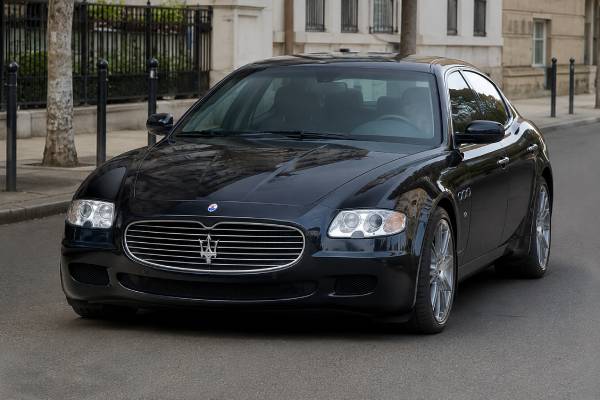
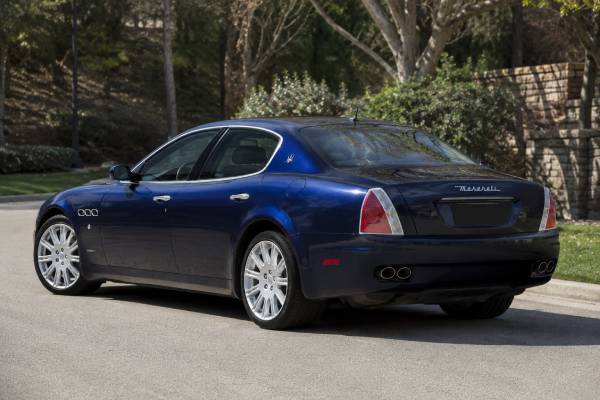
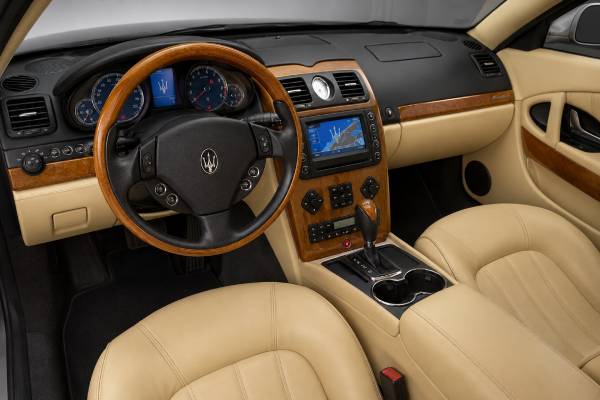
The 2005–2008 Maserati Quattroporte Executive GT is the comfort-led version of the original M139 DuoSelect sedan. Introduced alongside the Sport GT at the 2005 Frankfurt Motor Show, it kept the 400 hp F136S dry-sump V8, rear-mounted six-speed transaxle, Skyhook adaptive damping, and 47:53 weight distribution, then added a richer rear-cabin and exterior specification. Chrome mesh grilles, polished 19-inch wheels, a wood-and-leather steering wheel, Alcantara headlining, rear climate controls, blinds, folding veneered tables, and available heated, ventilated, massaging rear seats distinguished it from the standard car.
The Executive GT is therefore not a softer mechanical derivative or a different engine tune. It is a factory luxury package built on the same engaging but demanding DuoSelect architecture. That makes it unusually dual-purpose: the owner can enjoy hydraulic steering and a high-revving V8 from the front, while rear passengers receive equipment closer to a chauffeur limousine. Age complicates that promise. Every additional seat fan, motor, blind, table, switch, veneer panel, and climate function creates another inspection point, while the dry clutch and electrohydraulic gearbox still require informed driving. The best car is complete, correctly identified, mechanically sorted, and free from improvised repairs to its rare cabin equipment.
Table of Contents
- Maserati’s Rear-Seat-Focused M139
- Executive GT Powertrain and Chassis Data
- Luxury Equipment, Colors, and Option Content
- How Pininfarina Balanced Formality and Speed
- Comfort with a Transaxle Driving Character
- Maintaining the DuoSelect and Executive Cabin
- Inspecting a Complete Executive GT
Maserati’s Rear-Seat-Focused M139
The Executive GT was created for buyers who wanted the Quattroporte’s transaxle dynamics without sacrificing rear-passenger luxury. Its importance lies in making the early M139 a genuine owner-driver and chauffeur car at the same time.
When Maserati launched the fifth-generation Quattroporte in 2003, the range initially centered on one specification. The Pininfarina body, Ferrari-Maserati V8, rear transaxle, and Skyhook suspension gave it a personality unlike the more conventional luxury sedans it challenged. Two years later, the company divided that personality into clearer factory interpretations.
The Executive GT represented elegance and comfort. The Sport GT represented visual and dynamic aggression. Both retained the 4.2-liter F136S engine and DuoSelect electrohydraulic manual transmission during the years covered here. They were trim and calibration strategies, not simple horsepower steps.
For Executive GT buyers, the rear compartment was the decisive area. Available comfort seats added heating, ventilation, adjustment, and massage functions. Rear climate controls, powered window shades, an Alcantara headliner, and folding tables made the cabin suitable for business travel. Polished wheels and chrome mesh added formality outside without changing the Pininfarina sheet metal.
The combination was unusual. Most chauffeur-focused sedans used smooth torque-converter automatics and carried more of their mass at the front. The Executive GT kept the dry clutch and rear transaxle, so its driver still had to understand the gearbox. A rear passenger could enjoy a tailored cabin while feeling the pause and engagement of every automated-manual shift.
Market equipment varied. Some cars have the full rear comfort package; others carry only part of the Executive presentation. A seller may describe any wood-trimmed Quattroporte as an Executive GT, even though wood was available on standard cars. The identification must rest on VIN data, factory build records, labels, badges, wheels, grilles, and the complete option set.
The model also overlaps the arrival of the Quattroporte Automatica. In later pre-facelift years, Executive GT trim could be paired with the ZF automatic in some markets. This assignment covers the F136S DuoSelect version. Confirm the dry-sump engine and rear transaxle before applying its specifications or maintenance advice.
Today, the Executive GT is attractive because it remains understated. A Sport GT announces itself with carbon trim and 20-inch wheels; the Executive uses chrome, polished alloy, wood, soft leather, and pale headlining. Its rarity is less important than completeness. Missing rear tables, damaged veneer, nonfunctioning comfort seats, or swapped wheels can be difficult to correct.
Executive GT Powertrain and Chassis Data
Mechanically, the Executive GT is a 400 hp DuoSelect Quattroporte. Its 4,244 cc naturally aspirated V8 drives a six-speed rear transaxle, while double-wishbone suspension and adaptive dampers support both ride comfort and cornering control.
| Item | Specification |
|---|---|
| Platform code | M139 |
| Engine code | F136S |
| Engine | 90-degree all-aluminum V8, DOHC, 32 valves |
| Displacement | 4,244 cc |
| Induction | Naturally aspirated with electronic multipoint injection |
| Lubrication | Dry sump with external oil reservoir |
| Maximum power | 400 hp at 7,000 rpm |
| Maximum torque | Approximately 451 Nm at 4,500 rpm |
| Transmission | Six-speed DuoSelect electrohydraulic automated manual |
| Transmission position | Rear transaxle connected through a torque tube |
| Drive | Rear-wheel drive with limited-slip differential |
| Weight distribution | Approximately 47 percent front, 53 percent rear |
| Construction | Steel monocoque with front and rear subframes |
| Suspension | Unequal-length double wishbones front and rear |
| Damping | Skyhook electronically controlled adaptive dampers |
| Brakes | Four-wheel ventilated Brembo discs with ABS |
| Steering | Hydraulic power-assisted rack and pinion |
| Signature wheels | 19-inch ball-polished multi-spoke alloy wheels |
| Wheelbase | 3,064 mm |
| Length | 5,052 mm |
| Width | 1,895 mm |
| Kerb weight | Approximately 1,970 kg, varying with equipment |
| Fuel capacity | Approximately 90 liters |
| 0–100 km/h | Approximately 5.2 seconds |
| Top speed | Approximately 275 km/h |
The engine uses a cross-plane crankshaft, four camshafts, variable intake timing, and chain-driven camshafts. It develops power progressively rather than relying on forced induction. The peak figures arrive high in the rev range, yet sufficient mid-range torque moves the large sedan without constant downshifts.
Dry-sump lubrication helps the engine sit low and maintain oil supply during cornering. It also requires correct oil-level checking and careful inspection of the reservoir, cooler, hoses, unions, and scavenging system. Generic quick-service practices are inappropriate.
DuoSelect is a manual gearbox whose clutch and selectors are operated by an electrohydraulic system. There is no torque converter. Hydraulic pressure, clutch condition, actuator position, software calibration, and driver technique all influence how it moves away and changes gear.
The Executive’s extra cabin equipment may add modest weight, but it does not fundamentally alter the performance claim. Published acceleration can vary with launch method, clutch condition, tires, fuel load, and test standard. More useful evidence is whether the car pulls evenly, reaches high rpm cleanly, and shifts without slip, excessive delay, or warnings.
The standard 19-inch Executive wheel choice helps retain a more compliant ride than the Sport GT’s 20-inch setup. Correct offset, tire load rating, sidewall construction, pressure, and alignment still matter. A polished wheel that has been repeatedly refinished may hide cracks or lost material.
Luxury Equipment, Colors, and Option Content
An Executive GT is best identified as a coordinated luxury package rather than a single option. The correct car should show the expected bright exterior treatment and a cabin configured for rear-seat comfort, supported by factory records.
Period descriptions list a chrome mesh main grille and chrome mesh side vents, an exterior identification plate, and ball-polished 19-inch multi-spoke wheels. These details provide a formal appearance distinct from the darker mesh and larger wheels of the Sport GT.
Inside, a wood-and-leather steering wheel and Alcantara-covered roof section were signature items. The rear comfort package could include seats with heating, ventilation, massage, and additional adjustment. Rear climate controls allowed passengers to manage their environment without relying entirely on the front console.
Folding rear tables were available in wood or another coordinated finish, depending on market and personalization. Powered or manual shades reduced sunlight through the rear glass. Rich leather colors, contrast piping, stitching, and different veneer species allowed considerable variation, so two genuine Executive GTs need not look identical.
Equipment that deserves a function test
The inspection should cover more than whether the car has the parts:
- Run every rear-seat adjustment through its full travel.
- Check heat, ventilation fans, and massage on both sides.
- Test rear climate-control buttons, displays, vents, and temperature response.
- Raise and lower every shade repeatedly.
- Open tables gently and inspect hinges, catches, veneer, and support arms.
- Examine the Alcantara headliner for sagging, staining, and previous adhesive work.
- Check the wood-and-leather wheel for splitting, fading, and mismatched refinishing.
- Confirm that seat memory, front comfort functions, and steering-column controls work.
A nonfunctioning comfort seat may involve a switch, wiring, motor, fan, control module, mechanism, or damaged harness beneath the cushion. Diagnosis is preferable to forcing the seat or buying random used components. Rear tables are vulnerable to passengers leaning on them; broken hinges or missing latches can be hard to source in the correct finish.
Veneer should be inspected in natural light. Heat and ultraviolet exposure can cloud clearcoat, lift edges, crack curved pieces, and produce different colors across the cabin. A professional refinish can be excellent, but all pieces should match and original backing or markings should be retained.
Exterior chrome mesh can pit, bend, or lose plating. Replacement grilles from another model may fit but differ in finish or pattern. Polished wheels suffer curb damage and corrosion under clearcoat. Confirm that all four share the same design, dimensions, casting marks, and finish.
Factory personalization complicates authenticity in a useful way. An unusual color combination is not automatically incorrect. The build sheet, original order, window sticker, sales invoice, and option codes should explain it. Restoration should reproduce the documented car rather than an online photograph of another example.
How Pininfarina Balanced Formality and Speed
The Executive GT works because its luxury additions reinforce the M139’s formal side without hiding the performance architecture underneath. Pininfarina’s proportions remain elegant, while the transaxle and suspension preserve an athletic stance and response.
The low oval grille, sculpted hood, three fender vents, rising shoulder, and compact tail reduce the visual length of a five-meter body. Chrome mesh draws attention to the grille and vents, while the polished wheels provide brightness without the overt competition look of dark Sport GT trim.
The steel monocoque uses separate subframes to carry suspension and driveline loads. Aluminum exterior panels in selected areas help control mass. The engine sits rearward in the bay and the transaxle sits between the rear wheels, creating packaging that is sophisticated but service-intensive.
Rear passenger space comes from the long wheelbase rather than an extended-roof body. The roofline remains low and flowing, so very tall passengers should check headroom and entry. The broad transmission tunnel also influences the center rear position; the car is most luxurious for two rear occupants.
Skyhook adaptive damping is especially relevant to the Executive GT. In normal operation it allows compliance over long waves and rough surfaces while tightening individual dampers when sensors detect body movement. Sport mode reduces roll and pitch but cannot compensate for worn joints, old tires, leaking dampers, or poor alignment.
Hydraulic steering gives the driver detailed feedback that is increasingly rare in luxury sedans. The rear-biased layout helps the front tires turn rather than carry all the powertrain mass. At the same time, the Executive’s polished wheel and tire package should prioritize correct load capacity and ride quality rather than maximum visual width.
The cabin’s sensory character is deliberate. Soft leather, Alcantara, wood, polished metal, and a deep V8 exhaust note create a traditional Italian luxury atmosphere. Period navigation graphics, small buttons, and some Fiat-group switchgear are less timeless. Preserving function and finish is more important than pretending the technology is modern.
Cooling and airflow deserve attention because the low nose contains several heat exchangers. Undertrays and ducts guide air through the radiators and coolers. Missing panels, packed debris, or damaged fins can lead to high temperature in traffic, particularly with the air conditioning and rear climate functions operating.
Comfort with a Transaxle Driving Character
The Executive GT rides more graciously than its sporting siblings, but its controls still feel like those of an Italian grand tourer. The V8, paddles, hydraulic steering, and rear transaxle remain central to the experience.
The engine starts with a deep cross-plane pulse and becomes smoother as speed rises. Throttle response is immediate because there are no turbochargers. In ordinary use, the car can remain in the middle of the rev range; when the road opens, it pulls strongly toward 7,000 rpm with a harder induction and exhaust voice.
DuoSelect requires cooperation. In manual mode, a small throttle easing during moderate upshifts often creates the most polished progress for passengers. Sport mode speeds the process but introduces a firmer engagement. Automatic mode can be convenient, though its decisions and pauses may feel less natural in town.
Low-speed operation determines clutch wear. The system must slip its dry clutch to creep, reverse, or hold very low speed. Avoid inching repeatedly in traffic and never balance the car on an incline with the accelerator. Use the brake, create space, and move positively.
A chauffeur can learn to make DuoSelect smooth, but a buyer expecting torque-converter behavior may never enjoy it. The gearbox is most convincing once the car is moving, where shifts are cleaner and the transaxle’s balance becomes evident.
Steering response is light enough for city use and precise on faster roads. The sedan turns with less front-end reluctance than its size suggests. The long wheelbase keeps it stable, while the limited-slip differential helps deploy power through the rear tires.
In normal Skyhook mode, the Executive should absorb expansion joints and secondary roads without repeated bouncing. Harsh impacts may come from bent wheels, hardened tires, excessive pressure, worn mounts, or failed dampers. Float or diagonal movement can point to weak damping or suspension play.
Rear occupants will notice gearbox behavior and tire condition more than a driver might. During the test drive, sit in the back and listen for table rattles, seat noises, parcel-shelf vibration, wind leaks, suspension knocks, and climate-fan sounds. Confirm that the rear controls remain stable while the car is moving.
Braking should be progressive and straight. The mass and speed make fresh fluid, sound hoses, even pads, smooth discs, healthy calipers, and recent matched tires essential. A luxurious cabin does not reduce the consequences of neglected stopping hardware.
The Executive GT is at its best on a flowing road or long motorway journey, where the engine can work, the gearbox avoids constant clutch slip, and the chassis settles into its stride. Dense urban commuting is possible but represents the least sympathetic use for the transmission.
Maintaining the DuoSelect and Executive Cabin
Ownership success depends on treating the drivetrain and luxury equipment as separate specialist systems. A car can have a healthy V8 but a worn clutch, or a perfect transmission but thousands of dollars in failed rear-seat and trim hardware.
Clutch and hydraulic operation
Have a Maserati specialist read clutch wear and setup values with suitable diagnostic equipment. The calculated percentage is only one piece of evidence. Engagement quality, bite point, flywheel condition, pressure retention, fault history, and service invoices must support it.
Check how often the hydraulic pump runs, how quickly gears select, and whether behavior changes hot. The pump, relay, accumulator, actuator, sensors, lines, and connectors can each cause symptoms. Unexpected neutral, slow reverse, skipped shifts, warning messages, or repeated pressure cycling require diagnosis.
A clutch replacement should include inspection of the flywheel, release components, seals, mounts, and actuator condition, followed by correct calibration. A receipt that lists only a clutch disc is incomplete evidence.
Engine, cooling, and exhaust
Inspect the dry-sump reservoir and plumbing for leaks, then verify oil level using the correct warm procedure. Check cam covers, filter area, cooler, engine mounts, accessory drive, and undertrays. Listen to a genuinely cold start for abnormal rattle, knock, or exhaust leakage.
Test radiator fans, relays, thermostat, expansion tank, cap, hoses, condenser, and radiator faces. The temperature must stay stable in traffic with all climate systems running. Misfires, weak coils, old plugs, intake leaks, fuel-pressure problems, or damaged catalysts should be corrected promptly.
Chassis and comfort systems
Examine wishbones, ball joints, bushings, anti-roll links, wheel bearings, steering joints, rear tie rods, subframe mounts, dampers, and alignment. Confirm applicable safety campaigns by VIN. Measure brakes and assess tires by age, condition, specification, and matching set.
Operate comfort seats long enough to expose intermittent motors or overheating fans. Check harnesses under seats for crushing or poor repairs. Inspect shade tracks, table mechanisms, rear climate vents, headliner, veneer, leather stitching, and polished wheel finish.
Battery condition is crucial. Use the correct capacity, verify charging output and grounds, and maintain the car during storage. Low voltage may trigger multiple modules, but faults that return after voltage is restored need proper diagnosis.
Cabin parts can be scarcer than mechanical service items. Preserve removed switches, trim, table hardware, wheels, grilles, and upholstery pieces. A damaged original can provide patterns and markings for restoration even when it cannot be reused immediately.
Inspecting a Complete Executive GT
The ideal purchase is an authenticated F136S Executive GT whose rear-cabin equipment works and whose DuoSelect system has measurable life remaining. Buy the quality of the whole car rather than paying extra for a badge and incomplete options.
Request the VIN, build sheet, option codes, photographs of the engine bay and rear transaxle, wheel markings, grilles, badges, headliner, tables, rear controls, and seat switches. Confirm that it is the dry-sump DuoSelect model, not the later F136UC Automatica Executive GT.
Review invoices for annual service, clutch work, hydraulic components, diagnostic setup, cooling repairs, suspension arms, dampers, brake service, tires, batteries, and rear-cabin repairs. Mileage should align with inspection records and wear on the steering wheel, pedals, seat bolsters, switches, and door hardware.
Use a specialist inspection sequence:
- Start the car cold and save a complete module scan.
- Read clutch and actuator values and test hydraulic pressure retention.
- Drive in manual, automatic, and Sport modes until fully hot.
- Inspect dry-sump leaks, cooling, mounts, exhaust, and charging.
- Check every suspension joint, damper, wheel, tire, and brake.
- Test all front and rear seat functions, climate zones, shades, and tables.
- Inspect headliner, leather, piping, veneer, chrome mesh, and polished wheels.
- Verify VIN labels, accident history, paint depth, recalls, books, keys, and tools.
Do not accept “they all do that” for gearbox warnings, overheating, clunks, inoperative seat functions, or electrical resets. Normal DuoSelect shift feel is different from a fault, but a qualified technician can distinguish calibration, wear, and hardware failure.
Price rare trim damage realistically. One failed rear-seat function may be simple; multiple broken tables, mismatched veneer, sagging Alcantara, curb-damaged wheels, and corroded grilles can turn the cabin into a long sourcing project. Mechanical neglect on top of that makes a cheap car expensive.
A higher-mileage example with recent clutch calibration, suspension renewal, cooling work, matched tires, and documented cabin repairs may be preferable to a low-mileage car stored without maintenance. Regular use helps seals, switches, and hydraulic components remain active, provided fluids and heat cycles were managed correctly.
After purchase, establish a baseline and record every special component. Photograph option labels, trim markings, wheel stamps, and table hardware. Use conservative leather and Alcantara care, avoid silicone-heavy products, and protect the cabin from ultraviolet heat.
The Executive GT occupies a distinctive niche: it is the luxurious early Quattroporte that still carries Maserati’s rear-transaxle experiment. Its strongest examples deliver comfort without becoming anonymous. Confirm the specification, make every rear-seat feature prove itself, and demand the same mechanical evidence required of any DuoSelect.
References
- Quattroporte V Duoselect – Quattroporte models | Maserati 2026 (Manufacturer Heritage Specifications)
- Maserati TechInfo 2026 (Manufacturer Technical Information)
- Maserati Quattroporte at the 2005 Frankfurt Show | Classic Driver Magazine 2005 (Period Model Announcement)
- Two new versions of Maserati Quattroporte 2005 (Period Equipment Report)
- Maserati Quattroporte V buyer’s guide: what to pay and what to look for | Classic & Sports Car 2026 (Model Buying Guide)
Disclaimer
This article is for informational purposes only and is not a substitute for factory documentation, professional diagnosis, valuation, or a pre-purchase inspection. Equipment, specifications, recalls, clutch readings, and service requirements vary by VIN, market, model year, and personalization. Confirm the individual car with official records and a qualified Maserati specialist.
Please share this article on Facebook, X/Twitter, or your preferred enthusiast community if it was useful. Sharing supports the creation of more detailed specialist-car guides.