
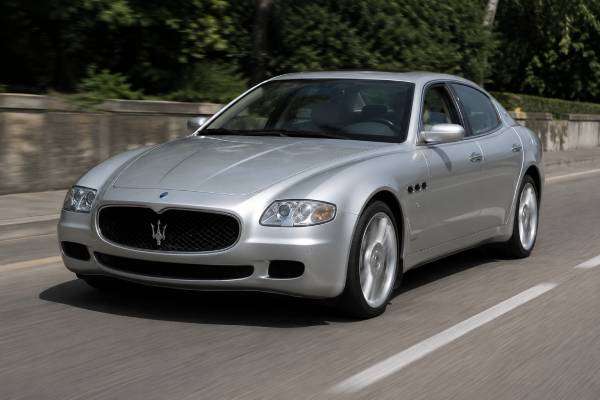
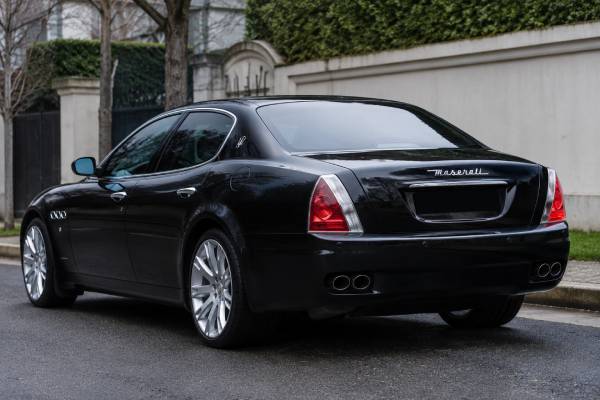
The 2005–2008 Maserati Quattroporte Sport GT sharpened the original M139 without raising its 400 hp output. Unveiled at the 2005 Frankfurt Motor Show, it combined the F136S dry-sump V8 and rear DuoSelect transaxle with revised control software, firmer Skyhook calibration, 20-inch wheels, drilled brake discs, braided brake lines, darker exterior details, and a carbon-trimmed cabin. Period information described shifts as up to 35 percent quicker, making the car feel more decisive even though its headline acceleration remained close to the standard Quattroporte.
The Sport GT was not intended to turn a two-ton sedan into a track special. It brought the M139’s strongest qualities into sharper focus: rear-biased balance, hydraulic steering, naturally aspirated response, firm braking, and a more assertive shift strategy. Those changes also create model-specific buying risks. Wheels bend, low-profile tires age, drilled rotors wear or crack, Skyhook components become costly, carbon trim can delaminate, and the DuoSelect clutch suffers when repeatedly slipped in traffic. A genuine, well-maintained Sport GT is one of the most involving early Quattroportes; a neglected one can combine ordinary M139 repair costs with expensive sporting hardware.
Table of Contents
- The First Factory Sporting M139
- Sport GT Engine, Chassis, and Brake Specifications
- Software, Wheels, Trim, and Market Variations
- How the Sport GT Created a Sharper Quattroporte
- Road Feel, Shift Speed, and V8 Character
- Sport GT Wear Points and Service Strategy
- Buying a Real and Healthy Sport GT
The First Factory Sporting M139
The Sport GT was Maserati’s first coordinated attempt to make the fifth-generation Quattroporte look, shift, ride, and brake more aggressively. It retained the launch car’s engine and transaxle, so its identity comes from factory calibration and hardware rather than additional horsepower.
The M139 had already proved that a large Pininfarina sedan could feel balanced and responsive. Its front-mid-mounted V8, rear transaxle, 47:53 weight distribution, double-wishbone suspension, and hydraulic steering separated it from conventional front-heavy luxury cars. The Sport GT amplified that formula in 2005, while the simultaneously introduced Executive GT emphasized rear-seat comfort.
The most important change was software. Revised DuoSelect control reduced shift time under the right conditions, and revised Skyhook mapping made the adaptive dampers firmer. The driver received a more immediate response without sacrificing the base car’s dry-sump lubrication, limited-slip differential, long wheelbase, or five-seat practicality.
Maserati supported the calibration with visible hardware. Seven-spoke 20-inch wheels and low-profile tires filled the arches. Cross-drilled brake discs and braided lines improved heat management and pedal consistency. Dark mesh grilles, darkened wheel or exhaust details in some markets, red accents on Trident badges, and model identification separated the exterior from the chrome-led Executive GT.
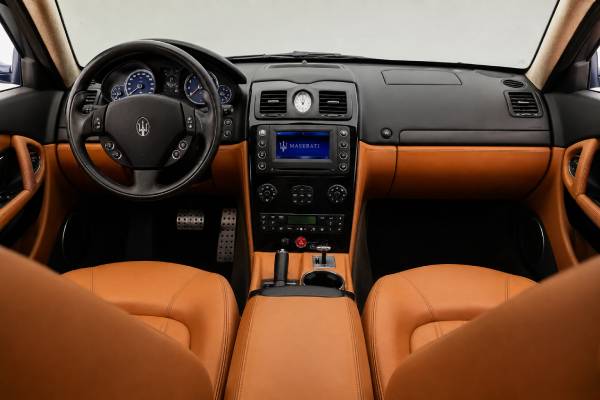
The interior followed the same direction. Carbon-fiber trim replaced traditional wood, aluminum pedals added a competition cue, and a sports steering wheel gave the driver a different touch point. Leather and Alcantara combinations appeared depending on order and market. The result was contemporary rather than formal, and complete original carbon remains important to value.
The Sport GT should not be confused with the Sport GT S. The later pre-facelift Sport GT S received more extensive suspension and brake changes, including fixed-rate dampers, lower ride height, wider rear tires, and dual-cast front discs with six-piston calipers. Nor should the 4.2-liter pre-facelift car be confused with the facelifted 4.7-liter Sport GT S launched later.
Used-car descriptions often blur these names. A standard DuoSelect with 20-inch aftermarket wheels, carbon wrap, or Sport badges is not automatically a Sport GT. The build sheet, VIN configuration, brake parts, suspension calibration, wheels, trim, and original sales paperwork should agree.
The model remains desirable because it adds focus without removing the early car’s distinctive architecture. The ZF automatic versions that followed are easier in traffic, while the Sport GT DuoSelect feels more deliberate. For an enthusiast who accepts the clutch and hydraulic system, it is a strong compromise between the base car and the rarer, more rigid Sport GT S.
Sport GT Engine, Chassis, and Brake Specifications
The Sport GT uses the same 4,244 cc F136S V8 and 400 hp rating as the standard DuoSelect, but revised shift and damper software, larger wheels, and upgraded braking hardware change how the performance is delivered.
| Item | Specification |
|---|---|
| Model code | M139 |
| Engine code | F136S |
| Engine | 90-degree aluminum V8, DOHC, 32 valves, variable intake timing |
| Displacement | 4,244 cc |
| Induction | Naturally aspirated with electronic multipoint injection |
| Lubrication | Dry sump with separate reservoir |
| Maximum power | 400 hp at 7,000 rpm |
| Maximum torque | Approximately 451 Nm at 4,500 rpm |
| Transmission | Six-speed DuoSelect automated manual with Sport GT software |
| Driveline | Rear transaxle, rear-wheel drive, limited-slip differential |
| Weight distribution | Approximately 47 percent front, 53 percent rear |
| Front suspension | Unequal-length double wishbones |
| Rear suspension | Unequal-length double wishbones |
| Damping | Skyhook adaptive system with firmer Sport GT calibration |
| Brakes | Ventilated, cross-drilled discs with braided lines and ABS |
| Steering | Hydraulic power-assisted rack and pinion |
| Wheels | 20-inch seven-spoke Sport GT alloys |
| Construction | Steel monocoque with front and rear subframes |
| Wheelbase | 3,064 mm |
| Length | 5,052 mm |
| Width | 1,895 mm |
| Kerb weight | Approximately 1,970 kg, depending on specification |
| Fuel capacity | Approximately 90 liters |
| 0–100 km/h | Approximately 5.2 seconds |
| Top speed | Approximately 275 km/h |
The cross-plane F136S produces a broad, smooth torque curve and a distinctive deep exhaust note. Its peak power arrives at 7,000 rpm, so the engine rewards revs. Because the Sport GT did not gain power, any claim that it is substantially faster in a straight line should be treated carefully. Quicker commanded shifts can reduce interruptions and make the car feel faster.
The rear transaxle contains the six-speed gearbox and differential. A torque tube joins it to the engine. The electrohydraulic system operates a single dry clutch and the shift mechanism. This is why the car can deliver rapid paddle changes yet still consume a clutch if used to creep like a conventional automatic.
Skyhook uses sensors and electronically controlled valves to vary damping. The Sport GT received a sportier software map rather than fundamentally different geometry. It can still ride acceptably in normal mode, but the 20-inch wheel and low-profile tire package transmits more impact than the standard car’s smaller wheels.
The drilled discs and braided lines improve repeated-use confidence when the system is fresh. Drilling does not eliminate wear or heat. Inspect for cracks radiating from holes, heavy lips, scoring, pad deposits, seized calipers, old fluid, and degraded hoses. Brake dimensions and part numbers should be confirmed because cars may have received later or aftermarket parts.
Performance depends on tire quality. A mixed set, hard old rubber, poor load rating, or incorrect pressure can make the Sport GT follow road grooves, lose wet grip, and trigger stability control early. Correct premium tires are a chassis component, not a cosmetic expense.
Software, Wheels, Trim, and Market Variations
A genuine Sport GT is a package of factory software, braking, wheels, exterior cues, and cabin materials. No one feature proves the model, and exact details can vary between Europe, North America, and other markets.
Contemporary launch information highlighted gear changes up to 35 percent faster. That figure refers to the optimized control strategy under relevant conditions, not every shift in every mode. Software versions may have been updated during servicing, and clutch setup strongly influences the result.
The Skyhook system also received revised calibration. Sport mode should produce a clear increase in control without warning lights or an unusably harsh ride. If the difference between modes is absent, inspect the switch, sensors, wiring, damper valves, and control module rather than assuming the software was removed.
The original 20-inch seven-spoke wheels are among the easiest identifiers. Confirm casting marks, widths, offsets, finish, and all four wheel designs. Large used wheels may have hidden welds, straightening marks, cracks, excessive machining, or corrosion beneath refinishing.
Dark mesh in the grille and side vents contrasts with the Executive GT’s chrome treatment. Red accents on the Trident emblems recalled historic competition Maseratis. Body-color or dark-finished details, exhaust treatment, and badging can differ by market and production stage, so use build records rather than an absolute visual checklist copied from one car.
Inside, carbon-fiber panels should have consistent weave direction, finish, fit, and aging. Carbon wrap over wood or plastic is easy to spot at edges and switch openings. Original panels can suffer cloudy clearcoat, edge lifting, cracks, or ultraviolet damage; careful professional refinishing is preferable to replacing the entire set with mismatched parts.
Aluminum pedals and the sport steering wheel complete the driver-focused environment. Leather and Alcantara wear patterns should align with mileage. A shiny steering rim, collapsed bolster, worn paddle coating, and polished pedal surface can contradict an implausibly low odometer reading.
Changes that affect originality and use
Common alterations include:
- Aftermarket exhaust systems that increase volume or trigger catalyst faults.
- Fixed suspension conversions replacing failed Skyhook dampers.
- Non-original wheels or spacers that change steering and bearing load.
- Brake conversions using Sport GT S or GranTurismo components.
- Carbon wrap, hydro-dipped trim, or replacement panels.
- Transmission software updates or undocumented clutch calibration.
- Modern head units with cut factory wiring.
A modification is not automatically harmful. A documented, reversible repair using appropriate geometry and electronics may improve usability. Problems begin when the seller uses modifications to disguise missing original parts, failed adaptive hardware, or accident damage.
Factory records can also resolve cars built near model-year transitions. Registration year, production date, and sales year may differ. The assignment period is 2005–2008, but local model-year language may describe a late-2005 build as a 2006 car. Record all dates rather than forcing one.
How the Sport GT Created a Sharper Quattroporte
The Sport GT’s engineering strategy was integration, not headline power. Faster shift commands, firmer adaptive damping, more tire, stronger brake feel, and sport-oriented contact points made the existing transaxle chassis more immediate.
The engine sits behind the front axle line and the gearbox sits at the back, giving the front tires less static burden. That helps the long sedan respond quickly to steering. The limited-slip differential supports traction as torque transfers rearward under acceleration.
Double-wishbone suspension controls camber as the body rolls. The Sport GT’s damper map reduces movement, while low-profile tires sharpen initial response. The tradeoff is reduced compliance over broken pavement and greater sensitivity to wheel damage, tire construction, alignment, and worn joints.
Hydraulic steering preserves natural force through the rim. A healthy car builds effort smoothly and returns cleanly toward center. Kickback, looseness, pull, or tramlining should prompt checks of tires, wheels, toe, camber, tie rods, wishbones, and rack mounts.
The brake changes target repeated fast-road use more than one emergency stop. Braided lines reduce expansion and can improve pedal consistency. Cross-drilling helps gas and water management but creates stress points, so disc condition must be inspected carefully.
Pininfarina’s body already carried sporting cues: low grille, muscular fenders, three vents, and a rising waistline. The dark mesh and 20-inch wheels make those forms more aggressive without adding wings or large spoilers. This restraint is part of the model’s appeal.
Cooling remains shared with the broader M139. Radiators, air-conditioning condenser, oil coolers, fans, and ducting occupy the low nose. Track-style appearance does not make the car immune to debris between heat exchangers or weak fan relays. Stable temperature during a slow, hot drive is essential.
The cabin’s carbon and aluminum change the mood from clubroom to cockpit, but the fundamental ergonomics remain early-2000s Maserati. The infotainment interface is dated, some plastics can become sticky, and the steering-column paddles remain fixed as the wheel turns. Fixed paddles are excellent on sweeping roads but require familiarity in tight corners.
Road Feel, Shift Speed, and V8 Character
The Sport GT feels most special when the road allows sustained movement. Its steering and balance disguise size, the V8 responds instantly, and the faster DuoSelect strategy gives each paddle command a stronger sense of purpose.
At low rpm the engine is smooth and flexible. It does not deliver the effortless surge of a modern turbo V8, but throttle response is cleaner and more linear. Above the middle range, acceleration strengthens and the exhaust develops a harder metallic edge toward 7,000 rpm.
Sport mode changes the car’s rhythm. Upshifts become quicker and more positive, downshifts arrive with greater urgency, and the dampers resist roll and pitch. The fastest change is not always the smoothest for passengers. For normal driving, a small lift during an upshift can reduce driveline shock.
Automatic mode remains available, but it cannot imitate a torque converter. The control unit opens the clutch, selects a ratio, and closes the clutch, so a pause is physically unavoidable. Clumsy or inconsistent behavior can come from wear, adaptation, hydraulic pressure, actuator setup, or driving input.
Low-speed clutch preservation is as important in the Sport GT as in any DuoSelect. Avoid extended creeping, hill holding on the throttle, and slow uphill reverse. Use the brake while stationary and move through gaps decisively. A fast-road specification does not protect the dry clutch from city heat.
On turn-in, the car feels alert rather than reluctant. The wide tires and firmer damping provide quick response, while the rear bias helps it settle into a neutral arc. Stability control should remain unobtrusive on dry roads with matched tires. Frequent intervention can indicate poor rubber, alignment faults, or sensor problems.
The ride is firm but should not be punishing. Sharp edges are more noticeable through 20-inch wheels. Repeated bouncing, crashing, or lateral movement indicates failed dampers, bent wheels, worn arms, hardened tires, or incorrect pressures.
Brake feel should be immediate and progressive. A soft pedal, vibration, pulling, or cracking around drilled holes requires attention. A buyer should make several controlled stops after warming the brakes, then inspect for odor, smoke, or abnormal heat differences between wheels.
High-speed stability is excellent when alignment, underbody panels, tires, and dampers are right. Wind noise around frameless glass or door seals and wheel-bearing hum may appear with age. The engine should remain smooth and coolant temperature steady during a long cruise.
The Sport GT is not a lightweight track sedan. Its mass consumes tires and brakes, and the DuoSelect clutch can overheat during repeated launches. It is best understood as a rapid grand-touring saloon for flowing roads, where balance and sound matter more than lap times.
Sport GT Wear Points and Service Strategy
Maintenance should begin with the components that make the Sport GT different—clutch calibration, adaptive damping, 20-inch wheels, and drilled brakes—then address the wider M139’s engine, cooling, mounts, electronics, and trim.
DuoSelect diagnosis
Use Maserati-capable diagnostics to read clutch wear calculations, bite-point parameters, actuator positions, pressure behavior, and stored faults. Never value a clutch from mileage alone. Urban use can consume one quickly, while open-road use may preserve it far longer.
Listen for frequent hydraulic-pump cycling and test engagement cold and hot. A weak pump, relay, accumulator, actuator, sensor, leak, or poor calibration can resemble a worn clutch. A complete clutch job should include flywheel and release-system inspection followed by correct setup.
Sport chassis and brakes
Remove the wheels and inspect inner barrels, repairs, cracks, runout, corrosion, and identification marks. Measure every disc, look around drilled holes, check pad wear, caliper pistons, hoses, fluid, parking brake, and ABS faults. Verify that any upgrade is balanced front to rear and documented.
Examine Skyhook dampers for leakage and test electronic response. Check wishbones, ball joints, bushings, links, tie rods, wheel bearings, springs, subframes, and driveline mounts. Confirm applicable rear tie-rod safety recall work by VIN.
Use four matched tires in correct sizes, ratings, and similar age. The Sport GT is highly sensitive to tire quality. Alignment should be performed only after worn components are repaired.
F136S engine and vehicle systems
Inspect dry-sump hoses, reservoir, cooler, seals, cam covers, undertrays, and the correct oil-level procedure. Cold-start noise, smoke, rough running, or warning lamps require diagnosis. Check coils, plugs, injectors, intake leaks, engine mounts, accessory pulleys, and catalysts.
Pressure-test cooling, clean heat exchangers, and verify fans, relays, thermostat, cap, tank, hoses, and air-conditioning operation. A car that remains cool at speed can still overheat in traffic.
Test battery capacity, charging, grounds, windows, locks, seats, climate control, parking sensors, instruments, audio, navigation, alarm, suspension modes, and lighting. Inspect carbon trim, Alcantara, leather, sticky coatings, and headliner. Preserve original parts removed during upgrades.
Buying a Real and Healthy Sport GT
The right car proves both its factory Sport GT identity and its current mechanical condition. Do not pay for wheels and badges while ignoring the build record, brake system, adaptive suspension, clutch data, or missing carbon.
Ask for the VIN, production date, build sheet, window sticker, option codes, engine and transaxle photographs, wheel markings, brake details, carbon trim, pedals, steering wheel, grille, and badges. Compare them with period information for the market.
Review service records for clutch replacement and calibration, hydraulic parts, oil and coolant, suspension arms, Skyhook dampers, brake discs and lines, tires, alignment, battery, and electrical diagnosis. A thick file is useful only when invoices identify the VIN, mileage, parts, and work performed.
A specialist inspection should include:
- Cold-start observation and a complete electronic scan.
- Clutch-wear interpretation and hydraulic pressure testing.
- Manual, automatic, and Sport-mode driving until fully hot.
- Dry-sump oil and cooling-system inspection.
- Wheel runout, tire age, alignment, and suspension-joint checks.
- Brake-disc measurement and inspection around drilled holes.
- Verification of Skyhook response and absence of conversions.
- Authentication of carbon, pedals, grilles, wheels, and model records.
- Paint-depth, structure, underbody, recall, and corrosion review.
- Testing of every cabin and safety function.
Walk away from persistent gear-selection faults, slipping clutch, unstable hydraulic pressure, overheating, structural repairs without evidence, cracked wheels, severely cracked discs, mixed tires, or a dashboard full of warnings. Several medium faults can cost more than buying a sorted car.
Consider intended use. A city commuter will expose the DuoSelect’s least favorable operating conditions. A weekend touring car on open roads suits the clutch and the chassis. Storage must include a battery maintainer, dry ventilation, tire care, and regular exercise rather than years of inactivity.
After purchase, establish a documented baseline before adding performance parts. Service fluids, inspect the clutch setup, correct cooling, renew unsafe tires and brakes, repair suspension play, and align the car. Learn its shift technique and keep removed original components.
The Sport GT deserves its own place in the M139 range because it sharpened the original car without abandoning its elegant shape or transaxle engineering. Its 400 hp figure tells only part of the story. Correct software, intact chassis hardware, healthy brakes, and a cooperative clutch are what make the model feel different—and what a buyer must verify.
References
- Quattroporte V Duoselect – Quattroporte models | Maserati 2026 (Manufacturer Heritage Specifications)
- Maserati TechInfo 2026 (Manufacturer Technical Information)
- Maserati Quattroporte at the 2005 Frankfurt Show | Classic Driver Magazine 2005 (Period Model Announcement)
- Retro review: the Maserati Quattroporte Sport GT Reviews 2026 | Top Gear 2023 (Driving Review)
- Maserati Quattroporte V buyer’s guide: what to pay and what to look for | Classic & Sports Car 2026 (Model Buying Guide)
Disclaimer
This article is for informational purposes only and does not replace official workshop information, professional diagnosis, valuation, or a pre-purchase inspection. Specifications, software, equipment, recalls, clutch readings, and service requirements vary by VIN, market, model year, and previous repair. Confirm every car with factory records and a qualified Maserati specialist.
Please share this article on Facebook, X/Twitter, or your preferred enthusiast community if it was useful. Sharing supports the creation of more detailed specialist-car guides.