
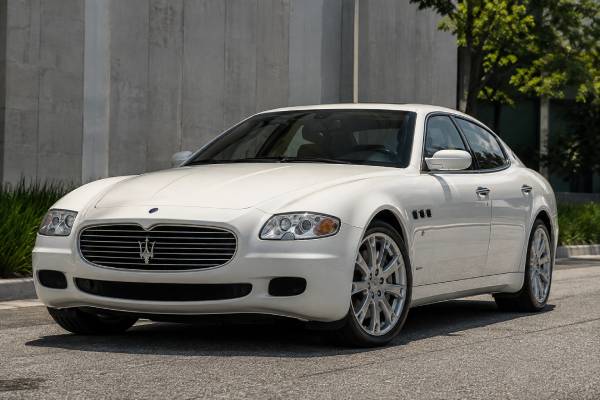
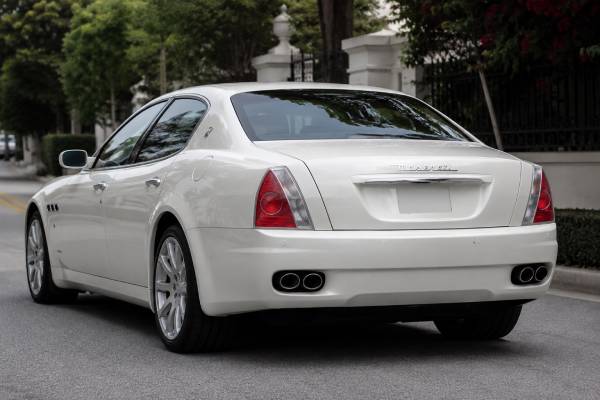
The 2006–2008 Maserati Quattroporte Automatica is the extensively re-engineered torque-converter version of the pre-facelift M139. Developed during 2006 and presented publicly in early 2007, it replaced the rear DuoSelect transaxle with a front-mounted ZF 6HP26 six-speed automatic. Maserati also revised the 4.2-liter V8 to wet-sump F136UC form and drove a separate rear limited-slip differential through a propeller shaft. The result delivered smooth creep, easy parking, and seamless urban shifts while retaining manual control through the lever or paddles.
This was far more than a gearbox swap. The powertrain mounts, propeller shaft, differential installation, subframes, transmission tunnel, lubrication system, intake calibration, and weight distribution all changed. Balance moved from approximately 47:53 to 49:51 front to rear, still slightly rear-biased, while power remained 400 hp and torque arrived a little earlier. The ZF avoids routine dry-clutch management, but it is not maintenance-free. Fluid leaks, connector sleeves, valve-body behavior, converter shudder, neglected cooling, cam-variator noise, oil leaks, suspension wear, and battery-sensitive electronics still demand specialist inspection.
Table of Contents
- The Quattroporte Reengineered for Everyday Use
- F136UC V8 and ZF Automatic Specifications
- Standard, Executive, Sport, and Market Versions
- What Changed Beneath the Pininfarina Body
- Smooth Shifts with Maserati Chassis Balance
- ZF Service, F136UC Risks, and Chassis Care
- Buying the Best Pre-Facelift Automatica
The Quattroporte Reengineered for Everyday Use
The Automatica transformed the M139 from a specialized automated-manual sedan into a genuinely easy luxury car without removing its naturally aspirated V8 or rear-biased chassis. It became the more practical choice for traffic, hills, parking, and daily use.
The fifth-generation Quattroporte had launched in 2003 with DuoSelect, an electrohydraulic six-speed manual transaxle. Enthusiasts appreciated its balance and paddle control, but many luxury buyers disliked the shift pause and dry-clutch behavior at low speed. Maserati responded with a much deeper engineering program than simply purchasing an automatic transmission.
The new Quattroporte Automatica appeared at the 2007 Detroit show, while company heritage data lists production beginning in 2006. The difference reflects engineering and build timing versus public launch and model-year availability. Buyers should record the actual build date, registration year, and market specification of each car.
A ZF 6HP26 six-speed automatic now sat directly behind the V8. It used a hydraulic torque converter, planetary gearsets, and electronically controlled clutches. A two-piece propeller shaft carried power to a separate rear differential. The car could creep naturally, hold smoothly at low speed, and change ratios without opening a dry clutch between every gear.
Maserati also converted the engine from the dry-sump F136S to wet-sump F136UC specification. Power remained 400 hp at 7,000 rpm. Period tests reported a modest torque increase to roughly 460 Nm at a lower engine speed, giving the automatic a little more flexibility.
The Automatica broadened the range immediately. Standard, Executive GT, and Sport GT forms were offered, and the Sport GT was later succeeded by the Sport GT S. These names describe equipment and chassis specification, not a different basic automatic powertrain during the 4.2-liter pre-facelift period.
Company heritage figures state that 6,050 examples were produced across the Automatica family through 2008. That makes it less numerous than the 10,639 DuoSelect cars but far from a tiny special edition. Condition and specification matter more than production rarity.
The automatic also changed the model’s reputation. It removed clutch-life anxiety and made the car easier to sell, but it did not turn the Quattroporte into a low-cost luxury sedan. The ZF, engine, cooling, steering, suspension, brakes, body electronics, and hand-finished trim all demand specialist care.
Today, the pre-facelift Automatica is often the most rational entry into M139 ownership. It preserves the original Pininfarina shape, oval grille, and 400 hp V8 while offering a transmission suited to modern traffic. The key is to buy one whose apparent ease has not encouraged years of deferred maintenance.
F136UC V8 and ZF Automatic Specifications
The Automatica pairs the 4,244 cc wet-sump F136UC V8 with a six-speed ZF torque-converter automatic. It retains rear-wheel drive, a limited-slip differential, double-wishbone suspension, Brembo brakes, and a slightly rear-biased 49:51 weight distribution.
| Item | Specification |
|---|---|
| Model code | M139 |
| Engine code | F136UC |
| Engine | 90-degree all-aluminum V8, DOHC, 32 valves |
| Displacement | 4,244 cc |
| Induction | Naturally aspirated with electronic multipoint injection |
| Lubrication | Wet sump |
| Maximum power | 400 hp at 7,000 rpm |
| Maximum torque | Approximately 460 Nm at about 4,250 rpm |
| Transmission | ZF 6HP26 six-speed hydraulic automatic |
| Manual control | Center-console selector; paddles optional or trim-dependent |
| Drive | Rear-wheel drive with limited-slip differential |
| Weight distribution | Approximately 49 percent front, 51 percent rear |
| Construction | Steel monocoque with revised front and rear subframes |
| Front suspension | Independent unequal-length double wishbones |
| Rear suspension | Independent unequal-length double wishbones |
| Damping | Skyhook adaptive damping on relevant pre-facelift versions |
| Brakes | Four-wheel ventilated Brembo discs with ABS |
| Steering | Hydraulic power-assisted rack and pinion |
| Wheelbase | 3,064 mm |
| Length | 5,052 mm |
| Width | 1,895 mm |
| Kerb weight | Approximately 1,970 kg, depending on trim and measurement |
| Fuel capacity | Approximately 90 liters |
| 0–100 km/h | Approximately 5.6 seconds |
| Top speed | Approximately 270–275 km/h, depending on source and version |
| Automatic-family production | 6,050 examples |
The F136UC retains the aluminum block and heads, cross-plane crankshaft, four camshafts, four valves per cylinder, and variable intake-cam timing of the F136 family. Wet-sump lubrication stores oil in the pan beneath the engine, simplifying external plumbing compared with the DuoSelect’s dry-sump arrangement.
The ZF 6HP26 was widely used in high-output luxury cars of the period. Its torque converter allows smooth launch and includes a lock-up clutch for efficiency and directness once moving. Electronic control adapts shift timing to load, speed, temperature, and driver demand.
Manual selection through the lever lets the driver hold gears, and paddle availability depends on specification. Sport GT automatic cars commonly carried paddles as standard; base and Executive cars may have them as an option. Confirm the factory build rather than judging added paddles alone.
The published 0–100 km/h time is slower than DuoSelect despite similar power because the automatic adds weight and uses a smoother launch strategy. In normal road use it often feels more responsive at low speed because torque-converter multiplication and earlier peak torque reduce hesitation.
The same 330 mm-class brake system appeared on many core versions, while Sport derivatives used their own disc and caliper treatments. Parts should be identified by VIN and measured hardware before ordering.
Standard, Executive, Sport, and Market Versions
The Automatica was sold in several personalities, all sharing the F136UC and ZF layout. The right label depends on factory trim, chassis equipment, market, and build date—not on wheels or badges added later.
The standard Quattroporte Automatica used the core leather-and-wood luxury specification with Skyhook adaptive damping and more restrained wheels. It is often the best-riding and least visually complicated version.
Executive GT emphasized rear-seat comfort and formal presentation. Depending on market, it could include chrome mesh grilles, polished 19-inch wheels, Alcantara headlining, a wood-and-leather wheel, rear climate controls, shades, folding tables, and comfort rear seats with heat, ventilation, massage, or additional adjustment.
Sport GT emphasized driver response. It combined 20-inch wheels, darker mesh, carbon trim, sport controls, revised suspension calibration, drilled discs, and paddles. Some period descriptions of “Sport GT automatic” mix features from DuoSelect and ZF cars, so verify the exact chassis and brake specification.
Sport GT S replaced the Sport GT at the top of the pre-facelift sporting range. The 4.2-liter 2007–2008 version used the same 400 hp rating but added lower, firmer fixed-rate suspension and upgraded front brakes. It is separate from the later 4.7-liter facelifted Sport GT S.
Special editions included the 2008 Collezione Cento, limited to 100 automatic cars with a distinct ivory-and-tan luxury theme and extensive rear entertainment equipment. Such cars need edition-specific authentication in addition to ordinary mechanical checks.
Recognizing the automatic powertrain
Useful identifiers include:
- F136UC engine designation and wet-sump arrangement.
- Conventional automatic selector gate on the center console.
- Transmission attached directly behind the engine.
- Propeller shaft leading to a separate rear differential.
- Approximately 49:51 quoted weight distribution in factory literature.
- Automatic-specific build records and transmission data.
- Paddles only where factory ordered or fitted by the appropriate trim.
Registration documents can use broad descriptions such as “automatic” for both DuoSelect and ZF cars because DuoSelect has an automatic mode. Mechanical confirmation is essential. Service procedures, parts, failure modes, and driving behavior differ substantially.
Factory options were extensive. Paint, leather, piping, stitching, wood, carbon, wheels, audio, climate features, rear equipment, and brake-caliper colors can vary. An unusual combination is not necessarily wrong when the build sheet supports it.
Modifications need context. A later infotainment unit may improve usability, while cut fiber-optic wiring or removed amplifiers can create faults. Aftermarket wheels can reduce replacement cost but may change offset and steering. Non-factory suspension can eliminate failed Skyhook hardware yet alter ride and resale.
What Changed Beneath the Pininfarina Body
The automatic conversion required a new driveline architecture beneath an almost unchanged exterior. Maserati redesigned major supporting structures so the ZF could sit behind the engine while preserving a slight rear weight bias.
The DuoSelect car used a rigid torque tube and rear transaxle. The Automatica moved the gearbox forward and installed a two-piece propeller shaft to a separate differential. Front and rear subframes and sections of the transmission tunnel were altered to accommodate the new components and their mounts.
Engine placement was adjusted rearward and lower where possible. The final 49:51 split is less rear-biased than the DuoSelect’s 47:53 but still favorable for a large front-engine sedan. The front tires carry more mass than before, yet the engine remains within the wheelbase enough to preserve clean turn-in.
Wet-sump conversion changed the lower engine and lubrication system. It reduced external oil plumbing and reportedly contributed to quieter operation. It also introduced its own pan, pickup, oil-level practice, and engine-code distinction. Parts should not be mixed casually with F136S specifications.
The suspension retained unequal-length wishbones, aluminum components, coil springs, anti-roll bars, and trim-dependent Skyhook damping. Geometry and calibration continued to balance comfort with control. Worn wishbones, tie rods, dampers, mounts, or tires can erase that advantage.
Hydraulic steering remained a major strength. It communicates grip and loading naturally, but hoses, pumps, racks, and seals can leak. Fluid contamination, pump whine, heavy spots, or a wet rack need diagnosis before the system is allowed to run low.
Pininfarina’s body required little visual change because the original proportions already suited the new layout. The oval grille, three side vents, low hood, long wheelbase, and short rear deck remained. Minor wheel, mirror, trim, and badge variations identify years and derivatives more reliably than the body shell.
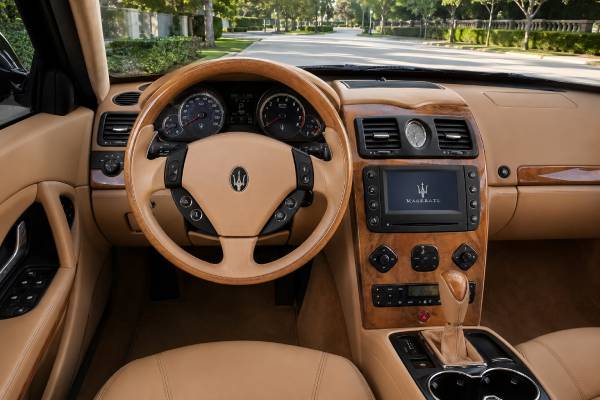
The cabin gained a conventional gear lever, which made the powertrain obvious to occupants. The rest remained a blend of Poltrona Frau leather, wood or carbon, analog instruments, and period multimedia. The automatic makes the car easier to drive, but dated navigation, sticky coatings, failed switches, and complex seat or climate systems remain common age-related concerns.
Smooth Shifts with Maserati Chassis Balance
The Automatica is calmer and more intuitive at low speed than the DuoSelect, yet it keeps the responsive V8, accurate steering, and composed rear-drive behavior that define the M139. Its dynamic character is grand touring rather than raw.
From rest, the torque converter allows a natural creep and smooth throttle pickup. Parking, reversing uphill, and stop-start traffic no longer require a dry clutch to slip. This single change makes the car far easier to use as a daily luxury sedan.
In Drive, the ZF seeks smooth, early shifts. Throttle demand brings downshifts without the long clutch-open pause of DuoSelect. Sport or manual selection holds gears longer and makes changes more assertive. The transmission should remain refined when cold and hot; a heavy bang, flare, delayed Drive or Reverse, shudder, or emergency mode is not normal.
The F136UC responds immediately because it is naturally aspirated. Low-speed torque feels a little fuller than the dry-sump tune, while the strongest power still arrives toward 7,000 rpm. The automatic may mask some of the engine’s drama in normal mode, but manual control restores a clear connection between gear and sound.
The change to 49:51 distribution introduces slightly more front weight, though the car still turns willingly for its size. Healthy hydraulic steering provides a progressive build-up of effort. The long wheelbase stabilizes the chassis, and the limited-slip differential supports traction under power.
Ride quality depends on trim. A standard car on smaller wheels is supple and controlled. Executive GT balances comfort with polished 19-inch wheels. Sport versions on 20-inch tires feel sharper but transmit more road texture and risk wheel damage.
Skyhook should soften the car in normal use and reduce body movement in Sport. The system works subtly. If the car bounces, crashes, leans inconsistently, or shows a suspension warning, inspect dampers, sensors, wiring, mounts, arms, and tires.
Braking performance is strong when the system is fresh. The automatic’s easier urban use may hide years of light braking that leave corrosion or uneven deposits. A proper test includes progressive and firm stops, checking for vibration, pull, pedal softness, or hot-wheel differences.
At motorway speed, the automatic settles into a high gear and lowers engine noise. Wind sealing, wheel bearings, driveshaft joints, differential, exhaust, and undertrays influence refinement. Vibration under load can come from wheels, tires, propshaft, mounts, or transmission—not only the engine.
Fuel use remains high. The automatic may be more efficient in some cycles, but a 400 hp, two-ton sedan still consumes heavily in town. Ownership budgeting should prioritize preventive service, tires, brakes, and specialist labor rather than focusing only on fuel.
ZF Service, F136UC Risks, and Chassis Care
The Automatica avoids routine dry-clutch replacement, but it needs disciplined transmission, engine, cooling, steering, suspension, and electrical maintenance. “Sealed for life” should not be interpreted as “fluid lasts forever” on an aging performance sedan.
ZF 6HP26 transmission
Check for leaks around the pan, electrical connector sleeve, cooler lines, and seals. The integrated filter is commonly part of the pan assembly. Fluid condition and service procedure require correct temperature, approved specification, and level-setting method.
A preventive fluid and filter service can be sensible when history is known and the unit operates well. A neglected gearbox already slipping or carrying debris needs specialist evaluation before a flush. Harsh 2–1 or 3–2 changes, delayed engagement, converter shudder, rpm flare, or faults can involve fluid, adaptation, valve body, solenoids, seals, torque converter, mounts, or internal wear.
The propshaft, center support, flexible couplings where fitted, differential mounts, and rear differential should also be inspected. Driveline thump may come from mounts or shaft joints rather than the transmission itself.
F136UC engine
Start completely cold and listen for cam-timing variator rattle, chain-related noise, accessory bearings, exhaust leaks, and knock. A brief noise must be assessed by a specialist; persistent or worsening rattle should not be dismissed. Documentation of updated or repaired variators can be valuable.
Inspect wet-sump oil leaks around cam covers, front timing area, filter housing, pan, and cooler lines. Verify hot oil pressure, correct oil, service intervals, and level. Check engine mounts, belts, pulleys, intake boots, coils, plugs, injectors, and catalysts.
The cooling system must remain stable in traffic. Clean debris from the radiator and condenser pack, pressure-test the system, and verify fans, relays, thermostat, expansion tank, cap, hoses, coolant age, and air-conditioning performance.
Steering, suspension, brakes, and electronics
Look for steering rack and hose leaks, pump noise, and uneven assistance. Inspect wishbone ball joints and bushes, tie rods, links, wheel bearings, Skyhook dampers, springs, subframes, and alignment. Confirm applicable rear tie-rod recall work by VIN.
Measure discs, assess pads and calipers, replace aged brake fluid, and use matched tires of the correct load and speed ratings. Tire age matters even on a low-mileage car.
Test battery capacity, alternator, grounds, every control module, windows, locks, seats, mirrors, climate zones, parking sensors, navigation, audio, suspension modes, and lighting. Low voltage causes confusing warnings, but recurring faults need diagnosis rather than repeated clearing.
Buying the Best Pre-Facelift Automatica
Choose an Automatica with confirmed F136UC and ZF identity, a quiet cold start, smooth hot shifts, stable cooling, tight suspension, and complete records. The cheapest example rarely remains cheapest after a proper baseline.
Begin with the VIN, build date, market, engine code, transmission record, trim level, options, recall status, and service invoices. Confirm whether the car is standard, Executive GT, Sport GT, Sport GT S, or a documented special edition.
Request cold-start video, underside photographs, diagnostic scan, transmission service history, oil records, suspension invoices, tire dates, brake measurements, and evidence for any cam-variator work. A seller who only provides polished exterior photographs has not answered the important questions.
A Maserati-specialist inspection should include:
- Cold-start listening and complete electronic scan.
- Verification of F136UC engine and ZF 6HP26 transmission.
- Fluid-leak and hot oil-pressure assessment.
- ZF engagement, adaptation, converter, and hot-shift testing.
- Cooling-system pressure and fan checks.
- Propshaft, differential, mounts, steering, suspension, and recall inspection.
- Brake measurement, wheel runout, tire age, and alignment review.
- Operation of all cabin electronics and trim-specific equipment.
- Paint-depth, structure, corrosion, underbody, VIN-label, and accident review.
- A costed list of immediate and near-term work.
Avoid cars with severe cold-start rattle, low oil pressure, overheating, transmission slip, delayed gear engagement, persistent converter shudder, structural damage, heavily modified wiring, or multiple disabled systems. Any one may be repairable; several together can exceed the value of a better car.
Do not assume low mileage protects the vehicle. Long storage can age seals, tires, batteries, fluids, dampers, and electronics. A regularly driven car with documented preventive work may be safer than an unused example with original everything.
After purchase, perform a baseline appropriate to history: engine oil and filter, coolant, brake fluid, transmission service where advised, differential fluid, filters, battery testing, tire evaluation, suspension inspection, and alignment. Preserve invoices and diagnostic results.
The pre-facelift Automatica is the M139 for owners who want the original design with a conventional luxury-car transmission. It gives up a small amount of transaxle purity but gains enormous everyday usability. Buy it as a sophisticated 400 hp Maserati, not as a depreciated bargain sedan, and its combination of sound, steering, comfort, and style remains difficult to replace.
References
- Quattroporte V Automatica – Quattroporte models | Maserati 2026 (Manufacturer Heritage Specifications)
- Maserati TechInfo 2026 (Manufacturer Technical Information)
- The 2007 Maserati Quattroporte | Classic Driver Magazine 2007 (Period Engineering Review)
- Maserati Quattroporte V buyer’s guide: what to pay and what to look for | Classic & Sports Car 2026 (Model Buying Guide)
Disclaimer
This article is for informational purposes only and does not replace factory service information, professional diagnosis, valuation, or a pre-purchase inspection. Specifications, equipment, recalls, transmission procedures, and service requirements vary by VIN, market, build date, and repair history. Confirm every car with official records and a qualified Maserati and ZF specialist.
Please share this article on Facebook, X/Twitter, or your preferred enthusiast community if it was useful. Sharing supports the creation of more detailed specialist-car guides.