
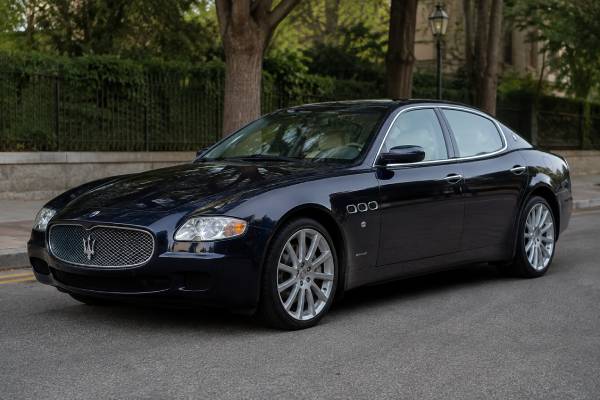
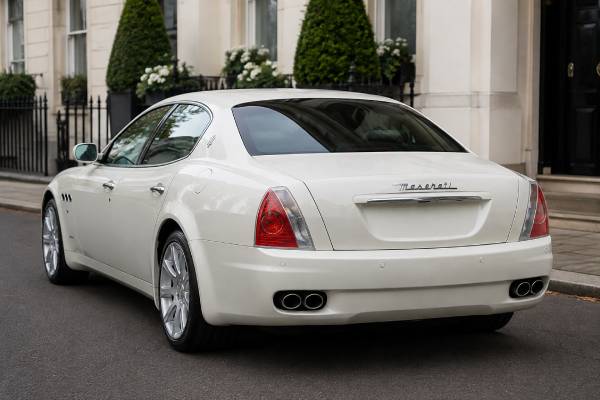
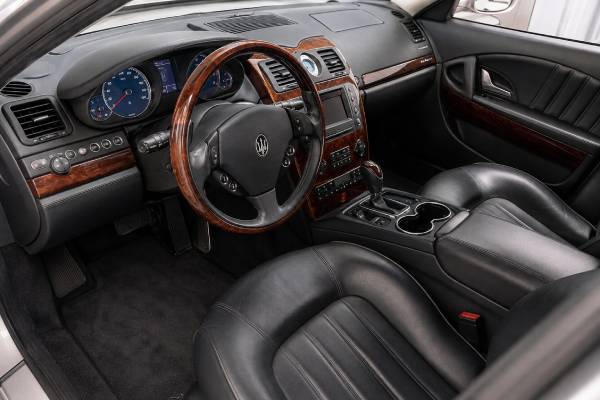
The 2006–2008 Maserati Quattroporte Automatica Executive GT combines the M139’s richest comfort specification with the drivetrain best suited to city and chauffeur use. Its wet-sump 4.2-liter F136UC V8 produces 400 hp, while a six-speed ZF torque-converter automatic replaces the dry-clutch DuoSelect system. Executive GT equipment typically adds chrome mesh, polished 19-inch wheels, a wood-and-leather steering wheel, Alcantara headlining, rear climate controls, shades, folding veneered tables, and available comfort seats with heating, ventilation, adjustment, and massage.
This pairing resolves the main contradiction of the earlier Executive GT. The rear cabin offers formal luxury, while the automatic can creep, reverse, and move through traffic smoothly without automated-manual clutch technique. It remains a complex exotic sedan rather than a cheap limousine. Cam-timing noise, oil leaks, ZF service history, steering leaks, Skyhook dampers, wishbones, brakes, battery-sensitive modules, rear climate equipment, seat mechanisms, tables, shades, and special trim all require inspection. The best car is complete, mechanically current, and able to demonstrate every rear-cabin function.
Table of Contents
- The Most Coherent Executive GT Combination
- Automatic V8, Chassis, and Comfort Specifications
- Executive GT Equipment and Authentication
- Luxury Packaging Around the ZF Driveline
- Chauffeur Smoothness with Italian Road Feel
- Maintaining the ZF, V8, and Rear Cabin
- How to Buy a Complete Automatic Executive
The Most Coherent Executive GT Combination
The Automatica Executive GT is the most logically matched luxury version of the pre-facelift Quattroporte. The Executive package serves rear passengers, and the ZF automatic gives those passengers the smooth low-speed behavior expected from a flagship sedan.
Maserati introduced Executive GT trim in 2005 on the original DuoSelect car. Its cabin and exterior were configured for comfort and ceremony, but the rear transaxle still used an electrohydraulic dry clutch. Skilled drivers could make it smooth, yet stop-start traffic always exposed the basic manual-gearbox operation.
The Automatica program changed that in 2006–2007. Maserati fitted a ZF 6HP26 behind a wet-sump F136UC V8, used a propshaft and separate rear differential, and revised the subframes and tunnel. The Executive package could then deliver effortless creeping and nearly uninterrupted shifts without losing the V8’s response or the chassis’s slight rear weight bias.
The model belongs to a short pre-facelift window. Factory heritage data covers 2006–2008 for the Automatica family, while many markets identify customer cars as 2007 or 2008 model years. The exact production date, model year, registration year, and trim should be recorded independently.
This version is sometimes overshadowed by the Sport GT S, yet it may be more representative of the Quattroporte name, which means “four-door.” It was intended to transport four adults quickly and elegantly, not merely to imitate a sports coupe with a rear bench.
The Executive GT designation did not create a separate engine tune. It retained 400 hp and the same core automatic chassis as the standard car. Value comes from the coordinated luxury equipment and its condition. A missing table, failed massage seat, damaged chrome grille, or mismatched veneer matters more here than it would on a base Quattroporte.
The specification also demands careful authentication because many standard cars were ordered with leather, wood, rear shades, or polished wheels. No single feature proves an Executive GT. Factory build data, badges, exterior treatment, headliner, steering wheel, rear equipment, and trim should form a consistent picture.
When complete, the car occupies an unusual niche. It is less anonymous than a German long-wheelbase sedan, more usable than the DuoSelect Executive, and more comfortable than the Sport GT. Its weakness is complexity: luxury systems age even when mileage remains low.
Automatic V8, Chassis, and Comfort Specifications
The powertrain is the wet-sump 4,244 cc F136UC V8 with a six-speed ZF automatic and rear limited-slip differential. Executive GT trim changes equipment and presentation rather than the 400 hp rating.
| Item | Specification |
|---|---|
| Model code | M139 |
| Engine code | F136UC |
| Engine | 90-degree aluminum V8, dual overhead camshafts, 32 valves |
| Displacement | 4,244 cc |
| Fuel system | Electronic multipoint injection |
| Induction | Naturally aspirated |
| Lubrication | Wet sump |
| Maximum power | 400 hp at 7,000 rpm |
| Maximum torque | Approximately 460 Nm at about 4,250 rpm |
| Transmission | ZF 6HP26 six-speed torque-converter automatic |
| Drivetrain | Rear-wheel drive with limited-slip differential |
| Weight distribution | Approximately 49 percent front, 51 percent rear |
| Construction | Steel monocoque with front and rear subframes |
| Suspension | Unequal-length double wishbones front and rear |
| Dampers | Skyhook adaptive electronic damping |
| Brakes | Ventilated Brembo discs with ABS |
| Steering | Hydraulic power-assisted rack and pinion |
| Executive wheels | 19-inch ball-polished multi-spoke alloys |
| Wheelbase | 3,064 mm |
| Length | 5,052 mm |
| Width | 1,895 mm |
| Kerb weight | Approximately 1,970 kg, varying with options |
| Fuel capacity | Approximately 90 liters |
| 0–100 km/h | Approximately 5.6 seconds |
| Top speed | Approximately 270–275 km/h |
The V8 uses an aluminum-silicon block and heads, a cross-plane crankshaft, four camshafts, four valves per cylinder, and variable intake timing. It delivers torque more strongly in the mid-range than the peak-power figure alone suggests, while still encouraging high-rpm use.
The ZF transmission sits directly behind the engine. A torque converter smooths launch and low-speed movement; internal clutches and planetary gearsets create six forward ratios. Manual selection is available through the console lever, while paddles depend on market and option specification.
The automatic layout changes the static balance from the DuoSelect’s 47:53 to approximately 49:51. The car remains slightly rear-biased and retains a limited-slip differential, so it does not become a nose-heavy limousine.
Skyhook adaptive dampers are especially appropriate here. Normal mode prioritizes compliance, while Sport reduces body movement. The system must be considered alongside bushings, ball joints, mounts, tires, and alignment; electronics cannot hide worn hardware.
The Executive’s 19-inch wheels are a useful compromise. They provide more sidewall than the Sport GT’s 20-inch package and suit long-distance comfort, yet polished finishes are vulnerable to corrosion, curb damage, and repeated machining.
Executive GT Equipment and Authentication
A real Executive GT should present a consistent luxury specification inside and out. Its most valuable features are also the most likely to be incomplete or inoperative after years of use.
Period equipment descriptions identify chrome mesh for the main grille and side vents, an exterior model plate, and polished 19-inch wheels. These details distinguish the formal Executive look from dark Sport trim, but they can be retrofitted.
The cabin normally includes an Alcantara headliner and a wood-and-leather steering wheel. Rear passengers may receive separate climate controls, powered shades, and folding tables finished in wood or a coordinated material. The available rear comfort-seat package adds heat, ventilation, massage, and additional electrical adjustment.
Equipment varies because Maserati offered extensive personalization and market packages. Some genuine cars lack one feature commonly seen in another country, while some standard cars carry selected Executive options. The VIN configuration or factory build sheet is the most reliable starting point.
Authenticity and condition checklist
Document these items before valuation:
- Factory trim designation and original option codes.
- Correct chrome grille and side-vent mesh.
- Matching 19-inch wheel castings and original-type finish.
- Alcantara headliner color and stitching.
- Wood-and-leather steering wheel specification.
- Rear-seat switch panels and comfort functions.
- Rear climate display, controls, vents, and sensors.
- Shade mechanisms and original rear tables.
- Leather, piping, stitching, carpet, and veneer colors.
- Books, keys, tools, window sticker, and original sales invoice.
Test features rather than merely photographing them. Seat ventilation fans may run weakly or noisily. Massage bladders or mechanisms may work only on one side. A table may open but fail to lock. Shades can bind, tear, or stop halfway. Rear climate buttons may illuminate without controlling temperature.
Inspect the underside of seats for pinched harnesses, added wiring, moisture, and broken connectors. Seat modules and motors can be damaged by low voltage or objects stored beneath the rails. Do not force a stalled mechanism.
Veneer can crack, cloud, fade, or lift around curved edges. Pieces refinished separately often differ in shade or gloss. A sympathetic restoration should preserve backing labels and match the full set rather than making one panel unnaturally perfect.
The polished wheels should retain crisp shapes and correct dimensions. Repeated curb repairs can remove material. Inspect inner barrels for welds or straightening and check runout before assuming a bright finish means sound structure.
Luxury Packaging Around the ZF Driveline
The engineering achievement is the way Maserati inserted a conventional automatic beneath the existing Pininfarina body while retaining generous passenger space and rear-biased handling. The cabin gains smoothness without a visibly different silhouette.
The engine remains set rearward in the bay, but the ZF attaches directly behind it. A two-piece propeller shaft crosses the tunnel to a separate differential. Maserati revised the front and rear subframes and sections of the floor structure to accommodate the layout.
Wet-sump lubrication replaced the DuoSelect engine’s external dry-sump reservoir and associated lines. The change simplified the lower engine package and reduced some mechanical noise. It also means that F136S and F136UC service information cannot be interchanged casually.
The 3,064 mm wheelbase creates legroom without stretching the original body into a separate long-wheelbase model. Rear seating is most luxurious for two because the center tunnel divides the floor and the sculpted outer seats receive the comfort functions.
Pininfarina’s low roof and tapered glass maintain elegance, though very tall rear passengers should check headroom. Door openings are generous enough for ordinary use, but the low seating position and broad sill are not as limousine-like as a boxier luxury sedan.
Skyhook monitors vertical and body movement, adjusting individual dampers. The Executive calibration still allows the driver to select a firmer setting. A healthy system gives the car controlled suppleness; a failed damper or worn arm produces knocks, float, or harshness no software can correct.
Hydraulic steering remains one of the M139’s advantages. The automatic’s extra front mass slightly softens the transaxle car’s delicacy but still leaves natural effort and accurate response. Steering rack leaks, hose seepage, pump noise, and worn tie rods are age-related inspection points.
The cabin materials do much of the emotional work. Poltrona Frau leather, wood, Alcantara, metal details, and the V8’s low-frequency sound create a richer experience than the period infotainment technology. Modernizing the radio can help, but modifications must preserve amplifiers, control integration, and factory wiring.
Chauffeur Smoothness with Italian Road Feel
The Automatica Executive GT is easy to drive gently but does not become numb. Its torque converter removes low-speed clutch drama, while the V8, hydraulic steering, rear-drive balance, and paddle or lever control keep the driver involved.
In Drive, the car pulls away progressively and creeps without clutch wear. Reverse maneuvers and inclines become normal luxury-car tasks. The transmission shifts early and softly under light throttle, then downshifts readily when the driver asks for acceleration.
Manual selection lets the engine remain in its stronger upper range. Changes are not as abrupt as the fastest DuoSelect Sport mode, but they keep power flowing and reduce head movement. The torque converter locks at speed, so the transmission can feel direct on a fast road.
The V8 produces 400 hp without turbochargers. Throttle response is immediate, and the engine’s cross-plane note grows from a deep rumble into a smoother mechanical howl. Torque peaks earlier than in the dry-sump tune, which suits the automatic and the car’s luxury purpose.
Rear passengers should experience little driveline interruption. During a test drive, however, evaluate the car from the back. Listen for table rattles, shade movement, seat-fan noise, parcel-shelf vibration, suspension thumps, and wind noise. Test climate temperature and airflow while moving.
Steering is lighter than a sports coupe but more communicative than most chauffeur cars. The long wheelbase keeps direction changes progressive. Correct tires and alignment are essential; broad old tires can make the car tramline or follow road crowns.
Normal Skyhook mode should handle rough surfaces without repeated after-movement. Sport firms the body and suits a flowing road. A luxury badge does not justify wallow, and a Maserati badge does not justify crashing impacts.
Brakes are powerful enough for high-speed use when discs, pads, calipers, fluid, and tires are healthy. Long periods of gentle chauffeur use can leave lip wear, corrosion, or pad deposits, so inspect rather than judging by pedal feel alone.
The best environment is long-distance travel. At motorway speed the ZF settles, the V8 quiets, and the body tracks steadily. The Executive equipment then provides genuine value. In dense city use the car is easier than DuoSelect, though its length, wheel finish, parking sensors, and fuel consumption still require care.
Maintaining the ZF, V8, and Rear Cabin
The maintenance plan must give equal weight to mechanical systems and luxury hardware. Ignoring either side undermines the reason to own this particular Quattroporte.
ZF automatic and driveline
Inspect the transmission pan, filter, electrical connector sleeve, cooler lines, and seals for leakage. Service requires approved fluid, the correct temperature, and an exact level procedure. A history of sensible fluid and filter changes is preferable to the claim that the unit was permanently sealed.
Test Drive and Reverse engagement cold and hot. Look for flare, harsh downshifts, converter shudder, delayed selection, vibration, or emergency mode. Possible causes include fluid condition, adaptation, valve body, solenoids, sleeve leakage, torque converter, mounts, propshaft, or internal wear.
Inspect the two-piece shaft, center support, differential, and mounts. A thump on take-up or vibration under load may originate behind the transmission.
F136UC engine and cooling
A fully cold start is essential. Listen for cam-variator rattle, timing noise, accessory bearings, exhaust leaks, and knock. Check service records for any timing-component or variator repair and verify the quality of the work.
Look for oil leakage at cam covers, timing case, filter area, pan, and cooler connections. Verify correct oil, regular changes, and hot pressure. Inspect engine mounts, belts, pulleys, plugs, coils, injectors, intake hoses, catalysts, and exhaust hangers.
Pressure-test cooling and verify both fan operation and stable temperature with all climate zones active. Clean debris from the radiator and condenser pack. Check thermostat, expansion tank, cap, hoses, coolant age, and air-conditioning performance.
Executive systems and chassis
Cycle every seat motor, fan, heater, massage mode, shade, table, rear climate control, window, lock, mirror, sensor, and light. Use a strong battery and verify alternator output and grounds before condemning multiple modules.
Inspect Skyhook dampers, wishbones, ball joints, bushings, links, tie rods, wheel bearings, springs, subframes, steering rack, hoses, and applicable rear tie-rod recall completion. Measure brakes and assess tire age, matching, pressure, and load rating.
Protect Alcantara from aggressive cleaners and avoid saturating perforated seat leather. Preserve original trim and hardware removed during repair. Rear-cabin parts can take longer to source than routine mechanical components.
Rear-cabin restoration costs are easy to underestimate because several small faults can involve separate systems. A table hinge, blind motor, seat fan, massage bladder, climate actuator, or veneer panel may require individual diagnosis and trim removal. Price each defect before buying instead of treating the entire rear compartment as one minor cosmetic allowance.
How to Buy a Complete Automatic Executive
Buy only after the car proves three things: it is a factory Automatica Executive GT, its ZF and F136UC are healthy, and the rear-cabin equipment is complete and functional. One of those without the others is not enough.
Ask for the VIN, build sheet, option list, engine and transmission identification, production date, service records, recall evidence, photographs of every Executive feature, and a cold-start video. Request close views of wheels, mesh, headliner, rear tables, switches, and veneer.
A specialist pre-purchase inspection should include:
- Factory trim and powertrain authentication.
- Cold-start noise and a full electronic scan.
- ZF engagement, adaptation, leak, and hot-shift evaluation.
- Engine oil leakage, hot pressure, mounts, and exhaust checks.
- Cooling pressure and fan testing with climate systems running.
- Steering, suspension, Skyhook, differential, brake, wheel, and tire inspection.
- Operation of all front and rear seat functions.
- Rear climate, shades, tables, audio, parking sensors, and lighting tests.
- Paint-depth, body structure, underbody, corrosion, and VIN-label review.
- A realistic estimate for immediate trim and mechanical work.
Reject a car with persistent variator noise, transmission slip, overheating, major steering leaks, structural damage, extensive electrical faults, or several missing Executive components unless the price and restoration plan are exceptional.
A low odometer can be misleading. Sun exposure ages leather, Alcantara, veneer, and electronics. Long storage affects tires, seals, batteries, fluids, dampers, and air-conditioning. Service dates and actual condition matter more than mileage alone.
A high-quality repaint or professional veneer restoration need not destroy value when documented. Poor color match, cut wiring, substitute tables, generic wheels, wrapped trim, or disabled warning systems are different. Restoration should return the individual build to its factory specification.
After purchase, establish a baseline and operate every feature regularly. Maintain the battery, exercise the seats and shades, keep climate drains clear, use the car enough to heat fluids fully, and save diagnostic reports and photographs.
The Automatica Executive GT succeeds because its transmission finally matches its purpose. It can move rear passengers with genuine smoothness while giving the driver a naturally aspirated Maserati V8 and a communicative chassis. Completeness is the deciding quality: the more of its factory luxury that works as intended, the more convincing the car becomes.
References
- Quattroporte V Automatica – Quattroporte models | Maserati 2026 (Manufacturer Heritage Specifications)
- Maserati TechInfo 2026 (Manufacturer Technical Information)
- 2007 Maserati Quattroporte Automatic First Drive 2007 (Period Driving Review)
- Maserati Quattroporte V Buying Guide – Petrolicious 2017 (Model Buying Guide)
Disclaimer
This article is for informational purposes only and is not a substitute for official service information, professional diagnosis, authentication, valuation, or a pre-purchase inspection. Equipment, specifications, recalls, transmission procedures, and maintenance needs vary by VIN, market, build date, and previous work. Use factory records and qualified Maserati and ZF specialists.
Please share this article on Facebook, X/Twitter, or your preferred enthusiast community if it was useful. Sharing supports the creation of more detailed specialist-car guides.