
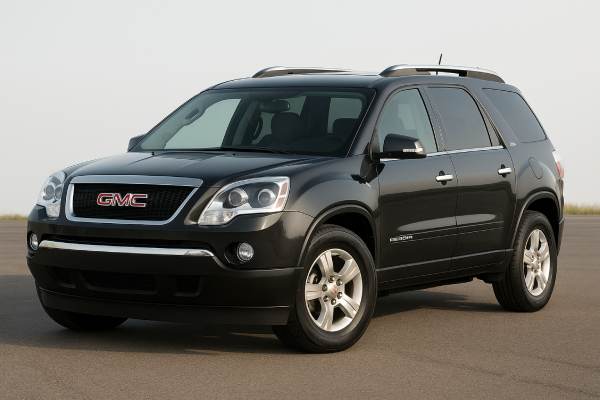

The first-generation GMC Acadia AWD (GMT968) is a three-row crossover that tried to combine minivan practicality with SUV stance and genuine all-weather traction. Built from 2006 to 2008 for the 2007–2008 model years, this Acadia sits on GM’s Lambda platform, sharing its structure with the Buick Enclave, Saturn Outlook and later Chevrolet Traverse.
Under the hood you get the LY7 3.6-litre V6 with 275 hp, paired to a six-speed automatic and an on-demand AWD system that normally drives the front wheels but can send torque rearward when slip is detected. Owners value its spacious cabin, comfortable ride and strong towing for a crossover, but long-term durability depends heavily on maintenance, especially engine oil changes and drivetrain fluids.
If you are looking at a used GMC Acadia AWD from this era, it is worth understanding not only the brochure specs but also the known issues, realistic fuel economy, safety performance, and the service work that keeps these trucks dependable past 200,000 miles.
Owner Snapshot
- Strong space for 7–8 passengers, with adult-friendly third row and flat load floor.
- AWD system improves winter and wet-road traction without driver input.
- Respectable 4,500 lb (about 2,040 kg) towing when factory-equipped with the trailering package.
- Needs strict oil changes and timely transmission/AWD fluid service to avoid expensive repairs.
- Plan on engine oil and filter every 5,000–7,500 miles (8,000–12,000 km) or once a year, whichever comes first.
Explore the sections
- GMC Acadia AWD in detail
- GMC Acadia AWD specs and data
- Acadia AWD trims, safety and tech
- Reliability patterns and repair priorities
- Maintenance planning and buyer guidance
- Driving impressions and real-world performance
- GMC Acadia AWD versus rivals
GMC Acadia AWD in detail
The 2006–2008 GMC Acadia AWD is best understood as an early modern family crossover: unibody construction for carlike manners, but with true three-row capacity and an AWD system tuned for poor weather rather than rock crawling. Compared with truck-based SUVs of the same era, it rides softer, uses fuel more efficiently, and offers easier access to the third row, while still handling trailers and cargo confidently when set up correctly.
The LY7 3.6-litre V6 uses an all-alloy block and heads, dual overhead cams, four valves per cylinder and variable valve timing. At 275 hp and 251 lb-ft, it is not a performance engine, but in the Acadia AWD it provides adequate passing power and enough torque to pull a medium camper or boat within the rated 4,500 lb limit. The trade-off is that this early V6 design is sensitive to neglected oil changes, which can accelerate timing-chain wear.
The AWD hardware is integrated into the Lambda platform with a power transfer unit on the transmission and a rear drive module. Under light, steady cruising the Acadia behaves like a front-wheel-drive crossover, which helps efficiency. When the system detects slip, an electronically controlled clutch sends a portion of torque rearward, up to a roughly 35/65 front–rear split in demanding conditions. There is no low range and no driver-selectable lock; this is a foul-weather and light-trail setup, not a rock-crawler transfer case.
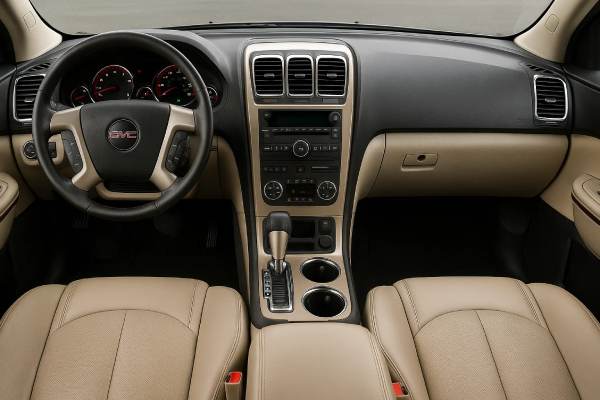
Inside, the AWD Acadia mirrors the FWD model: wide doors, a low floor and a relatively boxy greenhouse that give it genuinely useful space. Seating configurations include eight-passenger layouts with a second-row bench, or seven-passenger setups with second-row captain’s chairs that improve comfort and access to the third row. Materials and trim quality are more workmanlike than luxury, especially in SLE variants, but higher trims add leather, Bose audio and more technology.
For shoppers today, the Acadia AWD’s appeal is clear: abundant space, a secure winter driving feel and strong safety scores. The downside is that early Lambda-platform vehicles have several known weak points—timing chains, power liftgates, and some transmission and steering components—so this is a vehicle where a careful pre-purchase inspection and strong service history matter as much as the initial purchase price.
GMC Acadia AWD specs and data
Engine and performance (LY7 3.6 V6)
| Item | Value |
|---|---|
| Engine code | LY7 |
| Configuration | 60° V6, aluminium block and heads |
| Valvetrain | DOHC, 4 valves per cylinder, variable valve timing |
| Displacement | 3.6 l (3,564 cc) |
| Bore × stroke | 94.0 mm × 85.6 mm (3.70 in × 3.37 in) |
| Induction | Naturally aspirated |
| Fuel system | Sequential multi-port fuel injection (MPFI) |
| Compression ratio | Approx. 10.2:1–10.4:1 (market dependent) |
| Max power | 275 hp (205 kW) @ 6,600 rpm |
| Max torque | 251 lb-ft (340 Nm) @ 3,200 rpm |
| Timing drive | Chain (no scheduled replacement, inspect for wear) |
| Recommended fuel | Regular unleaded, 87 AKI (RON 91–92) |
| Emissions/efficiency standard | U.S. EPA, Tier 2 Bin 5 equivalent for this era |
| Rated economy AWD | 16 mpg city / 22 mpg highway / ~18 mpg combined |
| Approx. metric economy | 14.7 / 10.7 / 13.1 l/100 km (city / highway / combined) |
| Real-world highway @ 75 mph | Often closer to ~21 mpg (≈ 11.2 l/100 km), depending on load |
Transmission and AWD driveline
| Item | Value |
|---|---|
| Transmission | 6-speed automatic, 6T75, electronically controlled |
| Gear ratios (1–6 / R) | Approx. 4.48 / 2.87 / 1.84 / 1.41 / 1.00 / 0.74 / 2.88 (typical 6T75 values) |
| Final drive ratio | Around 3.16–3.39 (varies by trim/tow package) |
| Drive type | On-demand AWD, normally FWD-biased |
| Center coupling | Electronically controlled clutch in rear drive module |
| Differentials | Open front and rear, brake-based traction aids via stability control |
| Towing capacity | Up to 4,500 lb (≈ 2,040 kg) with factory trailering package |
Chassis and dimensions
| Item | Value |
|---|---|
| Platform | GM Lambda unibody crossover |
| Front suspension | MacPherson strut with coil springs and stabilizer |
| Rear suspension | Independent “H” rear suspension with coil springs |
| Steering | Hydraulic power steering |
| Brakes | 4-wheel discs with ABS |
| Wheelbase | 118.9 in (3,020 mm) |
| Length | 200.7 in (5,099 mm) |
| Width (without mirrors) | 78.2 in (1,986 mm) |
| Height | 69.9 in (1,775 mm) |
| Ground clearance | ~7.4 in (188 mm) |
| Turning circle (kerb-to-kerb) | 40.4 ft (12.3 m) |
| Curb weight (AWD, typical) | ~4,936 lb (≈ 2,240 kg) |
| Fuel tank capacity | 22.0 US gal (≈ 83 l) |
| Seating capacity | 7 or 8, depending on configuration |
| Cargo volume, behind 3rd row | ~19 ft³ (≈ 540–560 l) |
| Cargo volume, max | ~117 ft³ (≈ 3,300 l) |
Performance and capability
| Item | Value |
|---|---|
| 0–60 mph (0–97 km/h) | ~8.5–9.0 s (typical road tests, AWD) |
| 0–100 km/h | Roughly similar to 0–60 mph figure |
| Top speed (governed) | Around 110–115 mph (175–185 km/h), market dependent |
| Braked towing capacity | 4,500 lb (≈ 2,040 kg) |
| Unbraked towing | Typically limited to 1,500 lb (≈ 680 kg) |
| Roof load (with proper racks) | Commonly ~200 lb (≈ 90 kg) – verify in manual |
Fluids, lubricants and key service specs
Values below are typical for the LY7-powered Acadia AWD; always confirm by VIN and manual:
| System | Spec / Type | Approx. Capacity* |
|---|---|---|
| Engine oil | GM6094M-approved; SAE 5W-30; API “starburst” gasoline oil | ≈ 5.5 l (≈ 5.8 US qt) with filter |
| Engine coolant | 50/50 mix of clean water and DEX-COOL | ≈ 10–11 l (≈ 10–11.5 US qt) |
| Automatic transmission (6T75) | DEXRON-VI ATF | ≈ 8–9 l (≈ 8.5–9.5 US qt), partial drain much less |
| Rear drive module/differential | SAE 75W-90 synthetic axle lube meeting GM 9986115 | ≈ 1–1.2 l (≈ 1.1–1.3 US qt) |
| Power transfer unit (PTU) | Same 75W-90 synthetic axle lube | ≈ 0.6–0.8 l |
| Brake fluid | DOT-3 or Delco Supreme 11 | Fill as needed |
| Power steering | GM power steering fluid | ≈ 1 l |
| A/C refrigerant | R-134a | Charge varies; see label under hood |
*Capacities are approximate working values for planning; use factory documentation when servicing.
Electrical and safety equipment
| Item | Detail |
|---|---|
| Alternator | ~170 A (varies by trim/equipment) |
| 12V battery | Group 48/94R type common, ~600–700 CCA |
| Spark plugs | Iridium; service life up to ~100,000 miles (160,000 km) |
| Airbags | Front, front side, full-length side curtain (all three rows) |
| Safety systems | ABS, stability control (StabiliTrak), traction control, TPMS |
| Head restraints | All outboard seating positions |
| LATCH / ISOFIX | Second-row anchor points; top tethers for rear child seats |
| Crash test performance | Strong frontal and side ratings in U.S. testing for this era |
Acadia AWD trims, safety and tech
For 2007–2008, AWD was offered across most GMC Acadia trims, so you will find SLE-1, SLT-1 and SLT-2 examples with AWD. Mechanically, the AWD hardware is similar across the range, but equipment and curb weight can vary slightly with options such as larger wheels, dual sunroofs and power liftgate.
Typical trim structure (AWD-available)
- SLE-1 AWD
Cloth seats, 18-inch alloys, three-zone climate control, eight-passenger seating, OnStar, basic audio, and standard stability control. This is the most straightforward configuration and often the lightest. - SLT-1 AWD
Adds leather upholstery, heated and power-adjustable front seats, second-row captain’s chairs on many builds, upgraded Bose audio, and additional convenience features. These are popular family haulers with a good comfort–value balance. - SLT-2 AWD
Top trim with remote start, power tailgate, more power adjustments, available 19-inch wheels, head-up display and more advanced stereo/navigation on optioned vehicles. The extra equipment adds weight and complexity but can be attractive on the used market.
Key option packages affecting function rather than cosmetics include:
- Trailering package:
Heavy-duty cooling, hitch receiver and wiring, and sometimes different axle ratios; required to safely use the full 4,500 lb tow rating. - Wheel/tyre packages:
19-inch wheels improve appearance and steering response but can hurt ride comfort and winter tyre options. - Dual-panel sunroof:
Brightens the cabin but adds another potential leak point as these vehicles age.
Safety ratings and equipment
Safety is a strong point for the Acadia AWD:
- Crash tests from major bodies rated the early Acadia very highly in frontal and side impacts for this era.
- Rollover resistance scores are typical for a tall SUV, with electronic stability control helping reduce risk.
Standard safety equipment typically includes:
- Dual front airbags, front-seat side airbags and full-length curtain airbags covering all three rows.
- Electronic stability control, traction control, four-wheel ABS brakes.
- Tyre-pressure monitoring system (TPMS).
- LATCH child-seat anchors in the second row, with belt-based positions in the third row suitable for boosters and older children.
Higher trims and certain packages add:
- Rear parking assist sensors.
- Rearview camera, often integrated with the navigation or mirror.
- Head-up display on some SLT-2 vehicles.
There is no factory automatic emergency braking, lane-keeping assist or adaptive cruise control in this era; the Acadia predates mainstream adoption of those systems. However, in terms of structural crash protection and restraint systems, it remains competitive among similar-age SUVs.
When evaluating a used AWD Acadia, inspect the interior for airbags or trim that look disturbed (a hint of prior collision repair) and confirm that all safety recalls have been completed by checking the VIN through official databases.
Reliability patterns and repair priorities
Early GMC Acadia AWD models combine a complex V6, six-speed automatic and AWD hardware, so reliability depends heavily on maintenance, software updates and how the vehicle has been used. The core structure is solid, but there are repeating patterns worth understanding before you buy or invest further.
Common, higher-cost issues
- Timing chain wear (common, high cost)
- Symptoms: Check-engine light with timing correlation codes, rough running, rattle at cold start.
- Likely cause: Extended oil change intervals and dirty oil accelerate chain and guide wear on the LY7.
- Remedy: Replace timing chains, guides and tensioners; reset timing; update ECU calibration where applicable. This is a major engine-out or front-cover job, so documentation of timely oil changes is critical.
- 6T75 automatic transmission problems (common, medium–high cost)
- Symptoms: Harsh shifts, slipping, delayed engagement into drive or reverse, occasional flares on upshift.
- Likely cause: Internal clutch or wave-plate failures exacerbated by heat and lack of fluid changes.
- Remedy: Transmission rebuild or replacement; flushing alone rarely fixes mechanical damage. Prevent with periodic ATF service despite any “fill for life” marketing.
- Power steering and steering rack issues (common, medium cost)
- Symptoms: Heavy steering at low speed, groaning noises, fluid leaks.
- Likely cause: Age-related wear of pump, hoses and rack; some technical bulletins addressed assist problems.
- Remedy: Replace faulty pump or rack; flush system with correct fluid. Check for leaks around hose connections and rack boots.
AWD-specific concerns
- Rear drive module and PTU lubrication (occasional, medium cost)
- Symptoms: Whining or humming from rear under acceleration, fluid leaks, occasional binding on tight turns.
- Likely cause: Old or low fluid in rear drive module and power transfer unit; sometimes seal failures.
- Remedy: Drain and refill with correct 75W-90 synthetic lube, replace seals as needed. In severe cases, differential or PTU rebuild. Ensure matching tyres with similar tread depth to avoid drivetrain strain.
- Wheel bearings (occasional, medium cost)
- Heavier AWD curb weight and 18–19 inch wheels mean front wheel bearings can wear around 100,000–150,000 miles. Growling that changes with load and steering angle is a common sign.
Body, electrical and convenience issues
- Power liftgate struts and control (common, low–medium cost)
- Symptoms: Liftgate falls unexpectedly, fails to stay open, or opens/closes erratically.
- Cause: Worn gas struts and/or control module issues; some vehicles were part of liftgate-related recalls.
- Remedy: Replace struts; apply software updates or component replacements as per recall or service bulletin.
- Heated washer fluid system recall
- A heated washer fluid module could overheat and cause smoke or fire. Many vehicles had the system disabled or revised under recall. Confirm whether the recall has been performed and accept that heated washer function may be removed.
- Water leaks and interior trim wear (occasional, low–medium cost)
- Sunroof drains and door seals can clog or shrink with age, leading to damp carpets or headliner stains. Cleaning drains and renewing seals is usually straightforward but time consuming.
Software updates and campaigns
Over the years, GM released software updates for the engine, transmission and liftgate systems, as well as several recalls for airbags, liftgates and washer systems. A well-serviced Acadia AWD should show:
- Completed safety recalls recorded by a dealer.
- Updated power liftgate software where equipped.
- ECU/TCU programming that smooths shift timing and idle quality.
Ask for dealer printouts or online records; if none exist, factor potential catch-up work into your budget.
Pre-purchase reliability checks
Before buying, try to obtain:
- Full maintenance history including oil change intervals and any timing-chain work.
- Transmission service records or rebuild history.
- Evidence of differential and PTU fluid changes at least once by 100,000 miles.
- Confirmation of all recalls through an official VIN lookup and dealer service history.
During a road test, check for transmission hesitation, AWD noises, steering heaviness, warning lights and any water smells or damp carpets that suggest leaks.
Maintenance planning and buyer guidance
The GMC Acadia AWD rewards owners who treat maintenance as preventive rather than reactive. The factory oil-life monitor can allow long intervals in gentle use, but with age it is safer to shorten them and treat fluids as consumables.
Practical maintenance schedule (typical)
Always cross-check with the official schedule for your market, but as a rule of thumb:
- Engine oil and filter:
Every 5,000–7,500 miles (8,000–12,000 km) or 1 year, whichever comes first, using 5W-30 oil that meets GM6094M. Shorter intervals are wise for short trips, towing or hot climates. - Engine air filter:
Inspect every oil change; replace around 50,000 miles (80,000 km), sooner in dusty areas. - Cabin air filter:
Replace every 20,000–25,000 miles (32,000–40,000 km) or 2 years. - Spark plugs (iridium):
Replace around 100,000 miles (160,000 km) if no misfire or oil fouling is present. - Coolant (DEX-COOL):
Replace roughly every 5 years or 150,000 miles (240,000 km), whichever comes first. - Automatic transmission fluid (DEXRON-VI):
Even if labeled “lifetime,” many owners and specialists prefer drain-and-fill every 50,000–60,000 miles (80,000–100,000 km), more often if towing. - Rear drive module and PTU fluid:
Replace every 50,000–60,000 miles (80,000–100,000 km), especially for AWD vehicles used in snow, towing or hilly terrain. - Brake fluid:
Flush every 2–3 years to protect ABS components. - Serpentine/aux belt and hoses:
Inspect annually from 60,000 miles (100,000 km); replace belts showing cracking, glazing or noise and aged coolant hoses. - Brake pads/rotors:
Inspect at each tire rotation; rusted or deeply scored rotors and sticking calipers are common on vehicles that sit. - Wheel alignment and tyre rotation:
Rotate every 5,000–7,500 miles (8,000–12,000 km). Keep four matched tyres on AWD models to avoid driveline stress. - 12V battery:
Load-test annually after 4–5 years; many batteries are ready for replacement between 5 and 7 years. - Timing chain system:
No fixed interval, but investigate promptly if you notice chain rattle, new engine codes, or oil pressure concerns. Early repair is cheaper than a catastrophic failure.
Fluid specifications at a glance
- Engine oil: SAE 5W-30, GM6094M-approved.
- Coolant: DEX-COOL, 50/50 with clean water.
- ATF: DEXRON-VI.
- Differential and PTU: 75W-90 synthetic axle lube meeting GM 9986115.
- Brake fluid: DOT-3.
- Power steering: GM power steering fluid.
Buying guide: what to look for
When shopping for a 2006–2008 Acadia AWD:
- Start with history.
Look for evidence of regular oil changes, transmission service and cooling system care. A thick folder of receipts from reputable shops or dealers is a strong positive sign. - Inspect the AWD system.
On a test drive, feel for vibrations or binding on tight parking-lot turns. Listen for humming that changes with steering input (wheel bearings) and make sure there are no AWD-related warning messages. - Check for leaks and corrosion.
- Underneath: look for transmission, oil pan, diff and PTU leaks, and rust on subframes or brake lines.
- Inside: lift carpet edges where possible to sniff for dampness, especially under the front seats and footwells.
- Liftgate and doors.
Test the power liftgate (if equipped) multiple times. It should open smoothly, stay up and close without grinding noises. Check for evidence of recalls. - Cooling and temperature behavior.
Bring the vehicle fully to temperature and ensure it holds normal operating temperature in traffic and on the highway, with the heater and A/C used.
Which years and trims to prefer
- Later build 2008 models with documented service are usually better bets than early pre-production 2007 builds, because more running changes and early fixes were implemented.
- SLT-1 AWD with the trailering package often provides the most balanced combination of equipment, towing capability and cost.
- Avoid high-mileage examples with no transmission or AWD fluid history, evidence of timing-chain noise, or multiple electrical issues; the purchase price savings can evaporate quickly in repairs.
If maintained on time and driven with some mechanical sympathy, a GMC Acadia AWD can be a comfortable, capable family vehicle well into six-figure mileage. The key is to buy carefully and budget realistically for catch-up maintenance.
Driving impressions and real-world performance
On the road, the GMC Acadia AWD feels like what it is: a large, heavy crossover tuned for family comfort rather than sporty driving. The unibody construction and independent suspensions front and rear give it a more settled ride than many body-on-frame SUVs of the same era, and the AWD system adds a layer of confidence in poor weather without demanding any action from the driver.
Ride, handling and NVH
Ride quality on the standard 18-inch wheels is generally comfortable, soaking up highway expansion joints and typical suburban potholes reasonably well. The suspension tuning leans toward soft, so there is noticeable body roll if you push it through a series of bends, but the behavior is predictable and secure. Models with 19-inch wheels look sharper but can feel more jittery over broken pavement.
Steering is light at parking speeds and suitably weighted on the highway, though some drivers find it a bit numb on-center. Road and wind noise are moderate for this class; the big mirrors and upright windshield create some wind rustle at freeway speeds, but the engine is muted once in top gear.
Powertrain character
The LY7 3.6 V6 has a smooth revving character and does its best work above 3,000 rpm. Around town, you may find it needs a downshift or two for brisk acceleration, especially with seven or eight passengers onboard. The six-speed automatic tends to prioritize fuel economy and may be slow to kick down unless you press the throttle firmly.
Once you learn its responses, the combination delivers acceptable performance: merging and passing on the highway are comfortable rather than thrilling, and the AWD system puts power down without drama even in rain or light snow. The lack of low range and limited ground clearance mean this is not an off-road machine, but for gravel roads, snow-covered lanes and steep driveways, the system works well.
Real-world fuel economy
For the AWD Acadia with the 3.6 V6:
- Official ratings: about 16 mpg city and 22 mpg highway (roughly 14.7 and 10.7 l/100 km), with a combined figure near 18 mpg (≈ 13.1 l/100 km).
- Typical owner reports:
- Urban/suburban mix: 14–17 mpg (≈ 13.8–16.8 l/100 km).
- Highway at 65–70 mph (105–115 km/h): 20–23 mpg (≈ 10.2–11.8 l/100 km).
- Highway at 75 mph (120 km/h) or with a full load: often around 19–21 mpg.
Short trips, heavy use of remote start, and roof racks or cargo boxes can all drag the numbers down further. Towing at or near the 4,500 lb rating can easily cut fuel economy by 30–40 percent, particularly on hilly routes.
Towing and load behavior
With the proper trailering package, the Acadia AWD tows medium travel trailers, small boats and utility trailers respectably. The long wheelbase helps stability, and the AWD system assists with traction when pulling away on wet ramps or gravel. Watch transmission temperatures on hot days with heavy loads, and consider installing an auxiliary transmission cooler if your use is demanding and your truck does not already have one.
Under full passenger and cargo load, the suspension compresses but remains controlled. Pay attention to tyre pressures and use load-appropriate tyres; worn or under-inflated tyres on such a heavy vehicle can lead to vague steering and longer stopping distances.
Traction and control in bad weather
Where the Acadia AWD shines is in winter or heavy rain. The on-demand AWD, combined with stability control and all-season or winter tyres, gives reassuring traction when pulling away from intersections or climbing snowy hills. Because it behaves like a front-drive vehicle most of the time, you do not feel constant driveline wind-up or binding on dry pavement.
For maximum benefit:
- Use a good set of dedicated winter tyres in harsh climates.
- Avoid mismatched tyre brands or sizes, which can stress the AWD clutches.
- Keep the stability control engaged; it is tuned to work with the AWD system.
Overall, the Acadia AWD driving experience is about peace of mind and comfort, not excitement. If you accept that, and you stay on top of fluids and tyres, it is a relaxed long-distance companion.
GMC Acadia AWD versus rivals
When new, the GMC Acadia AWD competed with other three-row crossovers and larger SUVs such as the Honda Pilot, Toyota Highlander, Mazda CX-9, Hyundai Veracruz, and Ford Explorer, as well as its own corporate siblings, the Buick Enclave and Saturn Outlook. On the used market, those comparisons still help frame its strengths and weaknesses.
Space and practicality
- Versus Honda Pilot / Toyota Highlander (same era):
The Acadia AWD is larger, with a more adult-friendly third row and more cargo space behind it. If you regularly carry seven or eight people, the Acadia often feels less cramped. - Versus Mazda CX-9:
Both offer good driving dynamics, but the Acadia’s boxier shape and long wheelbase give it an edge in cargo flexibility and rear headroom. - Versus traditional SUVs (e.g., Tahoe, Explorer of the time):
The Acadia’s unibody structure means a lower floor and easier third-row access, and it generally rides more smoothly.
Performance and towing
The 275 hp V6 and 6-speed automatic put the Acadia in the middle of the pack. It is not significantly quicker than rivals, but its 4,500 lb tow rating is competitive for a crossover and, in some cases, better than compact three-row competitors.
Compared with a body-on-frame SUV, the Acadia’s AWD system is less capable off-road due to the lack of low range and less ground clearance, but for snow, rain and gravel roads, it is entirely adequate and often more user friendly.
Reliability and ownership costs
Here rivals often have an advantage:
- Toyota Highlander and Honda Pilot from the same years have strong reliability reputations and, on average, lower long-term repair costs, though they may sacrifice some interior space and towing strength.
- Mazda CX-9 and early Hyundai/Kia crossovers can have their own engine and corrosion concerns, so they are not automatically safer choices than an Acadia AWD.
- Buick Enclave and Saturn Outlook, being close relatives, share most mechanical strengths and weaknesses. The Enclave leans more upscale, while the Outlook usually represents a cheaper entry point with similar hardware.
If you find a well-maintained Acadia AWD at a fair price, it can still be a compelling value, especially if you need the size, towing and safety performance it offers. But if your top priorities are low long-term risk and minimal major repairs, a carefully chosen Highlander or Pilot may be better aligned with those goals, despite a higher purchase price.
Who the Acadia AWD suits best
- Families needing real three-row space plus winter capability.
- Owners who tow modest trailers occasionally and prefer a more carlike ride than a truck-based SUV.
- Buyers willing to prioritize maintenance and pre-purchase inspection to manage known reliability risks.
If you recognize that the Acadia AWD is not a “cheap to neglect” vehicle and budget accordingly, it can deliver a lot of utility and comfort for the money.
References
- 2008 GMC Acadia Owner Manual M 2007 (Owner’s Manual)
- Gas Mileage of 2008 GMC Acadia 2008 (Fuel Economy Data)
- 2008 GMC Acadia 4-door SUV 2008 (Safety Rating)
- Vehicle Detail Search – 2008 GMC ACADIA 4 DR FWD/AWD | NHTSA 2008 (Recall Database)
- Used 2008 GMC ACADIA-V6 Wagon 4D SLT AWD Specs | J.D. Power 2025 (Specifications)
Disclaimer
This article is for informational purposes only and is not a substitute for professional diagnosis, repair advice, or safety guidance. Specifications, fluid capacities, torque values, service intervals and procedures can vary by VIN, production date, market, and installed equipment. Always verify all data against your vehicle’s official service manual, owner’s manual, and manufacturer service information, and follow local regulations and safety practices when working on any vehicle.
If you found this guide helpful, feel free to share it with fellow owners or shoppers on Facebook, X/Twitter, or your favourite forum—your support helps us keep producing detailed, independent technical content.