


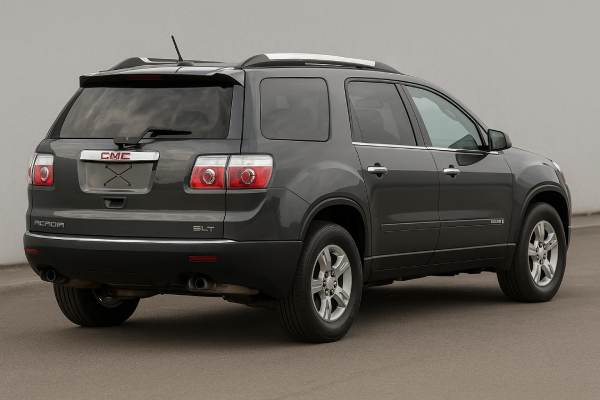
The 2009–2012 GMC Acadia FWD with the LLT 3.6-litre V6 is the heart of the first-generation facelift range. GMC replaced the older LY7 engine with the direct-injected LLT, lifting output to 288 hp and 270 lb-ft and sharpening both response and towing performance. Paired with the 6T75 six-speed automatic, front-wheel drive gives this large crossover a more car-like feel than truck-based SUVs, while still carrying eight people and serious cargo.
For many buyers, this FWD LLT Acadia is a value sweet spot: newer than the earliest 2007–2008 trucks, but still affordable and widely available. The trade-off is that you must pay attention to known issues with the 3.6-litre timing chains and transmission service. When maintained well, though, these trucks can deliver a long, comfortable life as family haulers, tow rigs for light campers, or high-mileage highway cruisers.
This guide walks you through specs, reliability, maintenance, and how the FWD LLT Acadia stacks up against rivals.
Fast Facts
- Strong 288 hp LLT V6 with good mid-range torque for passing and towing.
- Huge, flexible cabin with 7–8 seats and very generous cargo space.
- LLT timing chain and 6T75 transmission both respond poorly to skipped fluid changes.
- Typical engine oil interval: 5,000–7,500 miles (8,000–12,000 km) or when the Oil Life Monitor prompts, whichever comes first.
What’s inside
- GMC Acadia FWD LLT snapshot
- GMC Acadia FWD LLT specs
- Acadia FWD trims and protection
- Reliability concerns and fix strategies
- Service schedule and buyer guide
- Driving feel and on-road behaviour
- How Acadia FWD compares to rivals
GMC Acadia FWD LLT snapshot
For 2009, GMC updated the Acadia’s powertrain to the LLT 3.6-litre V6 with gasoline direct injection. Power climbs to 288 hp and 270 lb-ft, giving the big crossover more confident acceleration and slightly better efficiency than the earlier 275 hp LY7 engine. All 2009–2012 front-wheel-drive Acadias share this LLT setup and a 6T75 six-speed automatic.
As a front-drive Lambda-platform sibling to the Buick Enclave and Chevy Traverse, the Acadia targets buyers who want minivan practicality without sliding doors. The cabin is genuinely large, with seating for seven or eight and a low, flat load floor. Cargo space ranges from a useful boot with the third row up to van-like volume with all rows folded, putting the Acadia among the roomiest vehicles in its class.
The FWD layout simplifies the driveline compared with the AWD version: fewer components to service, slightly lower curb weight, and marginally better fuel economy. For drivers in mild climates who do not need all-wheel traction, that trade-off makes sense and often means lower running costs over time.
Properly equipped with the factory towing package, a 2009–2012 FWD Acadia can tow up to 5,200 lb (2,359 kg); models without the package are typically limited to 2,000 lb (907 kg). That spread covers small travel trailers, boats, and utility trailers, but you must confirm the rating for the exact VIN and specification, especially outside North America where limits can differ.
On the road, owners tend to treat these trucks as long-distance people movers rather than fast crossovers. The LLT engine will rev and pull when asked, but the Acadia feels happiest cruising at highway speeds with a light throttle. Where the 2009–2012 FWD LLT stands out is in its mix of relatively modern powertrain, abundant space, and pricing that has now dropped into very accessible territory—provided you account for its known reliability sensitivities, especially timing chains and transmission service history.
GMC Acadia FWD LLT specs
This section focuses on the 2009–2012 GMC Acadia FWD with the LLT 3.6-litre V6 and six-speed automatic.
Engine and performance (LLT 3.6 V6)
| Item | Detail |
|---|---|
| Engine code | LLT 3.6-litre V6 |
| Layout and valvetrain | 60° V6, aluminium block and heads, DOHC, 4 valves per cylinder |
| Displacement | 3.6 L (3,564 cc) |
| Bore × stroke | 94.0 × 85.6 mm |
| Induction | Naturally aspirated |
| Fuel system | Gasoline direct injection |
| Compression ratio | Approximately 11.3:1 |
| Max power | 288 hp (≈215 kW) @ 6,300 rpm |
| Max torque | 270 lb-ft (366 Nm) @ 3,400 rpm |
| Recommended fuel | Regular unleaded (check manual for octane minimum in your market) |
| Timing drive | Chain, with hydraulic tensioners |
| Emissions/efficiency standard | U.S. EPA Tier 2, Bin 5 era |
| EPA fuel economy (FWD) | Around 17 mpg city / 24 mpg highway / 19 mpg combined (≈13.8 / 9.8 / 12.4 L/100 km) |
| Real-world highway @ 120 km/h | Often ~10–11 L/100 km (21–24 mpg US) when lightly loaded |
| Aerodynamics | Drag coefficient around the mid-0.3 range, with a large frontal area typical of 3-row SUVs |
Transmission and driveline
| Item | Detail |
|---|---|
| Transmission | Hydra-Matic 6T75 six-speed automatic (often RPO code MY9) |
| Drive type | Front-wheel drive |
| 1st / 2nd / 3rd | 4.48 / 2.87 / 1.84 :1 (typical 6T75 ratios) |
| 4th / 5th / 6th | 1.41 / 1.00 / 0.74 :1 |
| Reverse | 2.88 :1 |
| Final drive ratio | About 3.16 :1 for many FWD LLT Acadias |
| Differential | Open front differential; no rear differential on FWD |
| Tow ratings | 2,000 lb (907 kg) base; up to 5,200 lb (2,359 kg) with factory tow package and correct equipment |
Chassis, weight, and dimensions
| Item | Detail |
|---|---|
| Platform | GM Lambda unibody crossover architecture |
| Suspension (front) | MacPherson strut, coil springs, anti-roll bar |
| Suspension (rear) | Independent multi-link |
| Steering | Hydraulic rack-and-pinion, power assisted |
| Brakes | 4-wheel discs with ABS (ventilated front and rear) |
| Typical wheel/tyre sizes | 18–19 in alloys; common size P255/65R18 |
| Length | About 5,108–5,109 mm (≈200.7–201.1 in) depending on trim |
| Width | About 1,986–2,004 mm (≈78–78.9 in) |
| Height | Around 1,775–1,846 mm (≈69.9–72.7 in) depending on trim and racks |
| Wheelbase | 3,020 mm (118.9 in) |
| Ground clearance | Roughly 189–193 mm (7.4–7.6 in) |
| Turning circle | About 12.3 m (40.3 ft) |
| Curb weight (FWD LLT) | Roughly 2,140–2,150 kg (≈4,720 lb), depending on equipment |
| GVWR | Around 2,930 kg (≈6,460 lb) |
| Cargo volume | Approximately 558–3,280+ L (≈19.7–116.9 ft³) depending on row configuration |
| Fuel tank | Around 83 L (≈21.9 US gal) |
Performance and capability
| Metric | Value (typical) |
|---|---|
| 0–100 km/h (0–62 mph) | Around 8.4 seconds for a healthy FWD LLT Acadia |
| Top speed | About 175 km/h (≈109 mph), often electronically limited |
| Maximum towing | 2,000–5,200 lb, depending on tow package and region |
| Roof load | Adequate for common crossbars/cargo boxes; verify rating in the owner’s manual |
Fluids and service capacities (approximate planning values)
Always verify against the owner’s manual and service information for your VIN.
| System | Specification and notes |
|---|---|
| Engine oil | Dexos-approved full-synthetic SAE 5W-30; capacity ≈ 5.7 L (~6.0 US qt) with filter |
| Coolant | Long-life Dex-Cool, 50/50 with demineralised water; system fill ≈ 10.8–11.8 L |
| Automatic transmission | Dexron VI ATF; total capacity roughly 9.5 US qt (a pan drain will be less) |
| Power steering | GM-approved power-steering fluid; capacity typically around 1 L |
| Brake fluid | DOT 3 or equivalent; flush quantity varies |
| A/C refrigerant | R-134a; a typical charge is in the mid-30 oz range with matching PAG oil for the compressor |
| Wheel lug nuts | Often around 190 Nm (≈140 lb-ft); always confirm for your wheel package |
Electrical
| Item | Detail |
|---|---|
| Alternator output | Around 170 A on many trims |
| 12 V battery | Around 690 CCA, group size varies by market and options |
| Spark plugs | Iridium, long-life type (often 100,000-mile / 160,000-km interval in light-duty use) |
Safety and driver assistance
The 2009–2012 Acadia family performs well in major crash-test programs for frontal and side impacts, with available ratings up near the top of its segment for those years. Rollover resistance is typical for a large SUV, with stability control helping to reduce risk.
Standard safety equipment typically includes:
- Dual front airbags, front side airbags, and full-length curtain airbags
- Four-wheel disc brakes with ABS
- Electronic stability control and traction control
- Tyre-pressure monitoring system (TPMS)
- LATCH/ISOFIX child-seat anchor points in the second row
Backup cameras and rear parking sensors become more common in later years and higher trims. Advanced driver aids such as automatic emergency braking, lane-keeping assist, and blind-spot monitoring were not fitted on these model years.
Acadia FWD trims and protection
During 2009–2012, the FWD Acadia was sold with a clear trim structure, especially in North America:
- SLE1 / SLE2 – Cloth seats, 7- or 8-seat layouts, basic audio, three-zone climate control, and 18-inch wheels. These are the simplest and often the lightest variants.
- SLT1 / SLT2 – Leather seating, heated front seats, more power adjustments, upgraded stereo options, larger wheels, and more convenience features. These are common and popular as well-equipped family vehicles.
- Denali (introduced later in this range) – High-content version with distinctive grille and cladding, more insulation, premium interior trim, and nearly every option standard.
Mechanically, all FWD trims share the same LLT 3.6 engine and 6T75 transmission. Suspension tuning is broadly similar, but SLT and Denali models may ride slightly firmer when equipped with larger wheels and lower-profile tyres. That brings sharper steering response at the cost of some ride comfort and higher tyre replacement costs.
The trailering package is worth finding if you plan to tow:
- Factory hitch receiver and wiring
- Heavy-duty engine and transmission cooling
- Higher tow ratings (up to 5,200 lb) when combined with the correct axle ratio and equipment
If a seller claims a high tow rating, look for an OEM-style hitch, seven-pin connector, and confirm the RPO codes or build sheet, rather than assuming all Acadias can tow the same amount.
Cabin layout varies by trim and options:
- SLE models often offer both second-row bench (8-seat) and captain’s chairs (7-seat) configurations.
- SLT and Denali usually favour captain’s chairs for easier third-row access and a more upmarket feel.
- Higher trims add features like power tailgate, Bose audio, navigation, and dual-panel sunroof.
From a safety perspective, even base SLE trims include the key structural and restraint systems. Later model years and higher trims may include:
- Rear parking sensors
- Rear-view camera integrated in the mirror or infotainment screen
- Head-up display on some Denali-spec trucks
Across 2009–2012, there are several important safety-related recalls, particularly for front seat-belt anchor cables and side airbag wiring. These campaigns typically reinforce or replace affected components and may extend coverage into the vehicle’s second decade. Any prospective purchase should have its VIN checked to ensure all recall work is complete.
Reliability concerns and fix strategies
The 2009–2012 FWD Acadia and its LLT engine can be dependable when maintained properly, but they do have characteristic problem areas that are now well-known in the trade.
LLT timing chain stretch (common, high cost)
The direct-injected LLT V6 uses three timing chains. Extended oil change intervals, low oil, or poor-quality oil can accelerate chain and tensioner wear. Typical symptoms include:
- Check-engine light with cam/crank correlation or timing codes
- Cold-start rattles from the timing cover area
- Rough running or hesitation, especially as the problem worsens
If ignored, the engine can jump time and sustain internal damage.
Prevention and mitigation:
- Shorten oil change intervals to 5,000 miles (8,000 km) or less with good-quality Dexos-approved synthetic oil.
- Check oil level regularly and investigate any consumption.
- Avoid heavy towing or extended idling on degraded oil.
Remedy:
A proper fix usually involves replacing the complete timing set (chains, guides, tensioners, and often phasers), plus seals and fluids. This is a labour-intensive job and can easily run into several thousand in most markets.
6T75 transmission wear and wave-plate issues (occasional, medium–high cost)
Early 6T70/6T75 units gained a reputation for failures related to the 3-5-R wave plate and other internal components. Although many issues were addressed with updated parts and later calibrations, neglected fluid can still lead to wear.
Symptoms:
- Flare or slip on upshifts, especially into 3rd or 5th
- Delayed or harsh reverse engagement
- Metallic debris in the transmission pan
Prevention:
- Regular Dexron VI ATF service every 50–60,000 miles (80–100,000 km), more often if towing or in hot climates
- Use tow/haul mode when towing to keep temperatures under control
Remedy:
Once internal parts are damaged, the usual solution is a transmission rebuild or a replacement unit built with updated components.
Power steering and steering rack problems (occasional, medium cost)
Power steering issues are common with age:
- Heavy steering at low speeds
- Whining noise when turning
- Fluid leaks from hoses, pump, or rack
Long-term city driving, big wheels, and low fluid levels all worsen the problem.
Fix:
Start with a careful leak inspection and fluid flush. Worn pumps or racks may need replacement. Look under the front of the vehicle for wet components and stains on undertrays.
Cooling system and heater issues (occasional, medium cost)
Typical age-related issues include clogged heater cores, failing thermostats, and occasional radiator leaks.
Symptoms:
- Poor cabin heat
- Temperature gauge wandering in traffic
- Coolant discolouration or debris in the expansion tank
Prevention:
Replace Dex-Cool coolant at reasonable intervals (about 5 years / 150,000 miles at most) and correct any leaks quickly. Mixing incompatible coolants can accelerate deposits and corrosion.
Electrical and safety-related items
As the vehicles age, various electrical and safety systems may need attention, including:
- Seat-belt anchor cables (subject to specific recalls)
- Side airbag wiring harnesses under seats
- Liftgate switches and wiring
These are often addressed by recall campaigns or special coverage programmes. A truck with documented dealer visits and recall completion is preferable to one with an unknown history.
Overall, if you find a 2009–2012 FWD Acadia with documented oil changes, no signs of timing-chain trouble, a smooth-shifting transmission, and completed recalls, it can be a workable and relatively affordable family SUV. Neglected trucks, however, can quickly consume more in repairs than their purchase price.
Service schedule and buyer guide
Practical maintenance schedule (general guidance)
Always follow the official maintenance schedule for your region and VIN, but the following intervals are a sensible baseline for a 2009–2012 Acadia FWD LLT:
- Engine oil and filter:
Every 5,000 miles (8,000 km) or 6 months, whichever comes first. Even if the Oil Life Monitor suggests a longer interval, shorter changes protect the timing chains. - Engine air filter:
Inspect at every oil change; replace approximately every 30,000–40,000 miles (50,000–65,000 km), or sooner in dusty conditions. - Cabin air filter:
Replace every 12–24 months. - Coolant (Dex-Cool):
Replace about every 5 years or 150,000 miles (240,000 km) at the latest, sooner if the coolant is contaminated or the system has been open for repairs. - Spark plugs (iridium):
Replace around 100,000 miles (160,000 km) under normal use. If you see misfire codes or rough running, earlier replacement makes sense. - Automatic transmission fluid (Dexron VI):
Drain-and-fill or service every 50–60,000 miles (80–100,000 km), more frequently with regular towing. - Brake fluid:
Flush and replace every 3 years regardless of mileage. - Brake pads and rotors:
Inspect at each tyre rotation. Replace pads before they wear too thin and watch for rusted or warped rotors. - Tyre rotation and alignment:
Rotate tyres every 5–7,500 miles (8–12,000 km). Check alignment annually or after any impact that jars the steering. - Serpentine/auxiliary belt and hoses:
Inspect annually after 60,000 miles (100,000 km); replace belts showing cracks, glazing, or noise; monitor coolant hoses for swelling or softness. - 12 V battery:
Load-test annually once it is over roughly 4–5 years old. Replace at signs of weakness, ideally before winter. - A/C system:
Check operation each spring; recharge only when necessary and use the correct R-134a quantity and PAG oil type when the system is opened.
Buyer’s inspection checklist
When evaluating a 2009–2012 FWD LLT Acadia, pay close attention to:
- Service history
- Look for consistent oil changes at sensible intervals.
- Check for at least one transmission fluid service.
- Confirm coolant and brake fluid changes.
- Engine health
- Cold-start the vehicle after it has been sitting; listen for timing-chain rattle or knocking.
- Look for oil leaks around the timing cover, valve covers, and oil pan.
- Check the dash for warning lights and, ideally, scan for stored or pending trouble codes.
- Transmission behaviour
- Drive at varying speeds and throttle positions; watch for slip, flare, harsh shifts, or delayed engagement into reverse.
- Use manual mode if available to confirm all gears engage cleanly.
- Cooling and HVAC
- Confirm the engine reaches and holds normal operating temperature.
- Test heater and air conditioning thoroughly.
- Inspect for coolant smells, damp carpets, or fogging windows.
- Suspension and steering
- Listen for clunks or knocks over bumps.
- Check for power-steering noise and effort changes.
- Examine tyres for uneven wear that might indicate alignment or bushing issues.
- Body, corrosion, and interior
- Inspect underbody subframes, suspension mounting points, and seams in rust-prone regions.
- Check all seat folding and sliding mechanisms; verify the tailgate opens and closes smoothly.
- Safety and recalls
- Run a VIN check on official recall databases.
- Ask for documentation that seat-belt and airbag-related campaigns have been completed.
Which years and trims to favour
Within 2009–2012 FWD LLT Acadias:
- 2011–2012 examples often benefit from the most running improvements and will be slightly newer, all else equal.
- Mid-level trims such as SLE2 or SLT1 provide a good balance of equipment and complexity; Denali adds comfort and styling but not additional mechanical robustness.
- Trucks with a genuine tow package are desirable if you need to pull trailers; just be sure to verify that transmission fluid has been serviced appropriately.
In general, the best candidate is a one- or two-owner vehicle with a traceable maintenance history, quiet cold starts, clean shifting, and no major fluid leaks.
Driving feel and on-road behaviour
Despite its size and weight, a healthy FWD LLT Acadia drives more like a large car than a traditional body-on-frame SUV. The unibody Lambda platform keeps the floor relatively low and contributes to a planted feel in turns, especially compared with older truck-based GMCs.
Ride and handling
On stock 18-inch wheels, ride quality is generally comfortable and controlled. The long wheelbase helps the Acadia smooth out highway expansion joints and undulations, although sharp potholes can still be felt. With 19- or 20-inch wheels, impacts become more pronounced, but steering response sharpens slightly.
Body roll is noticeable but well-managed, and the Acadia communicates its weight in a predictable way. It is not a vehicle that encourages aggressive cornering, but for family use and long-distance cruising it strikes a sensible balance between comfort and control.
Steering effort is light at parking speeds and builds moderately as speed increases. The hydraulic system gives a natural feel by the standards of its era, though it is not particularly talkative. Straight-line stability is good at motorway speeds when tyres, suspension, and alignment are in good condition.
Powertrain character
The LLT V6 is smooth and reasonably strong once revs climb past about 3,000 rpm. From a standstill, acceleration is adequate, and with a full complement of passengers or cargo the gearbox will downshift readily to maintain pace. The 6T75’s wide ratio spread allows both brisk initial acceleration and low engine speeds in sixth gear, which helps fuel economy and reduces noise.
Shift quality varies with calibration and wear. A healthy gearbox should shift cleanly with only occasional hunting on rolling terrain. When towing or descending long grades, using a lower gear or tow/haul mode helps keep temperatures under control and reduces brake wear.
Noise, vibration, and harshness (NVH)
Engine noise is well suppressed at steady cruise but becomes more noticeable during heavy acceleration. Wind noise is moderate, mainly from the large mirrors and frontal area. Road and tyre noise depend heavily on tyre brand and condition; premium touring tyres can improve comfort notably compared with harder, cheaper options.
Higher trims with additional insulation and better sound systems feel more refined on long journeys, which can matter if you spend hours on the motorway.
Real-world efficiency
In mixed use, drivers often see:
- City: roughly 14–16 L/100 km (15–17 mpg US)
- Highway (100–120 km/h / 60–75 mph): roughly 10–11 L/100 km (21–24 mpg US)
- Mixed driving: around 12–13 L/100 km (18–20 mpg US)
Frequent short trips, remote starts, roof boxes, and heavy loads can all push fuel use higher. Towing at or near the higher end of the rated limit can cut fuel economy by 30–40 percent, especially on hilly routes.
Towing and load behaviour
With the factory tow package and a properly set up trailer, FWD Acadias can pull medium travel trailers, small boats, or loaded utility trailers within their rating. The long wheelbase aids stability, but careful loading and correct tongue weight are still vital.
Under full passenger and cargo load, the suspension compresses, yet remains controlled if springs and dampers are in good condition. Tyre pressures should be set according to the placard and checked regularly; under-inflated tyres on such a heavy vehicle can degrade steering response and increase stopping distances.
Overall, the 2009–2012 Acadia FWD LLT is best viewed as a comfortable, long-haul people mover that can also handle occasional towing, rather than a performance SUV. If you value a relaxed highway ride, roomy seating, and a car-like driving position, it fits that role well.
How Acadia FWD compares to rivals
In the 2009–2012 three-row crossover market, the FWD GMC Acadia with the LLT 3.6 competes most directly with:
- Chevrolet Traverse (mechanical sibling)
- Buick Enclave (more upscale sibling)
- Honda Pilot
- Toyota Highlander (V6)
- Ford Explorer (early unibody years)
- Larger Dodge Journey variants and similar crossovers
Space and practicality
Against most rivals, the Acadia’s cabin volume and cargo space are its standout strengths. Many competitors offer 7-seat layouts but have cramped third rows or limited luggage room with all seats up. The Acadia’s third row is genuinely usable for adults on shorter trips, and cargo capacity with all rows folded is among the best in class. If you frequently carry bulky items or travel with a full family load, this advantage is significant.
Power and performance
With 288 hp, the LLT Acadia looks strong on paper compared with contemporary V6 Highlanders and Pilots, and it is broadly in line with some Explorer and Traverse configurations. In practice, the Acadia’s weight means it feels brisk but not especially quick. Some rivals with newer transmissions or turbocharged engines may feel more responsive off the line, but the Acadia remains more than adequate for everyday driving and motorway merging.
Fuel economy
Fuel economy is a relative weak spot. Many competitors achieve similar or slightly better real-world consumption, despite smaller engines or similar power, thanks to later-generation drivetrains or lighter curb weights. If top-tier efficiency is your main priority, a smaller or newer crossover—or a second-generation Acadia—may align better with your needs.
Ride and refinement
Compared with the Traverse, the Acadia’s ride and handling feel very similar, though Denali and some SLT trims gain additional sound insulation and a more upscale interior feel. Against the Pilot and Highlander of the same era, the Acadia generally feels larger and more substantial, with more available space but also a bit more wind and tyre noise if tyres and seals have aged.
Reliability and ownership risk
This is the area where the Acadia’s strengths in space and power are balanced by higher potential repair costs. First-generation Pilot and Highlander models are generally viewed as more robust over very high mileages. The Acadia’s timing-chain and transmission sensitivities are well known, and addressing them can be costly if prior owners have stretched service intervals.
That does not automatically make the FWD LLT Acadia a poor choice; it simply means buyers should weigh its low purchase price and excellent interior packaging against the need for careful pre-purchase screening and disciplined maintenance.
Best-fit buyer
A well-sorted 2009–2012 GMC Acadia FWD LLT best suits:
- Families needing genuine three-row space and frequent highway travel
- Drivers comfortable budgeting for preventive maintenance and periodic fluid services
- Owners in regions where FWD traction is sufficient most of the year
If your top priorities are maximum interior room and a comfortable ride, and you are willing to invest in preventive maintenance, a good FWD LLT Acadia can still be a capable and comfortable long-term companion. If you want the lowest possible risk of major repairs, a smaller or more conservative rival may be a better fit.
References
- 2012 GMC Acadia/Acadia Denali Owner Manual M 2011 (Owner’s Manual)
- Gas Mileage of 2012 GMC Acadia 2012 (Fuel Economy Data)
- 2010 GMC Acadia 2010 (Safety Rating)
- Vehicle Detail Search – 2010 GMC ACADIA 4 DR FWD/AWD 2014 (Recall Database)
- GMC Acadia I 3.6 V6 (288 Hp) Automatic technical specifications and fuel economy 2019 (Technical Specs)
Disclaimer
This article is for informational purposes only and is not a substitute for professional diagnosis, repair advice, or official service information. Specifications, torque values, fluid types, and maintenance intervals can vary by VIN, model year, market, and installed equipment. Always confirm details against your vehicle’s owner’s manual, factory service documentation, and current technical bulletins before performing any work or making purchase decisions.
If you found this guide useful, please consider sharing it with other owners or shoppers on social media platforms such as Facebook or X/Twitter. Your support helps more people make well-informed decisions about their vehicles.