
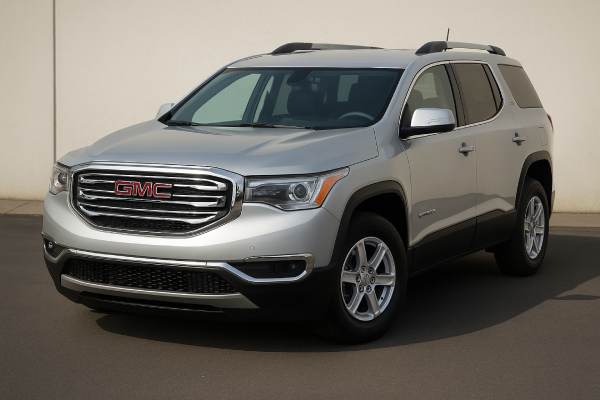
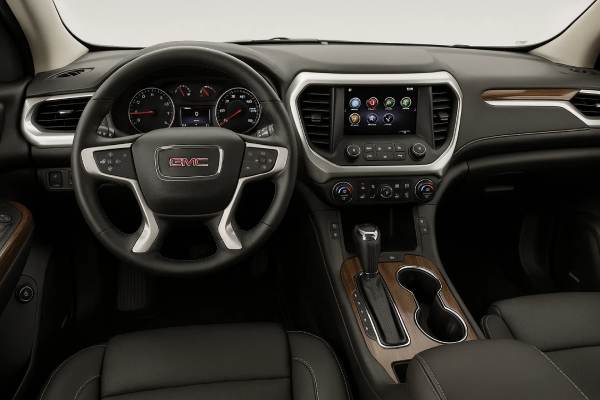
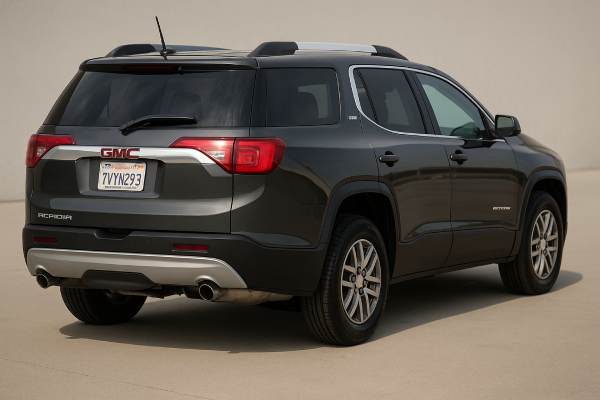
The final years of the first-generation GMC Acadia brought a mature, well-known package rather than a ground-up redesign. In 2016 and 2017, the front-wheel-drive Acadia with the 3.6 litre LLT V6 sat at the heart of the line-up, combining three-row space, a strong tow rating, and familiar GM hardware that many shops already know well.
This facelifted model kept the proven Lambda-platform layout but added updated exterior styling, revised lighting, and upgraded infotainment, while the LLT direct-injection V6 delivered 281 hp in FWD form. For families, it offered generous cargo volume, comfortable highway manners, and the ability to tow a medium-sized camper or boat. For buyers, the main questions today are reliability history, realistic fuel economy, and which years and trims are worth hunting for. This guide walks through the technical details, ownership costs, and real-world pros and cons to help you make a confident decision.
Fast Facts
- Strong 3.6L LLT V6 (281 hp) gives confident acceleration and solid towing for a seven- or eight-seat family SUV.
- Spacious three-row interior with usable third row and flat load floor once the rear rows are folded.
- Watch for timing chain stretch and transmission-related issues if oil and fluid changes were neglected.
- Plan engine oil and filter changes every 8,000–10,000 km (5,000–6,000 miles) or 12 months, whichever comes first.
Section overview
- Facelift Acadia FWD fundamentals
- FWD LLT engine specs summary
- Trim levels, equipment and safety
- Reliability patterns and repair actions
- Service schedule and buying checks
- Driving behaviour and real economy
- FWD Acadia versus alternatives
Facelift Acadia FWD fundamentals
The 2013–2017 facelifted GMC Acadia was the final evolution of the first-generation GMT968 platform before GMC downsized the model. By 2016–2017, the front-wheel-drive Acadia with the LLT 3.6 litre V6 had become a known quantity: a large, unibody crossover with minivan-like space, SUV styling, and a relatively traditional V6/automatic drivetrain.
In FWD form, this Acadia targets buyers who prioritise interior room and value over hardcore off-road ability. The absence of a rear drive module reduces weight and long-term complexity compared with AWD versions, and it marginally improves fuel economy. Yet the chassis and suspension tuning still assume regular family use with people and luggage on board, so it feels planted rather than floaty when loaded.
The facelift brought a more upright front fascia, LED running lights on many trims, and improved materials inside. GMC’s IntelliLink infotainment with a touchscreen, Bluetooth, and available navigation made the cabin feel more modern than early pre-facelift trucks. Safety content also increased over the years, with options like forward collision alert and lane departure warning becoming available.
Underneath, it remained a Lambda-platform crossover, sharing its basic structure and many components with the Chevrolet Traverse and Buick Enclave. This is useful from an ownership perspective: parts availability is generally excellent, there is a deep pool of technical knowledge in the independent repair world, and used components such as transmissions and subframes are easy to source.
For families, the key benefits are flexible seating and a generous cargo area. Sliding second-row seats, available captain’s chairs, and a low load floor make it easy to adapt the interior between people and cargo duty. From a buyer’s standpoint, the 2016–2017 FWD models often sit at a sweet spot: late enough to benefit from running changes and software updates, but still on the robust original platform that many shops know very well.
FWD LLT engine specs summary
For 2016–2017 FWD models, the Acadia uses GM’s High Feature 3.6 litre LLT V6 paired with a 6-speed automatic transmission. In this configuration, it is rated at approximately 281 hp and 266 lb-ft of torque, with direct fuel injection and variable valve timing on both camshafts. The engine is chain-driven and designed for long service life, provided oil quality and level are maintained.
Engine and performance (LLT 3.6L, FWD)
| Item | Data (approximate, market-dependent) |
|---|---|
| Engine code | LLT |
| Layout and cylinders | 60° V6, DOHC, aluminium block and heads |
| Valvetrain | Dual overhead camshafts, 4 valves/cyl, variable valve timing |
| Bore × stroke | ~94 mm × 85.6 mm (3.70 in × 3.37 in) |
| Displacement | 3.6 L (3564 cc) |
| Induction | Naturally aspirated |
| Fuel system | Direct injection (DI) gasoline |
| Compression ratio | ~11.3:1 |
| Max power | ~281 hp (210 kW) @ ~6300 rpm (FWD rating) |
| Max torque | ~266 lb-ft (361 Nm) @ ~3400 rpm |
| Timing drive | Chain (primary and secondary chains) |
| Recommended fuel | Regular unleaded (check owner’s manual for octane in your market) |
Transmission and driveline (FWD)
| Item | Data |
|---|---|
| Transmission | 6-speed automatic (6T75 or similar variant) |
| Gearbox type | Electronically controlled, torque-converter automatic |
| Drive type | Front-wheel drive (transverse engine) |
| Final drive ratio | Around 3.16–3.39:1 (varies by trim/tow package) |
| Differential | Open front differential |
| Towing equipment | Available factory tow package with heavy-duty cooling and wiring |
Chassis and key dimensions
| Item | Data (typical 2016 FWD) |
|---|---|
| Front suspension | MacPherson strut with coil springs, stabiliser bar |
| Rear suspension | Independent “H” rear with coil springs, stabiliser bar |
| Steering | Power-assisted rack-and-pinion |
| Front brakes | Ventilated discs (approx. 321–322 mm) |
| Rear brakes | Solid/vented discs (approx. 325 mm) with integrated parking brake |
| Wheelbase | ~3020 mm (118.9 in) |
| Overall length | ~5100 mm (200.8 in) |
| Width (without mirrors) | ~1990 mm (78.5 in) |
| Height | ~1780 mm (70 in) |
| Ground clearance | About 200 mm (7.9 in), trim dependent |
| Curb weight (FWD, 3-row) | Roughly 2050–2150 kg (4520–4740 lb) |
| Fuel tank capacity | Around 83 L (22.0 US gal) |
Performance and economy (realistic ranges)
| Item | Typical value |
|---|---|
| 0–100 km/h (0–62 mph) | ~8.5–9.0 s, unladen |
| Top speed | ~190–200 km/h (118–124 mph), electronically limited |
| Official fuel use (FWD) | Roughly 13–14 L/100 km city, 9–10 L/100 km highway |
| Real-world mixed | Often 12–13 L/100 km (18–20 mpg US / 21–24 mpg UK) depending on load and driving style |
| Braked towing capacity | Around 2040 kg (4500 lb) with tow package |
| Payload | Typically ~550–700 kg (1200–1550 lb) depending on trim and options |
Fluids and electrical (typical values, always confirm for your VIN)
| System | Specification and capacity (approximate) |
|---|---|
| Engine oil | Dexos-approved 5W-30 (or market equivalent); ~5.5–6.0 L (5.8–6.3 US qt) including filter |
| Engine coolant | Long-life OAT coolant; roughly 9–11 L (9.5–11.6 US qt) total system fill |
| Transmission fluid | GM-approved ATF (Dexron VI); ~8–9 L (8.5–9.5 US qt) for full change |
| Power steering | Synthetic power steering fluid (or electric assist on some later models) |
| A/C refrigerant | R-134a; charge weight depends on option (dual-zone vs rear A/C) |
| Alternator | Typically ~170–170+ A unit on higher-equipment trims |
| 12 V battery | Group 48/H6 style, cold-cranking amps tailored to climate package |
These values can vary slightly by model year, trim, and market regulations, so always verify torque specs and capacities against the official service literature for your specific VIN.
Trim levels, equipment and safety
By the facelift years, the Acadia range had settled into a clear hierarchy of trims. Exact designations vary by market, but in North America the FWD 3.6L Acadia typically appeared in SLE (1/2), SLT (1/2), and higher-feature Denali variants, with FWD available on most but not always all trims. For 2017, many markets rebranded the carryover GMT968 as “Acadia Limited,” but the basic trim logic stayed similar.
Lower SLE models focus on value and durability: cloth upholstery, manual or simple power seat adjustments, and fewer comfort features, but the same core mechanicals as higher trims. SLT adds leather seating, heated front seats, power tailgate on many builds, and upgraded audio. Denali brings distinctive exterior styling, more chrome, and richer interior materials; however, running costs and known mechanical issues are broadly similar across trims.
Key functional differences between trims often involve wheels, tyres, and braking or cooling packages. For example, tow packages can add heavy-duty engine and transmission cooling plus a specific final-drive ratio. Higher trims may receive larger diameter wheels with lower-profile tyres, improving response but slightly reducing ride comfort and potentially increasing replacement costs. When assessing a used example, confirm the presence of the factory tow package if you plan to tow near the rated limit.
The facelift years also brought safety and driver-assistance upgrades. Standard safety equipment typically includes:
- Front, side, and side-curtain airbags covering all three rows.
- Electronic stability control and traction control.
- Four-wheel disc brakes with ABS and electronic brake-force distribution.
- Tyre pressure monitoring.
Available systems (standard on higher trims or option packages, depending on year) include:
- Rear-view camera (became widely standard by this period).
- Rear park assist sensors.
- Blind spot monitoring and rear cross-traffic alert.
- Forward collision alert.
- Lane departure warning.
Crash-test scores for this generation are generally strong in frontal and side-impact testing, with solid ratings for overall occupant protection. Head restraints, roof strength, and child-seat compatibility (with lower anchors in the second row) are usually rated favourably, though you should check the exact year and seating configuration to confirm.
Because this is a relatively long and heavy vehicle, tyre condition, brake pad life, and shock absorber health all play important roles in real-world safety. On a used example, an inspection of tyre age and wear, brake rotor thickness, and suspension bushings is as important as checking for optional safety electronics.
Reliability patterns and repair actions
The facelift Acadia FWD with the LLT engine has a mixed but well-understood reliability profile. Many examples run well past 200,000 km (125,000 miles) with only routine wear items, while others suffer from timing chain and transmission issues if maintenance is neglected or driving conditions are harsh. The advantage today is that patterns are well known and fixes are widely documented.
Common engine-related issues (LLT V6)
- Timing chain stretch and guide wear (common, medium–high cost):
Symptoms include check-engine lights for cam/crank correlation codes, rough cold starts, and rattling on start-up. The root cause is often extended oil change intervals and low oil level. The remedy is replacement of chains, guides, and tensioners, plus careful inspection of cam phasers. A pre-purchase scan for stored or pending timing-related codes is strongly recommended. - Oil consumption and leaks (occasional, medium cost):
Higher-mileage engines may show increased oil consumption due to ring wear or valve-cover/PCV issues. Small leaks at cam covers or front covers are also possible. Monitoring oil level and addressing leaks early can prevent timing-chain damage. - Cooling-system weak points (occasional, medium cost):
Water pumps, radiators, and plastic coolant crossover components can develop leaks over time. Overheating is particularly dangerous for this aluminium V6, so pressure-testing the cooling system and checking for any signs of overheating on a used vehicle is essential.
Transmission and driveline
The 6-speed automatic is generally capable but can develop issues:
- Shift flare, harsh shifts, or slipping (occasional, medium–high cost):
Often related to fluid degradation, internal clutch wear, or valve-body problems. In some cases, software updates improve shift quality; in others, a rebuild with updated parts (including the well-known 3–5-R wave plate on related units) is required. - Mounts and driveline noise (occasional, low–medium cost):
Engine and transmission mounts, as well as front wheel bearings, can wear and cause thumps or humming noises. These are typically straightforward repairs but should be budgeted for on higher-mileage examples.
Chassis, body, and electrical
- Steering system concerns: Earlier years of this platform were known for power steering leaks and pump issues; facelift trucks are improved but can still see rack or hose seepage with age.
- Liftgate and door hardware: Power liftgate struts and latches can wear, leading to non-operational or slow liftgates.
- Corrosion hotspots: In rust-prone regions, check rear subframe mounting points, brake lines, and the lower edges of doors and tailgate for corrosion.
Recalls and service campaigns
Over the life of the GMT968 Acadia, various recalls and technical service bulletins (TSBs) have covered seat-belt anchors, airbags, liftgate operation, and other safety or durability items. For any candidate vehicle, you should:
- Run the VIN through the official recall database in your region.
- Ask the selling dealer or owner for documentation showing completed recall and TSB work.
- Confirm that any software updates for engine, transmission, and safety systems have been applied.
A well-documented service history with frequent oil changes, at least one transmission fluid exchange, and evidence of cooling-system maintenance is a strong positive sign.
Service schedule and buying checks
A practical maintenance plan for a 2016–2017 FWD Acadia with the LLT V6 should be slightly more conservative than the longest intervals suggested when these vehicles were new. Doing so significantly improves the chances of avoiding timing-chain and transmission issues.
Suggested maintenance schedule (typical usage)
- Engine oil and filter: Every 8,000–10,000 km (5,000–6,000 miles) or 12 months, using a Dexos-approved synthetic oil and a quality filter. Severe service (short trips, towing) should be closer to 5,000 miles.
- Engine air filter: Inspect every 20,000 km (12,000 miles); replace every 40,000–50,000 km (25,000–30,000 miles), or sooner in dusty conditions.
- Cabin air filter: Replace every 20,000–25,000 km (12,000–15,000 miles) or 2 years.
- Spark plugs: Iridium plugs typically last 160,000 km (100,000 miles), but on higher-mileage or older engines, replacing them earlier can help starting and fuel economy.
- Coolant: Replace around 5 years / 160,000 km (100,000 miles), then every 3–5 years depending on condition, using the correct long-life OAT coolant and distilled water mix if required.
- Automatic transmission fluid: Drain-and-fill or full fluid exchange approximately every 60,000–80,000 km (35,000–50,000 miles), especially if towing or driving in hilly or hot conditions.
- Brake fluid: Replace every 3 years regardless of mileage.
- Brake pads and rotors: Inspect at every service; expect pad replacement roughly every 40,000–70,000 km (25,000–45,000 miles) depending on use.
- Serpentine/auxiliary belt: Inspect annually; replace between 90,000–120,000 km (55,000–75,000 miles) or sooner if cracking or noise appears.
- Suspension and alignment: Check alignment and tyre wear every 20,000–30,000 km (12,000–18,000 miles); rotate tyres every 10,000–12,000 km (6,000–7,500 miles).
- 12 V battery: Test annually after 4–5 years; plan replacement in the 5–7 year window, especially in cold climates.
Because the LLT uses timing chains, there is no fixed belt replacement interval. Instead, you monitor chain health indirectly via:
- Engine noise on cold start.
- Cam timing correlation codes during scan-tool checks.
- Maintenance history for oil quality and consumption.
If signs of chain stretch appear, addressing them quickly is critical to avoid more extensive engine damage.
Buyer’s inspection checklist
When evaluating a used facelift FWD Acadia, pay close attention to:
- Service records: Look for evidence of regular oil changes, at least one transmission fluid service, and cooling-system work.
- Check-engine light history: Use a scan tool to read both stored and pending codes; timing-related or transmission-pressure codes are red flags.
- Engine condition: Cold-start behaviour, idle smoothness, and any unusual rattling or ticking noises.
- Transmission health: Smooth upshifts and downshifts, no flare between gears, and no shudder at light throttle. Test at highway speeds and mild grades.
- Steering and suspension: Listen for clunks over bumps, feel for wandering or kickback, and inspect tyres for cupping or uneven wear.
- Brakes: Check rotor condition, pedal feel, and stability under hard braking from highway speeds.
- Body and rust: Inspect wheel arches, subframes, underbody lines, and tailgate edges; rust repair can be costly.
Overall long-term durability can be good if the vehicle has been serviced on time and not heavily abused. A pre-purchase inspection by a technician familiar with GM’s Lambda-platform SUVs is highly recommended, especially on higher-mileage examples.
Driving behaviour and real economy
On the road, the FWD facelift Acadia feels more like a large, well-damped wagon than a truck-based SUV. The steering is light but predictable, and body motions are controlled reasonably well given the size and weight. Around town, you sit high with a clear view over the bonnet, though rearward visibility relies heavily on the camera and sensors when fitted.
Ride quality is generally comfortable, especially on trims with 18-inch wheels and higher-profile tyres. Larger 19- or 20-inch wheels sharpen initial response but add a bit more impact harshness over potholes and expansion joints. The suspension tuning is optimised for loaded driving, so the Acadia often feels better with passengers and luggage than completely empty.
The LLT V6 has a relatively free-revving character. There is enough low-rpm torque for relaxed driving, but the engine wakes up above about 3000 rpm, where it pulls strongly for passing manoeuvres or motorway on-ramps. The 6-speed automatic prefers to upshift early for fuel economy, but kickdown response is decent if you plan your throttle inputs.
Noise, vibration, and harshness (NVH) levels are acceptable for a family SUV of this era. At urban speeds, road and engine noise are modest, though coarse-chip surfaces and aggressive tyres can produce a noticeable hum at motorway speeds. Wind noise is generally well controlled, helped by the rounded body shape.
Real-world fuel consumption depends heavily on usage patterns:
- City driving: Expect around 14–16 L/100 km (15–17 mpg US, 18–20 mpg UK) with frequent stops, short trips, and use of climate control.
- Highway cruising: At steady 100–110 km/h (62–68 mph), many owners see 9–10 L/100 km (23–26 mpg US, 28–31 mpg UK) in calm conditions.
- Mixed commuting: A realistic blended figure is 11–13 L/100 km (18–21 mpg US, 22–25 mpg UK) for most drivers.
Towing a mid-sized caravan or boat significantly increases consumption; a 25–40% penalty is common when pulling close to the rated tow capacity, especially on hilly routes. In those situations, monitoring transmission temperature (if displayed) and downshifting manually on long grades can help protect the drivetrain.
Traction in poor weather is where FWD and tyre choice matter. With good all-season or dedicated winter tyres, the FWD Acadia manages light snow and wet roads competently, helped by traction and stability control systems. However, it cannot match the all-weather traction and hill-start confidence of an AWD version in deep snow or on unpaved, slippery surfaces. For predominantly urban and motorway use in moderate climates, FWD is usually sufficient and more economical.
FWD Acadia versus alternatives
When considering a 2016–2017 FWD Acadia, most buyers are cross-shopping similar three-row crossovers. The closest relatives are the Chevrolet Traverse and Buick Enclave of the same era, which share the underlying platform and much of the mechanical package. Against these, the Acadia often positions itself as the slightly more rugged or “professional grade” option, with styling and trim aimed at buyers who prefer a GMC badge and a slightly more upscale feel than a Chevrolet.
Compared with the Chevrolet Traverse, the Acadia’s driving experience and running costs are broadly similar. Your decision may come down to equipment, seat configurations, and local pricing rather than any major technical difference. Parts availability and repair procedures are nearly identical, which is positive from an ownership perspective.
The Buick Enclave, by contrast, typically emphasises a quieter cabin and a more refined interior. If you value sound insulation, soft-touch materials, and a more premium ambience and are willing to pay a little more, a well-kept Enclave may be attractive. However, the same LLT engine and 6-speed transmission mean that maintenance requirements and potential failure points are very similar to the Acadia.
Against non-GM competitors, such as the Ford Explorer, Honda Pilot, and Toyota Highlander of the same era, the Acadia has some clear strengths and weaknesses:
Strengths
- Very spacious third row and cargo area compared to many rivals.
- Strong V6 performance and relaxed cruising capability.
- Mature platform with well-known repair procedures and widely available parts.
Trade-offs
- Fuel consumption is often higher than some newer, smaller-displacement or hybrid competitors.
- The known timing-chain and transmission issues, while manageable, require attentive maintenance and careful pre-purchase checks.
- Interior design and materials, while improved in the facelift, may feel dated compared with newer crossovers introduced in the late 2010s.
For buyers who want maximum space and capability for the money, and who are comfortable budgeting for proactive maintenance, a late first-generation FWD Acadia can be appealing. If your priority is long-term, low-drama ownership with minimal fuel and repair costs, it is worth comparing it carefully with Japanese rivals and considering your annual mileage and usage patterns.
References
<a href="https://www.fueleconomy.gov/feg/bymodel/2016_GMC_Acadia.shtml">2016 GMC Acadia</a> 2016 (Fuel Economy Data)<a href="https://www.nhtsa.gov/vehicle/2016/GMC/ACADIA/SUV/FWD">2016 GMC ACADIA SUV FWD</a> 2016 (Recall and Safety Ratings Database)<a href="https://www.iihs.org/ratings/vehicle/gmc/acadia-4-door-suv/2016">2016 GMC Acadia 4-door SUV</a> 2016 (Safety Rating)<a href="https://www.iihs.org/ratings/vehicle/gmc/acadia-4-door-suv/2015">2015 GMC Acadia 4-door SUV</a> 2015 (Safety Rating, Carryover Platform)<a href="https://www.fueleconomy.gov/feg/bymodel/2017_GMC_Acadia_Limited.shtml">2017 GMC Acadia Limited</a> 2017 (Fuel Economy Data)
Disclaimer
This article is intended for informational purposes only and does not replace professional diagnosis, repair advice, or official service information. Specifications, torque values, fluid capacities, and maintenance intervals can vary by VIN, model year, market, and installed equipment. Always confirm critical data and procedures against the official owner’s manual and service documentation for your exact vehicle.
If you found this guide useful, consider sharing it with other owners or shoppers via Facebook, X/Twitter, or your favourite forums to help support the work that goes into creating detailed independent resources like this.