
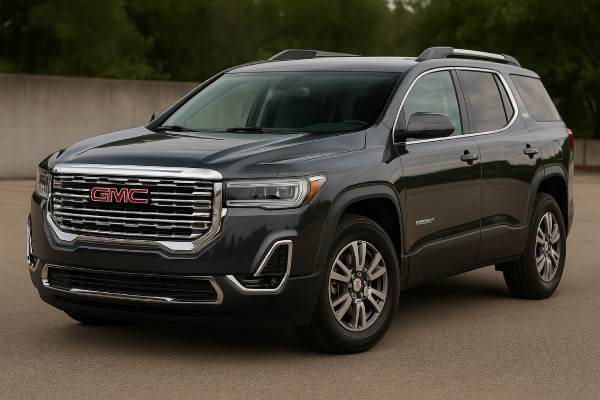
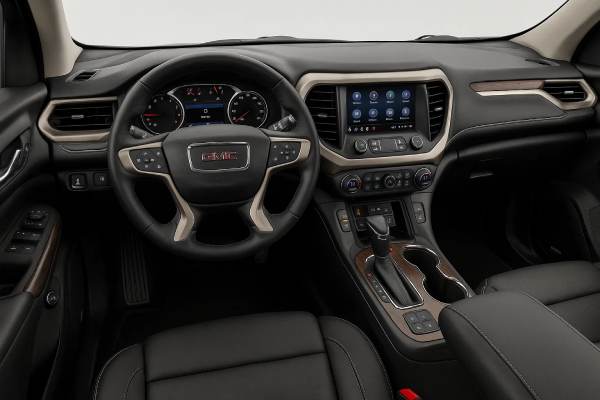
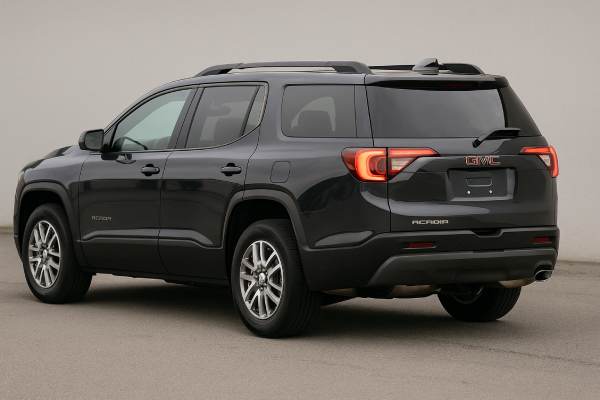
The 2020–2021 facelift GMC Acadia FWD with the 2.5 litre LCV four-cylinder sits at the sensible end of the midsize SUV market. It combines three-row practicality, a manageable exterior size, and a straightforward naturally aspirated engine. For many owners, this version is attractive because it avoids the complexity of turbocharging while still offering a modern 9-speed automatic, updated styling, and an improved infotainment system introduced with the facelift.
This Acadia is best understood as a family workhorse: easy to park, reasonably efficient, and comfortable on long journeys. It will not out-drag the V6 models, but it delivers predictable performance and usually lower purchase prices on the used market. If you are cross-shopping SUVs and want a clear view of running costs, reliability patterns, and what to look for when buying, this guide walks through the key specs, maintenance considerations, and how the facelifted 2.5 FWD stacks up against rivals.
Top Highlights
- Naturally aspirated 2.5 L four-cylinder with 193 hp and a simple, proven design that favours long-term ownership.
- Facelift brought a 9-speed automatic, updated front styling, and improved cabin tech without changing the basic practical packaging.
- Strong safety story with high crash-test scores and widely available active safety features.
- Watch for transmission shift quality and infotainment glitches; regular software updates and fluid changes help.
- Plan oil and filter changes roughly every 12,000 km or 12 months; shorten to about 8,000 km in heavy city or towing use.
Section overview
- GMC Acadia 2.5 FWD facelift context
- Facelift 2.5 FWD specs and data
- Trims equipment and 2020–2021 safety
- Reliability of the 2.5 FWD drivetrain
- Service schedule and buyer guidance
- Driving feel economy and response
- GMC Acadia 2.5 FWD versus rivals
GMC Acadia 2.5 FWD facelift context
When GMC refreshed the second-generation Acadia for 2020, the 2.5 litre FWD model remained the entry point to the range in North America. The facelift sharpened the exterior with a more upright front grille, revised lighting, and updated bumpers. Inside, there was a new centre console layout with a push-button gear selector and an upgraded infotainment system with better graphics and connectivity.
Under the skin, the most meaningful change for buyers was the move from a 6-speed automatic to a 9-speed unit across four-cylinder models. This allows the 2.5 to make better use of its modest torque, cut revs at highway speeds, and improve refinement. The engine itself is the familiar LCV 2.5L inline-four used in other GM products, tuned here for 193 hp and 188 lb-ft. It is naturally aspirated, with variable valve timing and direct injection, prioritising durability and linear power delivery over outright performance.
The facelift did not alter the Acadia’s basic role. It is still a slightly smaller three-row SUV than many rivals, which brings pros and cons. On the plus side, it is easier to park, lighter than some competitors, and often uses less fuel. On the downside, third-row space is more suitable for children or short adults, and cargo room behind all three rows is limited compared with big-box rivals. Still, with the rear seats folded, you get up to around 79 cubic feet of cargo space, making it flexible for family trips and DIY runs.
For buyers focused on all-weather traction, the 2.5 is available with AWD, but this article focuses on the front-wheel drive variant. FWD keeps weight, purchase price, and maintenance a little lower, and for many suburban owners, a good set of all-season or winter tyres will be more important than driven rear wheels. If you routinely tow near the limits or live in a very snowy region, the V6 AWD models deserve a look, but for light towing and everyday commuting, the 2.5 FWD is often more than sufficient.
The facelifted 2020–2021 run is also interesting from a used-market perspective. It benefits from early-generation bugs largely ironed out after the 2017 launch while still sitting within, or just beyond, the main warranty window for newer examples. That makes these years a sweet spot if you want modern safety and tech with a more predictable ownership pattern.
Facelift 2.5 FWD specs and data
Engine and performance
| Item | Specification |
|---|---|
| Engine code | LCV |
| Layout and cylinders | Inline-4, DOHC, 4 valves per cylinder |
| Displacement | 2.5 L (2,457 cc) |
| Induction | Naturally aspirated |
| Fuel system | Direct injection with variable valve timing |
| Compression ratio | ~11.3 : 1 |
| Max power | 193 hp (144 kW) @ 6,300 rpm |
| Max torque | 188 lb-ft (255 Nm) @ 4,400 rpm |
| Timing drive | Chain-driven camshafts |
| Emissions / certification | U.S. EPA / Tier 3 compliant |
Official fuel economy for the 2.5 FWD in this facelift period is around 21 mpg city, 27 mpg highway, and 23 mpg combined on regular unleaded, depending on exact specification and test cycle.
Transmission and driveline
| Item | Specification |
|---|---|
| Transmission | 9-speed automatic (9T50) |
| Drive type | Front-wheel drive |
| Final drive | Around 3.8 : 1 (trim-dependent) |
| Differential | Open with electronic traction aid |
| Towing (2.5 FWD) | Typically up to 1,000 lb (454 kg) without tow package |
The 9-speed’s closely spaced ratios help keep the engine in its more useful mid-range, though the calibration can occasionally feel busy, especially in city driving.
Chassis and dimensions
| Item | Specification |
|---|---|
| Platform | C1UG (second-generation Acadia) |
| Front suspension | MacPherson strut |
| Rear suspension | Multi-link independent |
| Steering | Electric power steering |
| Front brakes | Ventilated disc |
| Rear brakes | Solid disc |
| Wheelbase | ~2,857 mm (112.5 in) |
| Overall length | ~4,920 mm (193.4 in) |
| Width (without mirrors) | ~1,915 mm (75.4 in) |
| Height | ~1,676 mm (around 66–67 in) |
| Curb weight (2.5 FWD) | ~1,770–1,860 kg (3,900–4,100 lb) |
| Fuel tank capacity | ~72–73 L (approx. 19 US gal) |
| Cargo volume (max) | About 79 cu ft with rear rows folded |
| Cargo behind 2nd / 3rd row | Around 41.7 / 12.8 cu ft |
Performance and capability
| Metric | Value (approximate) |
|---|---|
| 0–60 mph (2.5 FWD) | About 8.9–9.5 seconds |
| Top speed (governed) | Around 190 km/h (118 mph) |
| Braking 60–0 mph | Typically 125–135 ft, tyre-dependent |
| Max payload (configuration-dependent) | Roughly 1,400–1,700 lb |
| Roof load | Around 150 lb (check rail rating) |
Fluids and service capacities (typical values)
Always confirm against the under-bonnet label and service data for your exact VIN.
| System | Type / Spec (typical) | Capacity (approx.) |
|---|---|---|
| Engine oil | Dexos1 Gen 2 5W-20 or 5W-30 | ~4.7–5.0 L |
| Engine coolant | Dex-Cool OAT | ~11–12 L total system |
| Automatic transmission | GM-approved ATF for 9T50 | ~8–9 L |
| Brake fluid | DOT 3 or DOT 4 | Fill as required |
| A/C refrigerant | R-1234yf on most facelift models | Charge per label |
Electrical
| Item | Specification (typical) |
|---|---|
| Alternator | Around 150 A unit |
| 12 V battery | 70–80 Ah AGM or flooded |
| Spark plugs | Long-life iridium, ~0.7–0.8 mm gap |
Safety and assistance hardware
Facelift Acadias commonly offer:
- Multiple airbags (front, side, curtain, often driver’s knee).
- ABS, stability control, and traction control as standard.
- Available forward collision alert, automatic emergency braking, lane keep assist, blind spot monitoring, rear cross-traffic alert, and rear park assist on higher trims or option packages.
Trims equipment and 2020–2021 safety
For 2020–2021, the 2.5 FWD powertrain was mainly paired with lower and mid-level trims such as SL, SLE, and some SLT configurations in the U.S. and Canada. AT4 and Denali models usually came with the 3.6 V6 or 2.0 turbo, so most 2.5 FWD Acadias in the market are more modestly equipped but still offer useful comfort and technology.
Typical trim and equipment patterns:
- SL / base (where offered)
Cloth seats, manual front seat adjustment, three-zone climate control, 8-inch touchscreen with Apple CarPlay and Android Auto, keyless entry and start, and a rear-view camera. - SLE
Usually adds alloy wheels, more front seat adjustments, enhanced audio, additional USB ports, and access to more option packages, including some safety bundles. - SLT (2.5-equipped examples)
Normally features leather-trimmed interior, power tailgate, heated front seats, and sometimes second-row captain’s chairs, plus broader access to tech and safety options such as blind spot monitoring and lane keep assist.
You can identify trims by:
- Badging on the tailgate (SLE, SLT, etc.).
- Interior cues like cloth versus leather, manual versus power seats, and the size of the driver information display.
- Option package content (for example, GMC Pro Safety or Driver Alert), often noted on the build label, original window sticker, or dealer printouts.
Safety ratings: 2020–2021
The second-generation Acadia, including facelift years, performs well in crash testing:
- U.S. testing shows a five-star overall rating in many configurations, with strong side-impact and frontal results and a four-star rollover rating.
- IIHS evaluations for equivalent models show “Good” scores in major crashworthiness categories such as moderate overlap front, side impact, roof strength, and head restraints.
Where the Acadia sometimes falls short of top honours is in headlight performance, which varies by trim and headlamp type. Some versions have headlights rated below the top level, so if you frequently drive at night on unlit roads, it is worth checking exactly which headlamp units you are getting and considering upgrades where legal and appropriate.
Active safety technology became more widespread with each model year, but it was not fully standard across all trims. When shopping, look for:
- Forward collision alert and automatic emergency braking indicators on the instrument cluster.
- Physical buttons for lane keeping, parking sensors, or rear cross-traffic alert on the steering wheel or dashboard.
- Additional radar and camera housings around the grille, bumper, and windscreen.
After repairs involving bumpers, windscreens, or front impact, driver-assistance sensors sometimes require calibration. Make sure any previous body repairs include documented calibration work; otherwise, systems may not function as intended even if no warning lights are on.
Reliability of the 2.5 FWD drivetrain
The 2.5 L LCV engine with the 9T50 automatic has a generally solid reputation when serviced properly, but there are patterns you should understand before buying.
Common to occasional issues (medium impact)
- 9-speed automatic shift quality
- Symptoms: Hesitation off the line, abrupt downshifts, or gear “hunting” at light throttle, especially in stop-start city driving.
- Likely causes: Software calibration quirks and, over time, normal wear or fluid degradation.
- Recommended remedy: Check that the latest transmission software updates have been applied. For vehicles with higher mileage, a fluid change and adaptation reset can improve behaviour. Persistent harshness or slipping should be evaluated by a transmission specialist.
- Infotainment and connectivity glitches
- Symptoms: Screen freezing, random reboots, Bluetooth dropouts, or intermittent camera display.
- Likely causes: Software bugs, occasional module faults, or low battery voltage.
- Recommended remedy: Hard reset and software updates via a dealer or specialist; confirm that the 12 V battery is healthy. Module replacement is sometimes needed on stubborn cases.
- Direct-injection deposit build-up
- Symptoms: Rough idle, hesitant acceleration, or gradually worsening fuel economy at higher mileage, especially on vehicles used mostly for short trips.
- Likely causes: Carbon build-up on intake valves, a common side effect of direct injection.
- Recommended remedy: Preventive high-quality fuel, occasional cleaning additives, and, in more severe cases, walnut blasting of intake valves by a specialist.
Less common but higher-impact concerns
- Timing chain wear or noise
The LCV’s timing chain is generally robust, but poor maintenance, extended oil change intervals, or low oil levels can accelerate wear. Signs include rattling on cold start and cam/crank correlation error codes. If confirmed, timing chain replacement with new guides and tensioners is a significant but infrequent repair on well-maintained engines. - Cooling system leaks
Radiators, hoses, or the water pump can develop leaks with age and mileage. Even small leaks should be addressed quickly to avoid overheating, as aluminium four-cylinder engines do not tolerate overheating well. - Steering and suspension wear
Over rough roads, front suspension bushings, ball joints, and sway-bar links can wear faster. A test drive over uneven surfaces should be quiet; any knocking or clunking is a sign that further inspection is needed.
Recalls and service actions
Facelift Acadias have several potential recalls, depending on VIN and build date. Issues may include seat belt fasteners, rear-view camera behaviour, and other build-specific items. To protect yourself:
- Run the VIN through your national safety agency’s recall lookup.
- Ask a dealer to print the vehicle’s recall and warranty repair history.
- Confirm that any open campaigns have been completed, and keep documentation for future buyers.
Pre-purchase checks specific to the 2.5 FWD
Ask the seller for:
- Proof of regular oil changes at sensible intervals.
- Confirmation of any transmission software updates and, ideally, at least one fluid service if the vehicle has higher mileage.
- Records of cooling system, steering, or suspension repairs.
- A recent diagnostic scan that shows no stored or pending powertrain, ABS, or airbag codes.
With basic care, many 2.5 FWD Acadias will reach well beyond 240,000 km with only routine maintenance and normal wear repairs.
Service schedule and buyer guidance
A structured maintenance plan is vital if you want predictable running costs and maximum reliability from the 2.5 FWD Acadia.
Practical maintenance schedule (general guidance)
- Engine oil and filter
- Normal use: every 7,500 miles / 12,000 km or 12 months.
- Severe use (short trips, lots of idling, frequent towing): every 5,000 miles / 8,000 km or 6 months.
- Engine air filter
Inspect every 15,000 miles / 24,000 km; replace every 30,000–45,000 miles (48,000–72,000 km), or sooner in dusty climates. - Cabin air filter
Replace every 15,000–20,000 miles (24,000–32,000 km) or roughly every two years. - Coolant
Long-life Dex-Cool coolant is typically rated for about 5 years or 150,000 miles (240,000 km) before the first change. After that, consider 4–5 year intervals depending on usage and coolant condition. - Spark plugs
Long-life iridium plugs can often go to around 97,500 miles (160,000 km). On a used car approaching or past that mileage, confirm whether they have been replaced. - Transmission fluid (9-speed)
Even if labelled “lifetime,” replacing fluid every 60,000–80,000 miles (96,000–130,000 km) is a sensible preventative measure, especially if the vehicle tows or sees mostly city use. - Brake fluid
Flush every 3 years regardless of mileage. - Brakes
Inspect pads, rotors, and parking-brake operation at least annually; more often in hilly or coastal regions. - Serpentine belt and pulleys
Inspect from around 60,000 miles (96,000 km) onward; replace around 100,000 miles or if any cracks or noise appear. - Tyres and alignment
Rotate every 5,000–7,500 miles (8,000–12,000 km) and check alignment yearly or after major pothole impacts. - 12 V battery
Test annually after 4–5 years of age; replacement before it fails outright can prevent a range of electronic issues.
Buyer’s inspection checklist
When viewing a facelift 2.5 FWD Acadia:
- Exterior and structure
- Look for consistent paint, panel gaps, and headlamp alignment.
- Check for overspray, mismatched bumper colour, or uneven shut lines that might indicate prior collision damage.
- Engine bay
- Inspect for oil or coolant leaks around the engine block, front cover, and radiator.
- Listen on cold start and warm idle for unusual rattles, ticks, or belt noises.
- Road test
- Evaluate the 9-speed automatic from rest, at urban speeds, and on the highway; note any hesitation, jerks, or flares.
- Check straight-line tracking, steering feel, and brake performance at moderate and firm pedal pressures.
- Electronics
- Test all power windows, mirrors, seats, and locks.
- Confirm climate control, rear HVAC, heated seats, infotainment, cameras, and parking sensors function correctly.
- Documents and history
- Prefer vehicles with a full service history, especially for oil and transmission services.
- Verify recall completion and ask for any warranty or goodwill repairs that were done.
Which trims and years to target
Within the 2020–2021 2.5 FWD range:
- SLE and lower-option SLT examples often offer the best value, combining key comfort features and safety tech without the higher fuel use and complexity of the V6 or turbo models.
- Very low-spec SL units can be appealing if you want simplicity and lower cost, but make sure they have the safety features you care about (for example, blind spot monitoring or lane keep assist).
Overall, a facelift 2.5 FWD Acadia with documented maintenance and updated transmission software is an appealing used buy for families who value practicality and predictable running costs over outright performance.
Driving feel economy and response
On the road, the 2.5 FWD Acadia feels tuned for calm, predictable family duty rather than excitement. The naturally aspirated four-cylinder delivers linear power, and in gentle use it is smooth and unobtrusive. Press harder, and it will work its way up the rev range with a noticeable increase in engine noise but still reasonably refined behaviour for a big four-cylinder.
Independent tests place 0–60 mph in the high eight- to mid-nine-second range, which is acceptable for day-to-day driving. You may need to plan overtakes more carefully when fully loaded or climbing steep grades, but the powertrain is rarely overwhelmed in normal suburban and motorway use.
The 9-speed automatic can feel very smooth on the open road, where it keeps engine speed low in the higher gears. In stop-start city traffic, it may sometimes hesitate or shuffle between gears as it tries to maximise efficiency. Many owners adjust quickly to its character, but a thorough test drive that includes heavy traffic and highway running is important to make sure you are comfortable with its behaviour.
Ride quality is one of the Acadia’s strong points. On 18-inch wheels with reasonably tall tyres, it absorbs bumps and expansion joints without harshness. Body roll is present but controlled, and the overall feel is more comfort-oriented than sporty. Steering is light and easy at parking speeds and becomes a little firmer on the motorway; feedback is modest but adequate for confident placement.
Noise levels are competitive for the class. There is some road and wind noise at higher speeds, as you would expect in this segment, but conversations remain easy and the engine is quiet when cruising. Only under heavy acceleration does the four-cylinder become a prominent part of the soundscape.
Real-world fuel economy
In everyday use, owners of 2.5 FWD Acadias typically see:
- City driving: around 18–21 mpg (13–11 L/100 km).
- Highway driving (110–120 km/h): around 26–29 mpg (9–8 L/100 km) when lightly loaded.
- Mixed use: roughly 22–24 mpg (10.7–9.8 L/100 km).
Cold weather, short trips, and heavy loads will reduce these numbers, while gentle driving at moderate speeds can improve them.
Load and light towing
The 2.5 FWD is designed more for people and cargo than for heavy trailers. Light-duty towing of small utility trailers or light watercraft is realistic within its rating, but you will notice the added weight in acceleration and braking. If regular towing of heavier campers or boats is part of your lifestyle, a V6-equipped variant with a higher tow rating is usually a better fit.
For the majority of households, though, the 2.5 FWD’s driving character aligns well with reality: school runs, commuting, weekend trips, and occasional long motorway journeys. It is easy to drive, predictable in poor weather with appropriate tyres, and not excessively thirsty.
GMC Acadia 2.5 FWD versus rivals
The facelifted 2.5 FWD Acadia competes with a wide range of midsize SUVs, including the Honda Pilot, Toyota Highlander, Ford Explorer, Hyundai Santa Fe, and Chevrolet Traverse. Each model has its own priorities; understanding the Acadia’s position helps you decide if it matches your needs.
Where the Acadia 2.5 FWD is strong
- Manageable size
The Acadia is slightly smaller than some three-row rivals, which makes it easier to manoeuvre and park, especially in urban settings and tight garages. You still get three rows and flexible cargo space with the seats folded. - Straightforward powertrain
The naturally aspirated four-cylinder avoids the added complexity of turbochargers and, in many cases, complex exhaust and cooling layouts. For long-term ownership with simple servicing, this is appealing. - Safety performance
High crash-test scores and widely available active safety technology make it competitive with class leaders in occupant protection and crash avoidance. - Comfort and tech
The cabin offers comfortable seating, a clear infotainment interface, and useful amenities such as tri-zone climate control and multiple USB ports, even on mid-spec versions.
Where rivals may do better
- Power and towing
V6-powered competitors—or the Acadia’s own V6 models—offer stronger acceleration and significantly higher tow ratings. If you tow frequently or often drive fully loaded in hilly regions, those may serve you better. - Third-row and cargo volume
Some rivals provide more generous third-row legroom and larger cargo capacity behind the third row. Families regularly carrying six or seven adults, plus luggage, may prefer those. - Resale and brand perception
Brands such as Toyota and Honda often enjoy stronger resale value, though the Acadia’s lower initial purchase price can offset this.
Who the facelift 2.5 FWD suits best
- Families who use the third row occasionally rather than every day and value ease of parking as much as total interior volume.
- Buyers who prefer a naturally aspirated engine, a modern but not overly complex drivetrain, and predictable maintenance.
- Drivers who want good safety scores and updated infotainment but do not need the extra power or tow rating of the V6 versions.
If you can find a well-maintained 2020–2021 2.5 FWD Acadia with a complete service history, clean inspection, and up-to-date software, it can be a very rational and cost-effective choice in the crowded midsize SUV market.
References
- 2020 GMC Acadia 4-door SUV 2020 (Safety Rating)
- 2020 GMC Acadia Review & Ratings 2020 (Safety Rating)
- 2020 GMC Acadia Catalog 2019 (Owner’s Manual/Brochure)
- 2021 GMC Acadia 2020 (Owner’s Manual/Brochure)
- Vehicle Detail Search – 2021 GMC ACADIA SUV FWD 2021 (Recall Database)
Disclaimer
This article is for informational purposes only and is not a substitute for professional diagnosis, repair, or official service information. Specifications, fluid types and capacities, torque values, safety ratings, and maintenance intervals can vary by VIN, model year, market, and equipment level. Always verify procedures and data against the official owner’s manual, workshop manual, and technical bulletins for your specific vehicle, and follow all applicable safety instructions.
If you found this guide useful, please consider sharing it with other owners and shoppers on platforms such as Facebook or X/Twitter. Your support helps keep detailed, independent technical content like this available.