
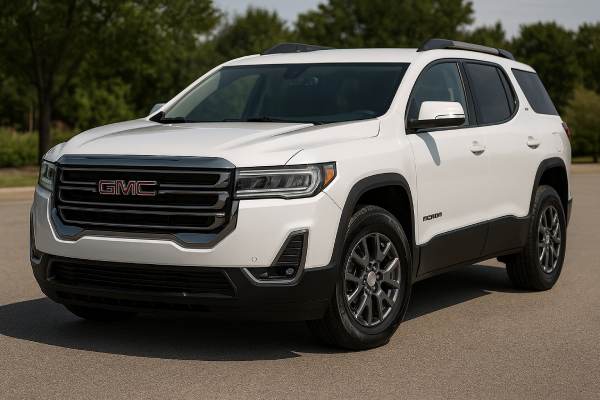
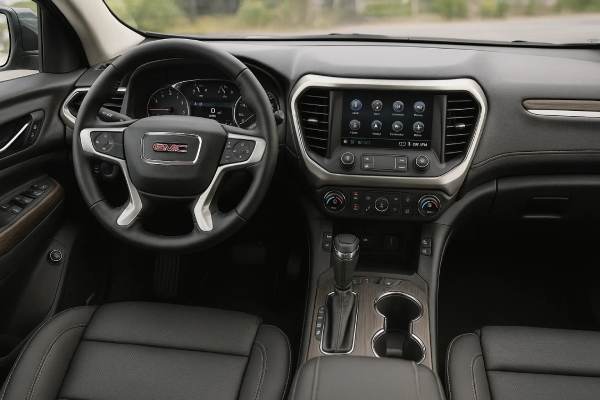
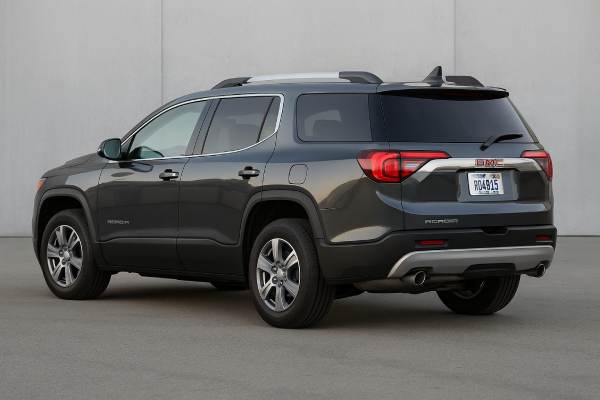
The 2020–2023 GMC Acadia FWD with the LGX 3.6-litre V6 sits in a useful middle ground between compact crossovers and full-size three-row SUVs. It uses the lighter second-generation C1UG platform, updated with the 2020 facelift’s bolder front end, revised lighting, and upgraded infotainment. Under the hood, the LGX direct-injection V6 delivers 310 hp and a confident top-end pull, while the nine-speed automatic and front-wheel-drive layout aim to balance performance with efficiency and everyday usability.
For families and long-distance commuters, this version of the Acadia offers comfortable seating for six or seven, a quiet cabin, and smart storage solutions, while still being easy to park compared with larger rivals. At the same time, it can tow up to 1,814 kg (4,000 lb) when properly equipped and feels noticeably stronger than the 2.0-litre turbo option when loaded. This guide walks through the key specs, real-world behaviour, reliability patterns, and what to look for when buying or maintaining one.
Fast Facts
- Strong LGX 3.6 V6 (310 hp, 271 lb-ft) gives brisk acceleration and relaxed highway passing.
- Relatively light body and FWD layout make the Acadia easy to manoeuvre and park for a three-row SUV.
- When properly equipped, towing capacity reaches about 1,814 kg (4,000 lb), enough for small campers or boats.
- V6 FWD fuel use is on the higher side; real-world mixed driving often lands around 11–12 L/100 km (20–22 mpg US).
- Plan engine oil and filter changes roughly every 12,000 km or 7,500 miles, or 12 months, whichever comes first.
What’s inside
- Acadia 3.6 FWD overview
- LGX V6 specs and data
- Trims, equipment and safety
- Reliability, issues and service
- Maintenance plan and buying guide
- Driving performance and efficiency
- How Acadia 3.6 compares
Acadia 3.6 FWD overview
The facelifted 2020–2023 Acadia FWD with the LGX 3.6-litre V6 is the “big-engine, lighter-chassis” version of GMC’s mid-size three-row SUV. Compared with the first-generation Acadia, this C1UG platform is shorter, narrower, and lighter, which improves manoeuvrability, braking, and everyday fuel use. With the 3.6 V6, it also recaptures much of the performance and towing confidence people expect from a traditional V6 family hauler.
The LGX V6 produces 310 hp and 271 lb-ft of torque through a nine-speed automatic transmission to the front wheels. Power delivery is smooth and linear, with most of the punch arriving above 3,000 rpm. This makes the FWD V6 Acadia particularly good for merging, highway passing, or carrying a full load of passengers and luggage. It does not feel overtaxed in the way some smaller turbo engines can when heavily loaded.
The 2020 facelift brought a squarer grille, revised bumpers, LED lighting, and an updated interior with a more modern infotainment interface. Inside, most V6 FWD models are SLT or Denali trims in many markets, so you will often find leather or leather-appointed seating, tri-zone climate control, a power liftgate, and advanced driver-assistance systems such as automatic emergency braking and lane keeping on better-equipped examples.
In terms of packaging, the Acadia sits between compact crossovers and larger three-row SUVs. You get three rows of seats, up to seven places, and a maximum of around 79 ft³ (2,237 L) of cargo volume with the rear rows folded, yet the overall length of about 193 in (4,910 mm) and a wheelbase of 112.5 in (2,858 mm) keep it relatively easy to park and thread through tight streets. The trade-off is less third-row and cargo space with all seats up than some rivals, which matters if you routinely carry seven adults.
For owners who regularly drive on snow or loose surfaces, the FWD layout is less capable than the Acadia AWD or AT4 variants, but winter tyres and the lighter front-drive hardware still make it predictable and easy to live with in most conditions. If your use is mainly urban and highway with occasional towing or holiday trips, the 3.6 FWD layout offers a compelling mix of performance and running costs.
LGX V6 specs and data
This section focuses on the LGX 3.6-litre gasoline V6 paired with front-wheel drive and the nine-speed automatic in the 2020–2023 Acadia FWD.
Engine and performance (LGX V6)
| Item | Value |
|---|---|
| Engine code | LGX |
| Layout and cylinders | 60° V6, aluminium block and heads |
| Valvetrain | DOHC, 4 valves per cylinder, continuously variable timing |
| Displacement | 3.6 L (3,649 cc) |
| Bore × stroke | ~95.0 mm × 85.8 mm |
| Induction | Naturally aspirated |
| Fuel system | Direct fuel injection (SIDI) |
| Compression ratio | About 11.5 : 1 |
| Maximum power | 310 hp (231 kW) @ ~6,600 rpm |
| Maximum torque | 271 lb-ft (367 Nm) @ ~5,000 rpm |
| Timing drive | Chain (no scheduled replacement interval) |
| Emissions/efficiency std. | U.S. EPA / Tier 3, similar to Euro 6 in practice |
| Rated economy (FWD V6) | Around 19 city / 27 highway / 22 combined mpg US |
| Aero drag coefficient | Approximately Cd 0.33–0.34 (varies slightly by trim) |
Transmission and driveline
| Item | Value |
|---|---|
| Transmission | 9-speed automatic, torque-converter |
| Typical transmission code | M3W (varies with trim/build) |
| Drive type | Front-wheel drive |
| Final drive ratio | Around 3.49 (varies slightly by calibration) |
| Differential | Open front differential |
| Selectable modes | Normal, Snow, Trailer/Tow (where equipped) |
Chassis and dimensions
| Item | Value |
|---|---|
| Front suspension | MacPherson strut with coil springs |
| Rear suspension | Independent multi-link |
| Steering | Electric power steering |
| Front brakes | Ventilated discs, approx. 320–321 mm |
| Rear brakes | Solid discs |
| Typical wheel/tyre sizes | 235/65 R18 or 235/55 R20 |
| Ground clearance | About 183 mm (7.2 in) |
| Overall length | 193.4 in (4,910 mm) |
| Width (without mirrors) | 75.4 in (1,915 mm) |
| Overall height | ~66.7 in (1,694 mm) |
| Wheelbase | 112.5 in (2,858 mm) |
| Turning circle (kerb-to-kerb) | ~38.7 ft (11.8 m), approximate |
| Base curb weight (FWD V6) | Around 3,920–4,050 lb (1,780–1,840 kg) |
| GVWR | Around 6,001 lb (≈2,722 kg) |
| Fuel tank capacity (FWD) | About 19 gal (72 L) |
| Cargo volume (behind 3rd / 2nd / 1st row) | 12.8 / 41.7 / 79.0 ft³ (≈362 / 1,181 / 2,237 L) |
Performance and capability
| Item | Value (typical for FWD 3.6 V6) |
|---|---|
| 0–100 km/h (0–62 mph) | Approximately 6.5–7.0 s with light load |
| Top speed (electronically limited) | Around 210–220 km/h (130–137 mph) |
| Braking 100–0 km/h | Roughly 38–42 m, depending on tyres and load |
| Maximum towing (properly equipped) | Up to 1,814 kg (4,000 lb) |
| Approximate payload | Typically 550–650 kg (1,200–1,400 lb), trim-dependent |
| Maximum roof load | Around 75–100 kg (165–220 lb) with correct crossbars |
Fluids and service capacities (typical values)
Always confirm against the exact manual for your VIN and market.
| System | Specification and capacity (approximate) |
|---|---|
| Engine oil | Dexos1-approved synthetic, typically 5W-30; around 5.7–6.0 L (6.0–6.3 qt) |
| Engine coolant | Long-life OAT coolant; roughly 9–10 L (9.5–10.5 qt) |
| Automatic transmission fluid | GM-specified low-viscosity ATF; around 8–9 L (8.5–9.5 qt) total fill |
| Power steering | Electric steering (no routine fluid service) |
| A/C refrigerant | R-1234yf; charge and compressor oil amounts vary by system |
Electrical and safety highlights
| Item | Value / notes |
|---|---|
| Alternator output | Around 220 A on many V6 trims |
| 12 V battery | Group 48/94R style, 70–80 Ah typical |
| Safety structure | IIHS “Good” in most crashworthiness categories |
| Headlight rating | Often “Marginal” depending on exact headlamp package |
| ADAS availability | AEB, lane keep assist, blind-spot monitor, rear cross-traffic alert, and adaptive cruise control available or standard on higher trims |
Trims, equipment and safety
For the 2020–2023 Acadia, the LGX 3.6 V6 in FWD form is typically found on mid- and upper-trim levels rather than the base model. Availability can vary by market, but in North America it is most commonly paired with SLT and Denali, and in some cases with well-optioned SLE models.
Trim and equipment patterns
- SLE with V6 (where available):
Cloth seats, keyless entry and start, tri-zone climate control, power driver’s seat, and the 8-inch infotainment system with smartphone integration. V6 powertrain is usually an option over the smaller engine, paired with 18-inch wheels and a basic towing preparation package on some builds. - SLT V6 FWD:
The “sweet spot” for many buyers. Leather-appointed seating, heated front seats, upgraded audio, more active safety features, and broader options such as a hands-free power liftgate, larger wheels, and navigation. Many SLT V6 FWD units are equipped with trailering packages, making them well suited to moderate towing. - Denali V6 FWD:
The upscale configuration with distinctive styling, larger wheels (often 20-inch), premium audio, more extensive chrome trim, and the most complete driver-assistance suite available for this generation. Denali models share the same core V6 and transmission but may use different wheel and tyre packages that affect ride and noise.
Cabin configurations include both seven-seat (bench second row) and six-seat layouts with captain’s chairs. The latter is more common on higher trims and improves access to the third row but slightly reduces maximum passenger count.
Functional differences by trim
- Towing:
The factory trailering package adds a heavy-duty cooling setup, hitch receiver, wiring, and stability software tweaks. V6 models with this package reach the maximum rated tow figure, while those without may carry lower published limits. - Wheels and tyres:
Larger 20-inch wheels look sharper but transmit more road imperfections and can slightly hurt fuel economy. For the best ride and durability on poor roads, the 18-inch setup is preferable. - Seats and interior:
Denali adds ventilated seats on many builds, more soft-touch surfaces, and extra sound insulation. SLT already offers a comfortable and quiet cabin; Denali mainly adds a more premium feel.
Safety ratings
Independent testing for 2020–2023 models shows:
- Strong overall crashworthiness with “Good” ratings in most frontal and side tests.
- Updated passenger-side airbag from 2020 onward improves small overlap protection on that side.
- Side-impact results in newer, more demanding tests can fall below top marks, but still remain competitive for the class.
- Headlight performance is often rated as “Marginal,” depending on the exact headlamp package. Denali and higher trims with advanced lighting may perform slightly better in real-world night driving.
Safety systems and ADAS
By the facelift years, the Acadia could be configured with an extensive driver-assistance package. Availability depends heavily on trim and options:
- Passive safety:
Front, side, and curtain airbags; active head restraints; and LATCH/ISOFIX anchors in the second row. The structure and restraint systems perform well in most crash scenarios tested. - Standard or common features on mid/high trims:
- Electronic stability control and traction control.
- Four-wheel disc brakes with ABS and electronic brake-force distribution.
- Rear-view camera; parking sensors on many builds.
- Available advanced systems (standard on some Denali/SLT packages):
- Forward collision alert and automatic emergency braking.
- Lane keep assist with lane departure warning.
- Blind-spot monitoring with rear cross-traffic alert.
- Adaptive cruise control on selected option packages.
- Surround vision multi-camera system on higher trims.
After collision repairs or windshield replacement, radar and camera-based systems often require calibration. Owners and workshops should budget for this when planning repairs, as skipping calibration can lead to warning lights, poor ADAS performance, or inspection issues.
Reliability, issues and service
The 2020–2023 Acadia FWD with the LGX V6 generally falls in the “average to slightly above average” reliability range, but like any modern SUV, it has some recurring patterns owners should understand. Many issues are manageable if caught early and maintained correctly.
Engine and powertrain
- LGX timing chains and oil quality
The LGX uses chains rather than a belt, with no routine replacement interval. However, extended oil changes or low-quality oil can accelerate chain wear and cause timing correlation fault codes, rough running, or check-engine lights. - Symptoms: Rattling at cold start, stored timing codes, reduced performance.
- Remedy: Verify oil change history, use correct Dexos1-approved synthetic, and address any timing-related codes promptly. Significant wear may require guides and chain replacements, which are labour-intensive.
- Carbon build-up and injectors
As a direct-injection engine, the LGX can develop intake valve deposits over high mileage, especially with short-trip use. - Symptoms: Rough idle, hesitation, minor misfires.
- Remedy: Quality fuel, periodic injector cleaning, and, if severe, walnut blasting of intake valves by a specialist.
- Nine-speed automatic behaviour
The nine-speed transmission is more refined than the earlier six-speed but still can show shift hesitation or occasional harshness, particularly when cold or after software changes. - Symptoms: Hard 2–3 or 3–4 shifts, occasional flare, or delayed engagement.
- Remedy: Check for updated transmission control software; perform fluid service using the correct specification; investigate further if symptoms persist.
Chassis and body
- Suspension wear
At higher mileages, front strut mounts, control arm bushings, and rear suspension links can wear, especially on vehicles that see frequent rough roads. - Symptoms: Clunks over bumps, vague steering, uneven tyre wear.
- Remedy: Inspection on a lift, followed by replacement of worn bushings, ball joints, or mounts as needed, plus an alignment.
- Brakes
Rotor warping or vibration under braking is not uncommon by mid-life if the vehicle has towed or been driven on mountain roads. - Symptoms: Steering wheel or pedal vibration at speed during braking.
- Remedy: Replace pads and rotors with quality components; check caliper slide pins and brake fluid condition.
Electronics and infotainment
- Rear camera and surround-view issues
Some 2020–2021 Acadia models were built with rear camera coaxial connectors that can fail or lose signal. - Symptoms: Intermittent or blank rear-view camera; warnings on the display.
- Remedy: Check for open recalls or service actions; repair or replace the affected harness/connectors under campaign where applicable.
- Shift-to-park and electronic controls
Earlier GM models were known for “shift to park” switch faults; the second-generation Acadia is less affected but occasional issues can still appear. - Symptoms: Warning messages, inability to turn off the vehicle or lock it easily.
- Remedy: Diagnosis of the shifter or related switch, replacement of affected components, and software updates if required.
Recalls, TSBs and extended coverage
Key areas to be aware of include:
- Rear-view camera performance:
A recall exists for specific 2020–2021 Acadia units with optional surround vision, addressing coaxial cable connector problems. Owners should verify completion through official recall lookup tools and dealer service records. - Software updates:
Various technical service bulletins (TSBs) address transmission shift quality, infotainment glitches, and ADAS false alerts. The remedy is usually an ECU or control-module reflash. When buying or servicing an Acadia, ask the dealer to check for outstanding updates. - Customer satisfaction or extended warranty programs:
In some regions, GM may offer extended coverage on specific components if patterns emerge. Ask the service adviser to check for non-recall field actions linked to your VIN.
Pre-purchase reliability checks
When evaluating a used 3.6 FWD Acadia:
- Check for a full service history with regular oil changes (time and mileage).
- Confirm recall and campaign completion via official lookup tools.
- Test all cameras and parking sensors; verify rear-view image is stable.
- Drive at various speeds to assess transmission shift quality and listen for suspension noises.
- Inspect tyres for uneven wear (possible alignment or suspension issues).
- Scan for stored codes with a professional scan tool, not just dashboard lights.
Maintenance plan and buying guide
A well-maintained LGX-powered Acadia can deliver long service life with predictable running costs. The key is to respect fluid quality, pay attention to early warning signs, and choose the right spec when buying.
Practical maintenance schedule (typical guidance)
Always adapt to your market’s official schedule, driving profile, and climate.
- Engine oil and filter:
Every 12,000 km (7,500 miles) or 12 months, whichever comes first. Shorter intervals (8,000–10,000 km) are sensible for frequent towing, stop-start city use, or very hot climates. - Engine air filter:
Inspect every 24,000–30,000 km (15,000–20,000 miles); replace as needed, typically no later than 48,000–60,000 km. - Cabin air filter:
Replace every 24,000–30,000 km or 2 years; more often in dusty areas. - Spark plugs:
Long-life plugs often rated to around 150,000 km (90,000–100,000 miles), but many owners choose replacement closer to 120,000 km for smoother running. - Cooling system:
Long-life OAT coolant usually lasts roughly 5 years or 240,000 km under light use; in practice, testing and possibly refreshing around 160,000–200,000 km is prudent. Always refill with the specified coolant type and mix ratio. - Automatic transmission fluid:
Many official guides treat the ATF as “long-life,” but a 60,000–80,000 km (40,000–50,000 mile) change interval is a sensible preventive measure, especially if towing or driving in hot climates. - Brake fluid:
Replace about every 3 years regardless of mileage to limit moisture build-up and maintain pedal feel. - Brake pads and rotors:
Inspect at least annually, or every 15,000–20,000 km. Replace when pad thickness is low, rotors are below minimum thickness, or vibrations develop. - Serpentine/auxiliary belt and hoses:
Inspect from around 100,000 km (60,000 miles); replace at signs of cracking, glazing, or noise. Hoses are often assessed at the same time. - Timing chains:
No scheduled replacement, but they should be evaluated if timing correlation codes appear, if there is rattling at start-up, or if oil-change history is poor. - Tyres, rotation and alignment:
Rotate every 10,000–12,000 km (6,000–7,500 miles) and check alignment annually or after impacts/pothole hits. - 12 V battery:
Expect a useful life of around 4–6 years in many climates; test yearly from year three and proactively replace if cranking slows or voltage tests poorly.
Buyer’s guide: what to look for
When shopping for a 2020–2023 Acadia FWD with the 3.6 V6:
- Prioritise condition and history over trim level.
A lower-trim SLT with meticulous maintenance is a safer bet than a top-spec Denali with gaps in service records. - Check key options for your use case.
- Towing: ensure the vehicle has the factory trailering package if you plan to tow regularly.
- Seating: decide between six-seat captain’s chairs and seven-seat bench.
- Wheels: 18-inch wheels are more practical and comfortable than 20-inch wheels for rough roads.
- Inspect for leaks and corrosion.
Pay attention to underbody components, rear subframe areas, and brake lines. While severe corrosion is less common than in older designs, coastal or high-salt environments can still cause problems over time. - Evaluate technology and ADAS.
Test the infotainment system, connectivity, cameras, and driver-assist features thoroughly. Confirm that warning lights go out after start-up and that assistance systems engage as expected. - Favour later build years where budget allows.
Minor continuing improvements to software, options packaging, and safety features often make a 2022–2023 example slightly more desirable if priced similarly to an early 2020.
Long-term durability outlook
With regular oil changes, timely coolant and ATF service, and attention to any emerging timing or transmission symptoms, the LGX V6 can cover high mileage. The body structure and chassis are robust, and the Acadia’s main long-term vulnerabilities tend to be electronic (sensors, cameras, infotainment modules) rather than major mechanical failures. For owners prepared to keep up with routine maintenance and occasional software updates, the 3.6 FWD Acadia offers a solid long-term proposition.
Driving performance and efficiency
The 3.6-litre Acadia FWD has a noticeably different character from the 2.0-litre turbo and from the AWD V6 variant. The emphasis is on smooth, naturally aspirated power delivery and relaxed highway cruising.
Ride, handling and refinement
On the road, the Acadia FWD feels lighter and more agile than many larger three-row SUVs. Steering is light at parking speeds and firms up adequately on the highway. Body roll is present but well controlled for a family-oriented vehicle, and the independent rear suspension keeps the ride composed over broken pavement.
Wheel choice has a marked effect on comfort. Acadia models on 18-inch tyres ride more softly, isolating potholes and expansion joints, while Denali-grade 20-inch wheels give a firmer feel and can introduce more road noise. Wind noise is generally modest at motorway speeds, and the V6 is mostly quiet when cruising, only making itself heard under hard acceleration.
Braking performance is competent, with a firm pedal and good resistance to fade under normal use. When towing or descending long grades, downshifts from the nine-speed help manage speed and reduce brake temperatures, provided the driver uses tow/haul or manual gear selection where available.
Powertrain character
The main appeal of the LGX lies in its smooth, linear response:
- Low-speed behaviour:
Off-the-line response is clean, though not explosive; the engine wakes up as revs climb. The nine-speed has many ratios, so it can occasionally feel busy in city driving, but software updates improve smoothness. - Mid-range and highway:
Passing power is strong once the transmission kicks down. Between about 3,000 and 6,000 rpm, the Acadia accelerates confidently, making highway merges and overtakes straightforward even with passengers and luggage. - Noise and vibration:
Under full throttle the V6 has a smooth, slightly sporty note, but most of the time it fades into the background. Vibrations are well isolated thanks to the engine mounts and the lighter second-generation structure.
Real-world efficiency
Official fuel-economy ratings for the FWD V6 typically fall around 19 mpg city / 27 mpg highway / 22 mpg combined (roughly 12.4 / 8.7 / 10.7 L/100 km). Real-world reports tend to align with the combined figure when driving is mixed.
Typical owner-reported figures:
- City driving (dense traffic):
About 13–15 L/100 km (15–18 mpg US), depending on climate and load. - Highway at 110–120 km/h (70–75 mph):
Around 8.5–9.5 L/100 km (25–28 mpg US) when driven smoothly on level ground. - Mixed use:
Often lands in the 11–12 L/100 km range (19–22 mpg US).
Cold weather, short commutes, roof boxes, and heavy loads all increase consumption. Conversely, careful driving, correct tyre pressures, and using ECO-oriented drive modes can keep figures closer to the rated numbers.
Load and towing behaviour
With the trailer package, the Acadia FWD can tow up to about 1,814 kg (4,000 lb). In this role:
- The 3.6 V6 provides enough torque to pull small travel trailers, boats, or utility trailers without excessive strain.
- The front-wheel-drive layout benefits from proper tongue weight and load distribution to maintain traction; weight distribution hitches and trailer brakes are recommended near the upper limit.
- Expect fuel consumption to rise into the mid-teens L/100 km (low- to mid-teens mpg US) when towing at highway speeds.
On steep grades, transmission temperatures should be monitored if possible, and it is wise to use lower gears and tow/haul mode to keep the powertrain within comfortable limits.
How Acadia 3.6 compares
In the crowded three-row SUV market, the Acadia FWD 3.6 V6 competes with vehicles like the Toyota Highlander V6 (for 2020–2022), Honda Pilot, Ford Explorer, Hyundai Palisade, Kia Telluride, and its corporate cousin, the Chevrolet Traverse.
Space and practicality
- The Acadia is slightly smaller than many direct rivals.
- Interior packaging is efficient, but third-row space and cargo room behind the third row are tighter than in a Traverse, Pilot, Palisade, or Telluride.
- For families that rarely use all three rows at once or routinely fold the third row for cargo, the smaller footprint is actually an advantage in daily use.
Performance and driving feel
- The LGX V6 delivers performance comparable to or better than many naturally aspirated rivals from the same era and feels livelier than some four-cylinder competitors when fully loaded.
- Against turbocharged four-cylinder rivals (such as some Explorer variants), the Acadia V6 offers more linear and predictable response, but its fuel economy is typically a bit lower.
- Handling is secure and predictable rather than sporty; it is more composed than some larger body-on-frame SUVs while remaining comfortable over long distances.
Efficiency
- Fuel economy is competitive with other V6, FWD-based three-row SUVs from the same period, but it cannot match the best newer four-cylinder turbos or hybrids on paper.
- For drivers who value simple, naturally aspirated power over maximum efficiency, the trade-off is acceptable, especially if most mileage is on steady-speed highways.
Reliability and ownership
- The LGX V6 and nine-speed automatic have a decent track record when maintained properly, though they are not entirely trouble-free.
- Rivals such as the Highlander V6 can offer a slight edge in long-term reliability statistics, but the Acadia does not carry any single chronic mechanical flaw that would make it a clear outlier in a negative sense.
- Electronics, sensors, and camera systems in all modern SUVs can be a headache; the Acadia is similar to its peers here, making a clean history and careful inspection more important than brand alone.
Value and positioning
- On the used market, the 3.6 FWD Acadia is often priced below some Japanese competitors of similar age and mileage while offering comparable equipment and comfort.
- For buyers prioritising compact exterior size, strong V6 power, and a comfortable cabin over maximum third-row space, it is a compelling alternative.
- If you regularly tow near the limit, drive in harsh winter conditions, or often carry seven adults, a larger or AWD-equipped rival may be a better fit. For mixed family duty with occasional towing and mostly paved-road use, the Acadia 3.6 FWD strikes a practical balance.
References
- 2022 GMC Acadia / Acadia Denali Owner’s Manual 2021 (Owner’s Manual)
- 2020 GMC Acadia 4-door SUV 2023 (Safety Rating)
- TRAILERING GUIDE 2020 (Trailering Guide)
- Check for Recalls: Vehicle, Car Seat, Tire, Equipment 2024 (Recall Database)
Disclaimer
This article is intended for general informational purposes only and does not replace professional diagnosis, repair advice, or official service documentation. Specifications, torque values, fluid types, service intervals, and available features can vary by VIN, market, model year, trim level, and optional equipment. Always confirm critical data against your vehicle’s owner’s manual, official workshop information, and current technical bulletins, and consult a qualified technician before carrying out repairs or modifications.
If you found this guide useful, consider sharing it with other owners or shoppers on platforms such as Facebook or X/Twitter. Your support helps more people make informed decisions about their vehicles.