
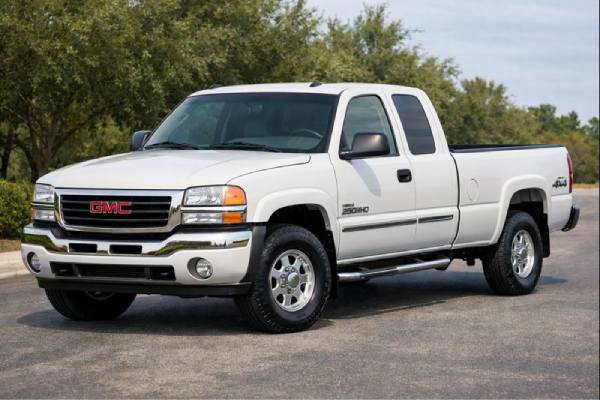
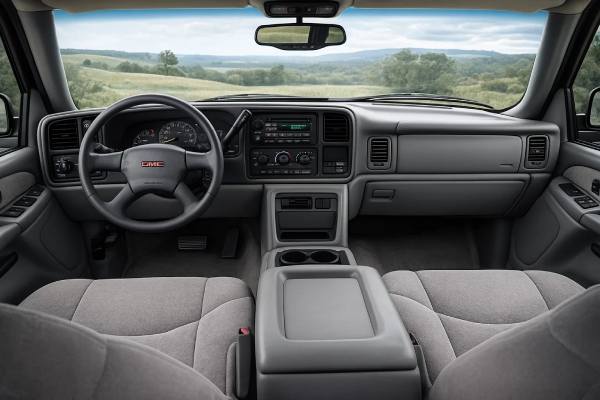
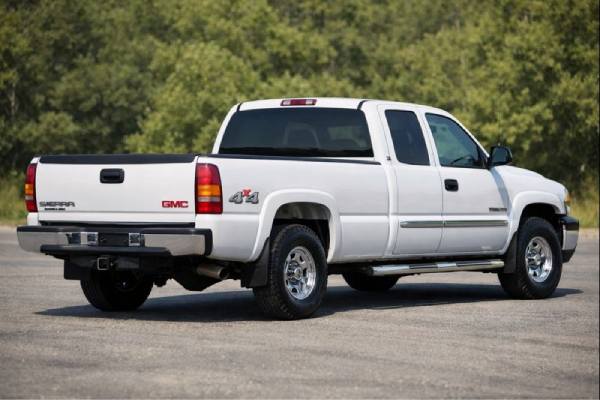
The 2001–2002 GMC Sierra HD 2WD on the GMT800 platform sits in a sweet spot for owners who want heavy-duty capability without the complexity of modern emissions hardware or high-tech drivetrains. In LQ4 form, the 6.0-liter V8 (300 hp) is a proven, low-stress engine that favors longevity when it is kept cool and fed clean oil. The HD chassis adds stronger axles, stiffer springs, and bigger brakes than light-duty models, making it a confident tow and work truck even in 2WD trim—especially with the right axle ratio and tires.
The trade-off is that these trucks are now old enough that condition matters more than mileage. Rubber, wiring, grounds, brake lines, and front-end wear items often determine whether a Sierra HD feels tight and dependable or tired and expensive. This guide focuses on what to check, what to service, and what to expect in real ownership.
Owner Snapshot
- Strong, durable V8 with simple hardware and good parts availability
- Heavy-duty chassis feels stable under payload and trailer tongue weight
- Straightforward 2WD layout keeps maintenance and driveline costs lower
- Watch for front-end wear, ABS sensor corrosion issues in rust-belt trucks, and cooling system neglect
- Plan on oil changes about every 8,000 km (5,000 mi) or 6 months for mixed-use driving
Guide contents
- Sierra HD 2WD LQ4 core design
- LQ4 Sierra HD specs and dimensions
- Trims, packages, and safety equipment
- Reliability patterns and known problem areas
- Maintenance schedule and buying checklist
- On-road feel, towing, and fuel use
- Rivals, Super Duty, and Ram comparisons
Sierra HD 2WD LQ4 core design
Think of this truck as three big systems working together: a conservative V8 (LQ4), a heavy-duty drivetrain, and an HD-rated frame and suspension. When they are healthy, the result is a pickup that can do “real truck” jobs—towing, hauling, and long highway miles—without feeling fragile.
The LQ4 6.0-liter V8 is part of GM’s LS-based small-block family. In this era it uses port fuel injection (not direct injection), a timing chain, and a relatively modest specific output. That matters because it reduces heat and stress per cylinder, which usually translates into long engine life if you keep oil pressure strong and temperatures stable. The LQ4’s personality is also well-matched to towing: it is happier revving than big-displacement pushrod engines from decades earlier, but it still makes useful torque in the midrange.
Why the HD chassis matters even in 2WD: The “HD” Sierra (commonly Sierra 2500HD in the U.S.) typically brings stronger rear axle hardware, higher GVWR capability, and suspension pieces designed for sustained load. The 2WD layout reduces rotating mass and complexity versus 4×4, which helps reliability and makes routine service simpler (no transfer case, fewer seals and u-joints to chase).
Ownership traits you feel day to day
- Stability under load: HD spring rates and shock tuning generally keep the truck composed with payload and trailer tongue weight.
- Serviceability: The engine bay and underbody layout are straightforward, with broad aftermarket support.
- Age-driven concerns: At 20+ years old, small problems (grounds, connectors, vacuum leaks, brittle plastics, tired mounts) can stack up into “mystery symptoms” unless you approach diagnosis methodically.
Advantages that age well
- Durable core powertrain when maintained (oil, cooling system, transmission heat control).
- Capability per dollar in the used market, especially for owners who do not need 4×4.
- Parts availability is strong, from OEM-style replacements to heavy-duty upgrades.
If you want an HD truck that you can keep running with sensible maintenance and readily available parts, this GMT800 Sierra HD 2WD with the LQ4 is one of the better long-term bets—provided you buy on condition, not on badge or mileage.
LQ4 Sierra HD specs and dimensions
Specs on GMT800 HD trucks vary by cab (regular/extended/crew), bed length, axle ratio, and equipment. The tables below focus on what is typical for a 2001–2002 Sierra HD 2WD with the LQ4 6.0 while calling out where you should verify the RPO codes (glovebox sticker) for your exact truck.
Engine and Performance (ICE)
| Item | Typical spec (2001–2002 Sierra HD 2WD LQ4) |
|---|---|
| Code | LQ4 |
| Layout | V8, pushrod OHV, 2 valves/cyl |
| Displacement | 6.0 L (5,967 cc) |
| Bore × stroke | 101.6 × 92.0 mm (4.00 × 3.62 in) |
| Induction | Naturally aspirated |
| Fuel system | Sequential port fuel injection |
| Compression ratio | ~9.4:1 (verify by year/calibration) |
| Max power | 300 hp (224 kW) @ ~4,400 rpm |
| Max torque | ~488 Nm (360 lb-ft) @ ~4,000 rpm |
| Timing drive | Chain |
Transmission and Driveline
| Item | Typical spec |
|---|---|
| Drive type | RWD (2WD) |
| Automatic | 4-speed heavy-duty automatic (commonly 4L80-E in HD applications) |
| Gear ratios (typical 4L80-E) | 1st 2.48 / 2nd 1.48 / 3rd 1.00 / 4th 0.75 / Rev 2.07 |
| Axle ratios (common) | 3.73 or 4.10 (varies by tow package) |
| Differential | Open standard; limited-slip may appear depending on RPO |
Chassis and Dimensions (ranges by cab/bed)
| Item | Typical range for HD pickups |
|---|---|
| Front suspension | Independent (torsion bar) |
| Rear suspension | Leaf springs |
| Brakes | 4-wheel ABS; disc sizes vary by year/axle package |
| Wheels/tires (common) | 245/75 R16 or 265/75 R16 (package-dependent) |
| Length | ~5,780–6,250 mm (227.6–246.1 in) |
| Width | ~2,020–2,040 mm (79.5–80.3 in) |
| Height | ~1,910–1,960 mm (75.2–77.2 in) |
| Wheelbase | ~3,380–4,000 mm (133.0–157.5 in) |
| Turning circle | ~13.7–15.0 m (45–49 ft) |
| Curb weight | ~2,360–2,720 kg (5,200–6,000 lb) |
| GVWR | ~3,900–4,200 kg (8,600–9,200 lb) |
| Fuel tank (typical) | ~129 L (34 US gal) (verify by configuration) |
Performance and Capability (real-world dependent)
| Metric | Typical expectation |
|---|---|
| 0–60 mph (0–97 km/h) | ~9–11 s (cab/axle ratio dependent) |
| Towing capacity | Commonly ~4,100–5,400 kg (9,000–12,000 lb) with the right axle and hitch |
| Payload | Often ~1,200–1,700 kg (2,600–3,700 lb) depending on GVWR and configuration |
Fluids, service capacities, and key torque notes (verify for your VIN)
| Item | Typical spec (guide-level) |
|---|---|
| Engine oil | 5W-30; capacity ~5.7 L (6.0 US qt) with filter |
| Coolant | Dex-Cool type; 50/50 mix; capacity varies with heater/tow package |
| ATF | Dexron-III era spec; capacity varies (pan vs total fill) |
| Rear axle | GL-5 gear oil (often 75W-90); capacity varies by axle |
| Lug nuts (8-lug HD) | Commonly ~190 Nm (140 lb-ft) (verify wheel type) |
Use these tables as a starting point, then confirm your truck’s RPO codes and service manual values—especially for tow ratings, axle ratio, and fluid capacities.
Trims, packages, and safety equipment
For 2001–2002 GMT800 HD trucks, “trim” is less about performance and more about comfort, towing prep, and convenience equipment. Most mechanical capability comes from configuration choices: axle ratio, cooling package, hitch equipment, and sometimes differential type.
Trims and quick identifiers
Common trims you will encounter include base/work-focused, SLE, and SLT (naming can vary by market). Practical ways to identify what matters:
- RPO codes (glovebox sticker): This is the most reliable way to confirm axle ratio, differential type, towing equipment, and heavy-duty cooling.
- Instrument cluster and interior materials: Higher trims often add better seat fabrics or leather, steering-wheel audio controls, and upgraded audio head units.
- Exterior cues: Chrome content, fog lamps, and wheel designs often track trim level, but can be swapped—treat them as hints, not proof.
Options that change how the truck works
If you care about towing and durability, prioritize functional packages over cosmetic ones:
- Tow package and hitch equipment: Look for evidence of factory-style wiring, a proper receiver hitch, and transmission cooling support. Poor aftermarket wiring is a common source of lighting faults.
- Axle ratio choice: A 4.10 ratio generally improves towing control and reduces transmission hunting on grades, while a 3.73 ratio can be nicer unloaded. Your “best” choice depends on trailer weight and terrain.
- Limited-slip differential (where equipped): Helpful for traction in wet conditions even without 4×4, especially when the bed is empty.
- Seating configuration: Regular cab vs extended/crew matters for payload and wheelbase. Longer wheelbase trucks usually tow more calmly.
Safety ratings and what they mean here
On older heavy-duty pickups, official consumer crash-test coverage can be incomplete. Two practical points:
- Some safety ratings may apply to related light-duty Sierra/Silverado variants rather than the HD configuration. Use them as context, not as a promise.
- Crash safety standards evolved quickly after this era, so do not expect modern performance in small-overlap or advanced side impacts.
The IIHS moderate-overlap frontal test for the related Sierra 1500 platform of this generation shows a Marginal overall evaluation and weak structure/safety cage notes, plus Poor head restraint and seat results in that era’s testing. That does not automatically equal the same result for every HD variant, but it helps explain why attentive seat belt use, good tires, and well-maintained brakes matter so much.
Safety systems and driver assistance (ADAS)
Expect a basic safety suite by modern standards:
- Airbags: Typically dual front airbags; side airbags were not common on HD trucks of this time.
- ABS: Commonly standard on HD configurations; keep it functional because it is a real safety advantage in panic stops with load.
- Stability control: Often not present or not comparable to modern systems; drive accordingly.
- LATCH/child-seat provisions: May be present depending on cab and year; confirm in the owner’s manual for your exact seating layout.
If safety is a top priority, the best “upgrade” you can make is not a gadget—it is ensuring the truck’s tires, brakes, steering, and suspension are in top condition.
Reliability patterns and known problem areas
The LQ4 Sierra HD 2WD can be very reliable, but its weak points are predictable—especially once age, corrosion, and towing heat enter the picture. Below is a practical map by prevalence and cost tier, plus what you typically notice first.
Common (expect to address eventually)
- Front-end wear (medium cost): Symptoms include wandering steering, uneven tire wear, and clunks over bumps. Likely roots are worn idler and pitman arms, ball joints, tie-rod ends, and tired shocks. Remedy is straightforward: replace worn components, then align.
- Fuel pump module aging (medium cost): Hard starts, stumble under load, or a “no start” can point here. Remedy is replacement with attention to wiring and ground integrity.
- ABS-related issues in corrosion climates (medium to high): In rust-belt conditions, corrosion around wheel speed sensor mounting surfaces can cause unwanted ABS activation at low speeds. A GM/NHTSA recall bulletin for front wheel speed sensor corrosion describes this condition and the inspection/clean/treat remedy for affected vehicles registered in severe corrosion areas. The takeaway: if you feel ABS “chatter” right before stopping on dry pavement, treat it as a real fault, not a quirk.
Occasional (depends on use and maintenance)
- Cooling system neglect (medium to high): Overheating under tow, heater performance changes, or coolant loss can trace to old coolant, weak radiator caps, tired hoses, or deposits. Keep the cooling system healthy because towing heat is what kills transmissions and head gaskets.
- Exhaust manifold bolt leakage (low to medium): Ticking on cold start that quiets when warm can be a manifold leak. Not usually catastrophic, but it can become annoying and can affect O2 readings if severe.
- Transmission shift quality issues (medium to high): The HD automatic can be durable, but heat and old fluid can lead to shudder, delayed engagement, or flare shifts. Remedy often starts with fluid condition, cooler function, and correct line pressure diagnosis—before assuming a full rebuild.
Rare but expensive
- Severe corrosion structural concerns (high): Brake lines, fuel lines, and frame crossmembers can corrode. This is less about brand and more about climate and storage. Remedy ranges from line replacement to walking away from a compromised frame.
Service actions, recalls, and how to verify
At this age, your best practice is simple:
- Run a VIN check using official recall resources and request dealer completion history if possible.
- Confirm recall work was actually performed (parts and labor paperwork beats “I think it was done”).
- Test-drive for safety-related symptoms: low-speed ABS activation, brake pull, steering looseness, and overheating.
A clean, well-maintained Sierra HD can be a long-term work partner. A neglected one often becomes a chain of “small” repairs that never quite ends. Buy the best condition you can—and treat corrosion and cooling health as first-priority items, not future projects.
Maintenance schedule and buying checklist
A 2001–2002 Sierra HD 2WD lives or dies by fluids, cooling, and front-end upkeep. The schedule below is practical for mixed driving, with a “severe use” mindset if you tow, idle a lot, or drive short trips.
Practical maintenance schedule (distance/time)
| Item | Interval (typical ownership best practice) |
|---|---|
| Engine oil and filter | Every 8,000 km (5,000 mi) or 6 months; 5,000 km (3,000 mi) for heavy towing/short trips |
| Tire rotation | Every 10,000–12,000 km (6,000–7,500 mi) |
| Engine air filter | Inspect every oil change; replace ~24,000–40,000 km (15,000–25,000 mi) as needed |
| Cabin air filter (if equipped) | Inspect yearly; replace as needed |
| Cooling system | Inspect every service; coolant change per factory spec or at most every 5 years if unknown history |
| Spark plugs | Inspect around 160,000 km (100,000 mi); replace if worn/misfiring |
| ATF and filter | If towing or unknown history: service baseline now, then ~50,000–80,000 km (30,000–50,000 mi) depending on use |
| Rear differential fluid | Baseline if unknown; then ~80,000 km (50,000 mi) for towing use |
| Brake fluid | Every 2–3 years |
| Belts and hoses | Inspect every oil change; replace at first signs of cracking, swelling, or seepage |
| Battery and charging test | Annually; expect replacement window around 4–6 years depending on climate |
Fluids and specs (owner-level guidance)
- Engine oil: A quality 5W-30 meeting the correct API specification for your climate; use a robust filter.
- Coolant: Use the correct GM-compatible long-life coolant type and maintain a proper 50/50 mix.
- Transmission fluid: Use the correct Dexron-era specification for the unit and avoid mixing unknown fluids.
- Gear oil: GL-5 gear oil of the correct viscosity for your climate and axle type.
Buyer’s checklist (what to inspect before money changes hands)
Rust and structure
- Frame rails, brake lines, fuel lines, cab mounts, and crossmembers
- Bed supports and rear spring hangers
- Any fresh undercoating that looks like it is hiding scaling metal
Engine and cooling
- Cold start behavior, idle stability, and oil pressure consistency
- Coolant condition (no sludge, no oily sheen) and evidence of leaks
- Radiator fins and transmission cooler lines for seepage/corrosion
Transmission and driveline
- Smooth engagement into Drive and Reverse
- No flare shifts, harsh banging, or delayed kickdown
- Check for leaks at pan, lines, and output seal areas
Steering, suspension, and brakes
- Steering play on-center and wander at highway speed
- Front-end clunks over small bumps (often wear items)
- ABS warning lights and low-speed ABS behavior during a careful test stop
Long-term durability outlook
If you baseline fluids, keep the cooling system strong, and refresh front-end wear items before they cascade, the LQ4 Sierra HD 2WD can deliver many more years of dependable service. The best examples feel “tight” even with higher mileage—and that tightness is almost always the result of maintenance discipline, not luck.
On-road feel, towing, and fuel use
Driving a GMT800 Sierra HD 2WD is a reminder that heavy-duty trucks are engineered around load. Unloaded, it can feel firm and busy over broken pavement; loaded correctly, it often settles into a stable, confident stride.
Ride, handling, and NVH
- Ride quality: Expect a stiff rear end when the bed is empty. Adding payload or trailer tongue weight usually improves composure because the rear springs start working in their intended range.
- Steering feel: These trucks tend to be light on-center but can develop wander as steering and suspension wear accumulates. A tight front end and correct alignment transform the driving experience.
- Braking feel: When brakes are fresh and the hydraulic system is healthy, pedal feel is predictable. If the pedal feels long or inconsistent, treat it as a system condition issue (fluid, hoses, calipers, rear hardware) rather than “old truck normal.”
- Cabin noise: Wind and tire noise are more noticeable than in modern trucks. Exhaust leaks, worn mounts, and aging door seals are common contributors.
Powertrain character (LQ4)
The LQ4’s strength is repeatable performance. It pulls cleanly, especially from midrange rpm, and it tolerates sustained work well when coolant and transmission temperatures are controlled. Under tow, you should expect downshifts on grades—this is normal. What is not normal is constant gear hunting on mild inclines, which often points to an axle ratio mismatch for your load, old ATF, or a weak transmission cooler setup.
Real-world fuel economy
Official EPA figures for a closely related 2002 Sierra 2500 2WD with the 6.0 show:
- City: 10 mpg (US) ≈ 23.5 L/100 km
- Highway: 12 mpg (US) ≈ 19.6 L/100 km
- Combined: 11 mpg (US) ≈ 21.4 L/100 km
Real-world results vary heavily with tires, axle ratio, speed, and load. As a practical expectation:
- Highway at 120 km/h (75 mph): often lands around 18–23 L/100 km (10–13 mpg US) depending on gearing and wind.
- Towing: fuel use can rise dramatically; a double-digit mpg tow day is a win with a big trailer.
Towing and load behavior
A properly set up Sierra HD 2WD can tow with impressive stability, especially with a longer wheelbase. Key points for safe towing:
- Use correct tongue weight and a weight-distribution hitch when appropriate.
- Control heat: ensure the cooling system and transmission cooler are healthy.
- Tires matter: use load-rated tires in good condition, inflated properly for the load.
- Brake controller quality: for trailer brakes, a good controller and wiring integrity are non-negotiable.
If your use case is frequent towing on grades, prioritize axle ratio, cooling condition, and brake health over trim level. Those are the factors that determine whether the truck feels effortless—or strained.
Rivals, Super Duty, and Ram comparisons
In the early-2000s heavy-duty market, the Sierra HD’s main rivals were the Ford Super Duty F-250 and the Ram 2500. Each has a clear “personality,” and your best choice depends on whether you prioritize gas simplicity, diesel torque, ride quality, or front-end durability.
Against Ford F-250 Super Duty (same era)
Where the Sierra HD 2WD often wins
- Engine simplicity and smoothness (gas vs gas): The LQ4 is a straightforward, durable gas V8 with broad parts support.
- Everyday drivability: Many owners find GM’s power delivery and shifting behavior easy to live with, especially unloaded.
Where the Ford often wins
- Front-end robustness and steering feel (varies by year/condition): Some Super Duty configurations feel more planted from the factory, though both brands suffer when wear items age.
- Diesel availability: If you need heavy towing at lower rpm and accept higher repair complexity, Ford’s diesel options were a major draw.
Against Ram 2500 (same era)
Where the Sierra HD 2WD often wins
- Refined gas towing manners: The LQ4 likes to rev and can hold speed predictably if gearing and cooling are right.
- Lower complexity than diesel-centric shopping: Many Ram shoppers gravitated to the Cummins; if you do not need diesel torque, gas Sierra ownership can be simpler.
Where the Ram often wins
- Diesel torque and aftermarket ecosystem (Cummins): For frequent heavy towing, the diesel Ram can feel effortless, but maintenance and repair costs can also rise.
A practical buyer takeaway
- Choose the Sierra HD 2WD LQ4 if you want gas-engine simplicity, strong capability, and a truck you can maintain with widely available parts.
- Consider a diesel rival if your towing is consistently heavy and long-distance and you are prepared for higher system complexity.
- No matter the brand, condition beats reputation at this age. A rust-free, well-documented Sierra often outperforms a more “desirable” competitor that has been neglected.
If you shop carefully and baseline the known wear areas, the 2001–2002 Sierra HD 2WD with the LQ4 remains a practical, honest work truck—and one of the easier HD pickups of its era to keep on the road for the long haul.
References
- Fuel Economy of the 2002 GMC Sierra 2500 2WD 2002 (Official Fuel Economy Data)
- 2001 GMC Sierra 1500 2001 (Safety Rating)
- Vehicle Detail Search – 2002 GMC SIERRA_2500HD 2002 (Recall Database)
- Microsoft Word – 05068C bulletin.doc 2008 (Recall Bulletin)
- 2002 GMC Sierra Denali Owner’s Manual 2002 (Owner’s Manual)
Disclaimer
This article is for informational purposes only and is not a substitute for professional diagnosis, inspection, or repair. Specifications, torque values, capacities, service intervals, and procedures can vary by VIN, market, axle ratio, cab/bed configuration, and installed equipment—always verify details using official service documentation for your exact vehicle.
If you found this guide useful, please consider sharing it on Facebook, X (Twitter), or your favorite forum to help others find reliable ownership information.