
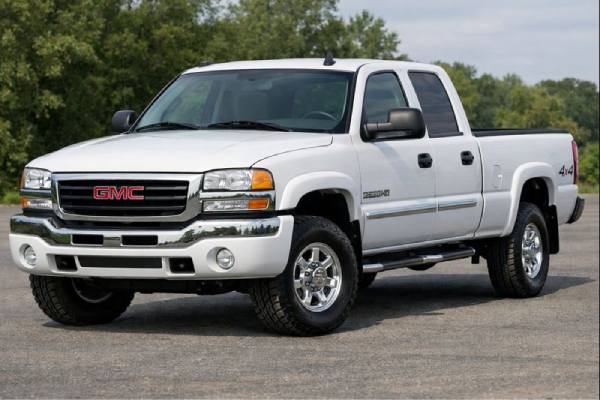
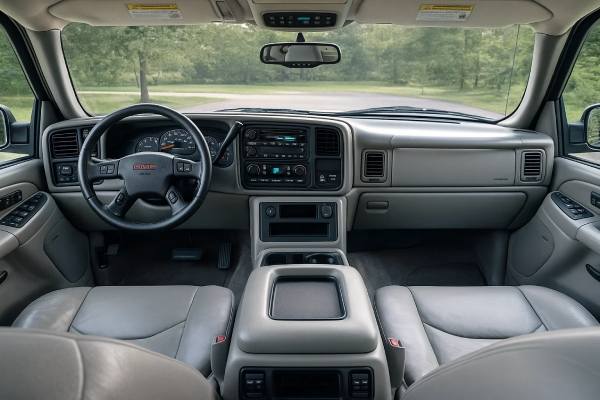
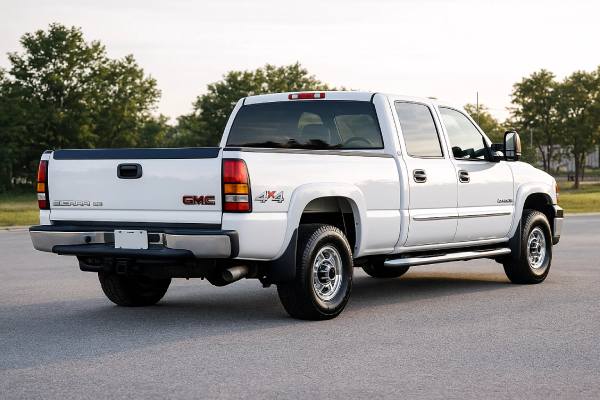
The 2004–2005 GMC Sierra HD 4WD on the GMT800 platform sits in a sweet spot for owners who want modern-enough comfort with old-school heavy-duty simplicity. In LLY form, the 6.6-liter Duramax brings a stronger, broader powerband than earlier calibrations and pairs naturally with the Allison automatic for controlled towing and relaxed highway work. The 4WD system adds real year-round utility, but it also introduces extra wear points—front axle, transfer case, and steering components—that matter on a 20-year-old work truck.
These trucks can age extremely well when maintained with the right fluids and intervals, especially if you prioritize cooling system health, fuel filtration, and driveline servicing. Buy the cleanest, most documented example you can, and you get a durable platform that still feels honest and capable.
Owner Snapshot
- Strong towing manners with the Allison and low-rpm diesel torque
- 4WD hardware makes it genuinely useful in winter and on job sites
- Parts availability and DIY friendliness are excellent for a heavy-duty diesel
- Cooling and airflow management matter under load; overheating history is a red flag
- Change engine oil and filter about every 8,000–10,000 miles (13,000–16,000 km) or 12 months, depending on duty cycle
Quick navigation
- LLY 4WD Sierra HD explained
- 2004-2005 LLY 4WD specs
- Trims, towing options, and safety
- Common LLY 4×4 problems
- Service strategy and buyer checks
- Driving feel and diesel pull
- Rivals worth cross-shopping
LLY 4WD Sierra HD explained
The “Sierra HD 4WD (GMT800) + LLY Duramax” recipe is popular for one main reason: it’s a heavy-duty pickup that still feels straightforward to own. The GMT800 chassis uses robust body-on-frame construction, simple front torsion-bar independent suspension, and leaf springs out back. That foundation is not fancy, but it is predictable under load and easy to service.
LLY refers to a mid-generation 6.6-liter Duramax variant used in the 2004–2005 period. It’s still a cast-iron-block V8 diesel with high-pressure common-rail injection, but it brought changes that affect real ownership. Compared with earlier versions, the LLY is often discussed as having better peak output and a different emissions strategy (notably EGR hardware). In practice, it means strong pull from low rpm, fast midrange for passing while towing, and the kind of “set it and forget it” cruising that makes long-distance hauling less tiring.
The 4WD system is where this truck either becomes a perfect tool—or a neglected money pit. On the plus side, it improves launch traction on wet ramps, keeps you moving on snow-packed roads, and reduces stress when you need to creep a trailer into a muddy field. On the downside, it adds a front differential, CV shafts (on IFS trucks), a transfer case, extra U-joints, and more seals that can leak with age. If the previous owner treated 4WD like a “use it once a year” button, you may inherit sticky actuators, old transfer case fluid, and driveline vibrations that only show up under torque.
What makes these trucks worth targeting today is the balance of capability and repairability. You can still find technicians who know the platform, parts are widely available, and there’s a large knowledge base for common faults. Your job as an owner is to keep it cool, keep it filtered (fuel and air), keep the driveline fluids fresh, and avoid ignoring small steering or front-end issues until they become tire-eating problems.
2004-2005 LLY 4WD specs
Below are practical specs for the 2004–2005 Sierra HD 4WD with the 6.6-liter Duramax (LLY) and Allison automatic. Exact values vary by cab, bed, axle ratio, single vs dual rear wheels, and GVWR class—so treat the tables as “most common configurations,” then verify by VIN (RPO codes) and door-jamb labels.
Engine and performance (LLY Duramax 6.6)
| Item | Specification |
|---|---|
| Code | LLY |
| Layout & cylinders | V8, 8 cylinders, OHV, 4 valves/cyl (32-valve) |
| Displacement | 6.6 L (6,599 cc) |
| Bore × stroke | 103.0 × 99.0 mm (4.06 × 3.90 in) |
| Induction | Turbocharged (variable-geometry turbo) |
| Fuel system | High-pressure common-rail direct injection |
| Compression ratio | ~17.5:1 (varies by calibration) |
| Max power | 300 hp (224 kW) to 310 hp (231 kW) @ ~3,000 rpm (published figures vary by application) |
| Max torque | commonly listed around 705–820 Nm (520–605 lb-ft) @ ~1,600 rpm (varies by calibration) |
| Timing drive | Gear-driven cam and accessories (diesel architecture) |
| Emissions / standard | U.S. EPA era diesel compliance; EGR-equipped |
Transmission and 4WD driveline
| Item | Specification |
|---|---|
| Transmission | Allison 1000 5-speed automatic (typical for this period) |
| Common gear ratios | 1st 3.10, 2nd 1.81, 3rd 1.41, 4th 1.00, 5th 0.71 (reverse ~5.09) |
| Drive type | Part-time 4WD; some trims offer AUTO 4WD mode |
| Transfer case | Commonly NV/NP261HD (manual shift) or NV/NP263HD (push-button, AUTO 4WD) depending on trim |
| Differential types | Open or locking rear differential depending on option; front differential open |
| Typical axle ratios | 3.73 or 4.10 (towing-focused builds often 4.10) |
Chassis and dimensions (ranges by cab/bed)
| Item | Typical range (approx.) |
|---|---|
| Suspension (front/rear) | Independent torsion-bar front / leaf-spring rear |
| Steering | Power steering (recirculating ball), heavy-duty linkages |
| Brakes | 4-wheel disc with ABS (hydro-boost assist common on HD) |
| Length | ~5,500–6,200 mm (217–244 in) |
| Wheelbase | ~3,450–3,900 mm (136–153 in) |
| Width | ~2,000 mm (79 in) excluding mirrors |
| Height | ~1,950–2,000 mm (77–79 in) |
| Turning circle | typically ~14–15 m (46–49 ft) depending on wheelbase |
| Curb weight | roughly ~2,900–3,500 kg (6,400–7,700 lb) depending on configuration |
| GVWR | commonly ~4,150–5,200+ kg (9,200–11,400+ lb) depending on 2500HD/3500/DRW |
Capability (typical, configuration-dependent)
| Item | Typical range (approx.) |
|---|---|
| Towing capacity (braked) | commonly ~5,900–7,100+ kg (13,000–15,600+ lb) depending on axle ratio and hitch type |
| Payload | commonly ~1,000–1,800 kg (2,200–4,000 lb) depending on SRW/DRW and GVWR |
| 0–100 km/h (0–62 mph) | often ~10–12 s (varies by curb weight and gearing) |
| Top speed | typically limited ~150–160 km/h (93–100 mph) |
Fluids and service capacities (decision-useful)
| Item | Spec (typical) |
|---|---|
| Engine oil | Heavy-duty diesel oil meeting period GM requirements; common viscosities 15W-40 (warm climates) or 5W-40 synthetic (cold); capacity commonly ~9.5 L (~10 US qt) with filter (verify for your VIN) |
| Fuel tank | 98 L (26.0 US gal) short bed; 136 L (36.0 US gal) long bed (pickup), with chassis-cab variations |
| A/C refrigerant | R134a; charge varies by HVAC configuration |
| Wheel nut torque | 190 Nm (140 lb-ft) |
Electrical (typical)
| Item | Spec (typical) |
|---|---|
| System | 12 V |
| Alternator | often 130–145 A class (varies by equipment and dual-battery setups) |
| Battery | Commonly single or dual batteries depending on build; verify CCA and tray type |
Safety and driver assistance (period-correct)
| Item | Notes |
|---|---|
| Crash ratings | Not all HD variants have complete public crash-test data; check the exact year/model on official databases |
| Airbags | Front airbags standard; side curtain airbags generally not typical for this era of HD trucks |
| ABS | Standard on HD |
| ADAS | Modern features like AEB/ACC/LKA were not typical; focus is on basic passive safety and ABS |
Trims, towing options, and safety
For 2004–2005 Sierra HD models, trim names matter less than the mechanical build hiding underneath. Most buyers encounter Work Truck (WT), SLE, and SLT-style equipment groupings, with a wide spread in comfort features but a smaller spread in core hardware. The big mechanical differentiators are usually axle ratio, rear differential type, cooling packages, hitch equipment, and whether the truck is single rear wheel (SRW) or dual rear wheel (DRW).
Trims and quick identifiers
- WT-oriented trucks usually have simpler interiors, fewer power options, and are more likely to have vinyl flooring and basic audio. They can be great buys if they were fleet-maintained and not overloaded daily.
- Mid trims (often SLE-type) commonly add power seats, better audio, and convenience features while keeping the same drivetrain choices.
- Top trims (often SLT-type) add leather and nicer trim, but still share most of the same tow-capable bones.
Options and packages that change ownership
- Axle ratio (3.73 vs 4.10): One of the biggest “feel” changes. A 4.10 truck often launches easier with heavy trailers and holds gears more confidently on grades, at the cost of higher cruising rpm and slightly higher fuel use.
- Rear differential locking option: If equipped, it improves traction on slick surfaces and when pulling a trailer out of soft ground. It also changes tire-wear behavior if mismatched tires are installed.
- Transfer case type: Manual-shift vs push-button, and whether AUTO 4WD exists. AUTO 4WD is convenient in mixed conditions but adds complexity and can be sensitive to mismatched tire diameters.
- Tow equipment: Look for factory hitch hardware and integrated wiring. Aftermarket wiring done poorly is a common source of lighting faults and intermittent trailer brake controller issues.
Seating and cab/bed configurations
Cab choice (regular, extended, crew) and bed length affect turning radius, curb weight, and payload. A long wheelbase crew cab 4WD diesel is a stable tow rig but is harder to park and often heavier, reducing payload compared with a regular cab.
Safety ratings and what they mean here
Heavy-duty pickups don’t always have the same publicly published crash-test coverage as lighter models, and test protocols also evolve over time. The best approach is to check official databases for your exact year and model, then interpret results as “era-correct” rather than modern-benchmark.
Safety systems you actually live with
- ABS is standard and helps maintain steering control during hard braking, especially with a trailer pushing behind you.
- Airbags are basic by today’s standards—typically front airbags and not much beyond that.
- Child-seat anchors: Many trucks of this era have LATCH/ISOFIX-type provisions, but you should verify anchor locations and whether rear seating positions meet your needs.
- No modern ADAS: Expect no automatic emergency braking, lane keeping, or adaptive cruise. If you want those, you’re shopping a much newer truck.
If you plan to tow, the “best trim” is usually the one with the right axle ratio, documented fluid servicing, intact factory tow wiring, and brakes that have not been cooked by repeated heavy descents.
Common LLY 4×4 problems
A well-kept LLY Sierra HD can be a long-lived workhorse, but age, heat, and neglected fluids are the enemies. Below are typical issues grouped by prevalence and cost impact, with the “symptom → likely cause → remedy” format to help you diagnose quickly.
Common (expect to see on higher-mile trucks)
- Runs hot under load → restricted airflow or cooling stack issues → clean, repair, or upgrade
- Many overheating complaints trace to airflow limitations (dirty or restrictive intake paths), clogged radiator/intercooler stacks, tired fan clutch, or old coolant. A towing truck that creeps past normal temps on grades deserves a careful cooling-system inspection before you buy.
- Power drop, limp mode, or boost irregularity → turbo vane sticking or boost-control faults → clean/repair turbo control system
- Variable-geometry turbos can stick if the truck is driven gently for long periods or if soot buildup is heavy. Symptoms often appear as inconsistent boost, sluggish response, or fault codes under load.
- Hard starts, fuel smell, or fuel dampness around filter head → fuel filter housing seals or fittings → reseal and bleed properly
- Air intrusion on the suction side of the fuel system can cause rough starts and inconsistent idle. It’s usually fixable, but it can masquerade as more expensive injector issues.
- Front-end looseness, wandering, uneven tire wear → worn idler/pitman arms, tie rods, or alignment drift → replace wear parts and align
- A heavy diesel 4WD with big tires stresses steering linkages. If the truck feels vague on-center, plan on steering refresh work.
Occasional (depends on use and maintenance)
- Coolant loss, pressure in cooling system → head gasket stress from chronic overheating → test and repair (can be expensive)
- Not every LLY has this problem, but repeated overheating events raise the risk. Look for signs of past overheating: discolored coolant, warped fan shroud, replaced radiators, or “it always runs a little warm” stories.
- 4WD engagement issues → actuator, encoder motor, switch, or vacuum-related faults (if equipped) → diagnose by system type
- Push-button systems can suffer from encoder motor wear or electrical gremlins. Manual-shift trucks can still have front axle engagement issues depending on the exact setup.
- Transfer case wear noises or leaks → low fluid, pump-rub wear (case damage), or seal aging → inspect, service, and protect
- A small leak that’s ignored becomes a big problem. If the truck has a history of running low on transfer case fluid, internal wear accelerates.
Rare but high-impact (verify before purchase)
- Injector electrical faults → harness chafe or connector issues → repair harness and confirm injector balance
- Compared with some earlier designs, many injector service tasks are more accessible, but electrical faults can still be time-consuming to trace.
Recalls, TSBs, and service actions: how to approach
Rather than guessing, run the VIN through the official recall lookup process and request dealer history if available. On a truck this age, the important question is not only “Was there a recall?” but “Was the remedy performed?” Printouts and dated invoices are ideal.
Pre-purchase checks worth paying for
- Cooling system pressure test and check for combustion gases (if overheating is suspected).
- Scan for stored codes, not just active ones.
- Road test in 2HI and 4HI (and AUTO 4WD if equipped) for noises and binding.
- Inspect steering and front suspension joints with the weight off the wheels.
- Confirm consistent tire sizes on all four corners (critical on AUTO 4WD systems).
Service strategy and buyer checks
Owning a GMT800 Sierra HD diesel is less about chasing perfection and more about disciplined intervals. If you keep fluids fresh and fix small leaks early, you can avoid the snowball failures that give old diesel trucks a bad reputation.
Practical maintenance schedule (distance/time)
Use this as a real-world baseline, then align it with your duty cycle (towing, idling, short trips, extreme heat/cold).
- Engine oil and filter: every 8,000–10,000 miles (13,000–16,000 km) or 12 months
- If you tow heavy, idle a lot, or do short trips in winter, shorten to ~5,000–7,500 miles (8,000–12,000 km).
- Fuel filter: every 10,000–15,000 miles (16,000–24,000 km) or sooner if fuel quality is uncertain
- This is one of the best “cheap insurance” items on a diesel.
- Air filter: inspect every oil change; replace as needed (often 15,000–30,000 miles / 24,000–48,000 km)
- Coolant: typically every 5 years (or per coolant type)
- If you don’t know what’s in it, flushing and refilling with the correct spec is smart.
- Transmission fluid and external filter (Allison): commonly 25,000–50,000 miles (40,000–80,000 km) depending on towing severity
- Use the correct spec fluid; a “universal ATF” shortcut can cost you.
- Transfer case fluid: every 30,000–50,000 miles (48,000–80,000 km)
- More often if you use AUTO 4WD frequently or drive through water/mud.
- Front and rear differential fluid: every 50,000 miles (80,000 km); sooner if towing heavy or if water intrusion is possible
- Brake fluid: every 2–3 years
- Tire rotation and alignment: rotate every 5,000–8,000 miles (8,000–13,000 km); align yearly or when steering parts are replaced
- Serpentine belt, tensioner, hoses: inspect every oil change; replace proactively around 80,000–120,000 miles (130,000–190,000 km) or by condition
- 12 V battery testing: test before winter yearly; replacement window often 4–6 years depending on climate
Fluids, specs, and capacities (buyer-focused)
- Fuel tank size: commonly 26.0 US gal (98 L) short bed; 36.0 US gal (136 L) long bed (verify by configuration).
- Wheel nut torque: 190 Nm (140 lb-ft).
- Oil viscosity choice: 15W-40 suits warm climates; 5W-40 synthetic improves cold starts and winter protection.
Buyer’s guide: what to inspect first
Rust and structural
- Frame rails (especially rear sections), brake line routing areas, cab corners, rocker panels, and bed crossmembers.
- Look for evidence of prior repairs that hide corrosion rather than remove it.
Cooling and towing health
- Check radiator/intercooler stack cleanliness and bent fins.
- Confirm the fan clutch engages properly under heat.
- Look for aftermarket “fixes” that suggest unresolved overheating.
Driveline and 4WD
- Transfer case leaks, front differential seepage, CV axle boots, driveshaft U-joints, and slip yokes.
- Verify 4HI engagement on a loose surface and confirm no binding or loud clunks.
Electronics and wiring
- Trailer connector wiring quality, brake controller operation, and ground points.
- Instrument cluster and warning lights function (a “bulb check” matters).
Recommended configurations to seek
- Documented cooling-system service, transmission service, and transfer case/differential fluid changes.
- Correct tire sizes and a matching spare (important for 4WD systems).
The long-term durability outlook is strong when the truck is kept within its intended duty cycle and serviced on time. The risky trucks are the ones with repeated overheating, neglected driveline fluids, and “it’s always towed fine” stories without receipts.
Driving feel and diesel pull
A 2004–2005 Sierra HD 4WD diesel drives like a heavy tool—stable, deliberate, and more confident under load than many lighter pickups. The steering is not “modern precise,” but when the front end is tight and aligned, it tracks well on the highway. Crosswinds and crowned roads still remind you that this is a tall, heavy vehicle with a solid rear axle and a work-first suspension.
Ride, handling, and NVH
Unloaded, the ride can feel firm, especially with higher tire pressures or stiff LT tires. Loaded with a trailer or payload, it settles into its intended operating range and becomes smoother and more composed. Road and tire noise are more noticeable than in modern trucks, and diesel clatter at idle is part of the package—though a healthy engine shouldn’t sound harsh or uneven.
Braking feel is typically strong for the era, especially on hydro-boost-equipped HD trucks, but brake condition matters a lot. A truck that has towed heavy without regular brake servicing may show pulsing rotors, long pedal travel, or caliper issues.
Powertrain character: where the LLY shines
The LLY Duramax is about usable torque, not drama. It pulls cleanly from low rpm and doesn’t need high revs to move weight. Paired with the Allison automatic, the truck tends to hold gears intelligently on grades and downshift predictably when you ask for power. For towing, that means fewer “gear hunts” and less heat buildup than you’d expect from a lighter-duty transmission.
Real-world efficiency expectations
Official fuel economy figures can be limited or inconsistent for heavy-duty trucks depending on GVWR class. In real use, many owners see:
- Highway (100–120 km/h / 60–75 mph): roughly 12–16 L/100 km (15–20 mpg US; 18–24 mpg UK), depending on tires, gearing, and lift/weight
- City/mixed: roughly 15–20 L/100 km (12–16 mpg US; 14–19 mpg UK)
- Towing penalty: often +20% to +50% consumption depending on trailer weight, speed, wind, and terrain
Cold weather usually reduces economy due to longer warm-up time, winterized fuel blends, and higher rolling resistance.
4WD behavior in daily driving
In 2HI, the truck behaves like a classic rear-drive pickup—fine on dry roads but traction-limited on wet ramps if the rear tires are worn. In 4HI, it gains confidence on snow and gravel. If your truck has AUTO 4WD, it can be convenient in changing conditions, but it’s sensitive to tire mismatch. A single odd tire circumference can cause binding, noise, or premature wear.
Towing impressions and stability
With the right hitch setup and a properly adjusted trailer brake controller, the Sierra HD feels stable at speed and controlled on descents. The keys are:
- Correct tongue weight and weight distribution (where appropriate)
- Fresh transmission and differential fluids
- Cooling system that stays at normal temperature on long grades
A well-sorted LLY/Allison/4WD combo is still a very competent tow rig today, especially for owners who value simple mechanical feedback over modern driver-assist layers.
Rivals worth cross-shopping
If you’re shopping a 2004–2005 Sierra HD 4WD Duramax, you’re likely comparing it to two era-defining rivals: Ford Super Duty diesels of the same period and Dodge Ram HD trucks with the 5.9 Cummins. Each has strengths, and your “best” choice depends on whether you value engine durability, transmission behavior, front-end robustness, or ownership cost.
Ford Super Duty (mid-2000s diesel era)
Why people choose it
- Strong chassis, big aftermarket support, and excellent work-truck availability
- Good towing stability and a very “truck-like” feel
What to watch
- Certain diesel generations from this era are known for cooling and EGR-related issues, and repairs can get expensive quickly if the truck was tuned or worked hard without the right preventive upgrades.
How the Sierra compares
- The Sierra’s LLY/Allison pairing often feels more cohesive for towing: smoother shifts, predictable grade behavior, and generally strong drivability when stock.
Dodge Ram 2500/3500 with 5.9 Cummins (common-rail era)
Why people choose it
- The inline-six Cummins has an excellent reputation for longevity and low-end pull
- Simple engine layout and strong torque delivery
What to watch
- Automatic transmission durability can be a concern depending on configuration and how the truck was used. Front-end wear and steering feel also vary widely based on maintenance and modifications.
How the Sierra compares
- The Sierra often wins on transmission behavior in stock form and can feel more “refined” in how it manages towing loads. The Ram can win on engine accessibility and long-term simplicity if the drivetrain around it is healthy.
GM sibling comparison: Sierra HD vs Silverado HD
Mechanically, these trucks are close cousins. Shopping both widens your options, which is useful because condition matters more than badges at this age. Focus on the same fundamentals: cooling history, fluid service records, front-end tightness, and clean electrical work.
The practical verdict
Choose the Sierra HD 4WD LLY if you want:
- A strong diesel with a proven heavy-duty automatic
- A platform with excellent parts availability and repair knowledge
- Confident towing behavior when maintained properly
Choose a rival if you find a substantially cleaner, better-documented example that matches your towing needs and has clear evidence of preventive maintenance. In this age bracket, the best truck is almost always the one with the best history—not the one with the best brochure specs.
References
- GM Owner Manuals 2005 (Owner’s Manual)
- Get To Know Guide,Vibe Get2Know2004 2005 (Owner’s Guide)
- 52068 LD Sp Apps TRL pgs 4 2005 (Trailering Information)
- Vehicle Detail Search – 2005 GMC SIERRA 2500HD | NHTSA 2025 (Recall Database)
- 2005 Chevrolet Silverado 1500 extended cab pickup 2005 (Safety Rating)
Disclaimer
This article is for informational purposes only and is not a substitute for professional inspection, diagnosis, or repair. Specifications, torque values, service intervals, and procedures vary by VIN, market, axle ratio, and equipment; always confirm details using your official service documentation and labeling on the vehicle.
If you found this guide useful, consider sharing it on Facebook, X (Twitter), or your favorite forum to help others maintain these trucks responsibly.