


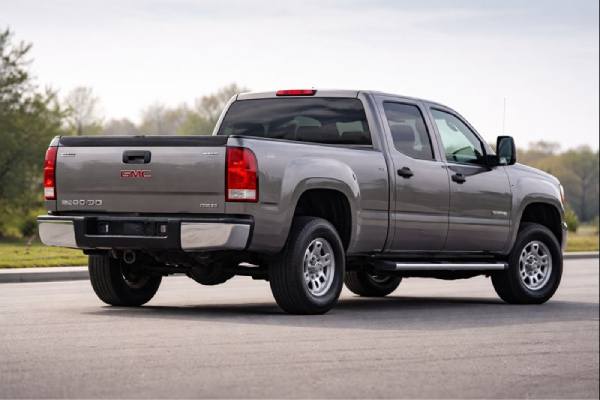
The 2007–2010 GMC Sierra HD RWD with the LMM 6.6L Duramax is the “modern classic” era of GM heavy-duty diesel trucks: strong chassis, big towing capability, and an engine/transmission combo (Duramax V8 plus Allison 6-speed) that became a benchmark for work use. The key engineering shift versus earlier Duramax models is emissions hardware—most notably a diesel particulate filter (DPF) and more aggressive exhaust-gas recirculation (EGR) strategies to meet tighter standards. That helps cleanliness, but it changes ownership: short-trip driving and long idle time matter more, and maintenance discipline becomes a bigger part of reliability. If you want a heavy-duty truck that’s straightforward to tow with, widely supported for parts and service, and still easy to live with in stock form, the LMM Sierra HD RWD is often a sweet spot—provided you buy the right configuration and verify recall and service history.
Owner Snapshot
- Strong low-rpm torque makes towing feel effortless, especially with the Allison’s tow/haul logic.
- Big aftermarket and OEM parts support keeps long-term running costs predictable.
- RWD simplicity (no transfer case/front drive hardware) can reduce service points versus 4×4.
- DPF and EGR systems dislike constant short trips and extended idling—expect more attention here.
- Replace the fuel filter about every 24,000 km (15,000 mi) (or sooner with questionable fuel).
Navigate this guide
- Model overview and strengths
- Specifications, dimensions, and capacities
- Trims, options, and safety equipment
- Reliability, issues, recalls, and service actions
- Maintenance schedule and buyer guidance
- Driving, towing, and real-world economy
- How it compares to rivals
Model overview and strengths
In GMC language, “Sierra HD” in 2007–2010 generally means the 2500HD or 3500HD built on the GMT900 platform. In RWD form, you’re getting the same heavy-duty frame and running gear concept as the 4×4 trucks, but with fewer driveline components up front. That matters because this generation is often bought for towing and hauling rather than trail use, and simplicity can be a real ownership advantage: fewer U-joints, no front differential/transfer-case service, and typically slightly less weight on the nose.
The headline powertrain is the LMM Duramax 6.6L V8 turbodiesel paired with the Allison 1000 six-speed automatic. In stock form, this engine family is rated at 365 hp and 660 lb-ft in the era covered here. The way it delivers that output is the real story: strong torque well below 2,000 rpm, steady pull on grades, and a transmission calibration that’s built to manage heat and gear hunting better than many half-ton automatics of the same time. If you tow frequently, the “confidence factor” is often what makes these trucks keepers.
The trade-off is emissions complexity. LMM introduced a diesel particulate filter (DPF), and regeneration events are part of normal operation. The truck can handle this quietly when it’s driven long enough at temperature, but repeated short trips, long idling, or low-speed use can push soot loading higher, which may lead to more frequent regens and (in neglected cases) expensive aftertreatment problems. The upside is that these trucks do not use diesel exhaust fluid (DEF), so you avoid the extra tank, heater, injector, and sensor set that arrived later.
Ownership sweet spots tend to be: buyers who tow regularly, commute far enough to fully warm the powertrain, and keep the truck close to stock calibration. The further a vehicle is pushed into “short-trip only” life or heavy tuning without supporting upgrades, the more the LMM’s strengths can get overshadowed by heat and emissions-system complaints.
Specifications, dimensions, and capacities
The challenge with Sierra HD specs is configuration spread: cab type, bed length, single- vs dual-rear-wheel (3500), axle ratio, and GVWR package all change the numbers that matter (weight ratings, turning circle, and sometimes tow ratings). The tables below focus on what’s most consistent for the 2007–2010 Sierra HD RWD Duramax/Allison combination, and where it varies, the table shows ranges and what drives the difference.
Engine and performance (LMM Duramax)
| Item | Specification |
|---|---|
| Code | LMM |
| Engine layout and cylinders | V8, turbocharged diesel, 4 valves/cyl (typical Duramax architecture) |
| Displacement | 6.6 L (6,600 cc) |
| Induction | Turbocharged and intercooled |
| Max power | 365 hp (272 kW) (factory-rated for this era) |
| Max torque | 660 lb-ft (895 Nm) (factory-rated for this era) |
| Timing drive | Gear-driven cam (Duramax family trait; verify by service info for your VIN) |
| Emissions and efficiency standard | U.S. emissions era includes DPF and EGR; no DEF on LMM trucks |
| Rated efficiency | Many HD configurations are not EPA-window-sticker rated; use real-world tracking |
| Real-world highway @ 120 km/h (75 mph) | Typically ~14–18 mpg US (16.8–13.1 L/100 km) unloaded; towing varies widely |
Transmission and driveline (RWD focus)
| Item | Specification |
|---|---|
| Transmission | Allison 1000 6-speed automatic (Duramax application) |
| Drive type | RWD |
| Differential | Usually open rear; limited-slip/locking availability varies by trim/package and axle |
| Common axle ratios | 3.73 or 4.10 are typical (verify RPO codes in glovebox/Service Parts ID label) |
Chassis and dimensions (ranges across common bodies)
| Item | Typical range (varies by cab/bed) |
|---|---|
| Suspension (front/rear) | Independent front (torsion bar) / leaf-spring rear |
| Brakes | 4-wheel disc (sizes vary by GVWR and year) |
| Wheelbase | ~3,530–4,170 mm (139–164 in) depending on bed/cab |
| Length | ~5,600–6,600 mm (220–260 in) depending on bed/cab/dually |
| Kerb weight | Often ~3,000–3,600 kg (6,600–7,900 lb) depending on build |
| Fuel tank | Commonly ~98–136 L (26–36 US gal) depending on configuration |
Capability (why configuration matters)
| Item | Typical range (verify by door sticker/tow guide) |
|---|---|
| Payload | Roughly ~900–1,800 kg (2,000–4,000 lb) depending on GVWR and equipment |
| Conventional towing | Often ~5,400–7,100 kg (12,000–15,500 lb) depending on axle/cab/bed |
| Fifth-wheel/gooseneck | Often higher on 3500 configs; payload usually becomes the limiting factor first |
Fluids and service capacities (decision-useful, verify by VIN)
| Item | Typical spec (confirm in official service info) |
|---|---|
| Engine oil | Heavy-duty diesel oil meeting the required GM diesel spec; common viscosity 15W-40 or 5W-40 (cold climates) |
| Engine oil capacity | About ~9.5 L (~10 US qt) with filter (varies slightly by pan and filter) |
| Coolant | Dex-Cool type long-life coolant (mix per label; confirm capacity by VIN) |
| ATF | GM/Allison application typically uses Dexron VI; capacity varies by pan vs full service |
| Rear differential | 75W-90 gear oil commonly used; capacity varies by axle |
How to use the tables: for towing and payload, trust your truck’s door-jamb GVWR/GAWR sticker first, then match your axle ratio and body style to the correct towing chart. For fluids and torque specs, always verify by VIN—GM made running changes, and prior owners may have swapped pans, coolers, or axle assemblies.
Trims, options, and safety equipment
Sierra HD trim strategy in 2007–2010 usually centers around Work Truck (WT), SLE, SLT, and (in some markets) Denali-style luxury packaging. The “best” trim for a Duramax RWD owner depends less on badges and more on functional equipment: towing hardware, axle ratio, cooling, brake controller readiness, seating configuration, and tire/wheel packages that match your load.
Trims and options that change how the truck works
Work Truck (WT): often the lightest, simplest interior, and frequently the best candidate for a long-life tow rig because it avoids some aging luxury electronics. WT trucks can still be very well equipped mechanically—look for factory tow package content and the right axle ratio.
SLE/SLT: these bring comfort (power seats, upgraded audio, better trim, sometimes added insulation). They’re popular used buys because they balance work capability with daily livability. The downside is simply more age-sensitive equipment (seat motors, HVAC actuators, steering wheel controls).
Key option groups to shop for (or avoid)
- Tow and cooling content: integrated hitch hardware, transmission cooling, and wiring provisions matter more than chrome.
- Axle ratio choice: 4.10 gearing can feel more relaxed under heavy tow; 3.73 is often a better compromise for mixed use.
- Bed and cab choice: crew cab comfort usually costs payload; regular cab can carry more but is less versatile.
- Rear axle type: if you need traction on gravel ramps or in winter, confirm whether your truck has a limited-slip/locker rather than assuming.
Quick identifiers you can use on a walk-around
- Service Parts ID (SPID/RPO) label: typically in the glovebox. This is your best tool for axle ratio, locking diff, suspension packages, and towing-related codes.
- Hitch receiver and wiring: factory-style routing and connectors usually look cleaner and more integrated than aftermarket splices.
- Brake controller readiness: many trucks are “wired for” towing but still need the correct controller—verify what is actually installed and functioning.
Safety ratings and what they mean for an HD truck
Here’s the important nuance: most formal crash-test ratings you’ll find are for the light-duty Sierra 1500, not the 2500HD/3500HD. Still, the cab structure and restraint philosophy are closely related across the lineup, and IIHS results can provide a useful baseline. For the 2007 Sierra 1500 crew cab, IIHS shows Good in the original moderate overlap front test, while side-test results depend heavily on whether optional side airbags are present.
Practical takeaway: when shopping a 2007–2010 Sierra HD, prioritize:
- Side-curtain airbags (if equipped on your build)
- Seatbelt condition and pretensioner integrity (no crash history)
- Tire quality and brake health (these affect real-world crash avoidance more than brochure features)
Driver assistance systems (ADAS) reality
This era predates modern AEB, lane-keeping, and radar cruise control. “Safety tech” is mostly:
- ABS and stability control (where equipped)
- Traction control
- Optional rear park assist and camera systems on some trims
In other words, the driver is still the primary safety system—visibility, braking condition, and tire choice matter a lot.
Reliability, issues, recalls, and service actions
A well-maintained LMM Duramax/Allison combination can be very durable, but it’s not “set and forget.” Most expensive problems show up when maintenance is inconsistent, when the truck’s duty cycle doesn’t let the emissions system complete its work, or when tuning adds heat and fuel without addressing exhaust and transmission management.
Common issues (higher prevalence)
DPF loading and regen complaints (medium cost, can become high):
- Symptoms: frequent regen, reduced fuel economy, soot smell, warning messages, limp behavior in severe cases.
- Likely cause: short trips, extended idle, failed sensors, or leaks that skew soot calculation.
- Remedy: fix the root sensor/leak problem first, confirm proper regen operation, and keep the truck on longer drives regularly. Avoid “cheap deletes” that create legal and calibration issues.
EGR system fouling (medium):
- Symptoms: rough running, reduced power, codes tied to EGR flow or temperature.
- Cause: soot accumulation and thermal cycling.
- Remedy: correct cleaning/replacement, and ensure the rest of the air path (boost hoses, intercooler) is tight.
Front-end wear (low to medium, but common):
- Symptoms: steering wander, clunks, uneven tire wear.
- Cause: idler and pitman arm wear, ball joints, tie rods, and alignment drift—especially with heavy tires or frequent towing.
- Remedy: quality steering components, proper alignment, and honest tire pressure management for load.
Occasional issues (watch the pattern)
Injector and fuel system sensitivity (medium to high): not every truck suffers, but poor fuel quality, neglected fuel filters, and water contamination can turn into expensive repairs. If the truck has unknown fuel history, treat the first months of ownership as a “baseline reset” period: fresh fuel filter, check for water, and watch balance rates (if you have scan access).
Turbo actuator/vane sticking (medium): more likely with lots of idling and soot-heavy use. Symptoms often present as inconsistent boost or over/underboost codes.
Rare but expensive issues
Transmission overheating due to use pattern or modifications (high): the Allison is robust, but it’s not immune to heat. Heavy tuning without supporting cooling, towing in high gear at low rpm, or ignoring slipping/shudder warnings can lead to rebuild territory.
Recalls and how to verify them
For this generation, safety recalls can include major items like airbag inflators depending on build date and region. A key example affecting 2007–2008 Sierra 2500/3500 is a Takata-related passenger airbag inflator recall campaign documented in NHTSA materials.
Verification steps (do this before money changes hands):
- Run the VIN through the official recall lookup and ask the seller for dealer completion records.
- Check for open campaigns and confirm parts availability (some campaigns were phased).
- If the truck has a salvage title or missing records, assume recall status is unknown until proven completed.
The best pre-purchase approach is to view reliability as a combination of duty cycle + service history + stock calibration. A clean, stock truck with documented fluid services often beats a “modified but fast” truck with gaps in records.
Maintenance schedule and buyer guidance
Think of LMM Sierra HD ownership as “heavy-duty simple, emissions-aware.” Your goal is to keep clean oil in the engine, clean fluid in the transmission, clean fuel feeding the high-pressure system, and a duty cycle that lets the DPF do its job.
Practical maintenance schedule (distance and time)
| Item | Interval (typical best practice) | Notes |
|---|---|---|
| Engine oil and filter | 8,000–12,000 km (5,000–7,500 mi) or 6–12 months | Use the correct diesel-rated oil; shorten interval with towing/idle-heavy use |
| Fuel filter | ~24,000 km (15,000 mi) | Sooner if fuel quality is questionable or you see restriction signs |
| Engine air filter | Inspect every oil change; replace as needed | Dusty work sites shorten life dramatically |
| Cabin air filter (if equipped) | 15,000–30,000 km (10,000–20,000 mi) | Comfort item, but helps HVAC longevity |
| ATF service | 80,000–160,000 km (50,000–100,000 mi) | Severe tow/heat use should be on the shorter end |
| Rear differential fluid | 80,000–160,000 km (50,000–100,000 mi) | Shorten interval if towing heavy or water exposure occurs |
| Coolant | Often 5 years / 240,000 km (150,000 mi) | Confirm coolant type and mix; don’t “top off” with the wrong chemistry |
| Brake fluid | Every 2–3 years | Moisture control is the point |
| Serpentine belt and hoses | Inspect every oil change | Replace at the first cracking or seepage, not the last |
Fluids and specs (quick decision list)
- Engine oil: use a heavy-duty diesel oil that meets the required GM diesel specification for your year; viscosity depends on climate (15W-40 common, 5W-40 for cold starts).
- ATF: Dexron VI is commonly specified for this era’s GM automatic applications; confirm for your exact transmission calibration and service method.
- Gear oil: 75W-90 is a common synthetic choice for the rear axle; confirm limited-slip additive requirements if equipped.
Essential torque specs (verify before wrenching)
| Fastener | Typical value (verify by service manual) |
|---|---|
| Wheel lug nuts (8-lug) | ~190 Nm (140 lb-ft) |
| Engine oil drain plug | ~25–30 Nm (18–22 lb-ft) |
| Trailer hitch fasteners | Varies widely by hitch and frame; follow GM procedure |
Buyer’s guide: what to inspect first
Service history and usage
- Oil change frequency and receipts (not just “it was done”)
- Fuel filter history (a great proxy for how the owner thinks)
- Towing use: what weight, how often, and whether it ran hot
Underbody and chassis
- Frame corrosion at crossmembers, brake line routing points, and rear spring mounts
- Steering play: idler/pitman movement, tie rod ends, ball joints
- Rear axle leaks at pinion and axle seals
Powertrain health
- Cold start behavior (smoothness, smoke, abnormal knock)
- Scan for codes—even “history” codes tell a story
- Test drive under load if possible (even a moderate hill can reveal weak cooling or boost control)
Recommended configurations (general guidance)
- Seek: stock tuning, documented maintenance, correct tow gearing for your intended load, and clean underbody condition.
- Avoid: unknown tuning, missing emissions components, chronic overheating history, and heavy rust in structural areas.
A clean LMM truck is usually a “buy once, maintain steadily” proposition. The ones that become money pits almost always show warning signs in records, wiring quality, and neglected chassis wear.
Driving, towing, and real-world economy
On the road, the LMM Sierra HD RWD feels like a purpose-built tool that also happens to be comfortable enough for long trips—especially in SLE/SLT trims. The steering is typically heavier and slower than modern trucks, but it tracks well when the front end is tight and aligned. If you feel wander, don’t blame the platform first—blame worn idler/pitman arms, tired ball joints, or mismatched tires.
Powertrain character
The Duramax’s defining trait is low-rpm torque. Around-town driving rarely needs much throttle, and towing starts feel controlled rather than strained. The Allison 6-speed is a major part of that impression: shifts are generally deliberate, and tow/haul mode is genuinely useful for holding gears and managing heat on grades. One realistic expectation to set: this era does not drive like a modern 10-speed half-ton. You’ll feel fewer, larger ratio changes, and the truck is happier when you let it pull in the torque band rather than forcing early upshifts.
Ride, handling, and NVH
Unloaded, HD trucks can feel busy over broken pavement because the rear suspension is designed for payload. With some weight in the bed—or with a trailer—the ride usually settles down. Cabin noise is acceptable for the era, but tire choice changes everything: aggressive all-terrains can add drone, while highway-terrain tires often make the truck feel more refined than buyers expect.
Real-world economy (what owners actually see)
Many HD configurations in this class were not labeled with the same EPA-style fuel economy disclosures as lighter vehicles, so owner tracking matters more than published numbers. As a realistic guide:
- Unloaded mixed driving: often ~13–17 mpg US (18.1–13.8 L/100 km)
- Highway steady-state: often ~14–18 mpg US (16.8–13.1 L/100 km)
- Towing: economy is highly load- and speed-dependent; a 20–40% penalty versus unloaded is common, with bigger hits at higher speeds or into headwinds
Cold weather can reduce efficiency further because diesels take longer to reach full operating temperature and because regen strategy can change with conditions.
Towing stability and temperature management
A healthy cooling stack and correct towing setup make more difference than most performance mods. For confident towing:
- Use tow/haul early, not late.
- Keep speeds reasonable; aerodynamic drag skyrockets above ~105 km/h (65 mph).
- Watch temperatures on long grades and don’t be afraid to downshift manually to keep rpm in a safer cooling range.
- Make sure your trailer brakes are truly dialed in—good braking reduces heat and stress across the truck.
With RWD, traction when launching a heavy trailer on a wet ramp is the main limitation. Good tires, sensible throttle, and proper tongue weight are your best tools.
How it compares to rivals
In the 2007–2010 heavy-duty diesel era, the Sierra HD LMM’s main rivals are the Ford Super Duty diesels of the same window (late 6.0L Power Stroke and then 6.4L) and the Ram 2500/3500 with the 6.7L Cummins (early DPF-era). All three can tow hard, but they differ in how they age, how they deliver power, and how forgiving they are of mixed use.
Versus Ford F-250 and F-350 Super Duty (6.4L Power Stroke era)
Where the Sierra HD often wins
- Smooth, strong torque delivery paired with an Allison calibration designed around towing.
- Broad service familiarity and parts availability, especially for stock trucks.
- Generally predictable ownership when kept close to factory configuration.
Where Ford may appeal
- Chassis feel and steering can feel more “truck-like planted” to some drivers.
- Strong performance potential, but that often comes with higher thermal and component stress if modified.
Buying reality: if you’re shopping used, prioritize the cleanest service history over brand. In this period, neglected trucks of any badge can be expensive, but the LMM/Allison combo is often favored for its balanced drivability and long-haul temperament.
Versus Ram 2500 and 3500 (6.7L Cummins early emissions era)
Where the Sierra HD often wins
- Transmission behavior under tow is a standout; the Allison’s grade logic and shift feel are widely appreciated.
- V8 smoothness and quieter operation in many stock setups.
Where Ram may appeal
- Cummins inline-six layout is loved for access and low-end pulling feel.
- Strong engine braking options were available in some configurations and later years.
Buying reality: the Ram can be an excellent tow rig, but pay close attention to transmission behavior and maintenance records in this era. The Sierra’s advantage is frequently “less drama” in daily towing use when everything is healthy.
Why RWD matters in the comparison
Against 4×4 rivals, the Sierra HD RWD can be a value play: fewer driveline parts to service and often lower buy-in cost. If your towing is mostly pavement-based and you don’t need off-road traction, RWD is a legitimate “work-optimized” choice. If you regularly launch boats, deal with snow, or pull across soft ground, 4×4 is worth the extra complexity.
Bottom line: the 2007–2010 Sierra HD LMM is at its best as a stock, well-maintained towing platform. Compared to rivals, it competes strongly on drivability, transmission integration, and ownership predictability—while asking you to respect the emissions system and the realities of heavy-duty wear items.
References
- p06-06-01-007H 1..11 2014 (TSB)
- Part 573 Safety Recall Report 15V-324 2015 (Recall Database)
- 2007 GMC Sierra 1500 crew cab pickup 2007 (Safety Rating)
- 2008 Chevrolet Silverado Owner Manual M 2007 (Owner’s Manual)
Disclaimer
This article is for informational purposes only and is not a substitute for professional diagnosis, inspection, or repair. Specifications, torque values, service intervals, and procedures can vary by VIN, market, model year, and installed equipment; always verify details using official GM service documentation and your vehicle’s labels before performing work.
If this guide helped, please consider sharing it on Facebook, X (Twitter), or your favorite forum to support our work.