
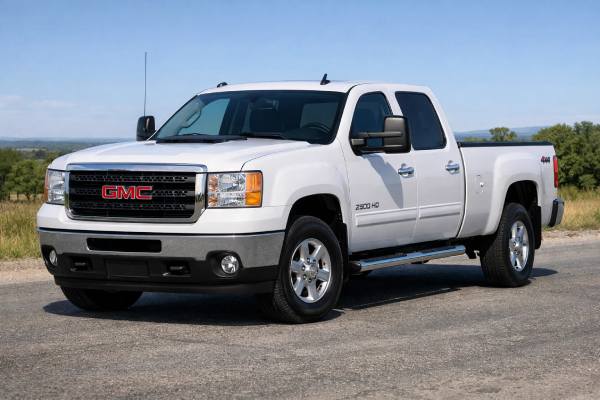
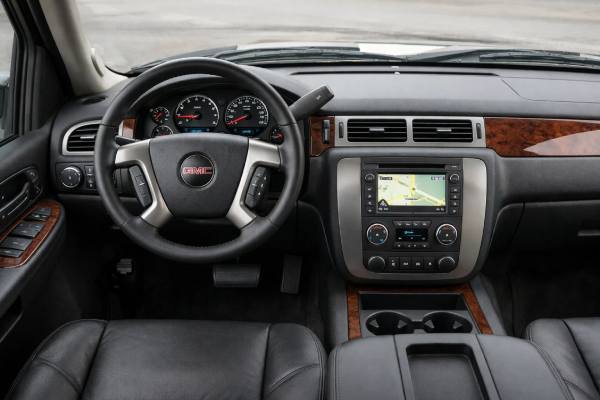
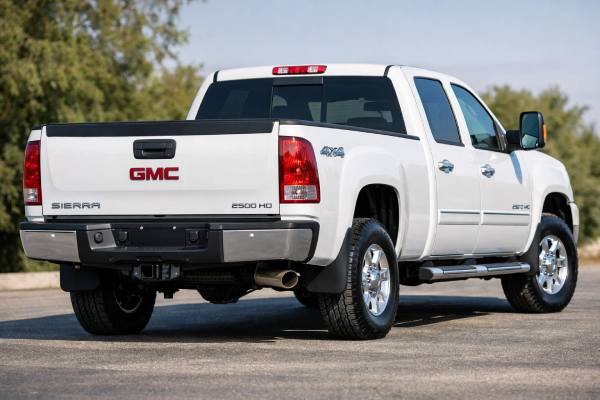
The 2011–2014 GMC Sierra HD 4WD with the LML 6.6-liter Duramax is built around one core mission: move heavy loads with control, day after day, in conditions that would overwhelm lighter pickups. The engineering highlights are the high-torque turbo-diesel, an Allison automatic calibrated for towing, and a selectable four-wheel-drive system that adds traction and low-range gearing when surfaces turn slick or steep. In ownership terms, the truck’s biggest strengths show up under sustained work—long grades, crosswinds, and heavy trailers—where its stability and cooling capacity matter more than peak horsepower.
The trade-off is complexity. Modern diesel emissions hardware, a high-pressure fuel system, and extra 4WD driveline components mean maintenance discipline is not optional. If you choose a stock, well-documented truck and service it like a piece of equipment, this Sierra HD can be a long-lived and extremely capable tow platform.
Quick Specs and Notes
- 4WD traction and low range make boat ramps, muddy job sites, and winter towing far less stressful.
- Strong low-rpm torque and the Allison automatic deliver calm, steady pull with heavy trailers.
- Expect higher service overhead than 2WD: transfer case and front axle fluids add cost and scheduling.
- Replace the fuel filter about every 36,000 km (22,500 mi) or at least every 2 years.
- Avoid using 4WD on clean, dry pavement to reduce driveline bind and tire wear.
Jump to sections
- GMC Sierra HD 4WD: what it is
- LML 6.6 specs, dimensions, and fluids
- Trims, tow packages, and safety gear
- Known issues: emissions, fuel, and 4WD
- Maintenance plan and buyer’s checklist
- Real driving, towing, and winter mpg
- How it stacks up to HD rivals
GMC Sierra HD 4WD: what it is
A GMT900 Sierra HD 4WD (2011–2014 facelift years) is best understood as a heavy-duty drivetrain with a comfort-focused body around it. You get a diesel built to pull at low rpm, an automatic that’s happier under steady torque than most half-ton gearboxes, and a chassis tuned for payload and trailer stability. The 4WD system is the key difference versus the 2WD truck: it adds a transfer case, a front differential, front driveshafts, and front axle half-shafts—components that bring real traction advantages, plus extra service needs.
For owners who tow in real weather, 4WD can be a safety feature as much as a capability feature. On wet grass, loose gravel, snow-packed roads, and boat ramps, traction is the limiting factor long before horsepower. The Sierra HD’s selectable 4WD modes let you run in two-wheel drive for normal pavement, then lock in additional traction when conditions demand it. Low range (4LO) is especially useful for slow, controlled movement: backing a heavy trailer uphill, creeping down a muddy incline, or maneuvering around a worksite without burning the brakes.
4WD also changes how you should think about tires and loading. The truck’s traction ceiling becomes more dependent on tire choice, inflation, and alignment quality. A great 4WD system can’t overcome worn all-season tires on ice, and oversized tires can accelerate steering and front-end wear. Likewise, payload and towing limits are still determined by the door sticker and axle ratings. 4WD helps you move; it does not increase your legal or safe load capacity.
These trucks reward “equipment thinking.” The best owners treat the Sierra HD like a tool that needs predictable inputs:
- Clean fuel and regular fuel-filter changes to protect the high-pressure system
- Correct fluids in the engine, Allison transmission, differentials, and transfer case
- A clean cooling stack and working fan system for sustained towing
- Stock or conservative modifications, because tuning and deletes can complicate diagnostics and resale
Buy the right example and keep it maintained, and the Sierra HD 4WD becomes a confident, low-drama tow and winter work truck. Buy a neglected one, and the same complexity that makes it capable can make it expensive.
LML 6.6 specs, dimensions, and fluids
This section focuses on the 2011–2014 Sierra HD 4WD with the LML Duramax rated at 397 hp. Exact numbers can vary by cab/bed, 2500HD vs 3500HD, axle ratio, and tire package, so use these as a practical baseline and confirm your truck’s labels and RPO codes.
Engine and performance (LML Duramax)
| Item | Specification |
|---|---|
| Code | LML |
| Layout | 90° V8 turbo-diesel |
| Displacement | 6.6 L (6,599 cc) |
| Induction | Turbocharged (variable-geometry) |
| Fuel system | High-pressure common-rail direct injection |
| Max power | 397 hp (296 kW) @ 3,000 rpm |
| Max torque | 1,037 Nm (765 lb-ft) @ 1,600 rpm |
| Emissions hardware | EGR + DPF + SCR/DEF (urea) |
| Timing drive | Diesel gear-driven timing architecture (service by condition) |
Transmission and driveline (4WD)
| Item | Specification |
|---|---|
| Transmission | Allison 6-speed automatic (HD application) |
| Common gear ratios | 1st 3.10 / 2nd 1.81 / 3rd 1.41 / 4th 1.00 / 5th 0.71 / 6th 0.61 |
| Drive type | 4×4 (selectable) |
| Transfer case | 2-speed electronic control (2HI / 4HI / 4LO / Neutral) |
| Differentials | Typically open; locking differential availability depends on package |
Chassis and dimensions (typical ranges)
| Item | Typical range (varies by cab/bed) |
|---|---|
| Front suspension | Independent with torsion bars |
| Rear suspension | Leaf springs |
| Length | ~5,700–6,600 mm (225–259 in) |
| Width (no mirrors) | ~2,032 mm (80.0 in) |
| Wheelbase | ~3,396–4,259 mm (133.7–167.7 in) |
| Curb weight | Often ~3,000–3,600 kg (6,600–7,900 lb), configuration-dependent |
| Ground clearance | Tire- and trim-dependent; verify on your truck |
Capability (why stickers matter)
HD towing and payload are not “one number.” They’re a set of limits that interact:
- GVWR and payload depend heavily on cab/bed and trim weight
- GCWR and towing depend on axle ratio, cooling, hitch class, and configuration
- 4WD can slightly reduce rated payload/tow versus comparable 2WD due to added hardware weight
If you tow regularly, confirm axle ratio and trailering equipment via the RPO list and door label, not assumptions.
Fluids, specifications, and key torque
| System | Spec and notes |
|---|---|
| Engine oil | Diesel-rated oil per climate; capacity 9.5 L (10 qt) with filter |
| Coolant | Long-life coolant (commonly Dex-Cool type); verify mix ratio and label |
| DEF | Tank 20.1 L (5.3 US gal) |
| Transmission fluid | Allison uses approved ATF; many trucks specify Dexron-type fluids |
| Transfer case (4WD) | DEXRON-VI automatic transmission fluid |
| Front axle fluid | SAE 75W-90 synthetic axle lubricant |
| Rear axle fluid | SAE 75W-90 synthetic axle lubricant |
| Fuel tank (pickup) | Commonly 136.3 L (36.0 US gal) |
| Wheel lug torque | 190 Nm (140 lb-ft) |
Transfer case and axle capacities can vary by exact unit and housing. Use the service information for your VIN when you’re planning fluid purchases or diagnosing low-fluid issues.
Trims, tow packages, and safety gear
Trims and what really changes
In the 2011–2014 Sierra HD range, you’ll commonly see WT, SLE, SLT, and Denali. Trim affects comfort, interior materials, and infotainment, but towing confidence is more about the truck’s mechanical and trailering equipment than the badge on the door.
High-value options for a Sierra HD 4WD tow build include:
- Integrated trailer brake controller (factory integration usually beats universal aftermarket setups)
- Factory trailering mirrors and receiver hardware matched to the truck’s rating
- Cooling and electrical equipment suited for towing and winter starts (diesels benefit from strong batteries and charging capacity)
- Axle ratio suited to your load profile (best confirmed via RPO codes)
If you tow in slippery conditions, the 4WD hardware itself is only half of the story. Tires and gearing often matter more than people expect. A heavy trailer can push the truck around; stability and braking are the foundation, and traction is what keeps the combination manageable when surfaces degrade.
4WD controls and operating behavior
These trucks typically offer a dial or selector with:
- 2HI for normal dry pavement (best fuel economy and least driveline wear)
- 4HI for extra traction at normal speeds when the surface is loose or slippery
- 4LO for slow-speed control, tight maneuvering, and steep grades
- Neutral for specific towing situations (flat towing procedures must be followed)
A key ownership habit is knowing when not to use 4WD. On clean, dry pavement, locked driveline operation can cause binding, faster tire wear, and harder shifting. Use 4HI as a tool for conditions, not a default mode.
Safety ratings: what to expect
Heavy-duty pickups are not always tested or published in the same way as mainstream passenger vehicles, and rating availability can vary by configuration and model year. For practical safety research, most owners use official sources to check:
- Open recalls and campaign completion status by VIN
- Complaint patterns and investigation history
- Equipment lists and restraint systems for the exact truck
Treat any “it’s rated the same as the half-ton” claim with caution. Structure, weight class, and equipment differences can be meaningful.
Safety systems and driver assistance (era-appropriate)
This generation is more about fundamentals than modern ADAS:
- ABS and stability control systems form the baseline, with traction management interacting with 4WD modes
- Airbag coverage depends on cab configuration and market requirements
- Parking assist features may exist on higher trims, but they’re not a substitute for careful hitching and trailer checks
- Child-seat anchoring provisions exist where required, but the rear-seat layout can affect ease of use, especially on extended cabs
For most owners, the biggest safety upgrade is not a sensor—it’s correct tires, correct loading, correctly adjusted trailer brakes, and maintaining brake and steering hardware like a priority.
Known issues: emissions, fuel, and 4WD
Reliability on the LML Sierra HD 4WD is usually less about the crankshaft and more about the systems around it: emissions controls, the high-pressure fuel system, and the added 4WD driveline. A helpful way to think about issues is by prevalence and cost exposure.
Common (high frequency) concerns
- Emissions warnings and drivability events (medium to high cost tier)
Symptoms include warning messages, reduced-power behavior, frequent regeneration events, and check-engine lights tied to exhaust aftertreatment. Short-trip use is a common trigger because the system struggles to complete heat-based cleaning cycles. The best remedy is accurate diagnosis, then correcting the root cause: exhaust leaks, sensor faults, DEF quality issues, or soot loading driven by operating pattern. - DEF system sensor and heater faults (medium cost tier)
In colder climates, heaters and sensors can become repeat offenders. Owners often lose money by guessing. A disciplined approach—scan data, wiring checks, and verifying DEF quality—reduces parts-cannon repairs. - Front-end wear amplified by tires (low to medium cost tier)
4WD trucks carry extra hardware and often get larger tires. Oversized, heavy tire packages accelerate wear in steering and suspension joints and can cause wandering, vibration, and rapid tire wear if alignment is not kept current.
Occasional (use-dependent) concerns
- Turbo and EGR soot-related behavior (medium cost tier)
Low-load operation can promote soot accumulation that affects response and can contribute to control irregularities. Regular highway heat cycles and conservative driving habits help; neglected trucks may require cleaning or component replacement. - Transfer case and front axle leaks (medium cost tier)
Seepage at seals and yokes becomes more likely as mileage and age increase. The cost is not only the seal—it’s the risk of running low on fluid and accelerating wear. Periodic underbody inspection matters. - Allison shifting complaints tied to fluid condition (medium cost tier)
Many “transmission problems” are actually old fluid, incorrect fluid, overheated operation, or tuning-related behavior. A stock truck with correct service history is usually a calmer bet.
Rare, high-consequence risks
- Fuel system contamination leading to widespread damage (high cost tier)
Water or debris in diesel fuel can create a chain reaction in high-pressure components. The early warning sign is often in the fuel filter and the truck’s starting/idle behavior. This is why fuel filter discipline is more than routine—it’s risk management.
Recalls, TSBs, and how to verify
Rather than relying on memory of recall headlines, verify the exact truck:
- Run the VIN through an official recall lookup tool.
- Request dealer documentation showing open and completed campaigns.
- Treat unresolved safety recalls as non-negotiable before purchase.
That process is especially important for older HD trucks that may have passed through multiple owners and fleets.
Maintenance plan and buyer’s checklist
A Sierra HD 4WD Duramax is most reliable when it’s maintained like equipment, not like a casual commuter. The goal is to prevent the expensive failures by keeping fuel clean, heat managed, and driveline fluids fresh.
Practical maintenance schedule (distance and time)
Every 8,000–12,000 km (5,000–7,500 mi) or at least yearly (follow the truck’s oil-life monitoring and usage severity):
- Engine oil and filter (use the correct diesel-rated oil for your climate)
- Inspect intake plumbing and charge-air hoses for leaks (boost leaks cost power and increase heat)
- Check coolant level and look for dried residue around hoses and fittings
- Inspect serpentine belt condition and listen for pulley noise
Every 36,000 km (22,500 mi) or at least every 2 years:
- Replace the fuel filter (a primary defense for the high-pressure system)
- Drain water separators if equipped and follow the truck’s fuel system procedures
Every 24 months:
- Brake fluid service (especially valuable for tow vehicles that see heat and moisture)
- Battery testing before winter; replace weak batteries as a matched set when needed
Every 80,000–100,000 km (50,000–62,000 mi) in severe use (frequent towing, lots of idle time, hot climates, plow work):
- Transmission fluid and filter service (a “longevity” move even if your truck’s official schedule is longer)
- Transfer case fluid service (DEXRON-VI spec)
- Front and rear axle fluid service (75W-90 synthetic spec)
- Full brake inspection including slide pins, pad taper, and rotor condition
Condition-based items (age matters as much as mileage):
- Hoses, thermostats, and coolant quality checks
- Steering and suspension joints, especially if the truck runs heavy tires
- Wheel bearings, u-joints, and driveline play checks
Buyer’s inspection checklist (fast, but effective)
Paper and scan data:
- Evidence of fuel filter changes and oil services
- Proof of recall completion
- Scan for stored and pending codes (emissions and fuel codes matter most)
Underhood and underbody:
- Cooling stack cleanliness and fin condition
- Oil leaks, coolant residue, and wetness around driveline seals
- Transfer case and differential seepage
- Brake line and frame corrosion in salt climates
Road test cues:
- Cold start should be confident, not excessively long-cranking
- Shift behavior should be consistent under light throttle and moderate load
- 4WD engagement should be smooth, with indicator lights behaving normally
What to seek (and what to be cautious with)
Seek trucks that are stock or lightly modified, with records that show diesel-specific awareness. Be cautious with heavily tuned or emissions-deleted trucks for legal, resale, and diagnostic reasons, and with oversized tire builds that have no corresponding steering and brake upgrades. On this platform, clean maintenance history often predicts ownership cost better than mileage alone.
Real driving, towing, and winter mpg
The Sierra HD 4WD Duramax feels strongest when you drive it the way it was designed to work: low rpm, steady throttle, and deliberate control. It does not feel like a quick-revving truck; it feels like a heavy, stable machine that always has reserve torque available.
Ride, handling, and NVH
Unloaded ride is firm because the rear suspension is built for payload. Add tongue weight or a bed load and the truck typically settles into a more controlled, less bouncy rhythm. Steering is tuned for stability more than sharp turn-in, and many “it feels loose” complaints trace back to worn steering parts, alignment drift, or aggressive tire choices.
Noise and vibration are era-typical for a heavy-duty diesel:
- You hear the engine more at idle than in newer HD trucks.
- Tire choice can dominate highway noise.
- Under load, fan roar can be noticeable; it often indicates the cooling system is actively managing heat.
Powertrain behavior and towing confidence
The Allison automatic is valued because it tends to behave predictably when towing. The best setups hold gears steadily on grades instead of hunting. When the truck is stock and serviced, it’s common to feel like the powertrain is “working with you,” not constantly changing its mind.
4WD adds a towing advantage that’s easy to underestimate: control during low-speed maneuvering on poor surfaces. Boat ramps, muddy fairgrounds, snowy driveways, and uneven job sites are where 4LO shines. Low range lets you creep with minimal throttle, reducing brake heat and clutch-like slipping behavior that can occur when you try to do the same work in high range.
A simple operating rule that protects hardware: use 4LO only at low speeds and shift thoughtfully. Slow, deliberate engagement reduces wear and prevents gear clash.
Real-world fuel use (what owners should plan around)
Fuel economy in HD diesels varies heavily with speed, tire choice, wind, and regeneration frequency. Typical patterns:
- Highway cruising, stock truck: often mid-teens mpg (US) when lightly loaded
- City and short trips: commonly low-to-mid teens mpg (US), sometimes worse with frequent regens
- Towing: depends on trailer shape and speed; tall RV trailers and high speeds can create a major consumption penalty
Winter can exaggerate costs. Cold starts, longer warm-up time, and more idle time can increase fuel use, and short trips are harder on emissions systems. If you want fewer warnings and better overall efficiency, the most effective “mod” is operating pattern: fewer short runs, more steady heat cycles, and minimizing unnecessary idling.
How it stacks up to HD rivals
In the 2011–2014 heavy-duty landscape, the Sierra HD 4WD Duramax competes most directly with Ford Super Duty diesels and Ram HD Cummins trucks of the same era. All three can be excellent, and all three can be expensive if neglected. The real separator in today’s market is usually condition, not brand.
Where the Sierra HD 4WD tends to win
- Cohesive towing feel
Many owners describe the Duramax-and-Allison pairing as calm under load. When serviced and stock, it often delivers steady pull with fewer “busy” shifts, which helps with heat management and driver fatigue. - Strong traction versatility
The selectable 4WD system and low range add genuine confidence in winter towing and low-speed maneuvering. If your work includes snow, mud, or ramps, 4WD is not just convenience—it can prevent stuck situations and reduce risk. - Familiar platform support
In many regions, independent shops understand this platform well. That can matter as the truck ages and you need cost-effective diagnostics and repairs.
Where a Ford Super Duty might fit better
- Configuration breadth
Depending on the exact year and market, Ford’s lineup can offer very specific combinations of wheelbase, axle, and towing equipment that match certain trailers better. If you’re chasing a particular rating in a particular body style, Ford can be a strong cross-shop. - Chassis feel preferences
Some buyers prefer Ford’s steering and brake feel on certain model years, especially with a specific tire and suspension setup.
Where a Ram HD might be the better match
- Engine character
Many drivers love the low-rpm feel and simplicity of the inline-six torque delivery. For some use cases and service preferences, that engine layout is a deciding factor. - Aftermarket and owner ecosystem
Ram HD trucks often have a large support network for towing setups, suspension tuning, and work-specific builds (though modifications still carry risks).
The buyer’s practical verdict
Choose the Sierra HD 4WD if you want a strong, stable tow platform with real winter and low-traction capability—and you’re willing to maintain diesel and 4WD systems proactively. Choose a rival if you find a cleaner, better-documented example at a better price, because at this age, maintenance history and operating pattern usually matter more than the badge.
References
- Owner’s Manual 2014 (Owner’s Manual)
- Vehicle Detail Search – 2014 GMC Sierra 2500HD | NHTSA 2014 (Recall Database)
- Check for Recalls: Vehicle, Car Seat, Tire, Equipment | NHTSA 2025 (Recall Database)
- Manuals and Guides | Vehicle Support | GMC 2025 (Manufacturer Publications)
Disclaimer
This article is for informational purposes only and is not a substitute for professional diagnosis, inspection, or repair. Specifications, torque values, service intervals, and procedures can vary by VIN, market, model year, calibration, and installed equipment, so always confirm details using your official owner’s manual, service information, and vehicle labels before purchasing parts or performing work.
If this guide helped, please consider sharing it on Facebook, X (Twitter), or your preferred community to support our work.