
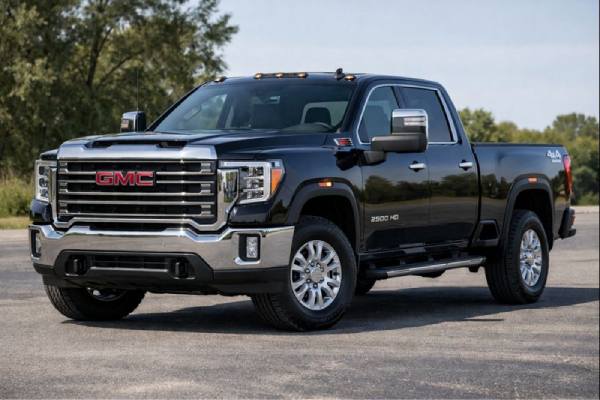
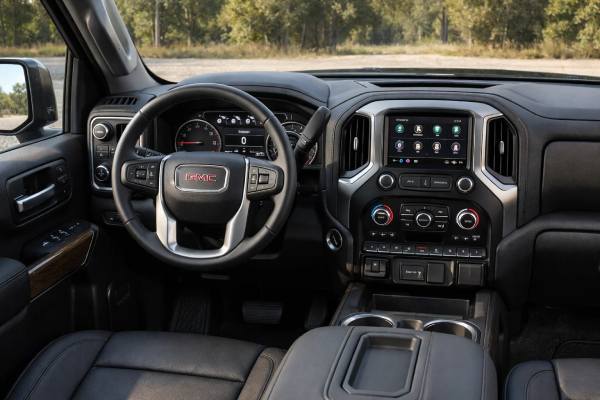
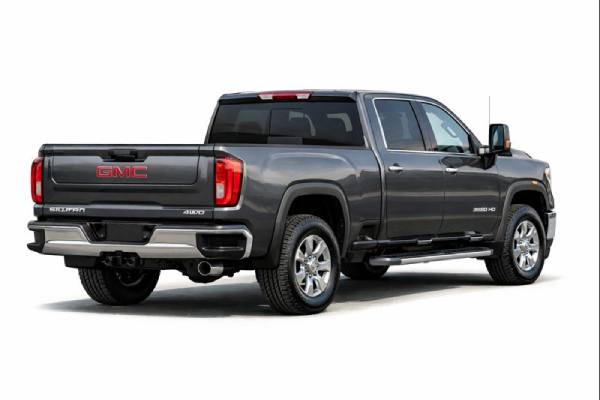
The 2020–2023 GMC Sierra HD 4WD on the T1XX platform with the 6.6L L8T gasoline V8 is built for owners who want heavy-duty chassis strength with fewer diesel-specific variables. The L8T pairs traditional pushrod V8 simplicity with modern controls (direct injection and variable valve timing) to deliver dependable torque for towing and payload work. In 4WD form, the Sierra HD gains true all-season utility: confident launches on wet ramps, better traction on snow and loose surfaces, and low-range control for slow, precise maneuvering with a trailer.
That extra capability comes with trade-offs: more driveline parts to service (transfer case, front differential, CV axles) and slightly lower payload than a similar 2WD truck. If you buy a clean, stock example and maintain its fluids based on real duty cycle, this configuration can be an excellent long-term “do-everything” work truck.
Core Points
- 4WD low range improves slow-speed control for towing on ramps, gravel, and steep driveways.
- The L8T gas V8 avoids diesel aftertreatment complexity while still offering strong work-ready torque.
- Expect more fuel use than a diesel under heavy tow, especially at higher highway speeds.
- Transfer case and front differential fluid service are key longevity items on 4WD trucks.
- Rotate LT tires every 10,000–12,000 km (6,000–7,500 mi) to reduce front-end wear and keep towing stability consistent.
What’s inside
- Why this 4WD L8T Sierra HD matters
- Technical specs for T1XX L8T 4WD
- Trims, options, and safety coverage
- Reliability patterns and known trouble spots
- Maintenance schedule and buyer’s checklist
- Driving feel, traction, and real-world economy
- How it stacks up against gas HD rivals
Why this 4WD L8T Sierra HD matters
A heavy-duty pickup is only as good as its worst day: the icy jobsite entrance, the wet boat ramp, the muddy fairground parking lot, or the steep driveway where you need to back a loaded trailer precisely. That’s the real reason the 2020–2023 Sierra HD 4WD with the L8T exists. It combines a modern HD chassis with a gasoline powertrain that many owners find simpler to operate and maintain than a modern diesel, then adds 4WD capability that expands where and when the truck can work.
On the T1XX platform, Sierra HD focuses on stability and cooling. The truck’s frame, suspension, steering, and brake sizing are designed around sustained load rather than light-duty comfort. You feel this in two ways: it stays composed at highway speed with a trailer, and it tolerates repeated work cycles (stop, pull, stop, pull) better than lighter trucks. The L8T fits that mission by making usable torque without relying on turbocharging. Under load, it will rev higher than a diesel to make its power, but it tends to respond predictably, with fewer “diesel-only” constraints like regeneration behavior or DEF logistics.
4WD changes ownership in a more mechanical way than many people expect. The obvious benefit is traction, but the deeper advantage is control. In low range (4LO), you can move a heavy load at walking speed with less brake pedal input and less drivetrain shock. That is helpful when backing a trailer into a tight spot, creeping down a slick grade, or aligning hitch points on uneven ground. In high range (4HI), you gain a safety margin when a heavy trailer reduces available traction at the rear tires or when conditions are variable across a jobsite.
The trade-offs are real and manageable. 4WD adds weight and additional service points: transfer case fluid, front differential fluid, and the wear items that come with CV axles and front driveline seals. In practice, the best owners treat 4WD as a tool, not a default driving mode: use 2HI on dry pavement, engage 4HI when traction is limited, and reserve 4LO for slow, controlled maneuvers. If you match that approach with correct tires and disciplined fluid maintenance, the 4WD L8T Sierra HD becomes a dependable all-season work platform rather than a complicated indulgence.
Technical specs for T1XX L8T 4WD
The 2020–2023 Sierra HD lineup includes 2500HD and 3500HD, multiple cab and bed lengths, and SRW/DRW rear wheel setups. Treat towing, payload, and some capacities as configuration-dependent and verify using the VIN-specific door-jamb labels and trailering charts for your exact truck.
Engine and Performance
| Item | Specification |
|---|---|
| Code | L8T |
| Engine layout and cylinders | V8, OHV pushrod, 2 valves/cyl |
| Displacement | 6.6 L (6,564 cc) |
| Bore × stroke | 103.25 × 98.0 mm (4.06 × 3.86 in) |
| Induction | Naturally aspirated |
| Fuel system | Direct injection |
| Compression ratio | ~10.8:1 (verify by year calibration) |
| Max power | 401 hp (299 kW) @ 5,200 rpm |
| Max torque | 629 Nm (464 lb-ft) @ 4,000 rpm |
| Timing drive | Chain |
| Efficiency standard | Typically EPA (weight class may limit published mpg labeling) |
Transmission and Driveline
| Item | Specification |
|---|---|
| Transmission | 6L90 6-speed automatic |
| Gear ratios | 4.03 / 2.36 / 1.53 / 1.15 / 0.85 / 0.67; Rev 3.06 |
| Drive type | 4WD (2HI / 4HI / 4LO) |
| Transfer case | 2-speed, electronic shift (varies by trim/RPO) |
| Low range ratio | Typically ~2.7:1 (verify by transfer case code) |
| Differentials | Front open; rear open or automatic locking (option-dependent) |
Chassis and Dimensions
| Item | Typical values (vary by cab/bed) |
|---|---|
| Suspension (front/rear) | Independent front; rear leaf springs |
| Steering | Power-assisted; ratio varies by trim |
| Brakes | 4-wheel discs; sizes vary by GVWR package |
| Wheels/tires | LT-rated sizes vary; load range matters for towing |
| Length / wheelbase (Crew Cab examples) | ~6,350–6,760 mm (250–266 in) / ~4,040–4,370 mm (159–172 in) |
| Width (excl. mirrors) | ~2,060–2,090 mm (~81–82 in) |
| Fuel tank | Commonly ~136 L (36 US gal), verify by build |
Performance and Capability
| Metric | What to expect |
|---|---|
| Acceleration | Strong for an HD truck unloaded; slower with heavy tires or tall gearing |
| Towing capacity | Wide spread by 2500/3500, axle ratio, cab/bed, and SRW/DRW; verify your configuration |
| Payload | 4WD reduces payload vs similar 2WD; the door sticker is the truth |
| Braking performance | Strong when maintained; downhill towing requires proper trailer brake setup |
Fluids and Service Capacities
| System | Planning guidance (verify exact spec/capacity) |
|---|---|
| Engine oil | dexos-approved oil grade per manual; capacity varies with cooler and filter |
| Coolant | GM-approved extended-life coolant; capacity varies by cooling package |
| Transmission/ATF | Spec fluid per GM service info; service-fill differs from dry fill |
| Transfer case | Fluid varies by transfer case/RPO; verify before servicing |
| Front and rear differentials | Gear oil spec depends on axle and locker; verify if additive is required |
Electrical and Safety (equipment-dependent)
| Category | Notes |
|---|---|
| Alternator and battery | Output and battery setup vary by tow and snow-plow prep packages |
| Safety systems | ABS, stability control, trailer sway control are core; ADAS features are trim/package dependent |
| Crash ratings | Some HD pickups have limited published test coverage; confirm via official databases for your exact year/model |
Trims, options, and safety coverage
For 2020–2023, Sierra HD trims typically span Pro (Work Truck), SLE, SLT, AT4, and Denali. In a 4WD L8T truck, trim is not just about comfort; it also influences tires, underbody protection, trailering visibility, and the specific driveline hardware installed. The best approach is to shop “capability content” first, then pick the interior you can live with.
Start with trailering equipment. If you tow frequently, a factory integrated trailer brake controller is one of the highest-value options because it improves braking consistency and simplifies troubleshooting. Trailering mirrors and a factory 7-pin connector are similarly practical: they reduce fatigue and reduce the odds of a wiring workaround. Many trucks bundle these in trailering packages that may also include higher-capacity cooling and charging equipment—useful for owners running accessories, lights, or winches.
Next, consider axle ratio and rear differential type. These two items change how the truck feels more than most people expect. A shorter (numerically higher) axle ratio generally improves launch feel and grade behavior with a trailer, while a taller ratio can feel calmer at cruise. A locking rear differential can make a big difference on wet ramps and loose surfaces, especially in 2HI, and it complements 4WD rather than replacing it.
The AT4 trim (where found) often emphasizes off-pavement readiness: higher-clearance tires, skid plates, and shock tuning aimed at rough surfaces. That can be helpful if your truck regularly works on uneven ground. Just remember that aggressive all-terrain tires can increase noise, reduce fuel economy, and sometimes soften steering precision on-road. Denali tends to focus on refinement and equipment depth, which may include more cameras and convenience features that help when hitching and maneuvering a long trailer.
On safety and driver assistance, confirm rather than assume. In this era, many Sierra HD builds offer a mix of core stability systems and optional alert-based features. Depending on trim and package, you may see lane departure warning, forward collision alerts, park assist, and expanded camera views. The practical benefit for HD owners is often the camera system rather than lane features: better visibility reduces low-speed incidents and helps you place a trailer accurately.
Finally, pay attention to year-to-year packaging changes. Even without a full redesign, manufacturers often reshuffle options, camera hardware, or infotainment modules. Two trucks that look identical in photos can have different driver-assist menus, camera counts, or hitch-support features. When possible, get the build sheet or RPO list and confirm the transfer case type, axle ratio, and trailering package content before you decide.
Reliability patterns and known trouble spots
The L8T Sierra HD 4WD is generally a straightforward ownership proposition, but “simple” does not mean “maintenance-free.” Reliability trends typically separate into three buckets: routine wear (expected), duty-cycle problems (usage-driven), and true failures (less common but more expensive). The most accurate predictor is how the truck was used: heavy towing, long idle hours, winter salt exposure, and off-pavement operation all leave different fingerprints.
Common (low to medium cost, often wear-related):
- Front-end wear and alignment drift: HD trucks carry heavy loads and often run LT tires with stiff sidewalls. Ball joints, tie rods, and steering linkages can wear faster if the truck sees rough roads or heavy tires. Symptoms include wander, clunks, and uneven tire wear. Remedy is inspection-based replacement and a proper alignment with the truck at normal ride height.
- Transfer case and driveline seepage: Mild seepage at seals is not unusual as miles accumulate, especially in salt regions. What matters is progression: fresh drips, low fluid levels, or new noises after 4WD use. Remedy is catching leaks early and servicing to the correct fluid spec.
- Brake wear under tow: Brake systems are strong, but downhill towing punishes pads and rotors if trailer brakes are not set correctly. Symptoms include vibration, longer pedal travel, or a burning smell after grades. Remedy is correct trailer brake setup and timely pad/rotor service.
Occasional (medium cost, condition-dependent):
- Transmission heat and shift quality: The 6L90 is robust, but towing in hot climates with old fluid can lead to shudder, harsher shifts, or delayed engagement. Remedy often starts with correct fluid service and cooler verification, then escalates only if symptoms persist.
- Direct-injection fuel system complaints: Rough running or misfires can be caused by injector or high-pressure fuel issues, though many drivability complaints trace back to plugs, coils, or vacuum leaks. Remedy is diagnosis with scan data, not guesswork.
- CV axle boot damage: Off-pavement use and debris can tear boots, leading to grease loss and eventual joint wear. Remedy is boot repair or axle replacement before noise develops.
Rare (high cost, but worth screening for):
- Internal engine mechanical issues: Poor oil-change habits under severe duty can accelerate valvetrain wear. Look for persistent ticking, repeat misfire codes, or low oil pressure warnings. A thorough test drive and scan are the best filters.
For recalls and service actions, treat the VIN check as mandatory. Paperwork matters on work trucks because repairs often happen “just enough to keep it moving.” Ask for records that show fluid services and driveline work, and be wary of trucks that show heavy towing wear but no documented maintenance.
Maintenance schedule and buyer’s checklist
A 4WD HD truck stays reliable when you service it based on heat, load, and environment, not just mileage. If the truck tows, idles for long periods, or runs in dust and salt, use a severe-duty mindset from day one.
Practical maintenance schedule (distance and time)
- Engine oil and filter: Follow the Oil Life Monitor when equipped, but many owners set a ceiling of 8,000–12,000 km (5,000–7,500 mi) or 12 months for towing and idle-heavy use. Use the correct dexos-approved oil grade specified for your year.
- Engine air filter: Inspect at every oil service; replace early if used in dust. A realistic range is 24,000–48,000 km (15,000–30,000 mi) depending on conditions.
- Cabin air filter: 12–24 months depending on dust and HVAC use.
- Spark plugs: Plan around 160,000 km (100,000 mi) unless your manual specifies a different interval, and shorten it if misfires appear under load.
- Coolant: Follow the official interval, but test freeze protection annually and inspect hoses and clamps at least yearly.
- Transmission fluid (6L90): If you tow regularly, a conservative interval is 72,000–96,000 km (45,000–60,000 mi).
- Transfer case fluid: Treat as a high-priority 4WD item; many owners service around 80,000 km (50,000 mi) or sooner with frequent 4WD use, water exposure, or salt.
- Front and rear differential fluid: Service around 80,000–120,000 km (50,000–75,000 mi) under towing or harsh use.
- Brake fluid: Flush every 2–3 years to reduce moisture-related corrosion and maintain pedal feel.
- Tires and alignment: Rotate every 10,000–12,000 km (6,000–7,500 mi); check alignment at least annually or after any steering/suspension work.
Fluids and essential torque values (decision-grade)
Because specifications vary by axle and transfer case code, the most important rule is to verify the correct fluid type before servicing. For a practical torque value that owners often need, 8-lug wheel lug nuts are commonly torqued to about 258 Nm (190 lb-ft)—confirm for your wheel type and year before tightening.
Buyer’s checklist for a used 4WD L8T Sierra HD
- Confirm configuration: 2500HD vs 3500HD, SRW vs DRW, axle ratio, and trailering package content. The door sticker and trailering label are more reliable than ads.
- Test 4WD engagement correctly: 4HI and 4LO should engage per the manual procedure without grinding, flashing indefinitely, or loud bangs.
- Inspect for driveline leaks and damage: Transfer case, front differential, CV boots, and driveshaft U-joints.
- Evaluate steering and tire wear: Uneven wear often signals alignment issues or worn front-end parts.
- Check tow equipment integrity: Brake controller function, wiring condition, hitch receiver wear, and camera functions if equipped.
- Review service history: Prioritize trucks with documented transmission, differential, and transfer case services if they towed.
Long-term outlook: the trucks that last are the ones treated like equipment. Clean fluids, correct tires, and early attention to small leaks often make the difference between “boring reliable” and “constant nuisance.”
Driving feel, traction, and real-world economy
The Sierra HD 4WD with the L8T feels purpose-built: stable, confident, and a little industrial when empty—then more settled once you add payload or a trailer. Steering is typically heavy in a reassuring way, designed to hold a line with a load rather than dart around town. Ride quality depends heavily on configuration. A 3500HD and especially a DRW truck can feel stiff when unladen, while many 2500HD setups are easier to daily-drive. Tire choice also matters: aggressive all-terrain tires can increase noise and soften steering precision, but they can be worth it if you frequently work on loose surfaces.
The L8T’s power delivery is a key difference versus a diesel. It does not “idle-pull” the same way; it makes more of its working power at higher rpm. In real use, that means the 6L90 will downshift more often on grades and during passing, especially with a trailer. Many owners find this perfectly acceptable because it is predictable: press the pedal, it drops a gear, and it climbs. Tow/Haul mode improves this behavior by holding gears longer and using engine braking more assertively on descents, which helps control heat in the service brakes.
4WD is where the truck earns its keep beyond a spec sheet. In 4HI, the truck launches more confidently on wet ramps, slick pavement, and gravel—conditions where a heavy trailer can quickly overwhelm rear traction. In 4LO, you gain low-speed control that is hard to replicate with throttle finesse alone. This is useful when backing a trailer into a tight spot, creeping down a steep grade, or pulling a load slowly over uneven ground without constant brake input.
Fuel economy is the trade-off that most buyers already expect. Because many HD trucks do not carry the same standardized fuel-economy labels as lighter vehicles, owners rely on real-world tracking. Typical patterns look like this:
- Empty highway cruising: often around 16–20 L/100 km (12–15 mpg US / 14–18 mpg UK) depending on speed, tires, and axle ratio.
- Mixed driving: often around 18–24 L/100 km (10–13 mpg US / 12–16 mpg UK).
- Towing: highly variable, commonly 24–39 L/100 km (6–10 mpg US / 7–12 mpg UK) depending on trailer shape, wind, and speed.
The biggest “free” efficiency gain is speed discipline. Aerodynamic drag rises quickly above typical highway speeds, and tall trailers amplify that effect. If you tow often, keeping tires properly inflated, maintaining alignment, and using Tow/Haul strategically can reduce driver fatigue and stabilize fuel use more than any single bolt-on.
How it stacks up against gas HD rivals
In the gas heavy-duty market, the Sierra HD L8T competes most directly with Ford Super Duty gasoline models and Ram Heavy Duty gasoline models, while diesel variants remain the alternative for buyers who tow very heavy, very often, and want maximum low-rpm torque and typically better fuel economy under load.
The Sierra HD’s appeal with the L8T is its balanced “work logic.” The engine is modern enough to feel responsive and controlled, but not so complex that routine service becomes intimidating. Many owners choose it because they want HD chassis strength without diesel-specific ownership variables. That is especially true for fleets and private owners who do a mix of towing, payload, and daily driving, and who value predictable maintenance more than peak tow ratings.
Against other gas HDs, a major differentiator is transmission strategy and gearing. Some competitors use newer multi-speed automatics, which can keep rpm lower in certain situations and may feel smoother when the truck is lightly loaded. The Sierra’s 6-speed setup can feel more “stepwise” on grades, but it is also widely understood and generally robust when fluid maintenance matches duty cycle. If your work involves frequent towing in heat, the condition of the cooling system and transmission fluid matters far more than the number of gears.
4WD comparison is also important. Many HD buyers default to 4WD because it protects against a handful of high-stress scenarios each year: winter traction, muddy worksites, and wet ramps. If those scenarios are real in your life, 4WD is often the correct tool even if you spend most miles in 2HI. If you rarely face traction limitations, a comparable 2WD truck can offer slightly higher payload and fewer driveline service points—though it may be harder to find in certain regions because many HD trucks are ordered as 4WD.
A practical decision framework looks like this:
- Choose the L8T gas HD when your work is mixed, your yearly mileage is moderate, and you want fewer diesel-specific systems to manage.
- Choose a diesel HD when you tow heavy at highway speed frequently enough that fuel cost, grade behavior, and range become dominant concerns.
- Choose 4WD when traction is your limiting factor even a few times per year, or when low-range control improves safety and precision for your typical tasks.
In short, the 2020–2023 Sierra HD 4WD L8T is often the “most usable” HD choice for owners who need real capability in all seasons but prefer the operating simplicity of gasoline power.
References
- 6.6L V-8 L8T Gasoline Engine | GM Powered Solutions 2025 (Engine Specifications)
- Check for Recalls: Vehicle, Car Seat, Tire, Equipment | NHTSA 2025 (Recall Database)
- Car Safety Ratings | Vehicles, Car Seats, Tires | NHTSA 2025 (Safety Rating Portal)
- GMC Owner Center 2025 (Owner’s Manuals)
- GMC Trailering and Towing Guide 2025 (Trailering Guide)
Disclaimer
This article is for informational purposes only and is not a substitute for professional diagnosis, inspection, or repair. Specifications, torque values, service intervals, capacities, and procedures vary by VIN, market, model year, and installed equipment. Always verify details using the official owner and service documentation for the exact vehicle.
If you found this guide helpful, please consider sharing it on Facebook, X/Twitter, or your preferred community to support our work.