
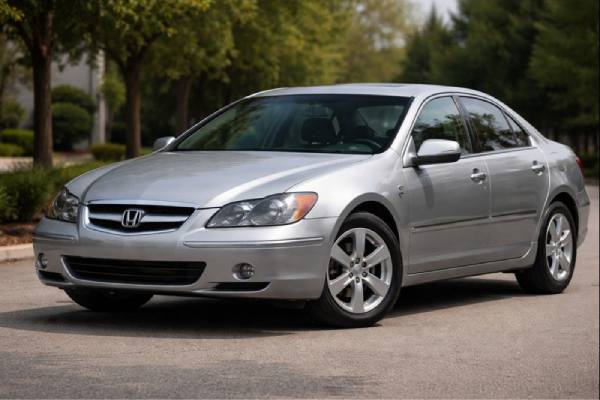
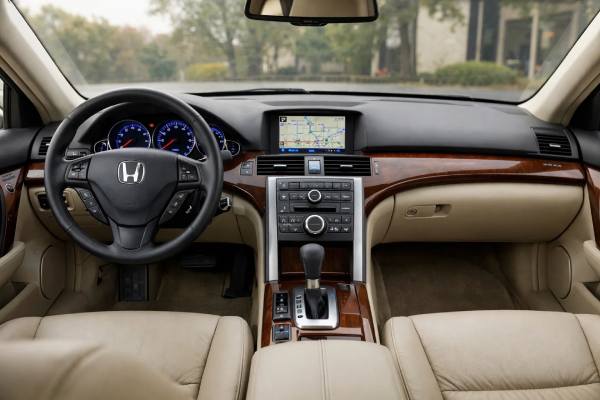

Honda’s fourth-generation Legend (KB1) is one of those understated executive sedans that rewards owners who value engineering over badge flash. Under the hood, the 3.5-liter J35A V6 delivers smooth, high-rpm power without turbo complexity. Underneath, the platform is tuned for stability and refinement first, with a chassis that feels heavier than sporty, but also unusually secure at speed. In many markets this era of Legend is closely linked to Honda’s torque-vectoring all-wheel-drive concept, which gives it confident traction and tidy corner exits for a big sedan.
Where the KB1 really stands out today is how “complete” it feels: quiet cabin, strong brakes, sophisticated safety options for the time, and a drivetrain that can run for years if it is serviced on schedule. The trade-off is that this is a tech-rich, low-volume model—parts pricing, diagnostics, and correct fluid choices matter more than on a simpler Accord.
At a Glance
- Smooth, naturally aspirated V6 with strong midrange and predictable response in all weather.
- Stable, confidence-first chassis with secure high-speed manners and a quiet cabin.
- Ownership caveat: tech-heavy systems (infotainment, radar safety options, AWD hardware) reward careful diagnosis over guesswork.
- Plan on timing-belt service every 160,000–170,000 km (100,000–105,000 mi) or 7 years (whichever comes first).
- Keep tyre tread depth closely matched across the axle set to reduce drivetrain stress (aim for < 2 mm difference).
Section overview
- KB1 Legend design and engineering
- J35A 295 hp technical specs
- Equipment trims and driver aids
- Reliability patterns and service campaigns
- Service planning and purchase checks
- Driving character and real mpg
- KB1 Legend versus rivals
KB1 Legend design and engineering
The 2006–2008 Honda Legend (KB1) was engineered as a flagship sedan with a very specific brief: deliver V6 performance, long-distance comfort, and all-weather security without relying on harsh suspension tuning. That shows in the way the car feels on real roads. It is not a “pointy” sports sedan, but it is composed—especially at motorway speeds—where wind noise, steering corrections, and suspension reactions stay well controlled.
The J35A 3.5-liter V6 is a major part of the experience. In this tune it favors linear power and low vibration over dramatic shove. You get the most satisfying acceleration from a clean, progressive throttle application and letting the engine pull toward the upper midrange, where it feels eager without sounding strained. Because this is a naturally aspirated setup, there is no turbo lag and no boost-dependent torque spike—just a consistent build that makes the car easy to drive smoothly.
Where many owners notice a “premium” difference is in the cabin and refinement systems. The KB1 was built around quietness: good sealing, dense materials, and noise-control strategies that reduce low-frequency boom that can tire you out on long trips. That quiet, stable baseline also helps the chassis feel more confident than its size suggests in wet or cold conditions.
From an ownership perspective, the KB1 is best approached like a modern executive car rather than an older, simple Honda. The drivetrain is durable, but it expects the right fluids and the right service timing. The same is true for optional safety technology: radar-based braking support and adaptive cruise systems (where fitted) can be excellent, but they demand correct calibration after front-end repairs and careful troubleshooting if warning lights appear.
If you are shopping today, the KB1’s strongest value is the blend of flagship comfort and straightforward V6 durability. The biggest risk is neglect: missed timing-belt intervals, wrong transmission fluid, mismatched tyres, and half-finished electrical repairs are what turn a good Legend into an expensive project.
J35A 295 hp technical specs
Below are the key specifications most owners and buyers actually use. Figures can vary slightly by market and equipment, so treat these as a high-confidence baseline for the 3.5 V6 295 hp KB1 era and verify by VIN when ordering parts.
Powertrain and efficiency
| Item | Specification |
|---|---|
| Engine code | J35A (market-specific suffix) |
| Layout and valvetrain | 60° V6, SOHC i-VTEC, 4 valves/cyl (24 total) |
| Bore × stroke | 89.0 × 93.0 mm (3.50 × 3.66 in) |
| Displacement | 3.5 L (3471 cc) |
| Induction | Naturally aspirated |
| Fuel system | Multi-point fuel injection |
| Compression ratio | 11.0:1 |
| Max power | 295 hp (217 kW) @ 6200 rpm |
| Max torque | 351 Nm (259 lb-ft) @ 5000 rpm |
| Timing drive | Belt |
| Rated efficiency (combined, typical) | ~11.5–11.9 L/100 km (about 20–21 mpg US / 23–25 mpg UK) |
| Real-world highway @ 120 km/h | ~9.5–10.5 L/100 km (about 22–25 mpg US / 27–30 mpg UK) |
| Aerodynamics (typical) | Cd ~0.30 (varies by market equipment) |
Transmission and driveline
| Item | Specification |
|---|---|
| Transmission | 5-speed automatic (with manual mode on many cars) |
| Drive type | AWD in many markets (torque-vectoring concept); confirm by VIN/region |
| Differential | Electronically controlled rear differential (AWD models) |
Chassis and dimensions
| Item | Specification |
|---|---|
| Suspension (front / rear) | Independent / independent (multi-link type layouts) |
| Steering | Rack and pinion, power-assisted |
| Brakes | 4-wheel discs, ABS, EBD; sizes vary by market |
| Wheels and tyres | Commonly 17–18 in; tyres often in the 235–245 width range |
| Length / width / height (typical) | ~4957 / 1845 / 1450 mm (195.2 / 72.6 / 57.1 in) |
| Wheelbase (typical) | ~2800 mm (110.2 in) |
| Turning circle (kerb-to-kerb, typical) | ~11.8–12.2 m (38.7–40.0 ft) |
| Kerb weight (typical) | ~1850–1870 kg (4080–4120 lb) |
| Fuel tank | ~73 L (19.3 US gal / 16.1 UK gal) |
| Cargo volume (seats up) | ~452 L (about 16.0 ft³), method varies by market |
Performance and capability
| Item | Specification |
|---|---|
| 0–100 km/h (0–62 mph) | ~7.0–7.5 s (tyres and conditions matter) |
| Top speed | ~250 km/h (155 mph), often electronically limited |
| Towing capacity | Market-dependent; check homologation label and manual |
Fluids and service capacities
| System | Fluid and spec (typical) | Capacity (approx.) |
|---|---|---|
| Engine oil | 5W-30 or 0W-30 meeting the correct ACEA/API for market | ~4.3 L (4.5 US qt) |
| Coolant | Honda Type 2 equivalent premix (or correct spec concentrate mix) | ~7–8 L (varies) |
| Automatic transmission | Honda/Acura ATF (later DW-1 often supersedes earlier fluids) | drain and fill ~3–4 L; total varies |
| Rear differential (AWD) | Honda/Acura specified SH-AWD / rear diff fluid | varies |
| Brake fluid | DOT 3 (or DOT 4 where specified) | as required |
| A/C refrigerant | Depends on market and label under hood | label-based |
Electrical (typical)
| Item | Specification |
|---|---|
| 12 V battery | Commonly 60–70 Ah class (varies by market) |
| Spark plugs | Iridium long-life type; gap per service manual |
Safety and driver assistance (what to expect)
| Item | Notes |
|---|---|
| Airbags | Front, side, and curtain airbags typical; confirm count by market/year |
| Stability systems | ABS, EBD, and stability control commonly fitted |
| ADAS (where equipped) | Adaptive cruise and collision-mitigation systems may be optional; verify hardware in grille/windscreen area |
Equipment trims and driver aids
Because the Legend was sold in different regions with different naming conventions, “trim” often matters less than build specification. Many KB1 cars were delivered well-equipped by default, then differentiated by option packs—especially safety and infotainment.
Common equipment themes (most markets)
- Comfort and cabin: leather seating, power adjustment, dual-zone climate control, premium audio, and a strong focus on sound isolation. Higher-spec cars may add ventilated seats, upgraded speaker systems, and more extensive memory functions.
- Infotainment and navigation: factory navigation with integrated display was common. In 2006–2008 systems, the user interface and map storage are the weak points today, not the screen itself. Expect dated routing logic and older media compatibility unless updated.
- Lighting: xenon or HID headlamps were common in this class, often with washers or auto-leveling depending on market rules.
Safety ratings in context
For this generation of large sedans, the KB1’s structure and restraint systems were well regarded. Independent testing bodies awarded strong results for occupant protection for the period. If you are comparing safety across eras, remember that test protocols evolve; a “five-star” result in the mid-2000s does not automatically equal a modern five-star result, but it does indicate a car designed with serious crash engineering.
In addition to standard passive safety (airbags and belt pretensioners), many Legends were delivered with strong active safety fundamentals: stability control, traction control, and well-tuned ABS calibration. These systems are still valuable today because they work in the background, require minimal driver learning, and do not depend on camera visibility like modern lane systems.
Driver assistance systems and what to verify
On higher-spec cars, the KB1 can include early versions of:
- Adaptive Cruise Control (ACC): uses a radar sensor; excellent when working, but sensitive to front bumper damage and sensor alignment.
- Collision Mitigation Braking System (CMBS): an early forward-collision concept that can warn and assist braking. It is not the same as modern AEB, but it can reduce impact speed in specific scenarios.
- Lane Keeping Assist (LKAS): where fitted, it relies on camera and lane contrast; performance depends heavily on windscreen condition and calibration.
If the car has these systems, treat them like “calibrated equipment.” After a windscreen replacement, a front-end repair, or even a wheel alignment that changes steering angle sensor behavior, it is worth confirming there are no stored faults and that the system self-checks correctly. A clean dashboard is good, but a diagnostic scan is better.
Reliability patterns and service campaigns
A well-maintained KB1 Legend is typically a long-lived car, but it has two realities that shape reliability: it is heavy, and it is packed with premium-era electronics. Most problems fall into predictable buckets.
Common issues (higher prevalence)
- Timing belt overdue (high cost if neglected):
Symptoms: unknown belt history, noisy idlers, coolant seep near water pump.
Cause: age-based rubber and bearing wear.
Remedy: full timing-belt kit (belt, tensioner, idlers) plus water pump; refresh coolant and inspect front crank seal. - Automatic transmission shift quality decline (medium):
Symptoms: flare on upshift, delayed engagement, shudder under light load.
Cause: old ATF, repeated short-trip heat cycles, sometimes incorrect fluid.
Remedy: multiple drain-and-fills with the correct Honda-spec ATF; check mounts and update any available transmission software where applicable. - Engine mount wear (medium):
Symptoms: vibration at idle in gear, thump on takeoff.
Cause: hydraulic mount degradation from age and heat.
Remedy: replace worn mounts as a set where possible; verify idle speed and misfire status to avoid masking a tune issue.
Occasional issues (moderate prevalence)
- Oil leaks from upper engine (low to medium cost):
Symptoms: oil smell after a drive, wet valve cover edges, small drips.
Cause: valve cover gaskets and aged seals.
Remedy: replace gaskets, check PCV function, and clean the area to confirm the true source. - Cooling system aging (medium):
Symptoms: slow coolant loss, crusted hose ends, temperature creep in traffic.
Cause: hoses, radiator end tanks, and clamps aging.
Remedy: pressure test, refresh hoses and cap, and use the correct coolant type.
Rare but expensive
- AWD driveline sensitivity to tyres (can become high):
Symptoms: binding on tight turns, driveline vibration, unusual rear-end noise.
Cause: mismatched tyre circumference and tread depth stressing AWD hardware.
Remedy: replace tyres as a matched set where possible; keep tread depth very close side-to-side; use correct rear diff fluid and service intervals. - ADAS sensor and module faults (high):
Symptoms: ACC/CMBS warnings, intermittent braking support disable, random beeps.
Cause: radar alignment issues, wiring damage, windscreen camera problems, low battery voltage events.
Remedy: scan for codes, verify charging system health, inspect sensor mounts and wiring, and calibrate per service procedure.
Recalls, TSBs, and how to verify
Because campaigns vary by country, the safest approach is procedural:
- Run the car’s VIN through an official recall lookup for your market.
- Request dealer service history printouts where possible.
- If importing, verify recall completion in the original market as well.
This avoids relying on generic “common recall lists” that may not match your specific production date or region.
Service planning and purchase checks
Treat the KB1 like a premium car that happens to wear a Honda badge: preventative service is what keeps it affordable.
Practical maintenance schedule (distance and time)
- Engine oil and filter: every 8,000–10,000 km (5,000–6,000 mi) or 12 months. Short-trip use and hot climates justify the shorter interval.
- Cabin air filter: every 15,000–20,000 km or 12 months, sooner if the blower gets noisy.
- Engine air filter: every 20,000–30,000 km, inspect at each oil service.
- Coolant: typically 5 years initially, then 3 years (confirm by coolant type and service documentation).
- Spark plugs (iridium): about 160,000 km (100,000 mi), often aligned with timing-belt service.
- Timing belt and water pump: every 160,000–170,000 km (100,000–105,000 mi) or 7 years.
- Automatic transmission fluid: drain and fill every 40,000–60,000 km; consider shorter intervals for heavy city use.
- Brake fluid: every 3 years regardless of mileage.
- Brake pads and rotors: inspect at each tyre rotation; heavy weight means brakes can wear faster than you expect.
- Tyres: rotate every 8,000–10,000 km; keep pressures correct and align annually or when wear shows.
- 12 V battery and charging check: test yearly; replace proactively around 4–6 years depending on climate.
Fluids, parts, and “don’t guess” items
- Use the correct ATF and do not mix unknown fluids. If history is unclear, do a staged service (multiple drain-and-fills) instead of a harsh flush.
- If your car is AWD, use the specified rear differential fluid and keep tyre sizing consistent. AWD issues often start as “small” tyre mismatches.
Buyer’s guide: what to inspect before purchase
Paperwork and history
- Proof of timing-belt service (invoice showing parts list, not just “belt done”).
- Evidence of regular ATF services, not just engine oil.
- Any documentation for radar safety system repairs or windscreen replacements.
Physical checks
- Cold start: listen for belt-area chirps, mount thumps, and misfires.
- Test drive: check for transmission flare, shudder, and driveline binding in tight turns.
- Braking: repeated moderate stops should feel consistent; pulsing suggests rotor issues.
- Electronics: confirm navigation, audio amplifier behavior, climate control, seat motors, and parking sensors (if equipped).
- Tyres: confirm matching brand/model and similar tread depth across the set.
Long-term durability outlook
A sorted KB1 can be a dependable long-distance sedan. The ownership formula is simple: keep fluids correct, keep tyres matched, and fix small electrical faults properly the first time.
Driving character and real mpg
The KB1 Legend’s driving personality is best described as confident and polished rather than sharp. The steering is typically light-to-medium in effort and tuned for stability, with a calm on-center feel that reduces fatigue on long highway runs. Through quick direction changes, the car’s weight is present, but the chassis stays composed if the suspension and tyres are in good shape.
Ride, handling, and NVH
- Ride quality: generally smooth over broken pavement, with a mature “one movement” response rather than a choppy bounce. Worn dampers or bushings will show up as a floaty secondary motion on long undulations.
- Noise levels: the cabin is usually quiet for its age. If yours is loud, suspect tyre noise (often the biggest contributor), door seals, or wheel bearing wear.
- Braking feel: strong and reassuring when serviced correctly. Because the car is heavy, cheap pads can overheat and feel grabby or inconsistent; quality friction parts matter.
Powertrain character
The J35A V6’s best trait is predictability. Throttle response is clean, and the engine pulls smoothly from low rpm without the “surge then fade” feel some turbo cars have. The 5-speed automatic is tuned for unobtrusive shifting; in manual mode it can hold gears well enough for mountain roads, but it is not a modern dual-clutch. If you feel frequent gear hunting, start with tyre size matching, fluid condition, and engine mount health before assuming a transmission failure.
Real-world efficiency
Expect economy to depend heavily on speed and urban use:
- City-heavy driving: ~13–15 L/100 km (16–18 mpg US / 19–22 mpg UK) is common for short-trip traffic.
- Highway 100–120 km/h: ~9.5–10.5 L/100 km (22–25 mpg US / 27–30 mpg UK) when everything is healthy.
- Mixed use: ~11–12.5 L/100 km (19–21 mpg US / 23–26 mpg UK).
Cold weather typically adds consumption because the engine warms slowly and the cabin heating load is meaningful. Tyre choice also moves the needle: a quieter touring tyre can improve refinement but may slightly reduce efficiency if rolling resistance is higher.
Key performance metrics that matter day to day
- 0–100 km/h: mid-7s seconds feels genuinely quick in real traffic.
- Passing response: strong when the transmission kicks down cleanly; sluggish response often traces to tired ATF or a throttle body that needs proper service and adaptation.
- Turning circle: not small; plan your parking and tight urban maneuvers accordingly.
KB1 Legend versus rivals
If you are cross-shopping a 2006–2008 Legend, you are usually comparing it to German executive sedans and a few Japanese alternatives. The Legend’s value is not that it “beats” them at one headline metric; it is that it combines flagship comfort, a durable V6, and strong safety fundamentals with fewer chronic engine complications than some turbo-era competitors.
Versus Lexus GS (GS 300 / GS 350)
- Legend advantage: very smooth V6 character and a strong comfort baseline; often better equipped for the money in some markets.
- GS advantage: stronger brand support and typically easier parts sourcing; some versions deliver better fuel economy.
Versus BMW 5 Series (E60 525i / 530i)
- Legend advantage: less sensitive to neglected cooling-system and oil-leak patterns than many older BMWs, and generally less fussy to keep “daily ready.”
- 5 Series advantage: sharper steering and handling balance; deeper specialist ecosystem for performance and chassis tuning.
Versus Mercedes E-Class (W211 E350)
- Legend advantage: simpler naturally aspirated power delivery and typically fewer “cascade” electronics issues when maintained carefully.
- E-Class advantage: more classic luxury feel in some trims and stronger rear-drive dynamics (where equipped).
Versus Audi A6 (C6 3.2 FSI quattro)
- Legend advantage: avoids direct-injection carbon buildup and some of the complexity that comes with certain Audi-era engines.
- A6 advantage: interior tech feel and brand perception; quattro aftermarket support.
The practical verdict
Choose the KB1 Legend if you want:
- A quiet, secure long-distance sedan with a predictable V6.
- A car that responds well to correct maintenance rather than constant modification.
- A “premium without drama” ownership experience—provided you can source the right fluids and parts.
Look elsewhere if you want:
- The sharpest handling feel in the class.
- The easiest global parts availability and community support.
- Modern infotainment and driver assistance without retrofit work.
References
- Legend 2006 2006 (Manufacturer Press Release)
- 2006 Acura RL 2006 (Safety Rating)
- Honda Legend | Safety Rating & Report | ANCAP 2006 (Safety Rating)
- Check for Recalls: Vehicle, Car Seat, Tire, Equipment | NHTSA 2026 (Recall Database)
Disclaimer
This article is for informational purposes only and is not a substitute for professional inspection, diagnosis, or repair. Specifications, torque values, fluid types, service intervals, and procedures can vary by VIN, market, model year, and installed equipment, so always verify details using the official service documentation and labels for your vehicle.
If you found this guide useful, please consider sharing it on Facebook or X to help others find reliable ownership information.