
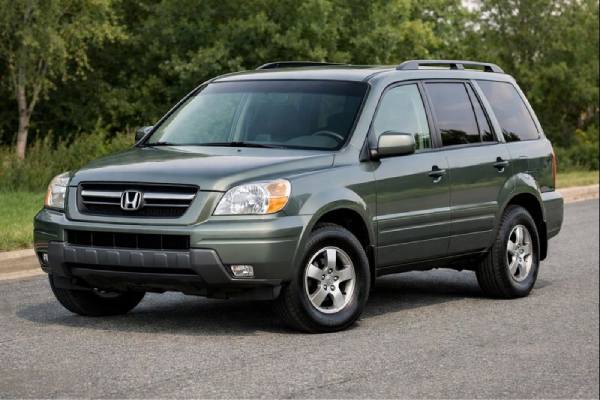
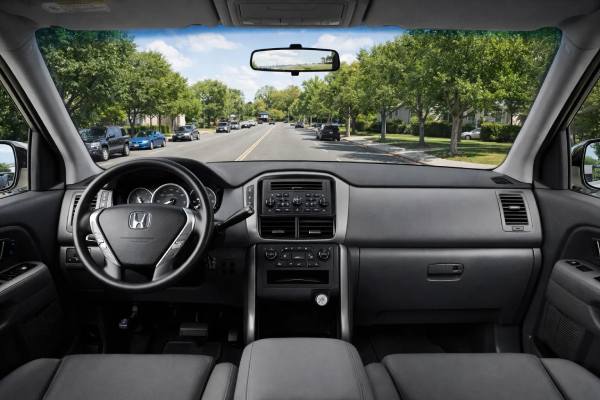
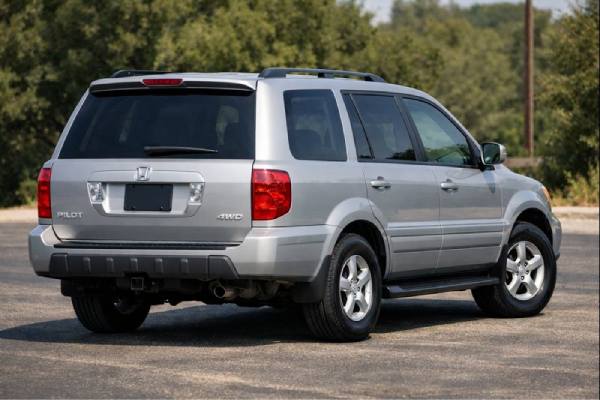
The 2005 Honda Pilot AWD (YF1) is the “sweet-spot” update of the first-generation Pilot: still simple by modern SUV standards, but meaningfully refined versus the earliest trucks. Its J35A6 3.5-liter V6 keeps the durable, low-stress Honda formula—aluminum block, SOHC VTEC, and a broad torque curve—while adding a more modern throttle strategy that can feel smoother in everyday driving. Pair that with a 5-speed automatic and Honda’s VTM-4 all-wheel-drive system, and you get an SUV that’s confident in poor weather and capable for light towing without feeling truck-heavy.
For owners today, the value lives in two areas: predictable mechanical access (maintenance is straightforward for most shops) and a body/chassis that still rides comfortably when the suspension is kept fresh. The trade-off is age-related upkeep—especially transmission behavior, timing-belt service, and AWD fluid discipline.
What to Know
- Strong, smooth V6 power delivery that suits highway cruising and moderate towing.
- VTM-4 AWD adds confident traction in rain and snow, especially with proper tires.
- Budget for timing-belt service if history is unclear; it’s a must-do at interval.
- Rotate tires about every 8,000–10,000 km (5,000–6,000 mi) to keep AWD happy.
- If the 5-speed automatic shifts harshly or flares, plan diagnostics before buying.
Navigate this guide
- Honda Pilot AWD 2005 snapshot
- Honda Pilot AWD data tables
- Honda Pilot AWD equipment and safety
- Known weak spots and recalls
- Service plan and buying tips
- On-road feel and economy
- Pilot AWD vs key rivals
Honda Pilot AWD 2005 snapshot
If you want a one-year “best of the early YF1” package, the 2005 Pilot AWD stands out because it blends first-generation simplicity with several meaningful usability upgrades. It still has the clean, square packaging that makes the Pilot easy to load and easy to see out of, and it retains the everyday strengths that made the early models popular: a comfortable seating position, predictable handling, and a drivetrain tuned for smoothness rather than drama.
The headline mechanical point is the J35A6 3.5-liter V6 rated at 255 hp for this model year. In practice, what owners feel is less about peak horsepower and more about the engine’s relaxed midrange. The Pilot doesn’t need high rpm to maintain speed on grades or to merge cleanly, and that matters because the vehicle’s mission is family hauling, not lap times. The 5-speed automatic generally complements that character when it is healthy: shifts are designed to be unobtrusive, and the gearing is spaced for steady highway use.
AWD is handled by Honda’s VTM-4 system. Think of it as front-wheel drive most of the time, with the rear axle receiving torque when the system detects slip or when conditions demand it. It’s not a rock-crawling transfer case, but it is very effective for wet roads, packed snow, muddy driveways, and boat ramps. The key is maintenance: the rear differential fluid is not “lifetime,” and ignoring it is one of the easiest ways to create shuddering, groaning, or binding complaints that feel larger than they are.
From an ownership standpoint, the 2005 Pilot rewards buyers who are disciplined about baseline service. The big-ticket item is the timing belt service (often bundled with the water pump and related seals). If you treat that as a scheduled cost—not a surprise—you can keep the engine in its comfort zone for a long time. The second ownership theme is “age plus heat”: rubber parts, engine mounts, suspension bushings, and cooling system components may be original on many examples, and refreshing them often transforms the way the vehicle drives.
The advantage of this generation is that the driving experience is still honest. You get a roomy cabin and usable cargo space without the layered complexity of modern turbo-and-hybrid systems. The downside is that time doesn’t forgive deferred maintenance. Buy the best-documented example you can, and plan a first-year catch-up budget if records are incomplete.
Honda Pilot AWD data tables
Below are practical, model-specific specs for the 2005 Pilot AWD (YF1) with the J35A6 3.5-liter V6. Where production differences exist by trim and market, use your doorjamb label and VIN-linked parts catalog to confirm exact tires, weights, and brake hardware.
Powertrain and efficiency
| Item | Spec |
|---|---|
| Code | J35A6 |
| Engine layout and cylinders | V6, SOHC, VTEC, 4-stroke gasoline |
| Valvetrain | SOHC; 4 valves/cyl (typical for this family) |
| Bore × stroke | 89.0 × 93.0 mm (3.50 × 3.66 in) |
| Displacement | 3.471 L (3,471 cc / 211.8 cu-in) |
| Induction | Naturally aspirated |
| Fuel system | PGM-FI (port fuel injection) |
| Compression ratio | 10.0:1 |
| Max power | 255 hp (190 kW) @ rpm* |
| Max torque | 339 Nm (250 lb-ft) @ rpm* |
| Timing drive | Belt |
| Rated efficiency (EPA) | 13.8 L/100 km combined (17 mpg US / 20 mpg UK) |
| City / Highway (EPA) | 15 mpg US city / 20 mpg US highway (15.7 / 24.0 mpg UK) |
| Real-world highway @ 120 km/h | Commonly ~12–14 L/100 km depending on tires, wind, and load |
*Peak rpm varies by calibration/market documentation; use OEM literature for the exact rpm line on your build.
Transmission and driveline
| Item | Spec |
|---|---|
| Transmission | 5-speed automatic |
| Drive type | AWD (VTM-4) |
| Differential | Rear differential uses dedicated VTM-4 fluid (no LSD/lockers in the traditional sense) |
Chassis and dimensions
| Item | Spec |
|---|---|
| Suspension (front/rear) | Independent front / independent rear (multi-link style rear layout on this platform) |
| Brakes | 4-wheel disc with ABS (hardware varies by trim) |
| Wheels/tires (common) | P235/70R16 |
| Spare tire | T155/90D16 |
| Tire pressure (cold) | 32 psi (220 kPa) front/rear; 60 psi (420 kPa) compact spare |
| Length / width / height | 4,775 mm / 1,938 mm / 1,793 mm (188.0 / 76.3 / 70.6 in) |
| Wheelbase | 2,700 mm (106.3 in) |
| Track (front/rear) | 1,685 / 1,690 mm (66.3 / 66.5 in) |
| Turning circle | Expect a mid-11 m class turning circle (varies by tire and alignment) |
Weights and capability
| Item | Spec |
|---|---|
| GVWR | Check doorjamb label (varies with trim and equipment) |
| GCWR | 4,400 kg (9,700 lb) noted for equipped configuration guidance |
| Towing capacity | Commonly up to 2,041 kg (4,500 lb) when properly equipped; verify hitch rating and cooling equipment |
| Payload | Depends on trim and options; confirm from the tire/loading label |
Fluids and service capacities
| System | Specification | Capacity |
|---|---|---|
| Engine oil | API premium grade 5W-20 | ~4.3 L (4.5 US qt) oil change with filter |
| Coolant | Honda-type coolant; premix used in practice | Total system capacity varies; reserve tank about 0.73 L (0.193 US gal) |
| ATF | Honda ATF-Z1 (period-correct) | Total and drain amounts vary; use correct service method and level procedure |
| Rear differential | Honda VTM-4 Differential Fluid | Amount varies by service; refill to spec procedure |
| A/C refrigerant | HFC-134a (R-134a) | 700–750 g (24.7–26.5 oz) |
| A/C compressor oil | ND-OIL8 | Per system service amount |
Safety and driver assistance (period-correct)
| Item | Notes |
|---|---|
| Stability and traction | ABS; stability control availability varies by trim and options for 2005 |
| ADAS suite | No modern AEB/ACC/LKA era features on this generation |
| Crash ratings | See IIHS and NHTSA listings for model-year applicability and test type notes |
Honda Pilot AWD equipment and safety
Trim structure matters on the 2005 Pilot because it can change what “safety” means in daily use. In many markets, the lineup centered around value-focused trims (often labeled LX) and more feature-heavy trims (often EX/EX-L), with available additions like leather, sunroof, and navigation on higher grades. The mechanical core—J35A6 V6, 5-speed automatic, and VTM-4 AWD—stays the same, but comfort and control features can differ in ways that show up in ownership.
Trims and options that change ownership
When you’re looking at a used example, prioritize features that improve control and reduce fatigue, not just comfort:
- Stability control (where fitted): If your target vehicle has stability control, it can be a real advantage in evasive maneuvers and low-grip conditions. Verify function by checking for the correct dash indicators and confirming there are no stored ABS/VSA faults.
- Seating configuration: Many Pilots are configured for 8 passengers with a second-row bench and a third-row seat. Check that the third-row mechanism latches correctly and that seatbelts retract smoothly—small issues here can become expensive if parts are missing.
- Climate control differences: Higher trims may have more robust climate control features. On a 20-year-old SUV, the practical value is that a properly working HVAC system reduces window fogging and helps driver alertness on long trips.
Quick identifiers to confirm what you’re buying
Because badges and wheels can be swapped, rely on durable identifiers:
- Doorjamb tire and loading label: Confirms original tire size and load rating expectations.
- VIN decoding and build stickers: Useful to validate drivetrain and some equipment variations.
- Interior tells: Leather seating surfaces, seat heater switches, and audio head-unit style can indicate higher trim, but confirm by label rather than appearance alone.
Safety ratings and what they really mean here
For the 2005 Pilot, you’ll see safety performance discussed in terms of structural crashworthiness and restraint tuning, rather than the driver-assistance tech that dominates modern ratings. IIHS testing for the 2003–2005 Pilot range highlights a key historical point: early production vehicles had airbag timing concerns, and later production received revised airbag deployment characteristics. For a 2005 vehicle, the practical takeaway is to confirm all recalls and safety campaigns are completed and that the SRS (airbag) light proves out correctly (on at start, then off).
Safety systems you should verify on a used example
Even without modern ADAS, these trucks still rely on systems that must be healthy:
- ABS function and brake feel: A firm pedal and straight stops matter more than brand-new pad thickness. Uneven braking or pulsing can be rotor issues, tire issues, or ABS sensor faults.
- Airbag system integrity: Any SRS light, intermittent warning, or evidence of prior crash repairs deserves deeper inspection.
- Child-seat provisions: Check lower anchors and top tether points for damage, and confirm plastic covers and trim pieces aren’t hiding bent mounts.
- Head restraints and seat tracks: Older SUVs can have worn seat tracks or poor head restraint positioning. Make sure the head restraint adjusts and locks, and that the driver’s seat doesn’t rock under braking.
If you’re choosing between two similar Pilots, pick the one with cleaner structural history (no major crash repairs, straight panels, consistent paint thickness) and verified safety campaign completion—even if it has slightly higher mileage.
Known weak spots and recalls
At this age, the “reliability story” of a 2005 Pilot AWD is less about one fatal flaw and more about patterns: a few high-impact areas (transmission behavior, timing-belt interval discipline, and AWD fluid service) and a longer list of normal aging components. A smart approach is to sort issues by how often they appear and how expensive they can become if ignored.
Common (watch closely)
- Automatic transmission shift quality (medium to high cost):
Symptoms: flare between gears, harsh 2–3 or 3–4 shifts, delayed engagement into Drive/Reverse, shudder under light load.
Likely causes: worn clutch packs, degraded ATF, pressure control issues, heat stress, or long intervals between services.
Remedy: start with proper diagnostics (codes, line pressure checks where appropriate), confirm correct fluid type, and avoid “quick fixes” that hide a failing unit. If it needs a rebuild, quality matters more than the lowest quote. - Rear differential (VTM-4) shudder or groan (low to medium cost):
Symptoms: shuddering on tight turns, low-speed groan, binding feeling when parking.
Likely causes: old or incorrect rear differential fluid.
Remedy: service with the correct VTM-4 fluid and follow the proper fill procedure; repeat if the first service was badly overdue. - Timing belt and water pump overdue (medium to high cost if ignored):
Symptoms: often none—until it becomes catastrophic.
Likely causes: skipped interval service.
Remedy: replace timing belt, water pump, and inspect/renew tensioner and seals at the recommended interval or immediately if history is unknown.
Occasional (varies by climate and use)
- Engine mounts (low to medium cost):
Symptoms: vibration at idle in gear, clunk on throttle transitions.
Remedy: replace the failed mount(s); confirm no misfire or idle control issue is masking as “mount vibration.” - Cooling system aging (low to medium cost):
Symptoms: slow coolant loss, sweet smell, temperature creep under load.
Remedy: pressure test, inspect radiator end tanks and hoses, confirm fans operate as commanded. - Suspension and steering wear (medium cost):
Symptoms: vague steering, clunks over bumps, uneven tire wear.
Remedy: inspect control arm bushings, ball joints, end links, and alignment. A refreshed front end can make the Pilot feel years newer.
Rare but important (high consequence)
- Severe corrosion in rust-belt vehicles:
Symptoms: flaky subframes, soft brake/fuel lines, structural weak points near suspension mounts.
Remedy: walk away from structural corrosion unless you have a specialist inspection and a realistic repair plan.
Recalls, campaigns, and how to verify completion
Because safety campaigns can change by region and VIN range, verification matters more than memorizing a list. Your best process is:
- Run a VIN-based recall check using an official recall database for your market.
- Ask for dealer service history printouts if available.
- Inspect for evidence of completion (labels, updated parts, or documented campaign closure).
One safety nuance worth knowing for the 2003–2005 Pilot range is that IIHS documentation discusses early airbag deployment timing and subsequent modifications for earlier production vehicles. Even if your 2005 should be past the earliest production window, you still want confirmation that all restraint-related campaigns are closed—especially if the vehicle has ever been in a front-end collision.
Service plan and buying tips
A 2005 Pilot AWD can be a dependable daily SUV if you treat maintenance as a schedule, not a reaction. The goal is to keep the V6 healthy (oil quality, cooling integrity, timing-belt interval), keep the driveline smooth (ATF and rear diff fluid), and prevent small chassis wear from turning into tire-eating alignment problems.
Practical maintenance schedule (distance or time, whichever comes first)
| Item | Interval (typical) | Notes |
|---|---|---|
| Engine oil and filter | 8,000–10,000 km (5,000–6,000 mi) or 6 months | Short-trip or towing use: shorten interval |
| Engine air filter | Inspect every 15,000–20,000 km; replace as needed | Dusty climates need more frequent service |
| Cabin air filter | 15,000–20,000 km (or annually) | Helps HVAC airflow and defogging |
| Coolant | Follow OEM schedule; refresh if unknown | Old coolant accelerates corrosion and leaks |
| Spark plugs | Often around 160,000 km (100,000 mi) class service | Use correct plug type and gap spec |
| Timing belt system | Follow OEM interval (often ~170,000 km / 105,000 mi or ~7 years) | Bundle water pump and tensioner inspection |
| Serpentine belt and hoses | Inspect every oil change; replace on cracking/noise | Don’t ignore glazing or chirping |
| Automatic transmission fluid | Conservative owners: 40,000–60,000 km | Drain-and-fill approach is common; avoid harsh flushing on unknown units |
| Rear differential fluid (VTM-4) | 25,000–50,000 km depending on use | Tight turns and towing increase load and heat |
| Brake fluid | Every 3 years | Moisture absorption is the main driver |
| Brake inspection | Every tire rotation | Check pad thickness, slider pin condition, and rotor runout |
| Tire rotation and alignment check | 8,000–10,000 km | Important for AWD driveline harmony |
| 12 V battery | Test annually after ~3 years | Typical replacement window: 4–6 years |
Fluid specifications and “decision-making” capacities
- Engine oil: 5W-20; oil change amount is about 4.3 L (4.5 US qt) including filter.
- Fuel tank: about 77.0 L (20.34 US gal).
- A/C refrigerant: R-134a, with a specified charge range (important if the system is opened for repair).
- Rear differential: use the correct VTM-4 differential fluid; incorrect fluid often leads to noise or shudder.
Key torque values (critical fasteners only)
Use official service documentation for your VIN and equipment. If you are missing the service manual, at minimum confirm:
- Wheel lug nuts: torque to the vehicle’s specified value for your wheel type (do not “guess” with an impact gun).
- Oil drain bolt and filter: tighten to specification; overtightening causes stripped threads and leaks.
Buyer’s guide: what to inspect before you commit
Bring a checklist and be systematic:
- Transmission behavior cold and hot: start with a cold test drive, then re-check after full warmup. Any flare, harsh engagement, or repeated hunting deserves professional diagnosis.
- Rear differential feel on tight turns: do several slow, full-lock circles in a parking lot. Shudder suggests overdue fluid service or deeper wear.
- Cooling system pressure and temperature control: verify stable temperature on hills and in traffic; inspect for dried coolant residue at seams and hose connections.
- Rust reality check: inspect subframes, brake lines, fuel lines, and suspension mounting points—especially if the vehicle lived in salted-winter regions.
- Electrical function sweep: windows, locks, HVAC modes, ABS and airbag lights, and instrument cluster operation.
- Tires matched as a set: same brand/model and similar tread depth across all four corners is ideal for AWD driveline harmony.
Long-term durability outlook
When maintained, the J35-series V6 is known for longevity, but the ownership outcome is usually decided by service history. A well-documented Pilot with steady fluid changes and on-time timing-belt service is typically a better bet than a lower-mileage example with missing records. Plan a “baseline refresh” budget after purchase, and you can end up with a very usable SUV for years.
On-road feel and economy
The 2005 Pilot AWD drives like a family SUV that was engineered for predictability. The steering is tuned for ease rather than sharp feedback, and the chassis prefers smooth, progressive inputs. That’s not a criticism—on long trips and in poor weather, the Pilot’s calm responses reduce fatigue. With good suspension bushings and quality tires, it tracks straight and feels stable at highway speed.
Ride, handling, and NVH
- Ride comfort: The suspension does a good job rounding off broken pavement when the shocks/struts are healthy. Worn dampers tend to show up as “extra bounce” over dips and a light float at speed.
- Cornering balance: Body roll is present, but predictable. Fresh sway-bar links and control arm bushings help the Pilot feel more tied down without making it harsh.
- Braking feel: A healthy system gives a firm, consistent pedal. If the pedal feels soft, look beyond pads—fluid age, caliper slide condition, and hose aging matter.
- Cabin noise: Wind and tire noise are more noticeable than in modern crossovers. Tire choice is a big variable; aggressive all-terrain patterns can make the vehicle feel louder than it really is.
Powertrain character
The J35A6 delivers usable thrust without needing to be pushed hard. Throttle response is generally smooth, and the V6 feels happiest in the midrange where it can pull without drama. The 5-speed automatic should shift cleanly and avoid constant gear hunting on gentle grades. If you feel repeated downshifts at small throttle openings, check for overdue ATF service, incorrect tire sizing, or engine performance issues that force the transmission to work harder.
Real-world efficiency (what most owners experience)
Official EPA estimates for the 2005 Pilot 4WD class vehicle are commonly listed as:
- City: 15 mpg US (about 15.7 mpg UK; ~15.7 L/100 km)
- Highway: 20 mpg US (about 24.0 mpg UK; ~11.8 L/100 km)
- Combined: 17 mpg US (about 20.4 mpg UK; ~13.8 L/100 km)
On real highways at about 120 km/h (75 mph), many drivers see a result near the combined figure or slightly worse depending on wind, roof racks, tire type, and load. Cold weather also hits consumption noticeably: longer warmups, winter fuel blends, and higher rolling resistance add up.
AWD traction and control
VTM-4 is most valuable when conditions are inconsistent: wet intersections, slushy highways, or steep gravel drives. Two points matter most:
- Tires are the first “traction system.” A good all-season or winter tire set often improves confidence more than any drivetrain feature.
- Matched tires protect the driveline. Significant tread depth differences can increase driveline stress and contribute to unwanted behavior.
Towing and load behavior
With the right equipment, the Pilot can tow moderate loads confidently, but it’s not a heavy-duty tow rig. If you tow:
- Confirm the hitch is correctly rated and installed.
- Keep up with cooling system condition and ATF health.
- Expect a meaningful fuel penalty under load and in hilly terrain.
- Watch brake feel and stopping distances—towing highlights weak brakes quickly.
Pilot AWD vs key rivals
Shopping a 2005 Pilot AWD today usually means cross-shopping other early-to-mid-2000s midsize SUVs. The best choice depends on whether you value drivetrain smoothness, long-term serviceability, or maximum towing and off-road hardware.
Versus Toyota Highlander V6 AWD (similar era)
Why the Pilot wins:
- Often feels roomier and more “SUV-practical” in cargo use.
- The Honda V6 character is smooth and flexible, and the Pilot’s packaging is family-friendly.
Why the Highlander can win:
- Some buyers prioritize Toyota’s reputation for conservative tuning and resale stability.
- Depending on exact year and powertrain, you may find examples with fewer “catch-up” items.
How to decide: choose the one with the best service history, cleanest underbody, and healthiest transmission behavior. At this age, condition beats brand.
Versus Ford Explorer (body-on-frame competitors of the time)
Why the Pilot wins:
- More car-like road manners and often a calmer highway experience.
- Typically easier to live with for daily family use.
Why the Explorer can win:
- Some configurations are better suited to heavier towing and rougher use cases.
- If you need a more truck-like feel, it may fit your preferences.
How to decide: if your priority is daily comfort and predictable handling, the Pilot is usually the safer bet. If you truly need heavier-duty towing hardware, confirm ratings and cooling setups carefully.
Versus Nissan Pathfinder (truckier alternatives)
Why the Pilot wins:
- Smoother power delivery and a more crossover-like ride.
- Often easier cabin access and family ergonomics.
Why the Pathfinder can win:
- Depending on configuration, can feel more rugged for certain use cases.
How to decide: if you spend most of your time on pavement and want a relaxed, dependable family SUV, the Pilot is hard to beat. If your driving is regularly rough-road or you want a more “traditional” SUV feel, compare carefully.
Versus Acura MDX (platform cousin)
Why the Pilot wins:
- Usually lower purchase price and simpler “value SUV” positioning.
- Similar core strengths in engine smoothness and usability.
Why the MDX can win:
- Often more premium features and a more upscale cabin experience.
How to decide: if you want the best value-per-dollar and you can find a well-maintained example, the Pilot is excellent. If you want more luxury features and you’re comfortable maintaining them, the MDX can be compelling.
Bottom line
The 2005 Pilot AWD shines when you want a spacious, honest family SUV with a smooth V6 and real bad-weather traction—without modern complexity. The rivals can match it in specific niches (heavier towing, more luxury, or different drivetrain flavors), but the Pilot’s advantage is how well it balances comfort, capability, and serviceability—provided you buy based on records and condition, not just mileage.
References
- 2005 Pilot Online Reference Owner’s Manual 2005 (Owner’s Manual)
- Fuel Economy of the 2005 Honda Pilot 4WD 2005 (Official Fuel Economy Data)
- 2005 Honda Pilot 2005 (Safety Rating)
- Vehicle Detail Search – 2005 HONDA PILOT | NHTSA 2005 (Recall Database)
Disclaimer
This article is for informational purposes only and is not a substitute for professional inspection, diagnosis, or repair. Specifications, torque values, service intervals, fluids, and procedures can vary by VIN, market, trim, and prior repairs, so always verify details using official Honda service information for your exact vehicle.
If this guide helped, please consider sharing it on Facebook, X, or your favorite forum to support our work.