
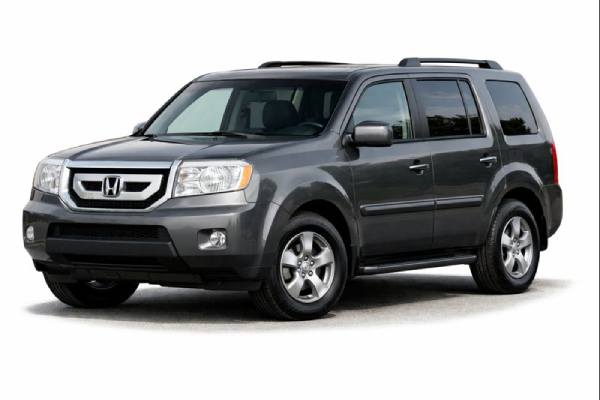
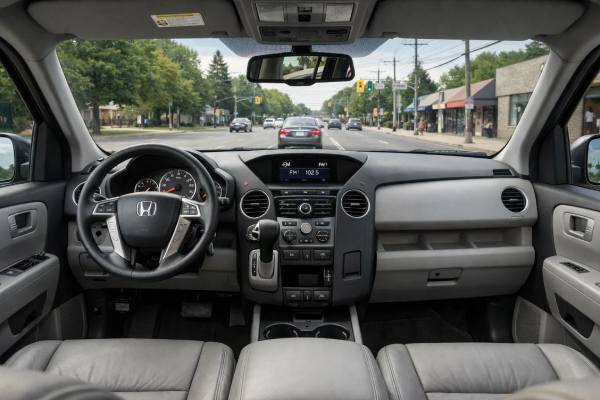
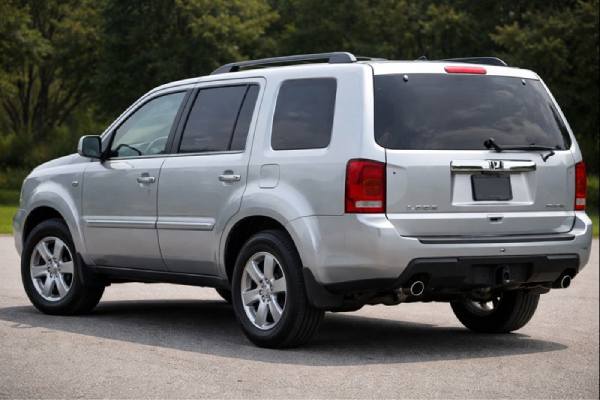
The 2009–2011 Honda Pilot AWD (often referred to as the YF4 AWD variant) is the “second-generation” Pilot formula at its most straightforward: a naturally aspirated 3.5-liter V6 (J35Z4) paired with a conventional 5-speed automatic and an on-demand all-wheel-drive system aimed at real family use. It is not a rock crawler, but it is built to handle wet roads, snow, steep driveways, and moderate towing with calm manners and predictable traction.
For owners today, the appeal is still clear: a roomy, square cargo area, three usable rows, simple mechanicals, and strong parts availability. The trade-off is also familiar: fuel economy is average at best, and long-term costs depend heavily on staying ahead of fluid services (especially ATF and rear differential fluid) and timing-belt maintenance.
Quick Specs and Notes
- Strong low-to-midrange pull for a 2-ton SUV, and stable manners when loaded or towing.
- Practical interior packaging with a boxy cargo area and useful third row for occasional adults.
- AWD adds confidence on slick surfaces, especially with good tires, without demanding driver input.
- Budget for timing belt and water pump service at ~170,000 km (105,000 mi) or 7 years, whichever comes first.
- Plan rear differential fluid service about every 48,000–80,000 km (30,000–50,000 mi) depending on use (towing, hills, snow).
Quick navigation
- Honda Pilot YF4 AWD: what it is
- Honda Pilot YF4 AWD specs that matter
- Honda Pilot YF4 AWD trims and safety gear
- Reliability hotspots and service actions
- Maintenance plan and smart buying tips
- Real-world driving and performance
- How it stacks up against rivals
Honda Pilot YF4 AWD: what it is
Think of the 2009–2011 Pilot AWD as Honda’s answer to a very specific family brief: maximize usable space in a mid-size SUV, keep the powertrain conventional, and make the AWD system “invisible” in everyday driving. It rides on a unibody platform (car-like structure rather than a body-on-frame truck), which is a big reason it feels stable on the highway and easy to place in town for its size.
The J35Z4 3.5-liter V6 is the centerpiece. In this era it delivers 250 hp with smooth, linear response and enough torque for highway merges even with a full cabin. Most owners experience it as a “quiet strength” engine: it doesn’t feel sporty, but it rarely feels strained unless you push hard at higher speeds or tow near the upper limit. The 5-speed automatic is also a key part of the Pilot’s character—simple, proven, and easy to service compared with more complex modern transmissions.
The AWD system in these Pilots is primarily on-demand: the vehicle behaves like a front-drive SUV most of the time, then sends torque rearward when slip is detected or when conditions call for it. The practical effect is this: you feel less wheelspin pulling away on wet pavement, you climb snowy inclines with fewer surprises, and you get more composure when towing on a slick boat ramp. It is not designed for deep mud ruts or repeated heavy off-road articulation, mainly due to ground clearance limits, tire selection, and cooling demands under sustained wheel slip.
Where the Pilot still shines is packaging. The cabin is wide, the roofline is tall, and the cargo area is squared off. Even by current standards, it holds bulky family items better than many “sportier” crossovers with sloped tailgates. If your use case is commuters plus weekend hauling—strollers, sports gear, flat-pack furniture, camping bins—this shape is a real advantage.
Ownership today is mostly about maintenance discipline. These Pilots can run to high mileage, but they are not tolerant of skipped fluids, overdue timing belts, or neglected cooling systems. A clean service history matters more than trim level.
Honda Pilot YF4 AWD specs that matter
Below are the core technical specs for the 2009–2011 Pilot AWD with the J35Z4 (250 hp). Depending on market and trim, you will see small differences in curb weight, wheel/tire sizing, and towing equipment, so treat the numbers as representative for the AWD configuration.
Powertrain and efficiency (J35Z4)
| Item | Spec |
|---|---|
| Code | J35Z4 |
| Engine layout and cylinders | V6, 6 cylinders, SOHC i-VTEC, 4 valves/cyl (24 valves total) |
| Bore × stroke | 89.0 × 93.0 mm (3.50 × 3.66 in) |
| Displacement | 3.5 L (3,471 cc) |
| Induction | Naturally aspirated (NA) |
| Fuel system | PFI / MPFI (port injection) |
| Compression ratio | ~10.5:1 (varies by market calibration) |
| Max power | 250 hp (186 kW) @ ~5,700 rpm |
| Max torque | ~347 Nm (256 lb-ft) @ ~4,800 rpm |
| Timing drive | Belt |
| Rated efficiency (typical AWD) | ~13.1 L/100 km combined (18 mpg US / ~21.6 mpg UK) |
| Real-world highway @ 120 km/h (75 mph) | ~11.5–12.8 L/100 km (varies with tires, load, wind, and temperature) |
| Aerodynamics | Cd (approx.) 0.37 / Frontal area (approx.) 2.9 m² |
Transmission and driveline
| Item | Spec |
|---|---|
| Transmission | 5-speed automatic (conventional torque-converter automatic) |
| Drive type | On-demand AWD |
| Differential | Front open; rear coupling/differential integrated with AWD control strategy |
Chassis and dimensions (typical AWD)
| Item | Spec |
|---|---|
| Suspension (front/rear) | MacPherson strut / multi-link |
| Steering | Electric power steering (rack-and-pinion) |
| Brakes | 4-wheel disc |
| Wheels/tires (common) | 245/65 R17 or 245/60 R18 (varies by trim) |
| Ground clearance | ~203 mm (8.0 in) |
| Length / width / height | ~4,850 / 1,995 / 1,840 mm (190.9 / 78.5 / 72.7 in) |
| Wheelbase | ~2,774 mm (109.2 in) |
| Turning circle (kerb-to-kerb) | ~11.8–12.0 m (~38.7–39.4 ft) |
| Kerb (curb) weight | ~2,040–2,090 kg (~4,500–4,610 lb) depending on trim |
| Fuel tank | ~79 L (20.9 US gal / 17.4 UK gal) |
| Cargo volume | Market/test-method dependent; typically strong “box volume” for class with seats folded |
Performance and capability (typical AWD)
| Item | Spec |
|---|---|
| 0–100 km/h (0–62 mph) | ~9.0–9.5 s (trim and conditions dependent) |
| Top speed | ~180 km/h (112 mph) (often limited) |
| Braking distance 100–0 km/h | ~40–43 m (tires and surface dependent) |
| Towing capacity | Commonly ~2,040 kg (4,500 lb) when properly equipped |
| Payload | Often ~550–650 kg (1,200–1,430 lb) depending on trim and GVWR |
Fluids and service capacities (typical)
| Item | Spec |
|---|---|
| Engine oil | 5W-20; API/ILSAC spec per market; capacity ~4.3 L (4.5 US qt) with filter |
| Coolant | Long-life OAT coolant (Honda Type 2 equivalent), 50/50; capacity ~8–9 L (system) |
| Transmission/ATF | Honda ATF (DW-1 backward-compatible with older specs); drain/fill often ~3.3–3.6 L |
| Rear differential | Honda AWD/VTM-4 type fluid (model-specific); ~1.1–1.5 L (service fill varies) |
| Brake fluid | DOT 3 (or DOT 4 where specified) |
| A/C refrigerant | R-134a; charge varies—verify under-hood label |
Safety and driver assistance (era-appropriate)
| Item | Spec |
|---|---|
| Core safety systems | ABS, brake assist, stability control, traction control, TPMS |
| Airbags | Front, front side, and full-length curtain airbags (config varies by market) |
| ADAS suite | No modern AEB/ACC/lane-keeping on most 2009–2011 trims (era-typical) |
Honda Pilot YF4 AWD trims and safety gear
For 2009–2011, Pilot trims differ more in comfort and convenience than in core mechanical hardware. The V6 and 5-speed automatic are broadly consistent, and AWD availability usually spans most trims. What changes the ownership experience is the wheel/tire package, seating configuration, and the presence of factory towing and family-use options (navigation, rear entertainment, power tailgate, etc.).
Trims and options you’ll commonly see
- Entry trims (often LX/“base”): Usually 17-inch wheels, cloth upholstery, and simpler audio. These are often the best value today if the vehicle has strong maintenance records, because replacement parts (tires, brakes, suspension) can be slightly cheaper.
- Mid trims (often EX): Adds practical family options—often upgraded audio, steering-wheel controls, and more convenience features that make daily use easier without adding complicated hardware.
- Upper trims (often EX-L / Touring): Leather, upgraded audio, available navigation, and in some markets a rear entertainment system. Many upper trims move to 18-inch wheels, which can improve steering response but may ride a bit firmer and cost more per tire.
How to identify quickly: wheel size is the easiest external clue (17 vs 18), while cabin cues include seat material, audio head unit, and the presence of rear-seat screens or a navigation display. For accuracy, use the door-jamb tire label (tire size and pressures) and the build plate/VIN decoding in your market.
Mechanical and functional differences that matter
- Tire and wheel package: This affects ride comfort, road noise, and braking feel more than most owners expect. A fresh set of quality tires can make a “tired” Pilot feel dramatically more secure in rain and snow.
- Towing equipment: Some vehicles have a factory receiver and wiring, others do not. A correctly installed tow package matters because it often includes cooling and electrical provisions that reduce stress when towing.
- Seating setup: Many are 8-passenger with a second-row bench, but some configurations (market/package dependent) swap to captain’s chairs, which can improve third-row access.
Safety ratings and real-world safety equipment
Because this generation predates modern camera-and-radar driver assistance, its safety story is mostly about structure, airbags, and stability control rather than automatic emergency braking.
- IIHS (Insurance Institute for Highway Safety): Ratings for this era typically include moderate overlap frontal, side impact, head restraints/seat design, and roof strength. For the 2011 model-year Pilot, you’ll see a mix of results—strong traditional crash performance areas with more mixed results in newer test formats.
- Braking and stability systems: Most are equipped with ABS and stability control (often called VSA in Honda terms). These systems help keep the vehicle composed when a driver makes a sudden steering input or brakes hard on uneven surfaces.
- Child-seat provisions: Look for LATCH/ISOFIX lower anchors in the second row and multiple tether anchors. In family use, tether anchors are often the difference between “installed” and “installed correctly.”
What “driver assistance” really means here
Expect basics: stability and traction control, plus (depending on trim) conveniences like parking sensors or a backup camera. After windshield replacement or major suspension work, there is generally less calibration complexity than on modern ADAS-heavy SUVs, which is a practical ownership advantage.
Reliability hotspots and service actions
A well-kept 2009–2011 Pilot AWD can be a long-term workhorse, but it has predictable weak points. The best way to think about reliability is not “good or bad,” but which systems need proactive care and what failures look like when they begin.
Common issues by prevalence and cost tier
Common (usually low to medium cost if caught early)
- AWD rear differential fluid breakdown
- Symptoms: groan, shudder, or binding feel in tight turns; sometimes more noticeable after a long drive.
- Likely cause: old or incorrect rear diff fluid, or missed service intervals.
- Remedy: correct fluid exchange (often multiple drain/fills if neglected), then keep a consistent interval.
- Automatic transmission “shift quality” decline with old ATF
- Symptoms: harsh 2–3 or 3–4 shifts, mild flare, shudder on light throttle.
- Likely cause: aged ATF, heat cycling, and varnish buildup.
- Remedy: drain/fill cycles with correct Honda fluid; address mounts if vibration persists.
- Engine mounts (especially if equipped with cylinder deactivation in your market)
- Symptoms: vibration at idle, thump on gear engagement, driveline harshness.
- Likely cause: worn hydraulic mounts; higher load cycles on active mounts.
- Remedy: replace failed mounts; confirm idle quality and tune health so mounts aren’t masking another issue.
Occasional (medium cost, often mileage-linked)
- Timing belt and water pump overdue
- Symptoms: usually none until it becomes urgent; sometimes coolant seepage at the pump.
- Risk: belt failure is high consequence on interference engines—treat the interval as non-negotiable.
- Remedy: belt, tensioner, idlers, and water pump as a complete service.
- Power steering leaks or noise
- Symptoms: whine when cold, seepage around pump or lines, heavy steering feel.
- Likely cause: aging seals, o-rings, or hoses.
- Remedy: replace seals/lines as needed; use correct fluid.
Rare but high-impact (high cost)
- Cooling system neglect leading to overheating
- Symptoms: temperature swings, coolant loss, heater performance changes.
- Likely cause: old coolant, radiator age, hoses, fan control issues.
- Remedy: pressure test, restore cooling efficiency, and avoid “stop-leak” shortcuts.
Recalls, TSBs, and extended coverage: how to handle them
This generation spans an era where many manufacturers issued safety campaigns for items like airbag inflators and other supplier-related components. Instead of relying on memory or paperwork from a previous owner:
- Run the VIN through an official recall database (and keep a screenshot or printout).
- Confirm completion with dealer service history if possible.
- Treat missing recall proof as a negotiation point, not a deal-breaker—unless the vehicle shows symptoms linked to an unresolved campaign.
Pre-purchase checks that prevent expensive surprises
- Evidence of timing belt service (dated invoice with mileage and parts list).
- Proof of ATF drain/fills (not just “flush” language) and rear diff fluid service.
- Tight-turn test in a parking lot for AWD binding or groaning.
- Underbody inspection for corrosion at subframes, brake lines, and rear suspension mounting points (especially in salt regions).
- Full scan for stored powertrain codes, then a long test drive to confirm no pending faults return.
Maintenance plan and smart buying tips
A Pilot AWD that feels “bulletproof” is usually just a Pilot that’s been maintained on schedule. The goal is to keep fluids fresh, rubber parts healthy, and known wear items from stacking up into a single expensive catch-up year.
Practical maintenance schedule (distance/time)
Use this as a conservative baseline. If you tow, do short trips, drive in mountains, or see frequent snow, stay on the shorter interval.
| Item | Interval (typical) | Notes |
|---|---|---|
| Engine oil and filter | 8,000–10,000 km (5,000–6,000 mi) or 6–12 months | Use correct viscosity; shorten interval for short trips |
| Engine air filter | 24,000–40,000 km (15,000–25,000 mi) | Check more often in dusty areas |
| Cabin air filter | 15,000–25,000 km (10,000–15,000 mi) | Easy comfort win; reduces HVAC strain |
| Coolant | 5 years / 100,000 km then every 3–5 years | Use proper long-life coolant and correct mix |
| Spark plugs | ~170,000 km (105,000 mi) | Often done with timing belt service for efficiency |
| Timing belt system | ~170,000 km (105,000 mi) or 7 years | Include water pump, tensioner, idlers |
| Serpentine belt and hoses | Inspect every oil service; replace as needed | Replace proactively if cracked or noisy |
| Automatic transmission fluid (ATF) | 40,000–60,000 km (25,000–40,000 mi) | Drain/fill, not “lifetime” |
| Rear differential fluid (AWD) | 48,000–80,000 km (30,000–50,000 mi) | Shorten for towing, hills, snow |
| Brake fluid | Every 2–3 years | Moisture control = pedal feel and ABS health |
| Brake pads/rotors | Inspect every 10,000–15,000 km | Heavy vehicle—rotor condition matters |
| Tire rotation | 8,000–10,000 km | Keeps AWD happy and road noise down |
| Alignment check | Annually or with new tires | Misalignment kills tires fast on this chassis |
| 12 V battery test | Annually after year 3 | Replace commonly every 4–6 years |
Fluids and specifications (decision-making level)
- Oil: 5W-20 is common for this era; use a quality oil meeting the correct API/ILSAC spec in your market.
- ATF: use the correct Honda-spec automatic transmission fluid. Mixing “universal” fluids often causes shift quality complaints.
- Rear differential fluid: use the specified AWD/differential fluid for this system—this is not an area to improvise.
- Coolant: long-life type, pre-mixed or properly mixed to 50/50.
Essential torque values (common critical fasteners)
Values can vary by year/market and component revision, so verify for your VIN when wrenching.
- Wheel lug nuts: ~108 Nm (80 lb-ft)
- Engine oil drain plug: ~39 Nm (29 lb-ft)
- Spark plugs (if serviced): ~18 Nm (13 lb-ft)
Buyer’s guide: what to seek (and what to avoid)
Seek
- Full records including timing belt service and consistent ATF/rear diff services.
- Smooth low-speed shifting and quiet AWD operation in tight turns.
- Cooling system health: stable temperatures, clean coolant, no sweet smell after a test drive.
Be cautious with
- “Runs great” listings with no timing belt proof.
- Shudder on light throttle, especially when warm (often ATF or mounts).
- AWD binding noises—sometimes it’s just fluid, but sometimes it signals neglect.
Long-term durability outlook
If you treat it like a system—fluids, belt service, and rust prevention—this Pilot is capable of long life. If you treat it like an appliance and skip intervals, it becomes an expensive “catch-up” SUV.
Real-world driving and performance
In daily use, the 2009–2011 Pilot AWD feels more “truck-solid” than many crossovers, but without the bouncy ride you might expect from older body-on-frame SUVs. The steering is light to moderate, the seating position is upright, and the vehicle’s squared-off shape makes it easier to judge in traffic than some rounded competitors.
Ride, handling, and NVH
- Ride quality: tuned for family comfort. It absorbs broken pavement well, especially on 17-inch wheels with taller tire sidewalls. On 18-inch packages, impacts are sharper and tire noise can rise.
- Body control: you feel the mass in quick transitions, but the chassis stays composed. It’s confident on long highway curves and stable under braking with a loaded cabin.
- Cabin noise: at city speeds it is typically quiet; at highway speeds, tire selection makes a big difference. An aggressive all-terrain tire can add a surprising amount of drone.
Powertrain character
The J35Z4 V6 delivers its best work in the midrange. Around-town throttle response is smooth rather than punchy, but the engine pulls strongly once you ask for more than half throttle. The 5-speed automatic is generally predictable, but it can “hunt” a bit on rolling hills—especially if you drive with a very light throttle. Many owners find that slightly firmer throttle input reduces unnecessary shifting.
If your specific vehicle is equipped with cylinder deactivation, pay attention to the transition feel. A healthy system is subtle. A poorly maintained one can contribute to vibration, mounts wearing early, or uneven plug deposits over long mileage.
Real-world economy (what to expect)
A realistic way to set expectations for AWD:
- City: ~14–16 L/100 km (roughly 15–17 mpg US) depending on traffic and warm-up time.
- Highway (100–120 km/h): ~11.5–12.8 L/100 km (roughly 18–20 mpg US).
- Mixed: ~13–14 L/100 km (roughly 17–19 mpg US).
Cold weather and short trips can easily add 10–20% consumption due to warm-up enrichment, winter fuel blends, and higher rolling resistance tires.
AWD traction and control
With good tires, the AWD system’s biggest benefit is how calm it feels when traction is uneven—wet leaves, slushy intersections, steep ramps. You won’t usually “feel” it working; you’ll just notice that the front tires spin less and the vehicle pulls away with less drama. For snow climates, tires matter more than AWD branding. A quality winter tire transforms the Pilot’s confidence.
Towing and load behavior
When properly equipped, this Pilot can be a solid tow vehicle for moderate loads (small campers, utility trailers, jet skis). The important pieces are:
- Cooling and fluids: towing is heat. Fresh ATF and healthy cooling capacity are non-negotiable.
- Brake condition: heavy SUVs hide brake fade until they don’t—inspect pads, rotors, and brake fluid condition before tow season.
- Stability: the Pilot’s wheelbase and weight help, but tongue weight setup and trailer brake hardware (where applicable) are what make it feel secure.
How it stacks up against rivals
The 2009–2011 Pilot AWD competes most naturally with family-focused crossovers and “soft-road” SUVs from the same period. Here’s how it tends to compare in the ways owners actually notice.
Versus Toyota Highlander (similar years)
Pilot advantages
- More square, usable cargo volume for bulky items.
- Often feels more “utilitarian” inside, which some families prefer for durability.
- Strong parts availability and straightforward service access in many shops.
Highlander advantages
- Often slightly better fuel economy depending on engine and configuration.
- Typically more car-like steering and ride tuning.
- Strong reputation for low-drama ownership when serviced consistently.
Who should choose the Pilot: families prioritizing space and a simple, strong V6 feel over maximizing mpg.
Versus Ford Explorer (late 2000s era)
Pilot advantages
- Unibody feel: generally more stable and comfortable for daily commuting.
- Often easier to live with in tight urban use due to visibility and packaging.
- Honda V6 smoothness and predictable power delivery.
Explorer advantages
- Depending on configuration, can feel more “truck-like” and may suit certain towing setups.
- Wider engine lineup in some markets, including options with different torque characteristics.
Who should choose the Pilot: drivers who want an all-around family SUV rather than a more traditional SUV driving feel.
Versus Nissan Pathfinder and Mazda CX-9
- Pathfinder: can offer a tougher image and, in some trims, stronger “SUV” vibes, but ownership experience depends heavily on the exact powertrain and service history.
- CX-9: often the driver’s choice for steering and road feel, but it can give up some of the Pilot’s boxy practicality and may run on different cost curves for parts and suspension wear.
The honest verdict
Choose the Pilot AWD if you want:
- A spacious, practical three-row cabin with a simple, proven V6/automatic pairing.
- Confident foul-weather traction with low driver workload.
- Ownership that rewards consistent maintenance more than brand-new tech.
Choose a rival if you want:
- Better fuel economy above all else.
- More modern driver assistance features (you’ll need a newer model year in most brands).
- A sportier driving feel or a smaller footprint.
References
- Gas Mileage of 2011 Honda Pilot 2026 (Fuel economy database)
- 2011 Honda Pilot 2026 (Safety Rating)
- Vehicle Detail Search – 2011 HONDA PILOT SUV AWD | NHTSA 2026 (Recall Database)
- Owner Resources 2026 (Owner’s resources)
Disclaimer
This article is for informational purposes only and is not a substitute for professional inspection, diagnosis, or repair. Specifications, torque values, service intervals, and procedures can vary by VIN, market, equipment, and prior repairs, so always verify details against the official documentation for your exact vehicle and follow qualified service guidance when needed.
If you found this guide helpful, please consider sharing it on Facebook, X (Twitter), or your favorite forum to support our work.