


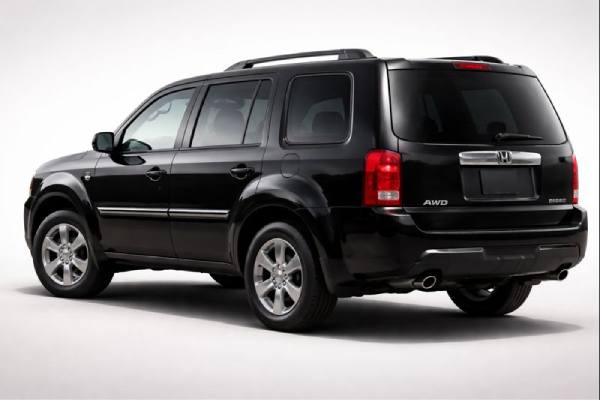
The 2012–2015 facelift Honda Pilot AWD (often labeled “4WD” in some markets) is a practical, family-focused three-row SUV built around a simple formula: a naturally aspirated 3.5-liter V6 (J35Z4), a conventional 5-speed automatic, and a torque-on-demand rear drive system. It is not a rock crawler, but it is one of the more confidence-inspiring choices in this era for slippery roads, steep driveways, and light towing.
Ownership typically comes down to two things. First, the powertrain is durable when it is maintained on schedule—especially the timing belt and driveline fluids. Second, the AWD hardware adds capability but also adds service needs (rear differential fluid, prop shaft wear points, and extra heat under load). If you shop carefully, verify recalls by VIN, and budget for age-related suspension and mount work, this Pilot can still be a long-lived, comfortable daily.
Quick Specs and Notes
- Strong low-end pull for a 3-row SUV, and the 5-speed automatic is generally predictable when serviced on time.
- AWD adds real foul-weather traction and helps stability when towing moderate loads.
- Budget for timing-belt service (belt, tensioner, and water pump) if history is unclear.
- Replace rear differential fluid about every 30,000–50,000 km (or sooner with towing/city use) to prevent chatter and wear.
- Typical engine-oil interval is 8,000–12,000 km or 6–12 months (follow the vehicle’s oil-life monitor if equipped).
Contents and shortcuts
- Honda Pilot AWD facelift in depth
- Honda Pilot AWD specs and capacities
- Honda Pilot AWD trims and safety tech
- Known faults, TSBs, and recall checks
- Maintenance routine and buying advice
- Real-world driving and efficiency
- How the Pilot AWD stacks up
Honda Pilot AWD facelift in depth
This facelift-era Pilot AWD sits in a sweet spot for buyers who want a traditional, low-drama three-row SUV. The design is truck-like in packaging (upright seating, generous glass, easy ingress) but it drives closer to a large crossover than a body-on-frame SUV. For 2012–2015, the headline is consistency: the J35Z4 3.5-liter V6 stays naturally aspirated and uncomplicated, and the 5-speed automatic avoids the “learning” behavior and gear-hunting some later multi-speed units can show.
Where the AWD model differs from the FWD version is in the driveline and the way you should think about upkeep. Honda’s system is primarily front-driven in normal cruising, then routes torque rearward when the fronts slip or when the system predicts the need (based on throttle, wheel-speed sensors, and steering angle). This is excellent for rain, snow, and gravel starts. It also improves composure when the cabin is full and the rear is loaded, because the rear axle can contribute traction instead of asking the front tires to do everything.
The flip side is that AWD adds wear points. You inherit a propeller shaft, a rear differential assembly, and extra seals and bearings. None of these are “bad,” but they are maintenance items in a way a simple FWD setup is not. In practical ownership terms, the Pilot AWD rewards drivers who treat driveline fluids like routine service—not “lifetime fill.” If you do that, the system is usually quiet and smooth for a long time.
In daily use, this Pilot’s strengths are comfort, space, and predictable behavior. It is not fast by modern standards, but 250 hp is enough for confident merging and passing—especially at mid-range speeds. The cabin design is also friendly to real families: usable second-row access, a third row that can handle smaller adults for shorter trips, and a cargo area that remains practical with the third row folded.
Honda Pilot AWD specs and capacities
Below are commonly referenced specifications for the 2012–2015 facelift Pilot AWD with the J35Z4 V6. Exact figures can vary by market, trim, wheel/tire package, towing equipment, and VIN-specific calibration.
Powertrain and efficiency
| Item | Specification |
|---|---|
| Code | J35Z4 |
| Engine layout and cylinders | V6, SOHC, 24 valves (4 valves/cyl) |
| Displacement | 3.5 L (3471 cc) |
| Bore × stroke | 89.0 × 93.0 mm (3.50 × 3.66 in) |
| Induction | Naturally aspirated |
| Fuel system | PGM-FI (port fuel injection) |
| Compression ratio | ~10.5:1 (varies by market calibration) |
| Max power | 250 hp (186 kW) @ ~5,700 rpm |
| Max torque | ~347 Nm (256 lb-ft) @ ~4,800 rpm |
| Timing drive | Belt |
| Rated efficiency (example, EPA) | 11.8 L/100 km (20 mpg US combined) for AWD/4WD |
| Real-world highway @ 120 km/h | Often ~10–12 L/100 km depending on tires, load, wind, and temperature |
Transmission and driveline
| Item | Specification |
|---|---|
| Transmission | 5-speed automatic |
| Drive type | AWD (often labeled 4WD) |
| Differential | Rear differential with torque-on-demand engagement (serviceable fluid) |
Chassis and dimensions (typical)
| Item | Specification |
|---|---|
| Suspension (front/rear) | Independent; front strut-type / rear multi-link |
| Steering | Rack-and-pinion, power-assisted |
| Brakes | 4-wheel discs (vented front), ABS |
| Wheels/tyres (popular) | 245/65 R17 or 245/60 R18 (varies by trim) |
| Ground clearance | ~200 mm (7.9 in), trim-dependent |
| Length / width / height | ~4,880 / 1,995 / 1,845 mm (192 / 78.5 / 72.6 in) |
| Wheelbase | ~2,775 mm (109.3 in) |
| Turning circle | ~11.8 m (38.7 ft), equipment-dependent |
| Kerb weight | Commonly ~2,050–2,150 kg (4,520–4,740 lb), trim-dependent |
| Fuel tank | ~79 L (20.9 US gal / 17.4 UK gal) |
| Cargo volume | Depends on measurement standard; typically strong for class with 3rd row folded |
Performance and capability (typical)
| Item | Specification |
|---|---|
| 0–100 km/h (0–62 mph) | ~8.5–9.5 s depending on trim and conditions |
| Top speed | ~175–190 km/h (109–118 mph), market dependent |
| Towing capacity (braked) | Often up to ~2,000 kg (4,400–4,500 lb) when properly equipped |
| Payload | Commonly ~450–650 kg (990–1,430 lb), trim-dependent |
Fluids and service capacities (decision-use values)
| System | Specification | Capacity (typical) |
|---|---|---|
| Engine oil | API/ILSAC gasoline spec; commonly 5W-20 (market dependent) | ~4.3–4.6 L (4.5–4.9 US qt) with filter |
| Coolant | Honda-type long-life coolant, 50/50 mix | ~8–9 L (8.5–9.5 US qt) |
| Transmission fluid | Honda ATF specification | Drain/fill often ~3 L (total larger) |
| Rear differential | Honda AWD/VTM-type fluid | ~1–1.2 L (1.1–1.3 US qt) |
| A/C refrigerant | R-134a | Varies by VIN/equipment |
Key torque specs (common reference)
| Fastener | Torque |
|---|---|
| Wheel lug nuts | ~108 Nm (80 lb-ft) |
| Engine oil drain plug | ~39 Nm (29 lb-ft) |
| Spark plugs | ~18 Nm (13 lb-ft) |
Honda Pilot AWD trims and safety tech
Trims vary by market, but most regions offered a ladder that starts with practical base models and climbs to leather, navigation, and rear entertainment. On this generation, “trim differences” are less about drivetrain hardware (AWD is broadly shared) and more about comfort, towing prep, and electronics. That is good news for long-term ownership: you can choose features without worrying that the “wrong” trim is hiding a unique mechanical system you cannot service later.
Trims and options: what matters mechanically
When comparing trims, focus on items that change operating cost or durability:
- Wheel and tire size: Larger wheels can sharpen steering response but may increase tire cost and road noise. They can also be more sensitive to alignment wear.
- Tow equipment: Some versions include a stronger cooling strategy, wiring provisions, or different final equipment ratings. For frequent towing, seek a vehicle with documented tow prep and a properly installed hitch and wiring.
- Rear entertainment and audio: Great for family trips, but verify all screens, remotes, and inputs work—repairs can be expensive and parts availability varies.
- Seat configurations: Some versions emphasize a second-row bench; others use captain’s chairs. This changes third-row access and child-seat practicality more than it changes mechanical reliability.
Quick identifiers while shopping:
- Check the build label and VIN decoding for drivetrain designation.
- Look for AWD system indicators on the cluster and any AWD-related warning lights during the key-on bulb check.
- Inspect the rear differential area for seepage and listen for low-speed groan/chatter on tight turns (a common clue of overdue fluid service).
Safety ratings: how to interpret them today
Safety outcomes depend on test type and year. For this generation, the key takeaway is that the structure can score well in traditional moderate-overlap and side impacts, but it performs poorly in the small-overlap front test used by one major US testing body. That does not mean the vehicle is “unsafe,” but it does mean newer designs improved significantly in this specific crash mode.
Use crash-test ratings the right way:
- Compare test types (small overlap vs moderate overlap vs side).
- Confirm whether the result is for the same generation (2009–2015 models share many structural elements).
- Treat ratings as one input—tires, braking condition, and driver behavior still matter.
Safety systems and driver assistance
Expect strong “core safety” equipment for the era:
- ABS and stability control (helpful in panic braking and slippery corners).
- Front, side, and curtain airbags (coverage varies by trim/market).
- Child-seat anchors across multiple seating positions (check for damaged covers and missing tether anchors).
What you generally should not expect in 2012–2015:
- Modern AEB (automatic emergency braking), lane centering, or adaptive cruise as common standard equipment. Some markets offered limited technology features, but the advanced ADAS suite seen in later models is typically absent.
After any windshield, steering, or suspension work, ensure the steering angle sensor and stability-control calibration are correct. A “pull,” a stability warning lamp, or unusual brake pulsing can be a clue that alignment or sensor calibration needs attention.
Known faults, TSBs, and recall checks
A well-kept Pilot AWD can be dependable, but this generation has predictable patterns that show up with mileage, age, and usage. Below is a practical map of what to watch for, organized by prevalence and cost impact.
Common (high likelihood)
- Timing belt overdue (high severity / high cost if ignored)
- Symptoms: no immediate symptoms until it’s too late; sometimes belt noise or oil contamination.
- Root cause: belt is a scheduled wear item on this V6.
- Remedy: replace belt, tensioner, idlers, and usually the water pump as a set. Treat missing documentation as “not done.”
- Rear differential fluid degradation (medium severity / low-to-medium cost)
- Symptoms: chatter, shudder, or groan during tight low-speed turns; occasional rear-end vibration.
- Root cause: old or incorrect fluid; heavy city driving, cold starts, and towing accelerate breakdown.
- Remedy: drain/refill with the correct Honda-spec fluid; repeat if contamination is heavy.
- Active engine mounts and general mount wear (medium severity / medium cost)
- Symptoms: vibration at idle in Drive, harshness on tip-in, thump on shifts.
- Root cause: aging hydraulic mounts, sometimes worsened by cylinder deactivation behavior.
- Remedy: diagnose mounts before chasing “misfire” parts; replace failed mounts with quality parts.
- Suspension bushings and ball joints (medium severity / medium cost)
- Symptoms: clunks over bumps, vague steering, uneven tire wear.
- Root cause: rubber bushing aging, potholes, and heavy curb weight.
- Remedy: replace worn control arm bushings/arms, stabilize alignment afterward.
Occasional (moderate likelihood)
- Propeller shaft vibration or bearing wear (medium-to-high severity / medium-to-high cost)
- Symptoms: vibration at steady speeds (often 50–100 km/h), sometimes worse in cold temperatures.
- Root cause: center support bearing/bushing wear, U-joint wear, or imbalance.
- Remedy: inspect shaft support and joints; replace shaft assembly or components as applicable; confirm tires are balanced first.
- Automatic transmission shift quality issues (medium severity / medium cost)
- Symptoms: flare, harsh 2–3 shift, torque converter shudder under light throttle.
- Root cause: old fluid, pressure switch faults, solenoid wear, or calibration sensitivities.
- Remedy: correct ATF, service intervals, diagnostic scan for codes, and update calibrations where applicable.
Rare (lower likelihood, but worth screening)
- Cooling system seepage (medium severity / medium cost)
- Symptoms: slow coolant loss, sweet smell, residue around radiator seams.
- Remedy: pressure test, repair leak points, and use proper coolant.
- Power steering leaks or pump noise (low-to-medium severity / medium cost)
- Symptoms: groan at full lock, fluid residue near pump or lines.
- Remedy: fix leaks early to avoid pump damage.
Recalls, TSBs, and extended coverage: how to handle them
For a 2012–2015 Pilot AWD, assume there may be multiple safety campaigns across its lifetime. The only reliable method is to verify by VIN using official databases and dealer records.
Do this on every candidate vehicle:
- Run an official VIN recall check and print/save the results.
- Ask for dealer documentation showing completion dates.
- If a recall is open, factor the inconvenience into price—but treat free safety remedies as a reason to walk away only if the seller refuses cooperation.
Also note that some drivability complaints (like steady-speed vibration) can have official service guidance. If you feel a vibration during a test drive, do not guess—request a scan for codes, confirm tire condition, and ask for any software updates related to drivability.
Maintenance routine and buying advice
This Pilot’s longevity is strongly tied to routine fluids and one big scheduled job: the timing belt. If you want a simple rule, follow this: treat the powertrain like it is “serviceable,” not “sealed,” and you will avoid many expensive surprises.
Practical maintenance schedule (distance/time)
Use this as a planning baseline; follow the vehicle’s maintenance monitor and local service documentation when available.
- Engine oil and filter: every 8,000–12,000 km or 6–12 months (short trips and cold weather push you shorter).
- Air filter (engine): inspect every 15,000–20,000 km; replace as needed.
- Cabin filter: every 15,000–20,000 km (more often in dusty cities).
- Spark plugs: typically around 160,000–170,000 km (or if misfire symptoms appear).
- Timing belt kit and water pump: around 168,000 km or 7 years is a common planning interval; earlier if oil contamination, noise, or unknown history.
- Coolant: long-life coolant, commonly 5 years/100,000 km then shorter intervals thereafter (verify by market).
- Automatic transmission fluid: drain/fill on a consistent cadence (often 40,000–60,000 km depending on use); towing and heavy city use should be more frequent.
- Rear differential fluid (AWD): about every 30,000–50,000 km; consider 25,000–30,000 km if towing, snow use, or frequent tight-turn parking.
- Brake fluid: every 2–3 years (moisture control matters for ABS performance).
- Brake inspection: every tire rotation; expect caliper slide service as the vehicle ages.
- Tire rotation and alignment check: rotate every 8,000–10,000 km; align annually or after suspension work.
- 12 V battery: test yearly after year 3; replace proactively around 4–6 years depending on climate.
“Must verify” items before purchase
Bring this checklist to every viewing:
- Timing belt proof: invoice with mileage and parts list (belt, tensioner, water pump). No proof = assume it needs service.
- AWD fluid history: rear diff service receipts are a strong sign of a careful owner.
- Transmission behavior: warm test drive, check for shudder under light throttle and for harsh shifts.
- Vibration screening: steady 60–100 km/h cruise, then light acceleration; feel for driveline vibration.
- Rust and corrosion hotspots: inspect rear subframe areas, brake lines, and underbody seams (especially in salt climates).
- Electronics and HVAC: confirm all windows, locks, tailgate, infotainment, rear climate controls, and (if equipped) rear entertainment.
- Tire match: AWD vehicles prefer matched tires with similar tread depth; mismatched tires can stress driveline components over time.
Long-term durability outlook
If you buy a clean example with documented belt service and you keep up with driveline fluids, this Pilot can be a “boring in a good way” SUV: comfortable, practical, and durable. The biggest ownership regrets usually come from neglected maintenance (belt, ATF, rear diff fluid) or from buying one with a persistent vibration and hoping it “goes away.”
Real-world driving and efficiency
On the road, the Pilot AWD feels like a roomy, stable family tool rather than a sporty crossover. The steering is tuned for low effort, the suspension is set up to absorb broken pavement, and the cabin is generally quiet at city speeds. At highway speeds, wind noise is present but not intrusive for the class and era, and the vehicle tracks straight without constant small corrections.
Powertrain character
The J35Z4 V6 delivers smooth, linear power. It is at its best in mid-range passing—rolling acceleration from 60–100 km/h feels confident, especially with only moderate throttle. The 5-speed automatic is not quick by modern multi-gear standards, but its shift logic is usually easy to predict. Kickdown can be deliberate, so plan passing moves with a little extra margin when the vehicle is fully loaded.
AWD engagement is generally seamless in normal driving. Where you notice it most is when traction is limited:
- Wet roundabouts and steep wet ramps feel more controlled.
- Snowy starts require less traction management from the driver.
- On loose gravel, the rear axle support reduces front tire spin.
Ride, handling, and NVH (noise, vibration, harshness)
- Ride: comfortable, slightly soft, well suited to long trips and rough roads.
- Handling: stable and secure, but not eager; the vehicle prefers smooth inputs.
- Braking feel: consistent when the brakes are in good condition; warped rotors or sticky calipers can create steering shake under braking, so inspect carefully.
- Typical noise: tire choice matters. Aggressive all-season or off-road-leaning tires can add a noticeable hum.
Real-world efficiency
Fuel economy depends heavily on speed, tires, temperature, and short-trip use. As a planning baseline for the AWD/4WD version:
- Mixed driving: often lands around 11–13 L/100 km (18–21 mpg US).
- Highway at 100–120 km/h: often around 10–12 L/100 km (20–24 mpg US), with headwinds and roof boxes pushing higher.
- Cold weather and short trips: can push well above 13 L/100 km (below 18 mpg US).
Two practical ownership tips help efficiency more than people expect:
- Keep tires at the correct pressure and align the vehicle when tire wear begins.
- Service driveline fluids on schedule—drag and heat can rise when fluids are degraded.
Load and towing notes
The Pilot AWD can tow moderate loads confidently when properly equipped, but you should treat it like a heat-managed system:
- Use the correct towing setup (hitch rating, wiring, and brake controller where needed).
- Expect a meaningful consumption penalty under tow—often 20–40% depending on trailer shape and speed.
- On long grades, watch temperatures and avoid wide-open throttle for extended periods; smooth, steady power is kinder to the transmission.
How the Pilot AWD stacks up
To judge this 2012–2015 Pilot AWD fairly, compare it to other three-row crossovers from the same era. Most rivals offer similar space and similar “family SUV” priorities, but they differ in how they age and what they cost to keep right.
Where the Pilot AWD stands out
- Simple, proven powertrain layout: a naturally aspirated V6 and a conventional automatic can be easier to own long term than early direct-injection systems or more complex transmissions.
- Practical packaging: easy visibility, usable third row for its class, and a cargo area that remains functional for real errands.
- AWD that’s genuinely useful: it is not a marketing-only system; it helps in real low-traction situations and with load stability.
Where rivals can be stronger
- Safety evolution: some competitors (and newer generations) improved structural performance in small-overlap tests and added modern crash-avoidance tech earlier.
- Fuel economy: smaller-displacement engines or newer transmissions in some competitors can reduce fuel use, especially in mixed driving.
- Driving feel: certain rivals steer and brake with more “modern crossover” sharpness, though that is taste-dependent.
Quick rival-by-rival guidance (typical shopping logic)
- Toyota Highlander (same era): often a benchmark for overall ease-of-ownership, though pricing can be higher.
- Ford Explorer (same era): can offer strong power and features, but inspect transmission behavior carefully.
- Nissan Pathfinder (same era): roomy and comfortable; evaluate transmission type and service history carefully depending on year and configuration.
- Subaru Ascent (newer, not same era): more modern safety tech and AWD philosophy, but not a direct price/age match unless you move to newer model years.
- Kia Sorento (varies by year): can be a value play, but compare third-row space and towing expectations carefully.
The bottom line
Choose the Pilot AWD if you value space, comfort, and a straightforward V6 drivetrain—and you are willing to maintain it like a mechanical system, not an appliance. If your priority is the newest safety tech or best-in-class fuel economy, it can be worth moving to a newer generation. But if your goal is a capable, family-friendly SUV that can still age gracefully with the right upkeep, this facelift Pilot AWD remains a strong contender.
References
- 2015 Honda Pilot 4-door SUV 2015 (Safety Rating)
- Gas Mileage of 2015 Honda Pilot 2015 (Official Fuel Economy Data)
- Check for Recalls: Vehicle, Car Seat, Tire, Equipment | NHTSA 2026 (Recall Database)
- Vehicle Detail Search – 2015 HONDA PILOT SUV AWD | NHTSA 2015 (Vehicle Database)
- 15 Pilot_Lx-Ex-SE-Exl-ExlRes_KA_English_TRG_AQS51289_ATG_NEW STYLE 2014 (Service Manual / Technology Guide)
Disclaimer
This article is for informational purposes only and is not a substitute for professional inspection, diagnosis, or repair. Specifications, torque values, service intervals, and procedures can vary by VIN, market, model year, and equipment; always confirm details using official Honda service information and the documentation specific to your vehicle.
If you found this guide useful, please consider sharing it on Facebook, X (Twitter), or your favorite forum to help others find reliable ownership information.