
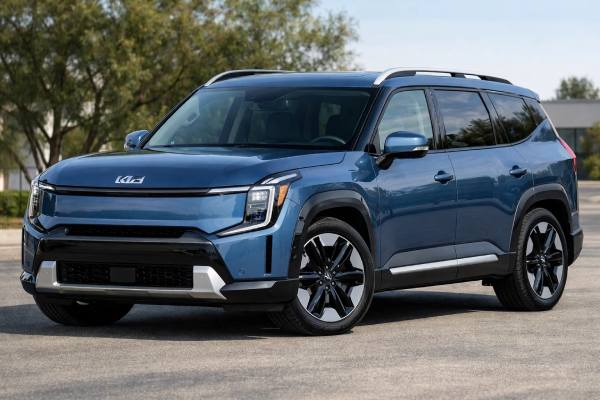
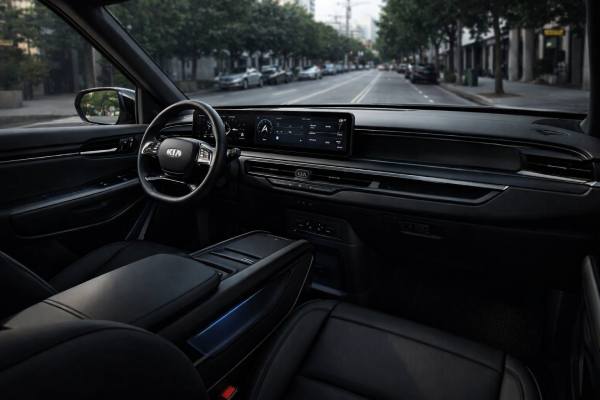
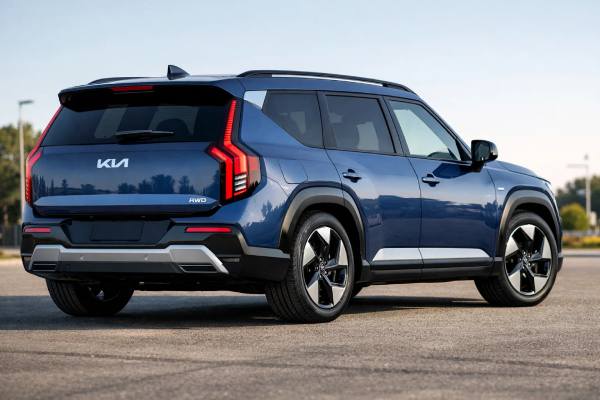
The Kia EV9 GT-Line AWD (MV) is the “everything switched on” version of Kia’s three-row electric SUV: dual motors, the big 99.8 kWh pack, and the most feature-rich cabin and driver assistance set. What makes it interesting is not just power, but how the platform manages it—strong thermal control, fast DC charging capability, and a chassis tuned to hide a lot of mass while keeping long-trip comfort intact. Ownership is also different from a large ICE SUV: fewer routine fluids, more attention to tires, brakes (because of heavy regen use), and software updates that can change charging and ADAS behavior over time. If you want an EV9 that feels premium and quick without stepping into full luxury pricing, the GT-Line AWD is the EV9’s sweet spot—so long as you understand its efficiency trade-offs on big wheels.
What to Know
- Strong dual-motor shove and confident highway passing, especially with loaded seats and cargo.
- Fast long-trip charging behavior is a genuine advantage for a three-row EV when the battery is warm.
- Rich standard equipment and top-tier lighting/ADAS availability reduce “must-have” options.
- Expect higher tire cost and faster wear than smaller-wheel EV9 trims, especially with 21-inch packages.
- Rotate tires about every 12,000 km (7,500 mi) to keep wear even and road noise down.
Section overview
- Kia EV9 GT-Line AWD essentials
- Kia EV9 GT-Line AWD specs
- Kia EV9 GT-Line AWD trims and ADAS
- Reliability and known fixes
- Maintenance plan and buying checklist
- Real driving range and charging
- EV9 GT-Line AWD vs competitors
Kia EV9 GT-Line AWD essentials
Think of the EV9 GT-Line AWD as a large, family-first EV built around two priorities: predictable range planning and stress-free charging. The dual-motor layout gives the EV9 a planted, “always ready” feel in traffic and on wet highways—useful in a tall SUV that often carries people, luggage, or both. Kia pairs that with a large battery that supports repeated long stints without forcing you into short, frequent stops. In practice, the EV9’s biggest ownership win is how it reduces friction: a big cabin, easy step-in height, usable third row, and a charging system that can take a lot of power when conditions are right.
The GT-Line’s engineering story is also about trade-offs. It typically runs larger wheels and wider tires, which improve lateral grip and steering response but increase energy use and tire wear. The mass is real, and you will feel it most in braking distances and tire costs—areas where smart maintenance matters. Another key point is software: battery management, charging behavior, and driver assistance features are heavily software-driven, so updates can meaningfully change how the vehicle feels over time.
If you’re shopping this variant specifically, focus on three things early: (1) wheel and tire package, because it affects range and ride; (2) heat-pump presence in your market/trim, because it helps winter range; and (3) charging hardware compatibility in your region (connector standard and network access). Get those aligned with your use case, and the EV9 GT-Line AWD becomes one of the more convincing “one car does it all” EVs in the three-row space.
Kia EV9 GT-Line AWD specs
Powertrain, Battery, and Efficiency
| Spec | Value |
|---|---|
| Motor type | Permanent-magnet synchronous motors (PMSM) |
| Motor count and axle | Dual-motor (front and rear) |
| Max power | 379 hp (283 kW) |
| Max torque | 700 Nm (516 lb-ft) |
| Traction battery (gross) | 99.8 kWh |
| Traction battery (usable) | 96.0 kWh |
| Battery chemistry | NMC lithium-ion |
| Battery nominal voltage | 552 V |
| Pack configuration | 152s3p |
| Thermal management | Liquid-cooled battery and power electronics |
| Heat pump | Available |
| Efficiency / test standard | EPA |
| Rated range (EPA) | 435 km (270 mi) |
Driveline and Charging
| Spec | Value |
|---|---|
| Transmission / drive unit | Single-speed reduction gear (front and rear e-axles) |
| Drive type | AWD (dual e-axle) |
| Charging connector (AC) | Type 2 (EU/UK) |
| Charging connector (DC) | CCS2 (EU/UK) |
| Charging port location | Rear-right (EU/UK configuration) |
| Onboard charger (AC) | 11 kW |
| DC fast-charge peak (charger rated) | 350 kW |
| Replenishment time (DC 10–80%) | 24 min |
| Battery preconditioning for DC charging | Available |
Performance and Capability
| Spec | Value |
|---|---|
| Acceleration 0–100 km/h (0–62 mph) | 5.3 s |
| Top speed | 200 km/h (124 mph) |
| Towing capacity (braked) | 2,500 kg (5,512 lb) |
| Towing capacity (unbraked) | 750 kg (1,653 lb) |
Chassis and Dimensions
| Spec | Value |
|---|---|
| Length | 5,015 mm (197.4 in) |
| Width | 1,980 mm (78.0 in) |
| Width with mirrors | 2,263 mm (89.1 in) |
| Height | 1,780 mm (70.1 in) |
| Wheelbase | 3,100 mm (122.0 in) |
| Kerb weight | 2,648 kg (5,837 lb) |
| GVWR | 3,190 kg (7,033 lb) |
| Payload | 617 kg (1,361 lb) |
| Cargo volume (seats up) | 333 L (11.8 ft³) |
| Cargo volume (max) | 2,393 L (84.5 ft³) |
| Frunk volume | 52 L (1.8 ft³) |
Safety and Driver Assistance Ratings
| Spec | Value |
|---|---|
| Euro NCAP (publication) | 5 stars (Dec 2023) |
| Euro NCAP adult occupant | 84% |
| Euro NCAP child occupant | 88% |
| Euro NCAP vulnerable road users | 76% |
| Euro NCAP safety assist | 83% |
| IIHS award | Top Safety Pick (2024; applies to vehicles built after Jan 2024) |
Kia EV9 GT-Line AWD trims and ADAS
“GT-Line AWD” usually sits at the top of the non-GT EV9 range and bundles equipment that can be optional or package-based on lower trims. That matters because the EV9’s comfort and safety tech can be very configuration-sensitive: wheel size changes ride and efficiency, seat count changes interior practicality, and some driver assistance features can vary by year and build date.
Trims and options (what typically separates GT-Line AWD):
- Dual-motor AWD as standard on GT-Line variants in most markets, with stronger passing response and improved low-grip traction versus RWD EV9 trims.
- Wheel and tire packages often skew larger (commonly 21-inch in many configurations). Larger wheels sharpen response, but they also:
- increase energy use at highway speed,
- raise replacement tire costs,
- and can add more impact harshness over broken pavement.
- Seating configurations frequently include a 6-seat (second-row captain’s chairs) or 7-seat layout depending on market. For family use, the 7-seat layout is better for flexibility; the 6-seat setup usually feels more upscale and improves third-row access.
- Infotainment and audio tiers are typically highest on GT-Line. In practice, you’re paying for reduced “option anxiety”: fewer compromises, fewer missing features, and better resale clarity.
- Convenience tech (like advanced parking features) is more likely to be standard at this level, which can reduce daily stress if you often park a big three-row SUV in tight spaces.
Safety ratings (how to read them for this model):
- Euro NCAP tested the EV9 as a vehicle line and awarded 5 stars with strong adult and child scores. That’s a good sign for structure, restraint tuning, and standard active safety.
- IIHS recognition is build-date sensitive for some vehicles; for the EV9, award applicability can depend on production timing. When you shop used, confirm build date and exact headlight/ADAS configuration if you’re buying specifically for the award criteria.
Safety systems and ADAS (what to expect, and how it can change):
- Multiple airbags across rows, plus strong child-seat usability (ISOFIX/LATCH provisions typically on outboard second-row positions; confirm third-row provisions in your market).
- Core ADAS functions you should expect on this class of Kia include:
- Automatic emergency braking (vehicle, pedestrian; cyclist coverage depends on market and software version),
- Adaptive cruise control with lane centering support,
- Blind-spot monitoring and rear cross-traffic alert,
- Driver attention monitoring and speed-limit assistance features.
- Calibration implications: windshield replacement, camera alignment, wheel alignment changes, and bumper repairs can require ADAS recalibration. If the vehicle has had front-end repairs, make sure the shop documented calibration results—especially if you rely on lane centering and adaptive cruise.
The practical takeaway: GT-Line AWD buyers usually benefit from a “most features are standard” build, but you still want to decode wheel size, seating layout, and build date. Those three details explain most of the real-world differences you’ll feel.
Reliability and known fixes
The EV9 is still a newer platform in most markets, so reliability is best understood as patterns: what tends to show up early, what is usually software-resolved, and what could become expensive if ignored. For the GT-Line AWD specifically, higher curb weight and larger wheels make the chassis and tire-related items more relevant than on lighter EVs.
Common (more frequent) issues
- 12 V battery weakness or parasitic drain symptoms
- Symptoms: intermittent “low 12V” warnings, slow wake-up, random infotainment resets, failure to start the high-voltage system.
- Likely root cause: high accessory load, software wake events, or a marginal 12 V battery.
- Remedy: battery test with conductance/CCA tool, confirm DC–DC charging behavior, update vehicle software, replace 12 V battery if it fails load tests.
- Charging session errors or slow DC charging (not temperature-ready)
- Symptoms: charging power ramps slowly, early taper, repeated start/stop sessions.
- Likely root cause: battery temperature not in the optimal window, station limits, or charging communication faults.
- Remedy: use navigation-based preconditioning where available, try a known-good high-power site, apply charging/BMS updates if campaigns exist.
Occasional (seen but not universal)
- Charge-port door and latch alignment issues
- Symptoms: port door doesn’t close cleanly, latch feels inconsistent, water seal concerns after winter grime.
- Root cause: alignment or contamination.
- Remedy: adjust latch/door alignment, inspect seals, keep the port area clean, replace damaged seals to prevent moisture ingress.
- Brake noise or corrosion due to heavy regen use
- Symptoms: grinding after rain, squeal at low speeds, rough first stop of the day.
- Root cause: friction brakes don’t get used hard enough to self-clean; surface rust builds.
- Remedy: periodic firm braking to clean rotors, brake service if corrosion is advanced, and ensure slide pins move freely.
Rare (lower frequency, higher consequence)
- HV isolation faults or moisture-related connector issues
- Symptoms: “Check EV system” warnings, reduced power, refusal to charge.
- Root cause: moisture intrusion at a connector, damaged seals, or a component developing leakage current.
- Remedy: dealer-level insulation resistance testing, targeted connector repair or component replacement, verify proper sealing and harness routing.
Software and calibrations (why updates matter more in EVs)
- EV behavior is deeply controlled by software: battery conditioning, charge curve management, regen blending, and ADAS decision-making. If an EV9 feels “off” (charging slower than expected, odd warnings, inconsistent ADAS), treat software status as a first diagnostic step, not a last resort.
Recalls, TSBs, and extended coverage (how to stay safe)
- Verify recall and service-action completion by:
- running an official VIN recall check in your region, and
- confirming dealer service history shows closure codes for campaigns.
- For used purchases, ask specifically for documentation related to charging system updates, ADAS camera calibrations after windshield work, and any 12 V system service.
A balanced outlook: most reported pain points in modern EVs tend to be “systems integration” issues (software, sensors, charging compatibility) rather than internal engine wear. Your best reliability tool is disciplined record-keeping and making sure updates and campaigns are actually completed.
Maintenance plan and buying checklist
EV maintenance is simpler than a combustion SUV, but the EV9 GT-Line AWD is heavy, powerful, and often on big wheels—so the wear items that remain (tires, brakes, suspension joints) deserve a more structured approach.
Practical maintenance schedule (normal use)
- Every 12,000 km (7,500 mi) or 12 months
- Tire rotation (critical on AWD and large wheel packages)
- Brake inspection (pad thickness, rotor condition, caliper slide movement)
- Suspension and steering inspection (bushings, ball joints, tie rods)
- Visual inspection of charge port seals and underbody covers
- Every 24,000 km (15,000 mi) or 24 months
- Cabin air filter replacement (so HVAC stays efficient and quiet)
- Alignment check (especially if tire shoulders show wear or steering feels off-center)
- 12 V battery test (capacity and load performance)
- Every 48,000 km (30,000 mi) or 48 months
- Brake fluid inspection and service as required by your official schedule (EVs still absorb moisture)
- Cooling system inspection (hoses, radiators, and signs of seepage)
- At 5–7 years (or earlier if weak)
- 12 V battery replacement window (many owners replace preventively, especially in cold climates)
Severe-use adjustments
If you do frequent DC fast charging, tow, drive in extreme heat/cold, or run sustained high speeds:
- shorten tire rotation intervals (for example every 8,000–10,000 km),
- increase brake cleaning frequency (intentional friction braking events),
- and pay more attention to cooling performance (fan behavior and radiator cleanliness).
Fluid specifications, capacities, and torque values
Because these vary by market and service documentation, the safest owner approach is:
- confirm the official Kia service manual/repair data for your VIN before any drivetrain fluid service,
- and avoid generic EV coolant substitutions or “universal” gear oil assumptions.
For decision-making, focus on what’s owner-actionable: use correct brake fluid spec stated for your market, keep the charge-port seals intact, and torque wheel fasteners to the specified value in your manual for the EV9.
Buyer’s guide (used EV9 GT-Line AWD)
- Traction battery health
- Request a battery state-of-health (SOH) report if your market supports it.
- Road test: check predicted range consistency at a known state-of-charge (SOC), then compare to your typical driving profile rather than chasing the absolute highest number.
- Fast-charge behavior: if possible, observe a DC session from ~15–60% SOC. Healthy systems usually ramp quickly when warm and taper smoothly.
- Charging hardware
- Inspect charge port pins, latch function, and door sealing.
- Confirm the included cables/adapters match your home setup and local networks.
- Thermal management
- Verify heat pump operation (if equipped) and check for HVAC performance in both heating and cooling.
- Listen for noisy fans or signs of blocked radiators if the car lived in dusty/salty climates.
- Chassis and body
- Underbody inspection is more important than on many cars because the battery pack sits low. Look for damaged covers, scraped pack guards, and corrosion on fasteners.
- Evaluate tire wear patterns—uneven wear can signal alignment, bushing wear, or prior curb impacts.
- Electronics and ADAS
- Confirm all cameras and sensors behave normally; a persistent warning light can mean expensive calibration work.
- Ask about OTA/software update history and any dealer-performed reflashes.
- Trims to seek or avoid
- Seek: heat pump (cold climates), smaller wheel setups if range is priority, documented campaign completion.
- Be cautious: heavily curbed 21-inch wheels (often signals suspension knocks), repeated fast-charge-only history without evidence of careful use (not always bad, but worth checking charge behavior and SOH).
Long-term durability outlook: the battery and drive units should age well when thermal management is healthy and software is current. The most likely “big ticket” ownership costs are tires, wheel repairs, and post-accident ADAS calibration—not engine-like mechanical failure.
Real driving range and charging
The EV9 GT-Line AWD’s real-world experience is shaped by two variables you can actually control: speed and wheel/tire choice. With dual motors and a large frontal area, efficiency falls faster with speed than it does in smaller, lower EVs. In city use, the EV9 can be surprisingly reasonable because regenerative braking recovers energy and the powertrain doesn’t idle. On highways, aerodynamic drag dominates, and the GT-Line’s larger tires can further raise consumption.
Ride, handling, and NVH (noise, vibration, harshness)
- Ride comfort: The long wheelbase helps the EV9 settle over expansion joints, but big wheels can add sharpness over pothole edges. If your roads are rough, a smaller wheel package typically pays dividends in comfort.
- Handling balance: The low-mounted battery keeps body roll in check for a tall SUV. You won’t mistake it for a sporty crossover, but it tracks cleanly and feels stable at speed.
- Steering and braking feel: Steering is typically light-to-moderate and tuned for confidence more than feedback. Braking can feel different depending on regen level: the best setups blend regen and friction smoothly, but you may still notice a handoff during very low-speed stops until you adapt.
Powertrain character and regen
- The dual-motor system delivers immediate response, especially in the mid-range where passing happens. It feels less strained than many three-row vehicles because torque is instant.
- Regenerative braking control is a daily quality-of-life feature. If you prefer one-pedal driving, spend time dialing in the regen level that matches your commute; it reduces brake wear and makes the big EV9 feel easier to place in traffic.
Real-world efficiency and range (what owners typically see)
- City: lower energy use than you’d expect for the size, especially with smooth driving and strong regen.
- Highway (100–120 km/h): the EV9’s range advantage shrinks compared with its EPA number. HVAC use and headwinds matter more than most people anticipate in a tall EV.
- Cold weather: expect a noticeable hit when temperatures drop and the cabin heater works harder. A heat pump helps, but it doesn’t erase physics—preheating while plugged in is your best winter trick.
Charging performance (everyday reality)
- Home AC charging: With an 11 kW onboard charger (where supported), overnight charging is straightforward. For many owners, “start every day at 70–90%” is the simplest strategy for battery-friendly routine use.
- DC fast charging: The EV9’s long-trip advantage is that it can take high power when the pack is warm and the charger can deliver. Best practice is to arrive at a fast charger with a low-to-mid SOC (often ~10–25%) to maximize time spent in the fastest part of the curve.
- Preconditioning: When available, using navigation to a DC station is one of the easiest ways to make charging consistent. Without it, winter charging can feel unexpectedly slow.
Towing and load
With the EV9’s mass and power, towing is feasible, but range will drop materially. If towing is a frequent use case, plan stops earlier than you think you need to, keep speeds moderate, and pay extra attention to tire pressures and brake condition.
EV9 GT-Line AWD vs competitors
The EV9 GT-Line AWD competes in a unique slice of the market: three rows, real adult space, and EV charging speed meant for road trips. Most rivals force a compromise—either smaller third rows, slower charging, or a higher price.
Where the EV9 GT-Line AWD tends to win
- Charging confidence for a family-sized EV: A three-row EV only feels liberating when charging stops are short and predictable. The EV9’s DC capability and battery conditioning features (when equipped and properly used) make it better suited to long trips than many similarly sized EVs.
- Cabin packaging: The EV9’s boxy shape is an advantage for real passengers. Adults fit in the third row more comfortably than in many “three-row” crossovers that are effectively 2+2+2 for short trips only.
- Feature density: GT-Line buyers often get high-end lighting, parking assistance, and driver assistance tech without stacking expensive packages.
Where rivals can be stronger
- Efficiency at speed: Some sleeker two-row EVs (and a few less upright three-row designs) will beat the EV9 on highway consumption. If you do mostly fast highway driving, you may prefer a more aerodynamic alternative even if it gives up interior space.
- Luxury refinement: Premium brands can deliver quieter cabins, more isolated suspensions, and more “polished” control tuning—usually at significantly higher purchase and repair costs.
- Handling sharpness: Lower, lighter EVs will feel more agile. The EV9 can be composed, but it can’t escape its size.
Key comparisons (shopping logic rather than badge battles)
- If you need true three-row comfort and want fast charging: the EV9 GT-Line AWD is among the most rounded choices.
- If you need maximum range per kWh and rarely use row three: a two-row EV with smaller wheels will feel cheaper to run.
- If you prioritize premium cabin isolation above all else: consider luxury three-row EVs, but expect higher tire, brake, and suspension costs—and sometimes more expensive out-of-warranty electronics.
Bottom line
The EV9 GT-Line AWD makes the strongest case for buyers who actually use the space: families, road-trippers, and people who carry adults in the back. Its main penalty is efficiency and wear cost from weight and wheel size. If you accept that and maintain it like a heavy performance-capable EV (tires, brakes, alignment, and software), it delivers an unusually complete ownership experience for the segment.
References
- 2026 Kia EV9: Long-Range, Fast-Charging, Available AWD, 3-Row Electric SUV | MSRP & Features | Kia 2026 (Manufacturer Specs)
- Kia EV9 2023 (Safety Rating)
- 2024 Kia EV9 4-door SUV 2024 (Safety Rating)
- The All-New, All-Electric 2024 Kia EV9 2024 (Manufacturer Overview)
- Kia EV9 99.8 kWh AWD GT-Line 2023 (Technical Data)
Disclaimer
This article is for informational purposes only and is not a substitute for professional diagnosis, inspection, or repair. Specifications, torque values, service intervals, and procedures can vary by VIN, market, model year, and equipment; always verify details using your official Kia owner’s literature and service documentation for your exact vehicle.
If you found this guide helpful, please consider sharing it on Facebook, X (Twitter), or your favorite forum to support our work.