
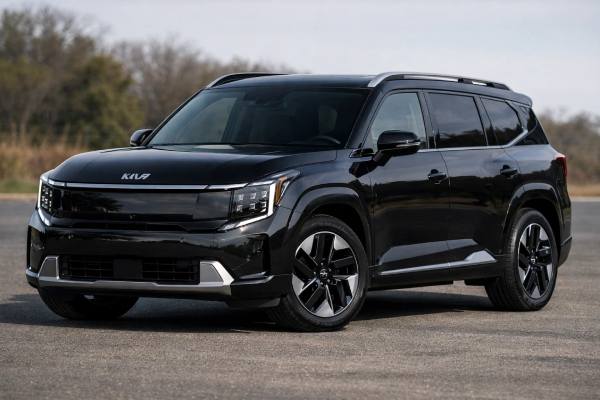
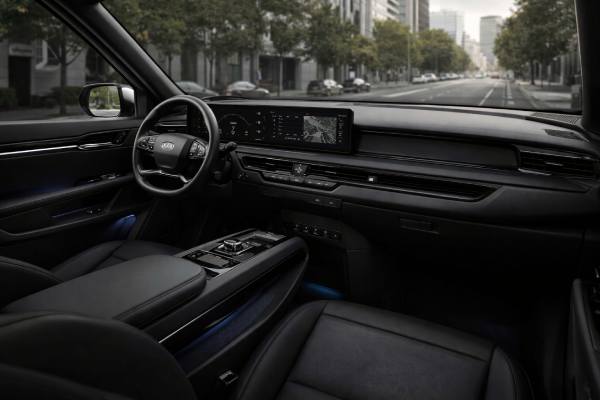
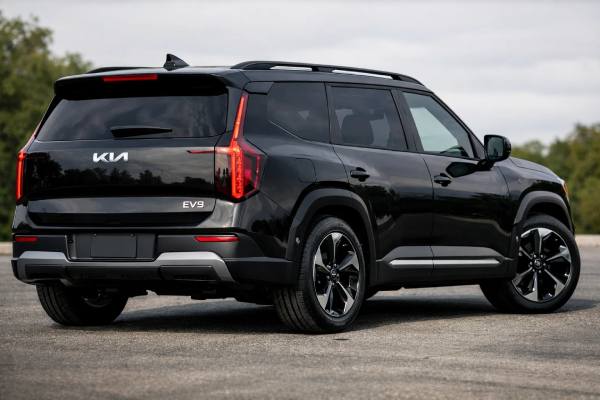
Kia’s EV9 GT is the “full-fat” version of the brand’s three-row electric SUV: dual-motor AWD, big-battery E-GMP hardware, and a chassis tuned to feel more controlled at speed than the family-focused trims. The engineering story is about managing mass well—battery low in the floor, stiff structure, and software that blends torque delivery, stability control, and regenerative braking so the car stays calm even when you use its performance. Ownership, meanwhile, comes down to charging behavior and heat management. The EV9 GT can take fast DC power when conditions are right, but you still benefit from smart battery preconditioning and a realistic approach to winter range. If you want a large EV that feels modern, quiet, and quick—without giving up everyday practicality—this is the EV9 variant built to satisfy both driver and family needs.
Top Highlights
- Dual-motor AWD with 502 hp delivers strong acceleration for a three-row SUV, with confident high-speed stability.
- 99.8 kWh battery supports long-distance use when you plan charging stops and precondition for fast DC sessions.
- Quick DC charging can be very competitive when the battery is warm and the charger can deliver high power.
- Expect higher tire and brake costs than lower trims because of performance focus and 21-inch wheel fitment.
- Rotate tires about every 10,000–12,000 km (or sooner if wear is uneven) to protect range and handling feel.
Quick navigation
- Kia EV9 GT AWD: what it is
- Kia EV9 GT AWD specs
- Kia EV9 GT AWD equipment and safety tech
- Reliability and known problems
- Maintenance and buying smart
- On-road performance and real range
- EV9 GT vs rivals
Kia EV9 GT AWD: what it is
The EV9 GT sits at the top of the EV9 lineup as the performance-led, dual-motor all-wheel-drive flagship. You still get the core EV9 fundamentals—three-row packaging, a flat floor, and the long wheelbase that gives it real adult-friendly space—but the GT’s mission is different: it is tuned to feel more immediate, more tied down, and more confident when driven briskly.
At the hardware level, the big headline is the dual-motor AWD layout paired with the 99.8 kWh battery pack. That combination gives the EV9 GT the kind of acceleration you normally associate with smaller performance EVs, not a large family SUV. Kia also leans on E-GMP’s fast-charging architecture to keep long trips practical, because a quick car that is slow to recharge would miss the point.
Where owners notice the “GT difference” most is how the car manages its mass. Large EV SUVs can feel tall and heavy if the chassis, dampers, and stability systems are tuned too softly. The GT counters that with tighter body control and a more performance-oriented calibration for traction and stability. In plain terms: it is built to put power down cleanly in the wet, keep the steering calmer at motorway speeds, and reduce the float you sometimes feel in comfort-first three-row vehicles.
Software is a major part of the package. Torque delivery, regen behavior, and thermal management all influence how the car feels. For example, if the battery is cold, you can see reduced charge speed and sometimes a different response to heavy acceleration. If you use navigation to a fast charger (where supported), the car can condition the battery to accept more power sooner, which makes road trips smoother and reduces “why is it charging slowly?” frustration.
Finally, the EV9 GT’s value proposition depends on your priorities. If you mainly want maximum range or the softest ride, other EV9 variants can make more sense. If you want three-row space with a genuinely quick powertrain and confident AWD behavior, the GT is the EV9 built to deliver that promise every day.
Kia EV9 GT AWD specs
Powertrain, battery, and efficiency
| Spec | Value |
|---|---|
| Drive type | AWD |
| Motor configuration | Dual motor (front + rear) |
| Max power | 502 hp (374 kW) |
| Max torque | 740 Nm (546 lb-ft) |
| Traction battery (gross) | 99.8 kWh |
| Battery rated voltage | 552 V |
| Efficiency (combined) | 26.3 kWh/100 km (423 Wh/mi) |
| Rated range (combined) | 451 km (280 mi) |
Driveline and charging
| Spec | Value |
|---|---|
| Transmission / drive unit | Single-speed reduction gear (front + rear e-axle) |
| Charging connector (AC) | Type 2 |
| Charging connector (DC) | CCS2 |
| Charging port location | Front grille area (driver-side/front area on EV9) |
| Onboard charger (AC) | 11 kW (3-phase) |
| DC fast-charge peak | 210 kW |
| Replenishment time (DC 10–80%) | 24 min |
| Replenishment time (AC 10–100% @ 11 kW) | 9 h 05 min |
Performance and capability
| Spec | Value |
|---|---|
| 0–100 km/h (0–62 mph) | 4.6 s |
| Top speed | 219 km/h (136 mph) |
| Kerb (curb) weight | 2,655 kg (5,853 lb) |
Chassis and dimensions
| Spec | Value |
|---|---|
| Suspension (front/rear) | MacPherson strut / multi-link |
| Steering | Electric power steering |
| Length / Width / Height | 5,015 / 1,980 / 1,755 mm |
| Wheelbase | 3,100 mm |
| Turning circle (kerb-to-kerb) | 12.38 m |
| Wheels | 21 in |
Safety and driver assistance
| Spec | Value |
|---|---|
| IIHS listing (model family) | 2024 Kia EV9 4-door SUV |
Kia EV9 GT AWD equipment and safety tech
Even within the EV9 family, equipment strategy differs a lot by market. The EV9 GT typically aligns with a “fully loaded” expectation: large wheels, performance-focused exterior details, and a broad set of comfort features that make sense in a flagship three-row EV. The key is not only what’s included, but how certain options change the way the car drives and what they cost to maintain.
Trims and option structure
In many European markets, EV9 ordering is simplified compared with traditional SUV lineups. That means fewer standalone options and more “pack” thinking: you pick the powertrain and the flagship grade, then choose paint and interior choices, and possibly a handful of tech upgrades. Practical implications:
- Wheel size matters. Moving to 21-inch fitment can sharpen response but often adds road noise and increases tire cost. It can also reduce efficiency at motorway speeds compared with smaller wheel packages.
- Seating configuration can change day-to-day usability. EV9 variants are offered with different second-row layouts (market-dependent). If you carry adults often, prioritize the configuration that gives the easiest third-row access, not just the most premium-looking seats.
- Towing hardware (where offered) should be treated as an engineering choice, not an accessory. It can change cooling demands, rear suspension loading, and real-world consumption during long climbs.
Safety ratings: what to look for
Safety scores are only comparable when the test year and protocol match. For the EV9 range, you should also confirm whether the tested vehicle had standard headlights and standard ADAS, because some rating bodies score equipment availability differently. If you shop across borders, pay attention to whether a “GT” badge changes headlight hardware or ADAS sensors (camera/radar layout) compared with other EV9 grades, because that can affect repair costs and calibration after windshield replacement or bumper repairs.
ADAS and driver assistance (what owners notice)
Modern Kia ADAS typically centers on a suite that can include autonomous emergency braking (AEB), adaptive cruise control (ACC), lane keeping/lane centering support, blind-spot monitoring, and rear cross-traffic alerts. The ownership details that matter are practical:
- Calibration sensitivity: bumper and windshield work may require sensor calibration. Budget time and money for that after even minor body repairs.
- Winter behavior: camera-based lane systems can degrade when road markings disappear or the windshield area is dirty.
- Regen and stability integration: in a powerful AWD EV, stability control and regen mapping work together. If tires are mismatched or worn unevenly, the car can feel less smooth under strong regen or quick throttle transitions.
If you want the most consistent “GT feel,” keep tires matched, align the car when wear patterns appear, and avoid mixing different tire models front-to-rear unless the manufacturer explicitly allows it.
Reliability and known problems
Because the EV9 GT is new, reliability data is still evolving. The best way to think about it is by system: high-voltage (HV) battery and charging, driveline (motors and reduction gears), thermal management, and the “digital car” layer (infotainment and driver assistance). The GT’s extra performance does not automatically mean less reliability, but it can expose weak links sooner if software or cooling is marginal.
Common (high frequency, usually medium cost)
- Charge-session quirks (AC or DC): symptoms can include slower-than-expected DC speed, charge interruptions, or charger-handshake errors. Likely root causes range from station-side issues to vehicle-side software logic that protects the battery when temperatures are out of range. Remedy is often a software update plus owner education: precondition when possible, arrive at chargers with a warm battery, and avoid starting DC sessions at very high state of charge (SOC) if you want speed.
- Infotainment glitches and connectivity drops: these are typically solved via updates rather than parts, but they can be annoying because they affect navigation-to-charger routing and preconditioning triggers.
Occasional (medium frequency, medium to high cost)
- 12 V battery sensitivity: EVs still rely on a 12 V system for wake-up and control modules. A weak 12 V can cause odd warnings, failed start/ready events, and charging problems that look “high voltage” but are not. Owners should treat 12 V health checks as routine.
- Thermal management leaks or valve faults: the EV9 uses liquid cooling circuits for battery and power electronics. If a valve sticks or a sensor drifts, the car may limit performance or charge speed to protect components.
Rare (low frequency, high cost)
- HV isolation faults and moisture ingress: water in connectors, charge-port assemblies, or junction areas can trigger isolation warnings and limp-home behavior. These cases demand professional diagnosis and careful sealing/connector inspection.
- Drive-unit bearing or reduction-gear noise: listen for a steady whine that changes with road speed (not motor torque) and for clunks during on/off throttle transitions. Early detection matters because repairs can range from fluid service to drive-unit replacement depending on cause.
Recalls, service actions, and how to verify
Do not rely on seller claims alone. Use an official VIN-based lookup (where available) and cross-check with dealer service records. If the car is imported, confirm recall completion in the country where it was first registered, because completion does not always automatically transfer across systems.
For a pre-purchase check on a performance EV like the GT, ask for:
- Evidence of software update history (especially charging and ADAS updates)
- A battery health report or dealership battery diagnostic printout
- Documentation of any charge-port, onboard charger, or coolant-system work
- Tire invoices (to confirm matched sets and correct load rating)
Maintenance and buying smart
EVs reduce routine servicing, but a powerful, heavy SUV still needs a plan. The EV9 GT’s most important maintenance items are tires, brakes (because regen changes how friction brakes age), cooling circuits, and the 12 V system.
Practical maintenance schedule (normal use)
- Every 10,000–12,000 km or 12 months: tire rotation; inspect tread wear patterns; check alignment if steering feels off-center or tires feather.
- Every 20,000 km or 24 months: cabin air filter replacement; brake inspection (pads, sliders, and rotor surface condition). Regen can leave rotors under-used, so you want periodic friction-brake cleaning and lubrication.
- Every 2 years: brake fluid test/replace depending on moisture content and local guidance; inspect coolant hoses and radiator areas for debris blockage.
- Every 3–5 years (or at first sign of weakness): 12 V battery test; replace proactively if the car shows repeated low-voltage warnings or slow wake-ups.
Severe-use adjustments
If you do frequent DC fast charging, heavy towing, repeated high-speed motorway driving, or live in very cold climates, your “service intervals” become less about mileage and more about inspection frequency:
- Inspect tires more often and keep pressures correct to protect range and stability.
- Watch for charging speed drop-offs over time; consistent throttling can signal a thermal-management issue, not just “the charger was slow.”
- Brake maintenance becomes more important, not less—light brake use can allow corrosion, especially in wet or salted-road regions.
Buyer’s guide: what to check before purchase
- Battery behavior: do a steady motorway test drive if possible; compare projected range and consumption with the trip profile you actually drive.
- Charging: test AC charging, and if feasible, run a short DC session to confirm stable charging and no charge-port latch errors.
- Cooling and HVAC: confirm cabin heat and (if equipped) heat-pump behavior in colder temperatures; slow cabin heat can indicate HVAC or control issues.
- Chassis: listen for knocks over sharp edges, and check inner tire shoulders—heavy EV SUVs can wear inner shoulders fast if alignment is off.
- Electronics and ADAS: confirm cameras, parking aids, ACC, and lane support work without persistent warning messages.
A well-kept EV9 GT should age well if software updates are current and the car has not been repeatedly pushed on cold batteries and cold tires. Treat it like a performance SUV with EV advantages—not like an appliance—and it tends to reward careful owners.
On-road performance and real range
The EV9 GT’s driving character is shaped by two things: torque delivery and body control. In normal use, it should feel effortless—quick step-off response, strong mid-range pull for overtakes, and a stable, quiet cabin at motorway speeds. When you press harder, the AWD system’s job is to convert big power into clean, repeatable acceleration without constant traction-control intervention.
Ride, handling, and NVH
Expect a “big but controlled” feel. The long wheelbase helps the EV9 ride smoothly over larger undulations, while the battery’s low mass reduces the top-heavy sensation you may feel in tall ICE SUVs. The trade-off is that 21-inch wheels can add sharpness over broken urban surfaces and may increase road roar on coarse asphalt. If your roads are rough, tire choice (and correct pressures) can matter as much as suspension tuning.
Braking feel deserves special attention in any strong EV. The transition from regenerative braking to friction braking can feel different depending on temperature, state of charge, and drive mode. A well-calibrated system feels consistent and predictable; if it feels grabby or inconsistent, it is often a combination of tire grip, brake condition, and software calibration.
Efficiency and “real range” planning
Your usable range depends on speed and temperature more than almost any other variables. The published combined figure sets a baseline, but large SUVs can lose meaningful range at sustained high speed or in winter when HVAC demand is high.
Practical guidance owners can actually use:
- At 100–120 km/h, expect consumption to rise sharply versus mixed driving.
- Short trips in cold weather can be less efficient than long trips because the car repeatedly heats the cabin and battery from cold soak.
- Roof boxes, heavy cargo, and aggressive tires cost range in a way you can feel on long trips.
Charging performance in daily life
Home charging is where the EV9 GT feels easiest to live with. An 11 kW AC supply can refill the battery overnight in typical use patterns, especially if you do not arrive home at very low state of charge. Public fast charging is where preparation matters most. The GT’s published DC 10–80% time is achievable in the right conditions: warm battery, capable charger, and a sensible arrival SOC (often around 10–20% for best speed).
If a DC session is slower than expected, the two most common reasons are battery temperature and station limits. A car that preconditions effectively and arrives warm tends to be far more consistent trip-to-trip.
EV9 GT vs rivals
The EV9 GT competes in a fast-growing space: large electric SUVs that must do family duty while still offering premium feel and strong performance. The best comparison depends on what you care about most—space, efficiency, charging convenience, or driving character.
Against premium-brand electric SUVs
If you cross-shop luxury-nameplate options, the EV9 GT’s edge is usually value-for-performance and three-row packaging. Many premium rivals feel more “polished” in cabin materials and brand cachet, but they can cost substantially more when similarly equipped. Where the premium options can win is in ultra-quiet cabins at high speed, advanced headlight performance, and sometimes more mature driver-assistance refinement—though that depends heavily on market spec and model year.
Against other three-row EVs
The EV9’s packaging is a core strength: flat floor, long wheelbase, and a cabin layout designed around real family use rather than a “coupe SUV” silhouette. If a rival offers more range, it may do so by sacrificing wheel size, power, or cabin volume. The EV9 GT’s trade is clear: you get performance and presence, but you should expect higher tire cost and somewhat higher motorway consumption than the most range-optimized alternatives.
Against performance-focused EV crossovers
Smaller “hot EV” crossovers can feel more agile simply because they are lighter and lower. The EV9 GT counters with stability, traction, and the ability to carry seven people while still being properly quick. If you want the best driver’s car, size works against the EV9. If you want one car that can do school runs, airport trips, and still feel exciting when the road opens up, the EV9 GT’s brief makes more sense.
The smartest way to decide is to drive rivals back-to-back on the same roads. Pay attention not just to 0–100 numbers, but to steering calmness at 120 km/h, brake consistency after repeated slow-downs, and how easy it is to plan charging stops with your real routes.
References
- EV9 GT 2025 (Manufacturer Specs)
- 2024 Kia EV9 4-door SUV 2024 (Safety Rating)
- Kia Recalls | Vin Lookup for Safety Recalls, Defects, and Service Campaigns 2026 (Recall Database)
- Kia EV9 Specifications and Pricing | Kia New Zealand 2024 (Specifications)
Disclaimer
This article is for informational purposes only and is not a substitute for professional diagnosis, inspection, or repair. Specifications, torque values, service intervals, charging performance, and procedures can vary by VIN, market, model year, and equipment. Always confirm details using official Kia owner and service documentation for your exact vehicle.
If you found this guide useful, please consider sharing it on Facebook, X (Twitter), or your favorite forum to help others find it.