
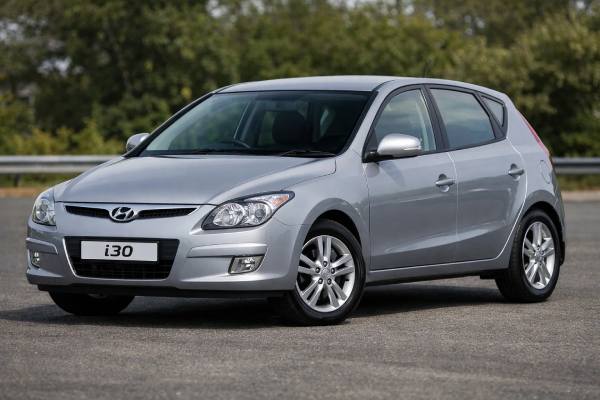
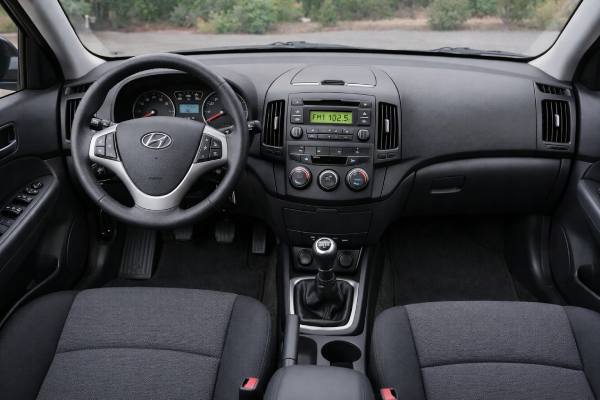
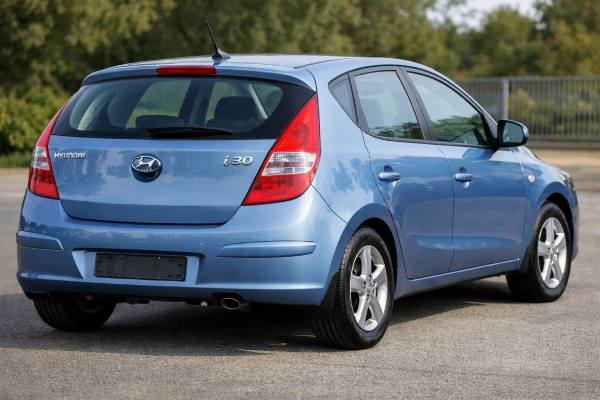
The first-generation Hyundai i30 FD was one of the cars that helped shift Hyundai from a value-first brand to a serious contender in the European family hatchback class. In 2.0 MPI form, it paired a simple naturally aspirated petrol engine with a roomy five-door body, a well-judged chassis, and the kind of straightforward mechanical layout that ages better than many later downsized turbo cars. That matters now, because buyers looking at a 2007–2010 i30 are usually less interested in showroom sparkle and more interested in durability, sensible running costs, and ease of ownership.
The 143 hp 2.0-liter version is not the most common FD on the used market, but it is one of the more satisfying petrol choices. It avoids diesel-specific complexity, delivers enough performance for motorway work, and keeps maintenance relatively familiar. Its weak points are mostly age-related rather than fundamentally flawed. For owners who want an honest hatchback that is easy to understand, the i30 FD 2.0 MPI still makes a solid case.
Owner Snapshot
- Strong cabin space, good visibility, and a mature chassis for a compact hatchback.
- The 2.0 MPI engine is simple by modern standards and avoids direct-injection carbon concerns.
- Four-wheel disc brakes and multi-link rear suspension give it a more substantial feel than many budget rivals.
- Timing-belt service is important on the G4GC engine, and neglected cooling or ignition maintenance can become expensive.
- A sensible oil service interval is every 12 months or about 10,000–15,000 km, depending on use and market guidance.
Guide contents
- Hyundai i30 FD Ownership Overview
- Hyundai i30 FD Specs and Fluids
- Hyundai i30 FD Trims and Safety
- Reliability and Service Actions
- Maintenance and Buyer Checks
- Driving and Performance
- Rivals and Value
Hyundai i30 FD Ownership Overview
The FD-generation i30 was designed for Europe, and you can feel that in the way it balances practicality, ride comfort, and road manners. Its footprint is compact enough for city driving, but the 2,650 mm wheelbase and upright hatchback packaging give it a cabin that feels closer to a class-and-a-half car. Front-seat space is generous, rear-seat legroom is usable for adults, and the hatch opening is wide enough to make daily loading easier than in some sleeker rivals.
What makes the 2.0 MPI version especially interesting is its character. The G4GC engine is an old-school multipoint-injected four-cylinder, not a tiny turbo motor trying to punch above its weight. That means linear throttle response, simple fueling hardware, and a power delivery curve that feels predictable rather than exciting. Peak output lands high enough in the rev range that the car still benefits from being worked through the gears, but it is not fussy in normal use. On mixed roads it feels adequate to brisk rather than fast, which is a healthy match for the chassis and the car’s family-hatch role.
The FD platform also deserves credit. Its multi-link rear suspension gives the car a planted, composed feel over broken roads and fast sweepers. Steering feel is only average, but motorway stability is better than many budget-minded hatchbacks of the same era.
Ownership today is mostly about condition. A well-kept 2.0 MPI i30 can still be a sensible long-term car, but a neglected one may need belts, bushes, brakes, cooling work, tyres, and rust repair in quick succession. The best cars are the ones with regular fluid changes, quality tyres, and timely age-related maintenance rather than the longest equipment list.
Hyundai i30 FD Specs and Fluids
Below is a practical specification summary for the 2007–2010 Hyundai i30 FD hatchback with the 2.0 MPI petrol engine. Market differences existed, especially in trim, tyres, and gearbox availability, so small detail changes by VIN are normal.
Powertrain and efficiency
| Item | Data |
|---|---|
| Engine code | G4GC |
| Layout | Front-transverse inline-4 |
| Valvetrain | DOHC, 16 valves, 4 valves per cylinder |
| Bore × stroke | 82.0 × 93.5 mm (3.23 × 3.68 in) |
| Displacement | 2.0 L (1,975 cc) |
| Induction | Naturally aspirated |
| Fuel system | MPFI / multi-point injection |
| Compression ratio | about 10.0:1 to 10.1:1 |
| Max power | 143 hp (105 kW) @ 6,000 rpm |
| Max torque | 186 Nm (137 lb-ft) @ about 4,500–4,600 rpm |
| Timing drive | Belt |
| Rated combined economy | about 7.1 L/100 km (33.1 mpg US / 39.8 mpg UK) manual |
| Real-world highway at 120 km/h | typically around 7.3–8.2 L/100 km (28.7–32.2 mpg US / 34.4–38.7 mpg UK) |
Transmission and driveline
| Item | Data |
|---|---|
| Manual gearbox | 5-speed manual |
| Automatic gearbox | 4-speed automatic on some markets |
| Drive type | FWD |
| Differential | Open |
Chassis and dimensions
| Item | Data |
|---|---|
| Front suspension | MacPherson strut |
| Rear suspension | Multi-link and trailing-arm type |
| Steering | Rack and pinion with electric assist |
| Brakes | 4-wheel disc; front ventilated, rear solid |
| Brake disc size | commonly about 280 × 26 mm front and 262 × 10 mm rear |
| Most common tyre size | 205/55 R16 |
| Length | 4,245 mm (167.1 in) |
| Width | 1,775 mm (69.9 in) |
| Height | 1,480 mm (58.3 in) |
| Wheelbase | 2,650 mm (104.3 in) |
| Turning circle | about 10.3–10.5 m (33.8–34.4 ft) kerb-to-kerb |
| Kerb weight | about 1,327 kg (2,926 lb) manual |
| GVWR | about 1,780 kg (3,924 lb) |
| Fuel tank | 53 L (14.0 US gal / 11.7 UK gal) |
| Cargo volume | about 340 L (12.0 ft³) seats up / about 1,250 L (44.1 ft³) seats folded |
Performance and capability
| Item | Data |
|---|---|
| 0–100 km/h | about 10.6 s |
| Top speed | about 205 km/h (127 mph) manual |
| Braking distance 100–0 km/h | road-test figures vary; not consistently published for this exact version |
| Towing capacity | often around 1,500 kg (3,307 lb) braked, market dependent |
| Payload | about 453 kg (999 lb) |
Fluids and service capacities
| Item | Data |
|---|---|
| Engine oil | API SJ/SL or above, ILSAC GF-3 or above; commonly 5W-30 or 5W-20 where climate allows |
| Engine oil capacity | 4.0 L (4.23 US qt) |
| Coolant | Ethylene-glycol base coolant for aluminium radiator |
| Coolant capacity | 6.6 L (6.97 US qt) |
| Manual transaxle fluid | API GL-4 SAE 75W-85, fill-for-life style factory guidance |
| Manual transaxle capacity | 2.0 L (2.11 US qt) |
| Automatic transaxle fluid | SP-III type fluid |
| Automatic transaxle capacity | 6.6 L (6.97 US qt) |
| Brake and clutch fluid | DOT 3 or DOT 4 |
| Brake and clutch fluid capacity | about 0.7–0.8 L (0.74–0.85 US qt) |
| A/C refrigerant | Verify by under-bonnet label; market and production date can differ |
| Key torque spec | Wheel nuts 88–107 Nm (65–79 lb-ft) |
The 2.0 MPI is mechanically simple, but belt service, coolant quality, ignition health, and correct fluids still matter more than brochure differences.
Hyundai i30 FD Trims and Safety
Trim structure varied by market, but many regions used a ladder that ran from basic fleet-oriented cars to better-equipped comfort or premium versions. The 2.0 MPI was often sold above base trim, so surviving examples frequently have alloy wheels, better audio, air conditioning or climate control, and upgraded seat trim.
In practical buying terms, trim matters less than condition, but there are still useful differences to know. Base or lower trims often ran 15-inch wheels and more basic interior materials. Mid-spec versions commonly added 16-inch wheels, fog lights, improved seat fabrics, leather-trimmed steering wheel, steering-wheel audio controls, and convenience upgrades. Higher trims could bring mixed leather upholstery, rear parking sensors, climate control, sunroof, and upgraded appearance details. Estate and hatchback equipment could also diverge slightly, so always decode the actual build rather than assume from badges alone.
Quick identifiers help. Wheel size is a first clue, but interior trim texture, climate-control controls, steering-wheel buttons, and the presence of parking sensors or a sunroof are usually more reliable because many older cars have had wheel swaps.
Safety equipment was respectable for the period but should be understood in period context. This is not an ADAS-era car. You are getting passive safety and baseline chassis electronics, not lane centring or automatic braking. Typical equipment included front airbags, front seatbelt pretensioners, load limiters, side airbags, and curtain airbags on broad sections of the range. ISOFIX child-seat anchorages were part of the package, though labeling and clarity were criticized in period testing. ABS was standard in many markets, while ESC and related functions could vary by year and trim.
For crash performance, the early i30 achieved a four-star Euro NCAP adult occupant result in 2007. That was respectable, but not class-leading even then. Euro NCAP noted a stable passenger compartment but highlighted weaker protection in some frontal-impact measures, especially around the driver’s knee and dashboard structures. Child-occupant and pedestrian scores were acceptable rather than standout.
There were effectively no modern driver-assistance systems in the 2007–2010 FD 2.0 MPI range. Buyers should think in terms of ABS, EBD, brake assist, parking sensors, and possibly stability control rather than AEB, adaptive cruise control, blind-spot monitoring, or lane-keep assist. After service or body repair, the main safety concern is not sensor calibration but whether airbags, seatbelts, suspension geometry, and brake hardware remain original-spec and properly repaired.
Reliability and Service Actions
The i30 FD 2.0 MPI is generally a solid older hatchback when serviced on time. Its biggest strength is that most of its common faults are conventional and diagnosable. The engine is simpler than later direct-injection or turbo units, and the chassis is durable if it has not spent years on poor roads with cheap replacement parts.
Common, low-to-medium cost issues
- Ignition wear: misfire under load, rough idle, or hard starting usually points first to spark plugs, ignition leads, or coil-related wear. On neglected cars, this is often the quickest route back to smooth running.
- Brakes: rear caliper drag, handbrake imbalance, or uneven pad wear can appear on older cars, especially where salt or infrequent use has encouraged corrosion.
- Suspension consumables: drop links, anti-roll-bar bushes, lower-arm bushes, and top mounts are regular age-and-mileage jobs. They usually show up as clunks, vague straight-line feel, or tyre-edge wear.
- Wheel bearings: humming that rises with road speed but changes little with engine load is a familiar symptom.
Occasional, medium-cost issues
- Cooling system wear: thermostat problems, ageing hoses, radiator seepage, or expansion-tank issues become more likely with age. Overheating is not a trait to ignore on the G4GC because a simple coolant leak can become a head-gasket problem if it is driven on.
- Steering column or EPS noises: some FD-platform cars develop steering-column play or a light clunk through the electric-assist system. It is often annoying before it is dangerous, but it should still be diagnosed properly.
- Manual gearbox and clutch wear: the manual is usually durable, but high-mileage cars can show a tired clutch, release-bearing noise, or notchy shift feel if fluid and linkage condition have been ignored.
Less common but higher-risk issues
- Timing-belt neglect: this is the big one on the 2.0 MPI. A car with no credible record of belt replacement should be treated as overdue until proven otherwise.
- Rust in climate-heavy regions: check rear arches, the lower tailgate seam, front subframe areas, rear axle carrier points, brake-line runs, jacking points, and underbody seams.
On service actions, the most relevant official campaign for many markets was the airbag-control-unit programming recall affecting 2007–2012 i30s in Australia. A separate ABS module short-circuit campaign affected closely related FD-platform cars in some regions, including the U.S.-market Elantra Touring sibling. That does not mean every 2.0 MPI i30 has both issues everywhere, but it does mean recall history matters.
Before purchase, ask for a full maintenance file, proof of recall completion, belt and coolant records, brake invoices, and any steering or suspension work. A tidy body with no paperwork is not enough on an older FD.
Maintenance and Buyer Checks
A practical maintenance plan for the i30 FD 2.0 MPI is straightforward, but it rewards preventive work rather than waiting for symptoms.
Core maintenance schedule
- Engine oil and filter: every 10,000–15,000 km or 12 months. If the car does frequent short trips, heavy city work, or dusty-road use, shorten that interval.
- Engine air filter: inspect at each service, replace about every 20,000–30,000 km sooner in dusty use.
- Cabin filter: replace every 12 months or about 15,000–20,000 km.
- Coolant: replace at the applicable factory interval or earlier if history is unclear. On a used example, a fresh coolant change after purchase is cheap insurance.
- Spark plugs: inspect according to service history; many owners treat 45,000–60,000 km as a sensible window for standard plugs.
- Brake fluid: every 2 years.
- Manual gearbox oil: even if marketed as long-life, a fluid refresh around 80,000–100,000 km is a smart ownership decision.
- Automatic transmission fluid: refresh earlier than lifetime marketing suggests, especially on older cars with uncertain service history.
- Timing belt and related hardware: replace strictly by verified market schedule. If there is any doubt, do the belt, tensioners, idlers, and usually the water pump.
- Auxiliary belts and hoses: inspect annually for glazing, cracks, swelling, or oil contamination.
- Tyres and alignment: rotate tyres and check alignment whenever wear becomes uneven or after suspension work.
- 12 V battery: load-test from about year four onward and keep terminals clean.
Inspection checklist before buying
- Cold-start the engine and listen for rattles, belt noise, rough idle, or misfire.
- Check the coolant reservoir, radiator area, and hose joints for staining or crusty residue.
- Confirm the timing-belt date, not just the mileage.
- Test clutch take-up and full-throttle acceleration in a higher gear for slip.
- Drive over rough roads and listen for front-end knocks or rear-suspension looseness.
- Check steering for light clunks, off-centre feel, or EPS warning history.
- Inspect all four tyres for mixed brands or uneven wear, which often reveals neglected geometry.
- Look underneath for rust around subframes, seams, brake lines, and jacking points.
- Verify air-conditioning performance and blower output.
- Ask specifically whether recall work was completed.
Common reconditioning items
Most newly purchased FD cars need at least some combination of tyres, brakes, filters, plugs, fluid changes, wiper blades, suspension links, and a battery. That is normal. Buy on evidence, not cosmetics, and the 2.0 MPI can still be a dependable daily hatch.
Driving and Performance
The i30 FD 2.0 MPI feels like a car from the last stretch of the naturally aspirated family-hatch era. There is enough power for normal overtaking, but the delivery is progressive rather than punchy. Around town, it steps off cleanly and predictably, and on the motorway it holds speed without strain. What it does not do is deliver strong low-rpm shove. You get the best from it by using the middle and upper part of the rev range rather than expecting turbo-like torque from 1,500 rpm.
That shapes the whole driving experience. The manual gearbox suits the engine better than the older four-speed automatic because it helps the driver stay in the useful part of the power band. The automatic is smooth enough in relaxed use, but it blunts response and dulls the car’s modest performance edge.
Ride quality is one of the stronger points. The FD has a more settled, grown-up feel than many budget hatchbacks, and the rear suspension helps it stay composed over patchy surfaces. At speed, it tracks cleanly and does not feel nervous in crosswinds. Steering weight is light, and feedback is limited, but the car is easy to place and confidence-inspiring for everyday use.
Noise levels are acceptable for the class and era. At city speeds the cabin is reasonably civil, but on coarser motorway surfaces you will hear tyre roar and some wind noise. The engine itself is fairly smooth under light to moderate load. Push harder and it becomes more audible, though not harsh.
In real use, expect roughly these economy ranges from a healthy manual car:
- City: about 8.8–10.5 L/100 km
- Highway at 100–120 km/h: about 6.7–8.2 L/100 km
- Mixed driving: about 7.5–8.8 L/100 km
Those are not outstanding numbers by modern standards, but they are reasonable for a 2.0-liter naturally aspirated hatchback with conventional automatic and manual gearbox options. Cold weather, short runs, old tyres, dragging brakes, or overdue plugs can easily push the real figure higher.
Performance is respectable rather than sporty. A 0–100 km/h time around 10.6 seconds is enough to keep the car from feeling slow in modern traffic, and the top speed of roughly 205 km/h shows that it has adequate long-leg gearing. Braking feel is usually firm and predictable when the system is healthy, and four-wheel discs help it feel more serious than some cheaper rivals with rear drums.
Overall, the i30 FD 2.0 MPI drives like a sensible all-rounder. Its strengths are composure, predictability, and mature road manners, not excitement. For many buyers, that is exactly the point.
Rivals and Value
The i30 FD 2.0 MPI lived in one of the hardest classes in Europe and many export markets. Its natural rivals included the Ford Focus Mk2, Volkswagen Golf Mk5, Mazda 3 BK, Toyota Corolla, Kia cee’d, and Honda Civic of the same era. Against those cars, the Hyundai did not win on badge prestige, but it often did well on value, equipment, warranty reputation in period, and straightforward ownership.
Against the Ford Focus Mk2, the i30 loses on steering feel but stays competitive on ride composure and practicality. Against the Volkswagen Golf Mk5, it offers a less premium cabin yet often lower buying and maintenance risk than turbocharged or DSG-equipped Golfs. Against the Mazda 3, it is calmer rather than sharper, while rust checks matter on both. Against the Toyota Corolla, the Hyundai usually feels less basic on the road, even if the Toyota keeps the stronger reliability image.
The closest rival is the Kia cee’d, because the cars share much of their engineering. In practice, condition, trim, service history, and local parts supply matter more than the badge.
For used buyers today, the i30 FD 2.0 MPI makes the most sense when you want a naturally aspirated petrol hatchback, a mature chassis, simpler maintenance than many later turbo rivals, and a lower entry price than an equivalent Golf or Civic. It makes less sense if you want standout fuel economy, sporty performance, or modern driver-assistance tech.
The verdict is simple: buy carefully, prioritise a documented belt service, a clean cooling system, sound suspension, and completed recall work, and this old Hyundai can still be a very sensible compact hatchback.
References
- OWNER’S MANUAL Operation Maintenance Specifications 2007 (Owner’s Manual)
- REC-000635 – Hyundai Motor Company – HYUNDAI I30 2007 – 2012 | Vehicle Recalls 2019 (Recall Database)
- Part 573 Safety Recall Report 20V-061 2020 (Recall Database)
- Important Extended Warranty Information 2017 (Service Bulletin)
- TEST RESULTS Hyundai i30 2007 (Safety Rating)
Disclaimer
This article is provided for informational purposes only and is not a substitute for professional diagnosis, repair, or model-specific workshop guidance. Specifications, torque values, service intervals, procedures, and equipment can vary by VIN, market, model year, gearbox, and trim, so always verify critical details against the correct official service documentation for the exact vehicle.
If this guide helped you, please consider sharing it on Facebook, X, or another social platform to support our work.