
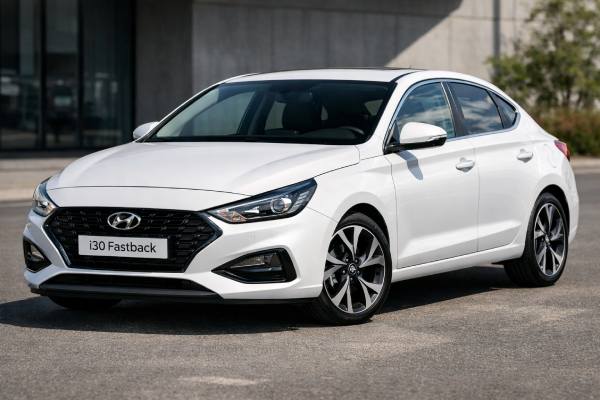
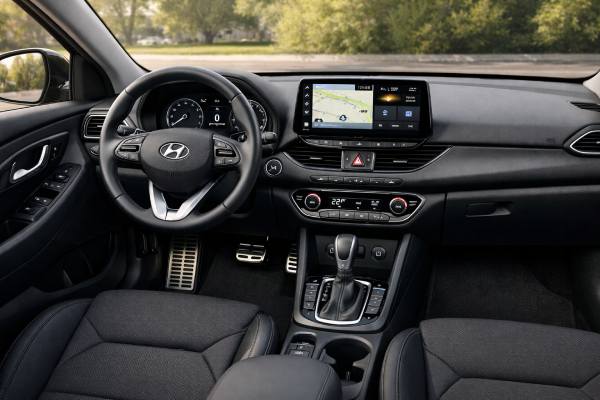
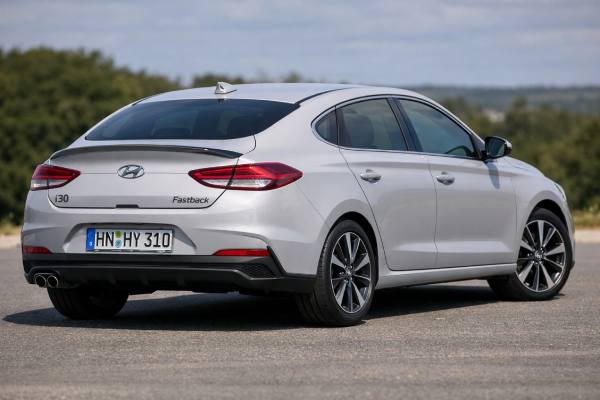
The facelift Hyundai i30 Fastback 1.0 T-GDi 100 sits in an unusual but useful corner of the compact-car market. It gives you the sleeker fastback body and updated 2024-era tech of the i30 range, but pairs it with the smallest petrol turbo in the line-up rather than a heavier diesel or a costlier high-output engine. That makes it appealing to buyers who want style, everyday usability, and simpler ownership costs without stepping into a crossover. The core engineering story is easy to understand: a 1.0-litre three-cylinder turbo petrol, front-wheel drive, a 6-speed manual as the default choice, and an optional 7-speed DCT in some markets. Hyundai’s 2024 update also brought more standard safety equipment, refreshed design details, and better cabin tech. The result is not a fast Fastback, but a balanced one. For drivers who value a useful five-door body, sensible running costs, and a more distinctive shape than the ordinary hatchback, this version deserves more attention than its modest power output suggests.
Core Points
- The 1.0 T-GDi gives the Fastback a lighter, more affordable ownership profile than the bigger engines.
- The fastback body remains stylish while still offering a practical 450 L boot in the non-48V layout.
- The 2024 refresh improves safety, lighting, connectivity, and day-to-day convenience.
- As a small direct-injected turbo petrol, it rewards regular oil changes and careful warm-up habits.
- A 12-month or 15,000 km oil-service routine is the safest long-term pattern for this engine.
Jump to sections
- Hyundai i30 Fastback entry profile
- Hyundai i30 Fastback figures and specs
- Hyundai i30 Fastback grades and safety tech
- Common issues and service-history signals
- Maintenance plan and used-buy checks
- Driving character and real economy
- Where it sits against rivals
Hyundai i30 Fastback entry profile
The facelift i30 Fastback 1.0 T-GDi is the value-minded version of Hyundai’s sleekest non-N i30 body style. It is not designed to be the fastest or most premium choice in the range. Instead, it offers a lower-cost way into the Fastback line while keeping the parts of the design that make this body style worth having in the first place: the lower roofline, the long rear silhouette, and a more mature, more individual look than the regular five-door hatchback.
That matters because the Fastback still occupies a rare niche. It is not a coupe, not a liftback in the larger-class sense, and not just a hatch with a different rear lamp shape. Hyundai tuned the entire body concept around a lower, more planted appearance, and even in base petrol form it feels a little more style-led than the hatchback. Yet it remains genuinely usable. In non-48V form, it keeps the larger 450-litre VDA boot, usable rear seats, and everyday practicality that many “sportier” compact cars sacrifice too quickly.
The 2024 update sharpened the package rather than reinventing it. Hyundai revised the front-end details, introduced standard LED lighting across the line, added more standard Hyundai SmartSense features, expanded USB-C charging, and improved the digital and connectivity experience. That is important for this engine because the 1.0 T-GDi is not sold on excitement alone. It depends on the overall quality of the package. The update makes the car feel newer than the underlying platform age might suggest.
From a powertrain standpoint, the headline numbers define the personality. Hyundai’s current public Fastback pages list the 1.0 T-GDi with 100 PS and 172 Nm in 6-speed manual form, while the optional 7-speed DCT version is shown with the same 100 PS but 200 Nm. That is enough torque to make the car feel more useful than a naturally aspirated small petrol, but not enough to disguise that this is still the entry performance option. Buyers should expect a smooth, willing turbo three-cylinder rather than anything close to an N Line or N experience.
The right owner for this model usually wants three things: distinctive styling, moderate running costs, and a car that spends more time in real-life commuting than in performance talk. If that sounds like your use case, the 1.0 T-GDi Fastback makes sense. If you regularly carry full loads, drive fast motorways, or simply want stronger effortless pace, the 1.5 T-GDi is the better match.
What makes the 1.0 appealing is not just that it is cheaper. It is that it gives the Fastback’s design and practicality to drivers who do not need the stronger engines. That keeps it relevant in a market where many compact cars have become heavier, more complicated, and more expensive than necessary.
Hyundai i30 Fastback figures and specs
The current open Hyundai material for the facelift Fastback 1.0 T-GDi does not publish every technical row in one single public sheet, so the clearest way to present the car is to combine Hyundai’s current 2024–present Fastback powertrain pages with Hyundai’s facelift-era Fastback technical architecture data for the same 1.0 T-GDi family. The result gives a solid picture of the model, while still leaving VIN-specific details to the official workshop literature.
| Powertrain and efficiency | Hyundai i30 Fastback 1.0 T-GDi 6MT | Hyundai i30 Fastback 1.0 T-GDi 7DCT |
|---|---|---|
| Engine family | 1.0 T-GDi petrol | 1.0 T-GDi petrol |
| Layout | Inline-3, front-transverse | Inline-3, front-transverse |
| Valvetrain | DOHC, 4 valves per cylinder | DOHC, 4 valves per cylinder |
| Bore × stroke | 71.0 × 84.0 mm (2.80 × 3.31 in) | 71.0 × 84.0 mm (2.80 × 3.31 in) |
| Displacement | 1.0 L (998 cc) | 1.0 L (998 cc) |
| Induction | Single-scroll turbocharger, intercooler | Single-scroll turbocharger, intercooler |
| Fuel system | Direct injection petrol | Direct injection petrol |
| Compression ratio | 10.0:1 | 10.0:1 |
| Max power | 100 hp / 74 kW @ market-dependent rpm, commonly around 6,000 rpm | 100 hp / 74 kW @ market-dependent rpm, commonly around 6,000 rpm |
| Max torque | 172 Nm (127 lb-ft) | 200 Nm (148 lb-ft) |
| Timing drive | Chain | |
| Rated efficiency | WLTP combined 5.4–6.4 L/100 km across published 1.0 T-GDi Fastback figures | |
| Real-world highway at 120 km/h | roughly 5.5–6.5 L/100 km in a healthy car |
| Transmission and driveline | Hyundai i30 Fastback 1.0 T-GDi |
|---|---|
| Transmission | 6-speed manual; optional 7-speed DCT in some markets |
| Drive type | FWD |
| Differential | Open |
| Chassis and dimensions | Hyundai i30 Fastback 1.0 T-GDi |
|---|---|
| Front suspension | MacPherson strut |
| Rear suspension | Multi-link |
| Steering | Electric rack and pinion |
| Steering ratio | 13.4:1 |
| Turns lock-to-lock | 2.57 |
| Front brakes | Ventilated discs, 288 mm; higher trims can use 305 mm |
| Rear brakes | Disc, 272 mm; some higher trims can use 284 mm |
| Most common tyre sizes | 205/55 R16, 225/45 R17 |
| Ground clearance | 135 mm (5.3 in) |
| Length | 4,455 mm (175.4 in) |
| Width | 1,795 mm (70.7 in) |
| Height | 1,425 mm (56.1 in) |
| Wheelbase | 2,650 mm (104.3 in) |
| Turning circle | 10.6 m (34.8 ft) |
| Kerb weight | roughly 1,242–1,439 kg (2,739–3,172 lb), trim and transmission dependent |
| GVWR | about 1,820–1,860 kg (4,012–4,101 lb), market dependent |
| Fuel tank | 50 L (13.2 US gal / 11.0 UK gal) |
| Cargo volume | 450 / 1,351 L (15.9 / 47.7 ft³), VDA |
| Performance and capability | Hyundai i30 Fastback 1.0 T-GDi |
|---|---|
| 0–100 km/h | current open 2024–present public Fastback pages do not consistently publish an exact figure for the 100 hp tune |
| Top speed | current open 2024–present public Fastback pages do not consistently publish an exact figure for the 100 hp tune |
| Braking distance | not consistently published as a fixed factory figure |
| Towing, braked | up to 1,200 kg (2,646 lb), market dependent |
| Towing, unbraked | 600 kg (1,323 lb) |
| Payload | roughly 435–578 kg (959–1,274 lb), trim dependent |
| Fluids and service capacities | Hyundai i30 Fastback 1.0 T-GDi |
|---|---|
| Engine oil | about 3.6 L (3.8 US qt) including filter |
| Oil specification | use the exact Hyundai-approved turbo petrol specification for the VIN and market |
| Coolant | about 6.0 L (6.3 US qt) |
| Manual transmission oil | about 1.6 L (1.7 US qt) |
| DCT fluid | verify exact Hyundai specification and capacity by VIN and transmission code |
| A/C refrigerant | verify under-bonnet label |
| A/C compressor oil | verify under-bonnet label |
| Key torque spec | wheel nuts 107–127 Nm (79–94 lb-ft) |
| Safety and driver assistance | Hyundai i30 Fastback facelift |
|---|---|
| Euro NCAP | 5 stars |
| Adult occupant protection | 88% |
| Child occupant protection | 84% |
| Vulnerable road user | 64% |
| Safety assist | 68% |
| IIHS | not applicable |
| ADAS suite | FCA, FCA with Junction Turning, ISLA, HDA 1.5, ROA, MCB, lane support, parking sensors, rear-view camera; standard and optional status varies by market and trim |
The biggest caveat in the table is performance. Hyundai’s current public 2024–present Fastback product pages clearly publish power, torque, transmission availability, and WLTP consumption ranges, but not every market page exposes a clean official 0–100 km/h or top-speed number for the 100 hp tune. That is why a buyer should treat those two figures as brochure- and market-dependent rather than universal.
Hyundai i30 Fastback grades and safety tech
The trim picture on the 2024–present Fastback 1.0 T-GDi is shaped more by market than by engineering, but there are still some clear patterns. The 1.0 engine usually sits as the accessible entry point into the Fastback range, yet Hyundai does not make it feel stripped. Even in markets where it opens the line-up, the facelift added enough standard hardware that the car no longer feels like a compromise model.
The 2024 update improved that story substantially. Hyundai made LED headlamps and taillamps standard across the broader i30 range, added a standard 4.2-inch colour LCD cluster, expanded USB-C charging, and improved OTA map-update support. On upper versions, buyers can add or retain the larger 10.25-inch digital cluster and 10.25-inch multimedia screen, which make the cabin feel much more modern than the platform age suggests.
Mechanically, the 1.0 T-GDi does not come with the more serious N-style tuning touches reserved for stronger N Line versions. But trim still changes the feel of the car in meaningful ways:
- wheel size changes ride and tyre cost,
- DCT availability changes the powertrain character,
- N Line trims add a visual and seating upgrade,
- and higher trims often bring a noticeably stronger safety and convenience package.
For this model, the sweet spot is usually a mid-spec or well-equipped standard trim on 16-inch wheels, or a restrained N Line on 17-inch wheels if you value appearance more strongly. Hyundai’s current design page for the Fastback highlights a new 16-inch alloy wheel design on the refreshed model, while N Line materials continue to position the 1.0 T-GDi around a 17-inch setup. That is useful because it mirrors what owners often discover in real life: the smaller wheel cars usually ride better and cost less to keep in tyres, while the bigger wheel cars look better in photos.
Safety is one of the strongest parts of the current Fastback story. Hyundai’s latest public Fastback pages describe the enhanced SmartSense package as fully integrated into the new model. The 2024 update also made more safety tech standard across the i30 family. Features now emphasized in Hyundai’s own material include:
- Forward Collision-Avoidance Assist,
- Forward Collision-Avoidance Assist with Junction Turning,
- Highway Driving Assist 1.5,
- Intelligent Speed Limit Assist,
- Rear Occupant Alert,
- Multi-Collision Braking,
- rear-view camera,
- and front and rear parking sensors.
In some markets, Navigation-based Smart Cruise Control and related driver-assistance features also appear on better-equipped trims. The important point for used buyers is not to assume a uniform spec. Hyundai’s own pages describe some systems as standard in one market and optional in another. Always verify the exact equipment list from the VIN, sales code, or original brochure for that country.
The Euro NCAP five-star result remains a helpful reassurance. It is an i30 family rating rather than a 2024 one-off crash program for this exact powertrain, but it still supports the car’s case as a family-friendly compact model. Structural basics, airbags, ESC, ISOFIX, and the expanded ADAS list all help the Fastback feel more than just a design-led variant.
For ownership, the trim lesson is simple: chase condition and equipment balance rather than badge status alone. A clean mid-spec car with the right safety pack often makes more sense than a highly optioned example with neglected maintenance or expensive low-profile tyres.
Common issues and service-history signals
The 1.0 T-GDi Fastback is not known for one giant defining defect, which is good news. Its reliability pattern is instead typical of a modern small turbo direct-injection petrol: it can be a very good long-term engine when serviced properly, but it does not reward neglect. The facelift 2024–present update did not turn it into a high-risk car. It simply means buyers need to pay attention to normal turbo-petrol priorities.
A realistic issue map looks like this:
- Common and low cost: 12 V battery fatigue, spark plugs, ignition coils, filters, brakes, tyres, and small cabin-electronics annoyances.
- Occasional and medium cost: boost leaks, thermostat or coolant seep issues, DCT hesitation where fitted, wheel bearings, and sensor faults.
- Rare but higher cost: chain noise from poor oil care, turbo wear after neglected servicing, serious overheating damage, or repeated misfire problems that were ignored too long.
Typical symptoms and likely causes are fairly predictable:
- slight hesitation or uneven running under load can start with worn plugs or weak coils;
- poor low-speed response or surging can come from vacuum or boost leaks, stale software, or neglected intake components;
- rising oil consumption is more likely to reflect neglect or hard use than a model-wide design problem;
- DCT jerks at parking speeds usually point to calibration, clutch-condition, or driving-pattern issues rather than a universal transmission flaw;
- cooling warnings or falling coolant level should be treated early, because small turbo engines do not tolerate overheating casually.
Because the 1.0 T-GDi is a direct-injection engine, long-term intake-valve deposits are a theoretical ownership point, especially on cars that do many short trips and rarely see sustained load. That is not the same as saying the engine is notorious for it. It means buyers should expect the usual DI-engine maintenance reality over higher mileage rather than assume old-style naturally aspirated petrol simplicity.
The timing drive is another reason proper oil service matters. Hyundai’s facelift-era Fastback technical data for the 1.0 T-GDi confirms a chain-driven camshaft arrangement. That generally removes a belt-replacement schedule, but it does not remove the need for correct oil and regular changes. Chain life is strongly tied to service quality.
On service actions and recalls, there is no single public engine-specific campaign that defines the 2024–present 1.0 Fastback the way some troubled engines become known by one headline repair. That said, market-specific updates and general model-range service campaigns can still apply. The correct process is always the same: run the VIN through Hyundai’s official recall portal and compare the result with dealer records.
For used-car shopping, the best questions are practical ones:
- Was the oil changed on time?
- Is the car on matching quality tyres?
- Does it cold-start cleanly and idle evenly?
- Does the DCT, if fitted, creep and engage smoothly?
- Has the car had any ADAS calibration after windscreen or front-end repair?
- Is there proof of recall completion?
A small turbo petrol can be a better long-term buy than a neglected diesel if it has been serviced honestly. That is the lens through which the 1.0 T-GDi should be judged.
Maintenance plan and used-buy checks
This engine rewards routine, boring maintenance. That is the good news. You do not need to treat it like an exotic powertrain. You just need to be more disciplined than the minimum.
A practical maintenance schedule looks like this:
| Item | Practical interval |
|---|---|
| Engine oil and filter | every 12 months or 15,000 km |
| Engine air filter | inspect yearly, replace around 30,000 km |
| Cabin filter | every 12 months or 15,000–20,000 km |
| Spark plugs | inspect by schedule; many owners budget replacement around 30,000–45,000 km |
| Coolant | inspect yearly; replace by VIN-specific schedule or if history is unclear |
| Brake fluid | every 2 years |
| Manual gearbox oil | inspect for leaks; refresh around 100,000–120,000 km is sensible |
| 7DCT fluid and operation check | follow exact Hyundai guidance and inspect behavior at every service |
| Auxiliary belt and hoses | inspect every service |
| Brake pads and discs | inspect every service |
| Tyre rotation and alignment check | every 10,000–15,000 km |
| 12 V battery test | yearly after year four |
| Timing chain | inspect only if noisy, out of phase, or fault symptoms appear |
Useful service data for decision-making:
- engine oil is about 3.6 L with filter,
- coolant is about 6.0 L,
- manual gearbox oil is about 1.6 L,
- fuel tank is 50 L,
- and wheel nuts sit in the 107–127 Nm range.
Even though Hyundai’s older facelift technical sheets listed a 15,000 km or annual maintenance rhythm for the 1.0 T-GDi, many owners are still tempted to stretch services where usage seems “easy.” That is not the smartest path on a small turbo DI engine. Annual oil changes remain the safest long-term habit, even on lower mileage cars.
For buyers, the checklist should focus on the kind of neglect that hides well:
- cold-start behavior,
- smooth turbo response,
- consistent service invoices rather than just a stamped book,
- clutch take-up on manual cars,
- low-speed shift quality on DCT cars,
- even tyre wear,
- correct operation of parking sensors, camera, and ADAS functions,
- and no signs of poor-quality body repair around the front bumper or windscreen.
Common reconditioning items are ordinary: tyres, plugs, battery, front brakes, filters, and sometimes a suspension link or alignment correction. None of that is alarming in itself. What matters is whether the car has been maintained as a modern turbo petrol or treated like something that never needs attention.
The best versions to seek are usually clean mid-spec cars with 16-inch or 17-inch wheels, a full history, and no obvious aftermarket tuning or cosmetic shortcuts. The versions to be careful with are high-mileage cars with missing invoices, worn cheap tyres, DCT hesitation, or cooling-system questions.
Long-term durability should be above average if the engine gets regular oil, reasonable warm-up habits, and quick attention to small problems. The 1.0 T-GDi Fastback is not the most glamorous version of the i30, but it can be one of the more rational ones.
Driving character and real economy
The facelift Fastback 1.0 T-GDi is not a fast car, but it is a pleasant one. Its road character is shaped more by the body style and chassis than by outright power. The Fastback’s lower suspension stance gives it a more planted feel than a basic compact hatchback, and Hyundai’s own product pages still emphasize that lowered setup as part of the model’s identity. That shows on the road.
At city pace, the 1.0 feels light, easy to place, and smoother than some drivers expect from a three-cylinder turbo. The engine does not hide its layout completely, but the character is more willing than rough. In the manual car, low-speed drivability is straightforward and predictable. The optional DCT adds convenience and extra torque on paper, but the manual remains the simpler, more transparent match for the engine.
On faster roads, the powertrain’s limits appear more clearly. This is not a strong overtaking engine when heavily loaded. It will do the job, but it asks the driver to plan ahead and use the gearbox. That is where the 1.0 T-GDi differs most from the stronger 1.5 T-GDi. The smaller engine needs revs and driver involvement to feel brisk. On a steady motorway cruise, though, it settles down well enough and the Fastback body continues to make the car feel more composed than its modest output suggests.
Ride quality is generally good in sensible trim. On 16-inch wheels, the car should feel like an easy everyday companion. Seventeen-inch setups on N Line cars sharpen the appearance and steering response, but they also bring more tyre cost and a slightly firmer edge over broken surfaces. The underlying balance is tidy rather than sporty. The multi-link rear axle helps the Fastback feel a little more grown-up than some cheaper compact cars with simpler rear layouts.
Real-world fuel use is one of the reasons to choose this version:
- city driving: about 6.8–7.8 L/100 km,
- highway at 100–120 km/h: about 5.5–6.5 L/100 km,
- mixed driving: about 6.0–7.0 L/100 km.
That is respectable rather than exceptional. The car’s strength is consistency. It is efficient enough to feel sensible, but without the diesel aftertreatment complexity or the higher-power petrol penalty. Cold weather, short urban trips, and heavy DCT traffic use will move the number upward. Smooth manual driving on open roads will usually bring it back down again.
The current Hyundai Fastback product material also makes clear that a 48-volt mild-hybrid version can be ordered in some markets for better consumption. Since this guide is focused on the core 100 hp 1.0 T-GDi line, the main verdict stays the same: the standard engine is competent, refined enough, and easy to live with, but it is best suited to drivers who prioritize balance over pace.
In real life, that is not a weak position. Not every Fastback buyer wants the strongest engine. Many simply want a good-looking compact five-door that feels modern, costs less to own, and does not punish everyday use. That is exactly where the 1.0 T-GDi makes sense.
Where it sits against rivals
The i30 Fastback 1.0 T-GDi does not compete by headline performance. It competes by combining shape, practicality, and sensible ownership. That makes its rival set slightly unusual.
The closest internal rival is the regular i30 hatchback with the same small petrol engine. The hatch is easier to find, more obviously practical, and in some markets slightly easier to spec. The Fastback answers with better style and a more distinctive road presence. If you care about appearance and do not need the absolute easiest rear opening, the Fastback is the more interesting car.
Against the Kia Ceed, Hyundai’s corporate cousin often wins on availability and sometimes on price. But the Ceed does not offer quite the same low-slung Fastback silhouette. The Hyundai’s advantage is that it feels like the more design-led choice while keeping a conventional ownership experience.
The Ford Focus is still one of the better drivers’ cars in the compact class, especially in stronger engine forms. But in equivalent small-petrol trim, the Hyundai counters with a more individual body shape, a well-judged cabin, and an ownership image that feels a little less aggressively fleet-focused.
The Skoda Octavia and some liftback alternatives win on outright practicality. They usually offer larger openings, more rear-room flexibility, and a more space-efficient cabin. If maximum utility is your priority, they are tough to ignore. The Hyundai responds by being smaller-feeling, more stylish, and easier to recommend to buyers who want practicality without a larger-car footprint.
The Mazda3 Fastback is the more emotional visual alternative. It often feels richer inside and more design-driven overall. But the Hyundai typically counters with a more straightforward cabin layout, lower running-cost expectations, and broader availability of modern assistance features in everyday trim levels.
A Toyota Corolla Hybrid is the smarter answer for mainly urban drivers who want low fuel use and automatic ease. That is perhaps the clearest alternative. But it also represents a different ownership philosophy. The Corolla is the hybrid commuter. The Hyundai is the simpler turbo-petrol Fastback for buyers who still want a manual option, lighter weight, and a more traditional driving feel.
So the final position is clear. Choose the Hyundai if you want:
- a more distinctive compact-car shape,
- good everyday practicality,
- moderate running costs,
- and enough modern tech to avoid feeling outdated.
Look elsewhere if you want:
- stronger motorway overtaking performance,
- the absolute best city fuel economy,
- or the largest rear cargo opening in the class.
In the right role, the i30 Fastback 1.0 T-GDi is a smart buy. It is not the version enthusiasts talk about most, but it may be one of the easier ones to own well. That makes it more valuable than its power figure first suggests.
References
- Nuevo i30 Fastback | Prestaciones | Hyundai Motor España 2026 (Technical Overview)
- Bolder and more high-tech: i30 gets update – Hyundai Europe 2024 (Press Release)
- Hyundai i30 Fastback | Technische Daten | Stand: 4.2019 2020 (Technical Data)
- Euro NCAP | Hyundai i30 2017 (Safety Rating)
- Hyundai Owners manuals | Hyundai Motor UK 2026 (Owner’s Manual)
Disclaimer
This article is for informational purposes only and is not a substitute for professional diagnosis, repair, or official workshop guidance. Specifications, torque values, service intervals, fluids, procedures, and equipment can vary by VIN, market, transmission, trim, and production date. Always verify critical details against the correct official service documentation and owner information for the exact vehicle.
If this guide helped you, please consider sharing it on Facebook, X, or another social platform to support our work.