
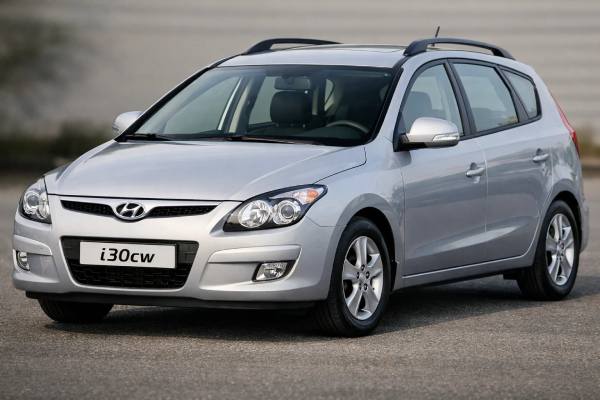

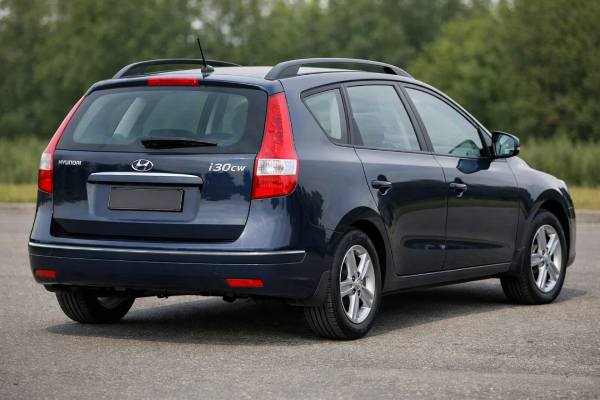
The Hyundai i30cw FD 1.6 MPI is one of those used wagons that makes more sense the longer you look at it. It takes the practical i30 formula and stretches it into a compact estate with a longer wheelbase, more rear cargo room, and the same simple naturally aspirated 1.6-litre petrol engine. That matters today because the core package is relatively straightforward: multi-point fuel injection, a timing chain instead of a timing belt, front-wheel drive, and a cabin that still works well for daily family use. With 126 hp, it is not quick, but it is adequate, especially with the five-speed manual. The bigger story is ownership value. The i30cw offers useful luggage space, honest running costs, and less mechanical complexity than many later small turbo wagons. The main caution is not the engine itself, but age: steering-related recall history, trim-dependent safety equipment, and ordinary wear now matter more than the badge on the tailgate.
At a Glance
- The 1.6 MPI G4FC engine is naturally aspirated, port-injected, and chain-driven, which keeps the powertrain simple.
- The wagon body adds meaningful practicality, with 415 L of boot space and up to 1,395 L with the rear seats folded.
- The five-speed manual is the stronger choice for both performance and fuel economy.
- Steering recall history is important, because column-joint and electric power-steering actions affected some FD-era cars.
- A sensible baseline service interval is engine oil every 15,000 km or 12 months, with spark plugs and fuel filter at about 60,000 km.
What’s inside
- Hyundai i30cw FD wagon profile
- Hyundai i30cw FD technical facts
- Hyundai i30cw FD equipment and protection
- Common faults and recall work
- Upkeep plan and used-buy tips
- Road manners and fuel use
- Where the i30cw stands against rivals
Hyundai i30cw FD wagon profile
The i30cw was Hyundai’s compact estate answer to buyers who wanted more usefulness than the hatchback without moving into a larger and heavier family car. In FD-generation form, that idea still holds up well. Compared with the regular i30 hatch, the i30cw is longer and rides on a longer 2,700 mm wheelbase. That gives it two practical benefits: a calmer overall stance on the road and a cargo area that is more useful for family luggage, prams, flat-pack shopping, or dog-duty. The wagon shape also makes the car easier to live with than many contemporary hatchbacks, even if it never became the class’s most famous estate.
The 1.6 MPI version is the one that most clearly fits the car’s personality. It uses Hyundai’s G4FC four-cylinder petrol engine, with double overhead camshafts, multi-point injection, and a timing chain. That combination matters because it avoids several of the costs that make some newer used petrol cars less appealing. There is no turbocharger to worry about, no direct-injection carbon build-up as a defining trait, and no scheduled timing-belt replacement in the usual sense. That does not make the engine maintenance-free, but it does make it easier to understand and usually cheaper to keep healthy over time.
Performance is enough rather than generous. In manual form, the wagon reaches 100 km/h in 11.5 seconds and tops out at 192 km/h. Those are perfectly workable figures for a compact estate from this era, but they tell you exactly what the car is about. The i30cw 1.6 MPI was never intended to be a driver’s special. It was designed to be a normal, versatile family car with sensible fuel use and low-stress mechanicals. That is why the manual makes the most sense. It helps the engine feel livelier, and it also delivers the better official combined figure at 6.2 L/100 km.
The ownership case becomes stronger when you look at the complete package. The wagon gives you 415 L of boot capacity with the rear seats in place and up to 1,395 L folded, while still keeping compact exterior dimensions by estate standards. That means it sits in a useful middle ground. It is noticeably more practical than a hatchback but not so large that it feels awkward as a commuter or urban family car.
Today, the i30cw’s real appeal is not novelty. It is predictability. A well-kept example offers simple petrol power, decent cabin space, reasonable efficiency, and an easier long-term ownership story than many later downsized turbo wagons. The biggest caveat is age and specification spread. Safety content changed by market and trim, and steering-related service history deserves close attention. Buy one with those points in mind, and the i30cw FD still feels like a very rational used estate.
Hyundai i30cw FD technical facts
The figures below refer to the Hyundai i30cw FD 1.6 MPI manual built for the 2008–2010 period unless noted otherwise. Because the i30cw was sold across multiple markets, equipment, weights, emissions, wheel packages, and some service details can vary by VIN and region. This table is best read as a strong baseline specification set for the model rather than an absolute replacement for workshop documentation.
| Powertrain and efficiency | Value |
|---|---|
| Engine code | G4FC |
| Engine layout and cylinders | Inline-4, DOHC, 4 valves per cylinder |
| Bore × stroke | 77.0 × 85.4 mm (3.03 × 3.36 in) |
| Displacement | 1.6 L (1,591 cc) |
| Induction | Naturally aspirated |
| Fuel system | MPFI / multi-port manifold injection |
| Compression ratio | 10.5:1 |
| Max power | 126 hp (93 kW) @ 6,200 rpm |
| Max torque | 154 Nm (113.6 lb-ft) @ 4,200 rpm |
| Timing drive | Chain |
| Rated efficiency | 6.2 L/100 km (37.9 US mpg / 45.6 UK mpg) |
| Urban / extra-urban | 8.0 / 5.2 L/100 km |
| Real-world highway @ 120 km/h (75 mph) | About 6.7–7.4 L/100 km is a realistic expectation in good condition |
| Transmission and driveline | Value |
|---|---|
| Standard transmission | 5-speed manual |
| Optional transmission | 4-speed automatic |
| Drive type | FWD |
| Differential | Open |
| Automatic official combined economy | 6.9 L/100 km |
| Automatic 0–100 km/h | About 12.0 s |
| Automatic top speed | 183 km/h (113.7 mph) |
| Chassis and dimensions | Value |
|---|---|
| Suspension, front / rear | MacPherson strut / independent multi-link |
| Steering | Rack-and-pinion with electric power assist |
| Steering ratio | Not consistently published in open wagon-specific data |
| Brakes | Ventilated front discs / rear discs |
| Brake diameters | Market- and equipment-dependent in public data; verify by VIN |
| Most common tyre size | 185/65 R15 |
| Length / width / height | 4,475 / 1,775 / 1,565 mm (176.2 / 69.9 / 61.6 in) |
| Wheelbase | 2,700 mm (106.3 in) |
| Turning circle | 10.4 m (34.1 ft) |
| Kerb weight | 1,236 kg (2,725 lb) manual |
| GVWR | 1,820 kg (4,012 lb) manual |
| Payload | 584 kg (1,288 lb) manual |
| Fuel tank | 53 L (14.0 US gal / 11.7 UK gal) |
| Cargo volume | 415–1,395 L (14.7–49.3 ft³) |
| Performance and capability | Value |
|---|---|
| 0–100 km/h | 11.5 s |
| Top speed | 192 km/h (119.3 mph) |
| Braking distance | No single open official figure is consistently published for this exact trim |
| Towing capacity | Varies by market and homologation; verify the exact VIN and tow rating plate |
| Payload | 584 kg (1,288 lb) |
| Fluids and service capacities | Value |
|---|---|
| Engine oil | Commonly 0W-30 or 5W-30 |
| Engine oil capacity | About 3.3 L drain fill, about 3.7 L total system |
| Coolant | About 6.0 L (6.34 US qt) |
| Transmission fluid | Specification depends on gearbox type and market |
| Differential / transfer case | Not applicable |
| A/C refrigerant | R134a; exact charge varies by compressor and market |
| A/C compressor oil | VIN-specific service data recommended |
| Key torque specs | Use official workshop data only for critical fasteners |
| Safety and driver assistance | Value |
|---|---|
| ANCAP rating context | 2009-era old-protocol small-car assessment |
| ANCAP result | 5 stars where side curtain airbags are fitted |
| Without curtains | 4 stars |
| Overall score | 32.54 out of 37 |
| Frontal / side / pole | 12.97 / 15.57 / 2.0 |
| Pedestrian protection | Marginal |
| ESC | Standard on the ANCAP-rated Australian wagon variants |
| ADAS | No AEB, adaptive cruise control, lane assist, or blind-spot monitoring |
The technical takeaway is straightforward. The i30cw 1.6 MPI is not technically exotic, but that is one of its main advantages. The wagon body adds valuable space, the manual gearbox suits the engine best, and the mechanical layout remains refreshingly uncomplicated by modern standards. That simplicity is exactly why the car still holds interest as a used family wagon.
Hyundai i30cw FD equipment and protection
One of the most important things to understand about the i30cw FD is that trim mattered. The wagon shared much of its underlying structure and cabin logic with the hatchback, but equipment and safety content were not identical across all markets. That means two apparently similar i30cw 1.6 MPI cars can differ quite a lot in the features that matter most to an owner, especially electronic stability control, side-curtain airbags, wheel size, and comfort equipment.
In basic trims, the i30cw was sold as a rational family estate, not a luxury car. Lower-grade versions usually came with smaller wheels, simpler cloth upholstery, manual climate control, and more limited convenience features. Mid-level variants tended to add alloy wheels, better steering-wheel trim, audio controls, and improved cabin presentation. Higher trims could add automatic climate control, parking sensors, upgraded seat materials, and more polished convenience touches. Those details matter because they shape how modern the car still feels in daily use.
The safety side deserves even more attention than the comfort side. ANCAP’s wagon-specific rating for the i30cw makes a critical distinction: the five-star result applies only to variants fitted with side-curtain airbags. Without curtains, the same wagon falls to a four-star result. That is a big deal for used buyers because it means you should not assume all i30cw examples offer the same crash protection just because they share the same body and engine. On the ANCAP-rated Australian variants, ABS, EBD, and ESC were standard, while the presence of side airbags and curtains depended on specification. That makes proper feature verification essential.
The broader safety picture fits the car’s era. The wagon was judged against period crash-test standards and achieved a respectable result for the late 2000s. It recorded a strong side-impact result and full pole score in the published ANCAP assessment, but pedestrian protection was only marginal, and modern active-safety systems were absent. There is no autonomous emergency braking, no lane-keeping support, no adaptive cruise control, and no blind-spot assistance. This is a car built before that equipment became common in compact wagons.
For families, the practical lesson is simple. Prioritize cars with confirmed curtain airbags and ESC. Those features matter more than nicer wheel designs or upgraded trim. Also check child-seat mounting points, rear-seat belt condition, and whether the airbag system has any warning lights or prior repair history. On an older estate, proper restraint and crash equipment are worth far more than cosmetic upgrades.
As a used buy, the best version of the i30cw is not necessarily the highest trim. It is the example that combines good maintenance, verified safety equipment, and honest ownership history. The wagon’s real strength is usefulness, and that usefulness rises sharply when the car is both well maintained and well specified.
Common faults and recall work
The i30cw FD 1.6 MPI is usually a dependable car when it has been maintained properly, but like most older compact wagons, its trouble spots now come more from age, mileage, and incomplete recall history than from a single fatal engineering flaw. The engine itself is one of the calmer parts of the ownership story. The naturally aspirated G4FC petrol unit is simpler than many later alternatives, and in broad terms it tolerates ordinary use well if it gets clean oil and timely service.
The most important model-specific concerns involve the steering system. One official recall covered a steering-column universal-joint bolt that may not have been tightened correctly. The risk was a loose joint, possible knocking noise, and in extreme cases a steering-control hazard. Another official campaign covered motor-driven power-steering faults on affected 2009–2010 FD cars, where loss of assist could increase steering effort and illuminate the EPS warning lamp. The remedy involved inspection and either a steering-motor replacement or a software upgrade, depending on the fault. These are not minor historical footnotes. They are core buying checks.
Even beyond official campaigns, steering-related wear remains one of the first things to test on any i30cw. Typical symptoms include clunking through the wheel, light knocking over rough surfaces, or an uneven assisted feel at low speed. The likely causes range from couplers and column-related wear to broader EPS issues. The correct response is diagnosis first. These cars are old enough that repeated partial repairs may already have been attempted, so paperwork matters almost as much as the road test.
The engine’s common concerns are much more ordinary. If oil changes have been stretched, the timing chain may become noisier with age, especially on cold starts. A chain is still an advantage over a belt here, but it is not a license to ignore maintenance forever. Listen for persistent start-up rattle, watch for timing-related fault codes, and pay attention to idle quality. Fuel injectors can also sound a little noisy on some cars, which is often more annoying than dangerous, but it is still worth distinguishing normal injector noise from deeper mechanical rattle.
Cooling-system age is another point to respect. Older hoses, plastic fittings, and coolant that has stayed in too long can turn a cheap estate into a minor but constant project. Suspension wear, wheel bearings, brake corrosion, and tired bushings should also be treated as expected age-related items rather than surprising defects.
For a pre-purchase inspection, ask for four essentials. First, proof of recall completion by VIN. Second, a cold start. Third, a road test long enough to assess EPS feel and suspension noise. Fourth, service invoices that show regular oil changes and spark-plug replacement at sensible intervals. The i30cw is usually reliable when cared for, but it punishes neglect in the same quiet, cumulative way that many ordinary family wagons do.
Upkeep plan and used-buy tips
A disciplined maintenance routine is what keeps the i30cw FD 1.6 MPI attractive as a long-term used wagon. The powertrain itself is not especially demanding, but the car responds best to steady service rather than deferred work followed by a large catch-up bill. As a practical plan, treat engine oil as a yearly job, even on lower mileage cars, and view neglected fluids as a red flag in any example you are considering.
| Item | Practical interval | Notes |
|---|---|---|
| Engine oil and filter | Every 15,000 km or 12 months | Shorter intervals are sensible with repeated short trips |
| Engine air filter | Every 45,000 km | Inspect earlier in dusty use |
| Cabin air filter | Inspect regularly and replace as needed | Often overdue on older family cars |
| Spark plugs | About every 60,000 km | Replace on schedule, not only after rough running begins |
| Fuel filter | About every 60,000 km if fitted as a service item in your market | Worth checking when history is unclear |
| Coolant | Around 120,000 km or by time limit | About 6.0 L system capacity |
| Serpentine / auxiliary belt | Around 120,000 km | Inspect for cracks and noise at every service |
| Timing chain | No fixed routine change like a belt | Inspect for noise, stretch symptoms, and timing faults |
| Brake fluid | Every 2 years is a sensible preventive interval | Important for pedal feel and corrosion control |
| Manual or automatic transmission fluid | Check history and condition | A preventive refresh is wise on older cars |
| Brake pads and rotors | Inspect at every service | Rear brake condition matters on lightly used wagons |
| Tyres and alignment | Inspect regularly | Uneven wear often reveals suspension or steering issues |
| 12 V battery | Test as the car ages | Weak batteries can trigger misleading electrical faults |
In fluid terms, the main known basics are clear: common oil grades include 0W-30 and 5W-30, drain-fill oil quantity is about 3.3 L, and total oil system volume is about 3.7 L. Coolant capacity is about 6.0 L. Beyond that, gearbox fluid specification, A/C oil charge, and some exact service values depend too heavily on VIN, transmission type, and local-market equipment to state as universal numbers. That is why official service documentation still matters, even on a simple petrol wagon.
As a used buy, the best i30cw is usually the manual 1.6 MPI with verified safety equipment and full steering campaign history. During inspection, focus on the items that make older wagons expensive by accumulation rather than by drama: worn tyres, steering knock, coolant seepage, tired brakes, electrical irritations, and underside corrosion. Check the tailgate opening, lower door seams, rear arch areas, and underbody hardware in salted climates.
Reconditioning costs are usually manageable if caught early. Fresh tyres, brakes, battery, filters, fluids, and minor suspension work do not ruin the value equation. But a neglected example with steering issues, poor recall history, and a stack of overdue service items will stop looking cheap very quickly.
The long-term durability outlook remains good. The i30cw 1.6 MPI is not glamorous, yet that is exactly why it still makes sense. It is a practical wagon with ordinary engineering, and ordinary engineering ages well when someone has cared about the basics.
Road manners and fuel use
The i30cw drives the way a sensible compact estate should. It feels steady, predictable, and mature rather than eager or playful. The longer wheelbase compared with the hatchback helps the wagon settle well on uneven roads, and that gives it a relaxed personality on faster trips. It is not a sharp sports estate, but it does not feel flimsy or crude either. In a healthy example, straight-line stability is good enough for regular motorway use, and the suspension strikes a usable compromise between comfort and control.
The engine character is clean and linear. With 126 hp and 154 Nm, the 1.6 MPI needs revs to feel lively, especially when the car is loaded with passengers or luggage. That is not a flaw so much as the normal behavior of a naturally aspirated 1.6-litre petrol from this era. The five-speed manual works with that character much better than the four-speed automatic. It lets the driver keep the engine in its more useful range and makes the whole car feel less strained in overtakes and slip-road work.
Official performance figures back that up. The manual reaches 100 km/h in 11.5 seconds and runs to 192 km/h, while the automatic needs roughly 12.0 seconds and tops out at 183 km/h. That difference is not dramatic on paper, but it is enough to shape the ownership verdict. The automatic feels like a convenience choice. The manual feels like the better-matched powertrain.
Fuel economy is one of the i30cw’s more persuasive strengths. The manual’s official combined figure is 6.2 L/100 km, with 8.0 L/100 km in urban use and 5.2 L/100 km extra-urban. The automatic rises to 6.9 L/100 km combined. In real driving, most owners should expect more than the official numbers but still remain in sensible territory. A sound manual car driven normally often lands in the high-sixes to low-sevens on mixed use, with steady highway runs often staying around the upper sixes. Heavy city traffic, cold weather, short trips, and an automatic transmission will push that upward.
Noise, vibration, and harshness are acceptable for the class and age. The engine is smoother than many small diesels and does not feel overworked at moderate speed. Cabin refinement depends strongly on tyres, wheel size, and general condition now that these cars are older. Cheap tyres, worn dampers, and tired door seals can make one i30cw feel far older than another.
Load carrying changes the picture only mildly. With luggage aboard, the car feels heavier rather than overwhelmed. Braking, overtaking, and hill work simply require more patience, as you would expect from a naturally aspirated compact wagon. That is the essential driving verdict: the i30cw FD 1.6 MPI is calm, honest, and easy to understand. It rewards realistic expectations and good maintenance, not aggressive driving.
Where the i30cw stands against rivals
The nearest mechanical rival is the first-generation Kia Cee’d SW 1.6 CVVT. That is not surprising, because the two cars share much of their engineering logic. The Kia offers 122 hp, the same 154 Nm torque figure, a 0–100 km/h time of 11.1 seconds, and a larger 534 L boot. In practice, that makes the Cee’d SW the roomier alternative, while the Hyundai counters with equally sensible mechanicals and a slightly cleaner, more understated ownership image in some markets. If you are choosing between the two, service history and condition matter more than brand.
A Ford Focus Turnier 1.6 from the same period is usually the better driver’s car, especially in steering feel and chassis polish. It also gives you a larger 482 L boot than the Hyundai. But the common 100 hp petrol Focus is slower, with a 12.2-second sprint to 100 km/h, and it is not clearly cheaper to keep if neglected. Buyers who value sharper handling will still prefer the Ford. Buyers who want a simple petrol estate with stronger output for the engine size may find the Hyundai easier to justify.
A Skoda Octavia Combi 1.6 sits at the more spacious end of the class. Its 580 L luggage area easily beats the Hyundai’s 415 L, and it has a slightly larger-car feel overall. The trade-off is that the common 102 hp 1.6 petrol is slower and less energetic, with a 12.4-second 0–100 km/h run and higher official combined fuel use than the Hyundai. If maximum load volume is the top priority, the Octavia is stronger. If you want a smaller wagon that still feels practical but easier to park and often cheaper to buy, the i30cw stays competitive.
That comparison reveals the i30cw’s true position. It is not the class leader in cargo space, and it is not the handling benchmark. What it offers instead is balance. It gives you more practicality than a hatchback, more straightforward petrol engineering than many later alternatives, and better performance than some same-era 1.6-litre estate rivals without turning into an expensive ownership proposition.
That is why the i30cw FD 1.6 MPI still deserves attention. It is the rational middle ground car. It does many things well, avoids unnecessary complexity, and works best for buyers who want an honest compact estate rather than a fashionable one. Find a manual example with complete service history, confirmed steering recall work, and the strongest safety specification you can verify, and the Hyundai makes a convincing case even now.
References
- Hyundai i30 | Safety Rating & Report | ANCAP 2009 (Safety Rating)
- REC-000611 – Hyundai Motor Company – HYUNDAI i30 | Vehicle Recalls 2014 (Recall Database)
- REC-000612 – Hyundai Motor Company – HYUNDAI i30 (FD) , Elantra (HD) 2009 – 2010 | Vehicle Recalls 2015 (Recall Database)
- Hyundai i30 I CW 1.6 (126 Hp) | Technical specs, data, fuel consumption, Dimensions 2026 (Technical Data)
- Hyundai i30 2008 CW 1.6i 2026 (Service Guide)
Disclaimer
This article is for informational purposes only and is not a substitute for professional diagnosis or repair. Specifications, torque values, service intervals, and procedures vary by VIN, market, transmission, and equipment, so always verify critical details against the official service documentation for the exact vehicle.
If this guide was useful, please consider sharing it on Facebook, X, or another social platform to support our work.