
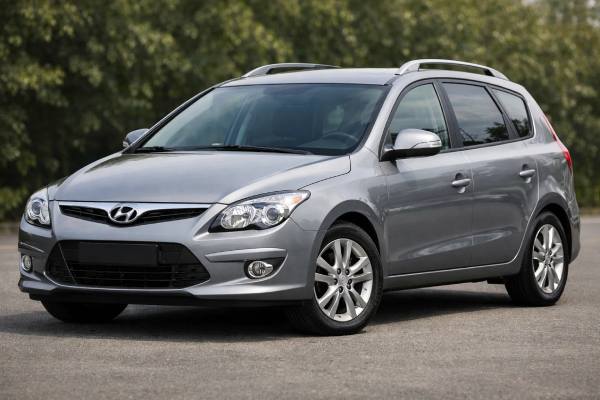
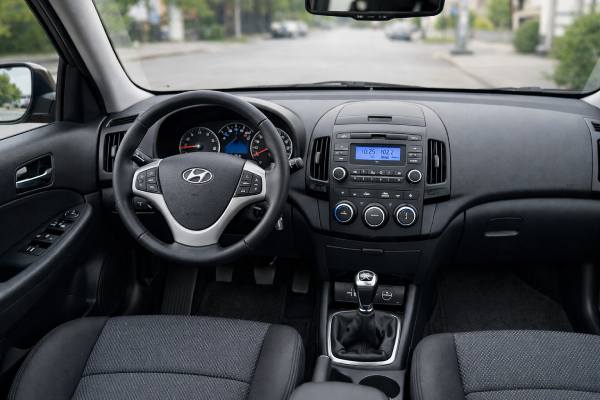
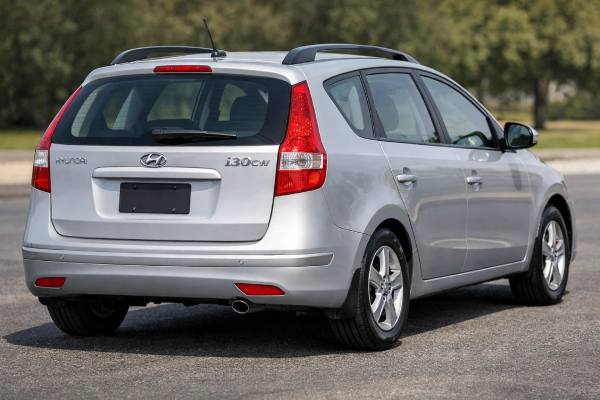
The facelifted Hyundai i30cw FD 1.4 MPI fills a very specific role in the used-car market. It is the practical estate version of the first-generation i30, powered by Hyundai’s simple 1.4-liter naturally aspirated petrol engine. That means it offers something many buyers still want today: honest mechanicals, useful cabin and cargo space, and fewer diesel-specific or turbo-related complications than many rivals from the same era. It is not a fast car, and it does not pretend to be, but it can be a very sensible long-term choice when condition is right.
The i30cw’s appeal starts with packaging. Compared with the hatchback, it gives you a longer body, a larger boot, a longer wheelbase, and better family usefulness without becoming awkward to drive. Add the chain-driven G4FA engine and Hyundai’s independent rear suspension, and the result is a compact estate that still feels balanced. The real question now is not design quality alone. It is whether the car has been serviced properly, kept rust-free underneath, and repaired without shortcuts.
Quick Specs and Notes
- Large, square cargo area makes the i30cw far more useful than the hatch for prams, luggage, and flat-pack loads.
- The 1.4 MPI petrol engine is simpler to own than many small diesels and avoids turbo and DPF concerns.
- Longer wheelbase and independent rear suspension help the wagon feel stable and comfortable on rough roads.
- Neglected cars can develop timing-chain noise, ignition misfires, rear brake drag, and underbody corrosion.
- A practical oil and filter interval is every 15,000 km or 12 months, and sooner if the car does many short trips.
Section overview
- Hyundai i30cw FD Wagon Basics
- Hyundai i30cw FD Data Tables
- Hyundai i30cw FD Features and Safety
- Reliability and Recall Watch
- Service Plan and Buying Advice
- Road Manners and Economy
- Estate Rivals Compared
Hyundai i30cw FD Wagon Basics
The Hyundai i30cw was Hyundai’s answer to buyers who liked the standard i30 but needed more utility. In facelifted 2010–2012 form, the wagon kept the same basic strengths as the hatchback while improving everyday practicality in a meaningful way. That matters, because many compact estates promise more space but do not always deliver a noticeably better ownership experience. The i30cw usually does.
The first advantage is simply shape. The longer body and wagon roofline make the rear compartment much more useful than the hatchback’s boot, especially when loading tall or boxy items. The luggage opening is more practical, the load area is longer, and the squared-off body gives the car a more genuinely family-focused character. Roof rails, a cargo blind, luggage hooks, and wagon-specific storage details also help it feel purpose-built rather than improvised.
Mechanically, the 1.4 MPI version is the simple end of the facelift i30cw line-up. The G4FA engine is a naturally aspirated 1.4-liter four-cylinder with multi-point injection and a timing chain. That is important because it means fewer high-cost systems to worry about than on a comparable small turbo engine or an older diesel estate. There is no turbocharger, no dual-mass flywheel issue in the diesel sense, and no particulate filter. The trade-off is modest low-end torque. This engine works best when driven cleanly through the gears rather than lugged at low rpm.
The wagon also benefits from the FD platform’s suspension layout. Hyundai gave the i30 range an independent rear setup, which helps the i30cw feel composed despite its extra size and cargo capacity. It rides with more maturity than some budget rivals, and the longer wheelbase gives the estate a slightly calmer road manner than the hatch. It is still a compact car, but it does not feel cheap or flimsy.
For used buyers, the i30cw 1.4 MPI makes the most sense as a practical ownership tool. It suits families, commuters, dog owners, cyclists, and anyone who values usable space more than quick acceleration. It is especially appealing to drivers who want a petrol estate without the complexity of more modern downsized turbo cars.
The weakness is not concept but condition. These are now older vehicles, and many have moved through several owners. A well-kept i30cw can still be a straightforward, dependable estate. A tired one can need a chain of ordinary but costly jobs all at once: tyres, brakes, battery, suspension links, ignition parts, air conditioning work, and corrosion repair. That is why the right example feels like good value, while the wrong one only looks cheap.
Hyundai i30cw FD Data Tables
The following figures describe the common European Hyundai i30cw FD facelift wagon with the 1.4 MPI 109 hp engine and 5-speed manual from 2010 to 2012. Some specifications vary by market, trim, and wheel package, so these numbers are the best working baseline for this exact model rather than an absolute answer for every VIN.
Powertrain and efficiency
| Item | Specification |
|---|---|
| Engine code | G4FA |
| Engine layout and cylinders | Inline-4, transverse, 4 cylinders |
| Valvetrain | DOHC, 4 valves per cylinder |
| Bore × stroke | 77.0 × 75.0 mm (3.03 × 2.95 in) |
| Displacement | 1.4 L (1,396 cc) |
| Induction | Naturally aspirated |
| Fuel system | Multi-port manifold injection |
| Compression ratio | 10.5:1 |
| Max power | 109 hp (80 kW) @ 6,200 rpm |
| Max torque | 137 Nm (101 lb-ft) @ 5,000 rpm |
| Timing drive | Chain |
| Rated combined efficiency | 6.3 L/100 km (37.3 mpg US / 44.8 mpg UK) |
| Real-world highway @ 120 km/h | about 6.4–7.2 L/100 km (32.7–36.8 mpg US / 39.2–44.1 mpg UK) |
Transmission and driveline
| Item | Specification |
|---|---|
| Transmission | 5-speed manual |
| Drive type | Front-wheel drive |
| Differential | Open |
Chassis and dimensions
| Item | Specification |
|---|---|
| Suspension front / rear | MacPherson strut / independent multi-link |
| Steering | Rack and pinion, electric assist |
| Steering turns lock-to-lock | about 2.69 |
| Brakes | Ventilated front discs / solid rear discs, commonly 280 mm (11.0 in) front and 262 mm (10.3 in) rear |
| Most common tyre size | 185/65 R15, with 205/55 R16 common on better-equipped cars |
| Ground clearance | about 135–150 mm (5.3–5.9 in), market and measurement method dependent |
| Length / width / height | 4,500 / 1,775 / 1,565 mm (177.2 / 69.9 / 61.6 in) |
| Wheelbase | 2,700 mm (106.3 in) |
| Turning circle | about 10.4 m (34.1 ft) |
| Kerb weight | about 1,236 kg (2,725 lb) |
| GVWR | about 1,820 kg (4,012 lb) |
| Fuel tank | 53 L (14.0 US gal / 11.7 UK gal) |
| Cargo volume | 415 L seats up / 1,395 L seats folded (14.7 / 49.3 ft³) |
Performance and capability
| Item | Specification |
|---|---|
| 0–100 km/h | 12.6 s |
| Top speed | 187 km/h (116 mph) |
| Braking distance | tyre and surface dependent; no single official figure confirmed for this exact trim |
| Towing capacity | 1,200 kg (2,646 lb) braked / 500–550 kg (1,102–1,213 lb) unbraked, market dependent |
| Payload | about 584 kg (1,288 lb) |
Fluids and service capacities
| Item | Specification |
|---|---|
| Engine oil | API SL or SM, ACEA A3 or above in Europe-market guidance; 3.3 L (3.49 US qt) |
| Coolant | about 6.0 L (6.34 US qt); long-life coolant mixed with water to climate requirements |
| Transmission fluid | manual gearbox specification varies by revision; verify by VIN |
| Differential / transfer case | Not applicable |
| Brake fluid | DOT 4 |
| A/C refrigerant | R134a; charge varies by equipment and market |
| Key torque specs | Wheel nuts 88–108 Nm (65–80 lb-ft) |
Safety and driver assistance
| Item | Specification |
|---|---|
| Euro NCAP | 2007 old-protocol result broadly applied to the i30 line: 4-star adult, 3-star child, 2-star pedestrian |
| IIHS | Not applicable for this market and body style |
| Headlight rating | Not applicable |
| ADAS suite | No AEB, ACC, lane-keeping assist, blind-spot monitoring, rear cross-traffic alert, or traffic-sign assist |
| Core safety hardware | ABS, airbags, ISOFIX, and ESC/ESP on many facelift cars depending on trim and region |
The data tells the story clearly. The i30cw is not a performance estate, but it is light, practical, and mechanically straightforward. Its strongest numbers are the cargo figures, sensible weight, and balanced chassis layout rather than its acceleration.
Hyundai i30cw FD Features and Safety
Trim structures varied by country, which is normal for Hyundai products of this period. Some markets used names such as Classic, Comfort, Style, Premium, SLX, or Elite. Others mixed equipment differently. For a used buyer, that means the badge matters less than the actual content fitted to the vehicle.
In base form, the i30cw usually covered the essentials well. Air conditioning, power accessories, folding rear seats, a decent stereo, and the wagon-specific practicality features were often enough to make even lower trims useful family cars. Mid-range versions tend to be the sweet spot. They often added alloy wheels, cruise control, better audio controls, improved seat trim, and more complete convenience equipment without pushing tyre or wheel costs too high. Higher trims may include parking sensors, automatic lighting, climate control, nicer interior finishes, and more polished cabin details.
The wagon also brought equipment that mattered in daily use:
- roof rails on many cars
- cargo-area tie-down points
- retractable cargo cover
- barrier net or load-management accessories on some markets
- rear armrest and split-fold rear seats
- luggage lamp and underfloor storage details
Quick identifiers are helpful when inspecting one:
- Check wheel size and tyre profile.
- Look for cruise-control buttons and steering-wheel audio controls.
- Confirm whether the car has manual air conditioning or climate control.
- Check for parking sensors and factory roof rails.
- Confirm ESC/ESP presence by switchgear, warning-light behavior, and equipment list.
Safety needs context. The i30 range tested respectably when new, but it belongs to the older Euro NCAP era, so its four-star adult rating is not directly comparable with current cars. Still, the structure held up reasonably well in the period test, and Hyundai fitted the important passive safety basics. Depending on trim and region, the i30cw may have dual front airbags, side airbags, curtain airbags, seatbelt pretensioners, ISOFIX anchor points, ABS with EBD, and electronic stability control.
The gap, by modern standards, is active safety. There is no camera-based lane system, no radar emergency braking, and no blind-spot support. That makes maintenance and condition especially important. A used estate with old tyres, poor headlamp output, weak rear brakes, or unresolved warning lights gives away a large part of its safety margin.
Inspect these areas carefully:
- airbag, ABS, ESC, and steering warning lights
- front crash structure and inner-wing repair quality
- condition of seatbelts and buckles
- operation of the tailgate latch and child locks
- correct fit of rear seats and ISOFIX points
- brake feel and straight-line stopping stability
The facelift did not transform the i30cw into a technology-led car. What it did offer was a sensible safety base for the time, a predictable chassis, and enough trim variety that buyers could choose between basic utility and near-family-spec comfort. The key today is verifying equipment rather than assuming it.
Reliability and Recall Watch
The facelifted i30cw 1.4 MPI is generally one of the simpler versions of the FD line to own. That does not make it fault-free. It means the common faults are usually easier to understand and less financially dangerous than those on an old diesel or a more complex automatic. The biggest enemy is delayed maintenance.
Common, low-to-medium cost issues
- Ignition coil and spark-plug faults: Symptoms are uneven idle, hesitation, misfire under load, and engine warning lights. The likely cause is a weak coil or overdue plugs. The usual fix is straightforward replacement and a check for oil contamination around the plug wells.
- Front suspension knocks: Anti-roll-bar links, bushes, and lower-arm wear are common on rough-road or city-used cars. The symptom is a loose, tapping front end over smaller bumps.
- Rear brake drag: Older rear calipers can seize or partially stick, especially on lightly used estates. Symptoms include uneven pad wear, hotter rear wheels, or poor economy.
- Electrical niggles: Window regulators, blower resistors, central locking actuators, hatch wiring fatigue, and weak batteries are all familiar age-related issues.
Occasional, medium-cost issues
- Timing-chain noise or stretch: The G4FA uses a timing chain, which removes a routine belt replacement job but does not make the system lifetime-proof. Cold-start rattle, correlation faults, or persistent chain noise after poor oil-service history deserve inspection.
- Cooling-system wear: Thermostats, radiators, hose joints, and water pumps can age out. Watch for slow warm-up, fluctuating temperature, coolant smell, or unexplained loss.
- Air-conditioning faults: Compressors, clutches, or small refrigerant leaks are common on older compact estates and often ignored until hot weather arrives.
Occasional, higher-cost if neglected
- Catalyst and lambda-sensor problems: Long-term misfire or rich running can damage emissions components.
- Clutch wear: The 1.4 MPI is not especially hard on clutches, but stop-start city use can still shorten life.
Corrosion is not the model’s defining weakness, but wagon buyers should pay close attention to underbody condition. Inspect front and rear subframes, brake pipes, sill seams, rear arches, jacking points, lower tailgate edges, and the floor around the cargo area. Wagons that have lived outdoors and carried wet cargo or dogs can hide moisture-related wear in the rear compartment.
Recall history is a serious part of the ownership picture. The FD-generation i30 line was affected by an airbag control unit programming recall affecting 2007–2012 vehicles, and certain 2010–2012 cars were recalled for ESC module casing damage that could let moisture in and lead to short-circuit malfunction. In some markets there were also ABS and ESC power short concerns. On a used i30cw, proof of recall completion is just as important as stamped servicing.
Before purchase, ask for:
- Complete service records.
- Recall completion evidence by VIN.
- A true cold start.
- Brake and tyre invoices.
- Underside inspection photos or lift access.
A healthy i30cw 1.4 MPI can age very well. A neglected one can still be recovered, but only if the purchase price reflects the real work it needs.
Service Plan and Buying Advice
The i30cw rewards steady, ordinary maintenance. It is not especially demanding, but it responds badly to the lazy used-car pattern of skipping services, fitting cheap tyres, and waiting for noises to become failures. A wagon that has carried family duty for years often survives well if it was serviced on time. One that was treated as disposable does not.
A practical maintenance schedule for real ownership looks like this:
| Item | Practical interval |
|---|---|
| Engine oil and filter | Every 15,000 km or 12 months |
| Engine air filter | Inspect regularly, replace about every 30,000–45,000 km or sooner in dusty use |
| Cabin air filter | Every 15,000 km or 12 months |
| Spark plugs | About every 45,000–60,000 km depending on plug type and service history |
| Coolant | First replacement at about 210,000 km or 10 years, then every 30,000 km or 24 months |
| Brake fluid | Every 24 months |
| Brake pads and discs | Inspect at every service |
| Drive belts and hoses | Inspect at every service, replace on condition |
| Manual gearbox oil | Check for leaks and shift quality; proactive renewal around 90,000–120,000 km is sensible |
| Timing chain | No fixed interval; inspect if cold-start noise or timing faults appear |
| Tyre rotation | Every 10,000–15,000 km |
| Alignment check | Yearly or when tyre wear becomes uneven |
| 12 V battery | Test from year 4 onward; many need replacement in the 4–6 year window |
Important service details are simple but worth getting right. Engine oil capacity is 3.3 L. Europe-market guidance calls for API SL or SM and ACEA A3 or above. Brake fluid is DOT 4. Coolant volume is about 6.0 L as a working reference. Wheel-nut torque is 88–108 Nm. Manual gearbox fluid specification should be confirmed by VIN and gearbox revision, not guessed from a generic parts listing.
Buyer’s checks should focus on the expensive truth:
- cold start and idle quality
- timing-chain noise on first start
- coolant condition and stable temperature
- clutch take-up and shift quality
- rear caliper drag
- air-conditioning performance
- warning lights and charging voltage
- underbody corrosion, subframes, and brake lines
- tailgate struts, latch, and cargo-area water leaks
- tyre age and matching brands
The best examples are usually later facelift cars with mid-spec equipment, good service documentation, sensible wheel sizes, and proof of recall work. Cars to approach carefully are those with vague history, noisy cold starts, mixed cheap tyres, fresh underbody coating over rusty metal, or obvious wagon wear such as damaged cargo trim and water ingress in the rear.
Long-term durability is decent. The engine itself is not the main concern. The real risk is buying an estate that looks practical but has five delayed maintenance jobs waiting underneath.
Road Manners and Economy
The i30cw 1.4 MPI drives like a car designed for everyday use, not for image. That is mostly a compliment. The steering is light, visibility is good, the controls are easy, and the estate body never feels clumsy. The wagon’s longer wheelbase gives it a slightly calmer feel than the hatchback, especially on broken roads and faster A-road or motorway travel.
Ride quality is one of its better traits. The suspension setup deals with poor surfaces more confidently than some cheaper compact estates of the same era. It is not soft in a floaty way, but it absorbs bumps without sounding brittle. Load it with luggage or a child seat and weekend gear, and it still feels composed. The rear suspension also helps the car stay tidy in corners, even if this is not a sporty estate.
Steering feel is adequate rather than memorable. The car tracks straight and behaves predictably, but it does not have the sharp feedback of the best Ford rivals. Braking is usually reassuring when the system is healthy, though rear-caliper condition has a big effect on pedal consistency and overall response.
The engine defines the rest of the experience. Throttle response is clean, but torque is modest and arrives high in the rev range. Around town the car feels pleasant enough, but on inclines, when fully loaded, or during motorway overtakes, the 1.4 needs a downshift and some planning. That does not make it a bad powertrain. It simply means it suits measured drivers better than impatient ones.
Real-world fuel use usually looks like this:
- city: about 7.8–8.8 L/100 km, or 26.7–30.2 mpg US and 32.1–36.2 mpg UK
- highway at 100–120 km/h: about 6.0–7.2 L/100 km, or 32.7–39.2 mpg US and 39.2–47.1 mpg UK
- mixed use: about 6.7–7.5 L/100 km, or 31.4–35.1 mpg US and 37.7–42.2 mpg UK
Those figures are reasonable for a petrol estate of this age and size. Short journeys, poor tyres, extra load, roof accessories, old spark plugs, and dragging rear brakes can push them higher. The 53-liter tank still gives the wagon a respectable touring range.
Performance figures explain the character honestly. A 0–100 km/h time of 12.6 seconds and top speed of 187 km/h mean the i30cw is competent, not brisk. When towing near its rated limit or carrying a full load, expect a clear reduction in response and a fuel-use penalty of roughly 10–20 percent. Even so, the car remains easy to place on the road and pleasant to operate, which is why many owners like it more than its numbers suggest.
Estate Rivals Compared
The facelifted Hyundai i30cw 1.4 MPI makes most sense when compared with other compact estates or practical hatchbacks from the same period. It was never the class icon, but it was a rational and well-packaged alternative.
Against the Kia cee’d SW 1.4, the Hyundai is facing its closest relative. Much of the core engineering is shared, so the buying decision often comes down to price, equipment, and condition. The i30cw can feel slightly more understated, while the cee’d SW is sometimes cheaper. Mechanically, there is no dramatic gap between them.
Against the Ford Focus estate 1.6 petrol, the Ford still wins for steering feel and driver engagement. It is the more rewarding car to push. But the i30cw answers with a simpler ownership proposition, often lower used prices, and very honest packaging. If your priority is family utility over cornering feel, the Hyundai remains highly competitive.
Against the Volkswagen Golf Variant 1.4 or 1.6 petrol, the Golf offers a stronger brand image and, in some trims, a more premium-feeling cabin. The Hyundai usually responds with better value, lower entry cost, and less worry about buying a badge at the expense of maintenance history.
Against the Toyota Auris Touring Sports there is a generational mismatch in some markets, but buyers often cross-shop them in the used world. Toyota usually wins on brand reputation, yet the i30cw can still feel more comfortable and less sterile for the money.
The Hyundai’s core strengths are easy to identify:
- genuinely useful estate body
- simple naturally aspirated petrol engine
- calm ride and stable chassis
- sensible purchase prices
- good everyday ergonomics
Its weaker points are equally clear:
- modest low-rpm performance
- no modern driver-assistance systems
- age-related electrical and suspension wear
- recall history that must be checked carefully
- less badge appeal than some European rivals
That leaves the i30cw in a strong value position. Buy the Focus if steering feel matters most. Buy the Golf if brand image and cabin polish lead the decision. Buy the i30cw if you want a straightforward compact estate with honest mechanicals, practical space, and fewer complexity traps than many rivals. In that role, it still makes a lot of sense.
References
- HYUNDAI I30 2011 OWNER’S MANUAL Pdf Download | ManualsLib 2011 (Owner’s Manual)
- Hyundai i30 I CW (facelift 2010) 1.4 (109 Hp) | Technical specs, data, fuel consumption, Dimensions 2026 (Technical Data)
- Frontal impact driver Frontal impact passenger Side impact … 2007 (Safety Rating)
- REC-000635 – Hyundai Motor Company – HYUNDAI I30 2007 – 2012 | Vehicle Recalls 2019 (Recall Database)
- REC-000614 – Hyundai Motor Company Australia Pty Ltd – HYUNDAI i30 2010 – 2012 | Vehicle Recalls 2016 (Recall Database)
Disclaimer
This article is for informational purposes only and is not a substitute for professional diagnosis, repair, or official workshop procedures. Specifications, torque values, intervals, capacities, and repair methods can vary by VIN, market, model year, transmission, and equipment, so always verify details against official service documentation for the exact vehicle.
If this guide helped you, please consider sharing it on Facebook, X, or another social platform to support our work.