
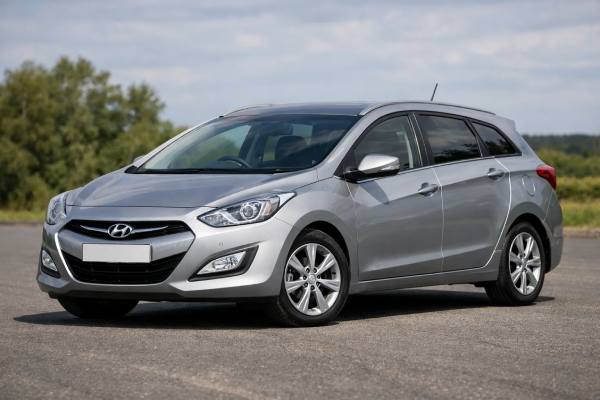
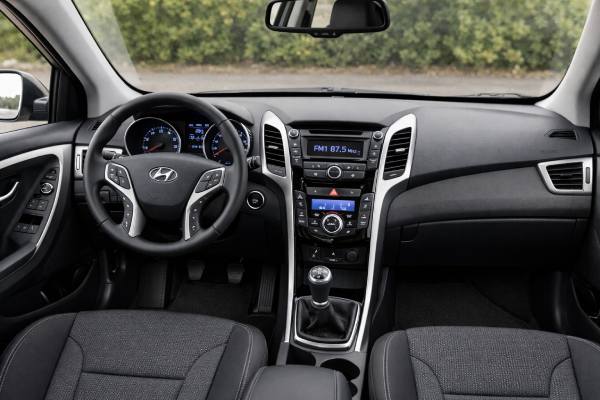
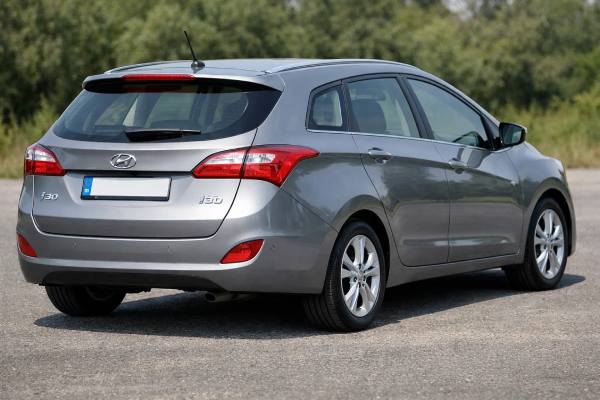
The Hyundai i30 Tourer GD 1.6 GDI is one of those estate cars that earns its place through balance rather than headline drama. It combines a roomy wagon body, a direct-injection naturally aspirated petrol engine, and a chassis that feels more mature than many buyers expect from a compact family Hyundai of this era. That makes it appealing today for owners who want more luggage space than a hatchback, but who do not want diesel complexity or a small turbo petrol working hard all the time.
This 135 hp version also sits in an interesting middle ground. It is stronger than the basic petrol engines and smoother than the diesels in short-trip use, yet it keeps the straightforward front-wheel-drive layout and practical cabin that helped the GD-generation i30 become a serious rival to the Focus, cee’d, and Golf. The main ownership question is not whether the design works. It does. The real question is whether the specific car has been maintained well enough to keep its direct-injection engine, steering system, and suspension feeling healthy.
Essential Insights
- The Tourer body is genuinely practical, with 528 L of luggage space and a long, useful load floor.
- The 1.6 GDI engine offers cleaner throttle response and better mid-range flexibility than the smaller petrol options.
- Ride comfort, high-speed stability, and cabin space are strong points for a compact estate.
- Direct injection means intake-valve carbon build-up and fuel-system cleanliness deserve more attention than on older MPI engines.
- A sensible engine-oil interval is every 10,000–15,000 km or every 12 months.
Contents and shortcuts
- Hyundai i30 Tourer GD Wagon Character
- Hyundai i30 Tourer GD Numbers and Capacities
- Hyundai i30 Tourer GD Grades and Protection
- Age-Related Trouble Spots and Campaigns
- Upkeep Schedule and Used-Buying Checks
- On-Road Feel and Economy
- Where It Stands Among Estates
Hyundai i30 Tourer GD Wagon Character
The GD-generation i30 Tourer was designed to do a very specific job. It had to offer the luggage flexibility of a wagon without becoming bulky or van-like to drive. Hyundai managed that well. The Tourer keeps the hatchback’s 2,650 mm wheelbase but extends the rear bodywork to create a longer roofline and a more useful cargo area. The result is an estate that remains easy to thread through town, yet can swallow family luggage, bicycles with wheels off, flat-pack furniture, or a dog crate more easily than the hatchback version.
That packaging is a major part of this model’s appeal. The 528-liter boot is not just large on paper. It is square, low enough to load without drama, and backed by split-folding seats that create a broad flat area for longer items. Roof rails, underfloor storage, cargo blind arrangements, and various tie-down solutions also made the Tourer feel purpose-built rather than improvised. For owners who regularly carry mixed loads, it is a more convincing everyday tool than many stylish compact wagons with narrow rear openings.
The 1.6 GDI engine is also a meaningful step up from the smaller 1.4 MPI. With 135 hp and 164 Nm, it gives the Tourer enough performance to feel comfortable with passengers and luggage, especially in manual form. It is not a torque-rich turbo engine, but it is smoother and more willing than the base petrol unit. Because it uses direct injection, it feels more modern in character, with better efficiency and sharper response than a conventional port-injected engine of similar size. The trade-off is that it needs cleaner maintenance habits and is more prone to intake-valve deposits over time.
On the road, the Tourer benefits from the GD i30’s generally mature chassis tune. Steering is light, but the car rides well, stays composed over broken surfaces, and feels stable on the motorway. The extra rear body length does not ruin the balance. In fact, it often makes the car feel a touch more settled than the hatch when loaded.
Today, this version makes the most sense for buyers who want petrol simplicity but still need estate practicality. It is not the cheapest i30 to maintain, and it is not the fastest, but it often lands in the sweet spot between usability, comfort, and long-term sense.
Hyundai i30 Tourer GD Numbers and Capacities
Below is a practical specification summary for the Hyundai i30 Tourer GD 1.6 GDI 135 hp built from 2012 to 2015. Small variations by country, trim, tyre package, and gearbox are normal, so always confirm exact values by VIN where it matters.
Powertrain and efficiency
| Item | Data |
|---|---|
| Engine code | G4FD |
| Engine layout and cylinders | Inline-4 petrol, 4 cylinders |
| Valvetrain | DOHC, D-CVVT, 4 valves per cylinder |
| Bore × stroke | 77.0 × 85.44 mm (3.03 × 3.36 in) |
| Displacement | 1.6 L (1,591 cc) |
| Induction | Naturally aspirated |
| Fuel system | Gasoline direct injection |
| Compression ratio | 11.0:1 |
| Max power | 135 hp (99 kW) @ 6,300 rpm |
| Max torque | 164 Nm (121 lb-ft) @ 4,850 rpm |
| Timing drive | Chain |
| Rated combined efficiency | about 6.3 L/100 km manual and about 6.9 L/100 km automatic |
| Real-world highway @ 120 km/h | usually about 6.5–7.4 L/100 km, depending on load, tyres, and weather |
Transmission and driveline
| Item | Data |
|---|---|
| Transmission | 6-speed manual or 6-speed automatic, market dependent |
| Drive type | FWD |
| Differential | Open |
Chassis and dimensions
| Item | Data |
|---|---|
| Front suspension | MacPherson strut |
| Rear suspension | Multi-link independent rear suspension |
| Steering | Motor-driven power steering, rack and pinion |
| Steering numeric detail | about 2.85 turns lock-to-lock |
| Brakes | Ventilated front discs and solid rear discs |
| Brake diameter | 280 mm (11.0 in) front / 262 mm (10.3 in) rear |
| Most popular tyre size | 205/55 R16 |
| Ground clearance | about 140 mm (5.5 in) |
| Length | 4,485 mm (176.6 in) |
| Width | 1,780 mm (70.1 in) |
| Height | 1,500 mm (59.1 in) |
| Wheelbase | 2,650 mm (104.3 in) |
| Turning circle | 10.6 m (34.8 ft) |
| Kerb weight | about 1,223–1,366 kg (2,696–3,012 lb) manual |
| GVWR | 1,820 kg (4,012 lb) manual |
| Fuel tank | 53 L (14.0 US gal / 11.7 UK gal) |
| Cargo volume | 528 L (18.6 ft³) seats up / 1,642 L (58.0 ft³) seats folded |
Performance and capability
| Item | Data |
|---|---|
| 0–100 km/h | about 10.2 s manual / about 11.0–11.3 s automatic |
| Top speed | about 192 km/h (119 mph) manual / about 190 km/h (118 mph) automatic |
| Braking distance | exact factory 100–0 km/h figure not consistently published for this variant |
| Towing capacity | 1,400 kg (3,086 lb) braked / 650 kg (1,433 lb) unbraked |
| Payload | roughly 450–600 kg depending on trim and kerb weight |
Fluids and service capacities
| Item | Data |
|---|---|
| Engine oil | usually 0W-30 or 5W-30 meeting the correct Hyundai petrol specification |
| Engine oil capacity | about 3.6 L (3.8 US qt) service fill / about 4.2 L (4.4 US qt) dry |
| Coolant | ethylene-glycol long-life coolant |
| Coolant capacity | about 5.8 L (6.1 US qt) |
| Manual transmission fluid | verify by gearbox code; usually just under 2.0 L |
| Automatic transmission fluid | verify by transmission code and market |
| Brake and clutch fluid | DOT 3 or DOT 4 |
| A/C refrigerant | verify by under-bonnet label |
| Key torque spec | wheel nuts 88–107 Nm (65–79 lb-ft) |
Safety and driver assistance
| Item | Data |
|---|---|
| Euro NCAP and ANCAP | 5 stars |
| Adult / child / vulnerable road user / safety assist | 90% / 90% / 67% / 86% |
| IIHS | not applicable to this European-market wagon |
| Headlight rating | no IIHS headlight rating applicable |
| ADAS suite | no AEB, ACC, lane-keep assist, blind-spot warning, or rear cross-traffic assist |
Hyundai i30 Tourer GD Grades and Protection
The i30 Tourer GD was sold in a wide range of trims, and that matters because used examples can feel very different depending on wheel size, seat trim, convenience equipment, and safety features. The base structure of the car stays the same, but the ownership experience does not. A smaller-wheel cloth-seat car with manual air conditioning will ride more softly and cost less to maintain than a larger-wheel upper trim with panoramic roof, heated seats, and more electronics.
Many markets followed a familiar ladder, moving from entry-level fleet grades through mid-spec family trims to better-equipped comfort or premium versions. Lower trims often included LED daytime running lights, air conditioning, Bluetooth, electric front windows, multiple airbags, stability control, and split-fold rear seats. Mid-spec cars usually added alloy wheels, cruise control with speed limiter, better audio, parking sensors, folding mirrors, and improved interior materials. Higher trims could bring a panoramic glass roof, leather or part-leather trim, heated front seats, automatic lights and wipers, navigation, rear camera, and sometimes a smart-key setup.
Mechanical differences were modest, but they are worth noting. Smaller wheels on 15- or 16-inch tyres generally suit the Tourer best for ride comfort and cost. Seventeen-inch wheels look better, but tyre bills are higher and broken-road refinement suffers. Automatic variants can be appealing in traffic, but the manual is the better fit for the 1.6 GDI engine because it makes the most of the engine’s moderate torque and helps keep the car feeling alert.
Safety was a strong point when the GD i30 range launched. ANCAP’s rating for the 2012 introduction explicitly applied to hatch and wagon variants, based on Euro NCAP testing of the left-hand-drive 1.4-liter European model and Hyundai evidence that other versions offered comparable protection. That is useful here because it means the Tourer shares the same strong basic crash structure and restraint strategy.
Standard safety equipment on many markets included front airbags, side airbags, full-length curtain airbags, ABS, electronic brake-force distribution, electronic stability control, and front seatbelt pretensioners. Some markets added a driver knee airbag as standard equipment. ISOFIX anchor points were also a routine part of the package.
What the Tourer does not have is a modern active-safety suite. There is no autonomous emergency braking, no adaptive cruise control, no blind-spot system, and no lane centring. Buyers should think of it as a car with strong passive safety and baseline stability electronics, not as a sensor-led modern family wagon. After repair, the main safety question is whether the structure, airbags, seatbelts, steering, and suspension geometry remain correct, not whether any camera system has been recalibrated.
Age-Related Trouble Spots and Campaigns
The i30 Tourer 1.6 GDI is generally durable, but it is not maintenance-proof. Like many naturally aspirated direct-injection petrol engines from the early 2010s, it stays dependable when serviced on time and becomes annoying or costly when neglected.
Common and usually low-to-medium cost issues
- Carbon build-up on intake valves: This is the defining GDI ownership issue. Symptoms include rough idle, flat response, reduced economy, hesitation, or occasional misfire. The likely cause is intake-valve deposit formation because fuel no longer washes the valves as it does in MPI engines. Remedy ranges from careful intake cleaning to more involved walnut blasting where needed.
- Ignition wear: Spark plugs and coils are routine suspects when the engine runs unevenly under load. This is common, usually affordable, and worth fixing early to protect the catalyst.
- Steering clunk or flex-coupling wear: Some Hyundai and Kia models of this era develop a light clunk through the motor-driven steering system, often at low speed. It is usually more irritating than dangerous, but it should not be dismissed without diagnosis.
- Brake drag at the rear: Older estate cars that do mixed use often show sticky rear calipers, uneven handbrake effort, or premature inner-pad wear.
Occasional medium-cost issues
- Timing-chain noise on poorly serviced cars: The chain is not a routine replacement item, but it depends heavily on clean oil. Cold-start rattle, correlation faults, or persistent chain noise deserve quick attention.
- Cooling-system seepage: Thermostat housing issues, ageing hoses, and minor radiator leaks can appear with age. Overheating is not common as a design flaw, but any neglected coolant loss is a risk.
- Clutch wear: The manual gearbox is usually durable, but heavy urban use, hill starts, or towing can shorten clutch life.
Less common but higher-cost concerns
- High-pressure fuel-system trouble: Injector faults or pump-related issues are not everyday failures, but they can appear on neglected cars, especially where poor fuel quality or extended service intervals have played a role.
- Catalyst damage after prolonged misfire: If a car has been driven too long with a coil or plug problem, the bill can grow.
Corrosion is less severe than on older FD-generation i30s, but it still matters. Check rear arches, lower tailgate or tailgate-seam areas, subframe points, door bottoms, jacking points, brake pipes, and underbody seams. Estates often lead harder practical lives than hatchbacks, so bumper scuffs and luggage-area abuse are not unusual.
On recalls and service actions, one relevant official Australian campaign covered 2010–2012 i30s for possible ESC electronic-control-case damage that could let moisture in, causing a short circuit and ESC malfunction. Early GD-era cars may overlap with those dates, so VIN-based recall verification is essential. More broadly, some Hyundai models from nearby years also saw ABS-related campaigns in certain markets. The safest approach is simple: check dealer history and official VIN databases rather than assume nothing applies.
Upkeep Schedule and Used-Buying Checks
The i30 Tourer 1.6 GDI rewards routine servicing. It is not a difficult car to own, but it responds best when the basics are handled on time and the direct-injection system is not treated casually.
Practical maintenance schedule
- Engine oil and filter: every 10,000–15,000 km or 12 months. For repeated short trips, cold weather, or heavy urban use, stay near the shorter interval.
- Engine air filter: inspect at each service and replace roughly every 20,000–30,000 km, sooner in dusty conditions.
- Cabin filter: every 12 months or about 15,000–20,000 km.
- Spark plugs: inspect on schedule and replace at a sensible interval based on plug type and use. Do not push worn plugs too far on a GDI engine.
- Coolant: renew at the proper interval and use the correct long-life coolant. On a used car with unknown history, a full coolant refresh is sensible.
- Brake fluid: every 2 years.
- Manual gearbox oil: even if described as long-life, changing it around 80,000–100,000 km is a practical decision.
- Automatic transmission fluid: refresh earlier than the marketing language suggests, especially on an older estate.
- Timing chain: inspect by symptoms rather than mileage alone. Cold-start noise, engine warning lights, or poor service history matter more than a fixed number.
- Auxiliary belt and hoses: inspect annually.
- Rear brake inspection: make this a habit, because sliding-pin or caliper issues are common age items.
- Tyre rotation and alignment: rotate when wear pattern allows and check alignment after any suspension work.
- 12 V battery: test from around year four onward and replace proactively once cold-start performance drops.
Useful fluid and torque guidance
| Item | Practical guidance |
|---|---|
| Engine oil | 0W-30 or 5W-30, using the correct Hyundai-approved petrol specification |
| Engine oil quantity | about 3.6 L at service fill |
| Coolant quantity | about 5.8 L |
| Manual gearbox oil | verify by gearbox code, usually just under 2.0 L |
| Brake fluid | DOT 3 or DOT 4 |
| Wheel nut torque | 88–107 Nm |
Used-buyer checklist
- Start the engine cold and listen for chain rattle, misfire, or unstable idle.
- Watch for hesitation or rough running once warm.
- Ask specifically about spark plugs, coils, and any intake cleaning history.
- Check for smooth clutch take-up and test for slip in a higher gear.
- Drive over broken roads and listen for steering clunks or front-suspension knocks.
- Inspect tyres for uneven wear that suggests bush or alignment issues.
- Check rear brakes and handbrake operation carefully.
- Look under the car for rust at subframes, seams, and brake lines.
- Confirm that parking sensors, rear camera, climate control, and all windows work.
- Verify recall completion and dealer campaign history.
The long-term durability outlook is good for a clean, serviced example. The wrong car feels like a tired compact estate. The right one feels like a very rational long-term family wagon.
On-Road Feel and Economy
The i30 Tourer 1.6 GDI is best judged as an everyday estate rather than as a performance car. Once you look at it that way, its strengths become easier to appreciate. The engine is smooth, linear, and cleaner in response than the smaller petrol units, while the estate body remains composed and secure even when carrying passengers and luggage. It does not leap forward with turbo urgency, but it is more flexible than its calm character first suggests.
Around town, the Tourer feels easy to manage. Steering is light, visibility is decent, and the engine responds crisply enough at small throttle openings. In city traffic, the manual gearbox suits the engine well because it lets the driver hold the right gear without waiting for a traditional automatic to kick down. The automatic version is more relaxed in congestion, but it blunts the car’s performance edge and tends to feel less eager.
On the open road, the Tourer’s chassis is one of its strongest assets. Straight-line stability is good, the rear suspension keeps the car planted over imperfect surfaces, and the longer estate body does not create a floppy or van-like feel. Steering feedback is limited, but body control is tidy and predictable. It is a car that feels mature rather than playful. For long family trips, that is usually the better outcome.
Noise levels are acceptable for the class and age. The engine is quiet enough under light load, though you hear it more clearly when asking for overtaking performance. On the motorway, wind and tyre noise depend heavily on wheel size and tyre brand. Smaller-wheel cars are typically the better all-round choice.
Real-world economy for a healthy manual Tourer
- City: about 7.5–9.0 L/100 km
- Highway at 100–120 km/h: about 6.1–7.4 L/100 km
- Mixed driving: about 6.8–7.8 L/100 km
Short cold trips, carbon build-up, old spark plugs, poor tyres, or dragging rear brakes can all push those figures upward. This is one reason a test drive should include both town work and a faster road.
The official performance numbers still matter because they explain the car’s character well: around 10.2 seconds to 100 km/h in manual form and a top speed of about 192 km/h. That is enough to feel capable without pretending to be fast. Load the car fully, and you notice the need to use the gearbox more actively, but the engine does not become harsh or unpleasant.
Overall, the i30 Tourer 1.6 GDI drives like a competent, well-rounded estate. Its priorities are comfort, predictability, and usable pace, not excitement. For many owners, that is exactly what makes it appealing.
Where It Stands Among Estates
The Hyundai i30 Tourer 1.6 GDI competed in one of Europe’s hardest segments. Its natural rivals included the Kia cee’d Sportswagon 1.6 GDI, Ford Focus Estate 1.6 Ti-VCT, Volkswagen Golf Variant 1.4 or 1.6 petrol, Opel or Vauxhall Astra Sports Tourer, Toyota Auris Touring Sports, and Mazda3-based family alternatives. Against those cars, the Hyundai rarely dominated in one single category, but it built a convincing all-round case.
Against the Ford Focus Estate, the Hyundai gives up some steering feel and driver involvement. The Ford remains the sharper car. The Hyundai answers with a calmer ride, strong practicality, and often lower used prices. Against the Volkswagen Golf Variant, the i30 Tourer feels less premium inside, but it often avoids the extra cost and complexity that can come with small turbo engines and DSG ownership. Against the Toyota Auris Touring Sports, the Hyundai usually feels more conventional and less costly to buy, though the Toyota keeps the stronger efficiency and hybrid argument in other versions. Against the Kia cee’d Sportswagon, the contest is especially close because the engineering overlap is substantial. In real life, service history matters more than the badge.
The Hyundai’s strongest arguments are simple:
- a useful 528-liter boot and practical wagon shape
- a petrol engine that avoids diesel emissions hardware
- a mature ride and stable motorway behavior
- strong period safety
- straightforward routine servicing
Its weaknesses are equally clear. The 1.6 GDI is not especially quick by modern standards, and because it is a direct-injection naturally aspirated engine, it lacks both the simplicity of old MPI engines and the effortless torque of later small turbos. Intake carbon and ignition upkeep are part of the ownership picture. That does not make it a poor choice, but it does mean buyers should know what they are choosing.
This Tourer makes the most sense for families, dog owners, cyclists, or commuters who want one car to do many jobs without moving into a larger class. It makes less sense for drivers who want effortless overtaking with a full load, or for those who mostly do very short urban trips and never give a GDI engine a proper run.
The verdict is straightforward. The Hyundai i30 Tourer GD 1.6 GDI is not the most glamorous estate of its era, but it remains one of the more rational ones. A well-kept example still offers a lot of useful car for sensible money.
References
- Think you know Hyundai? Think Again. 2012 (Brochure)
- Hyundai ireland Fleet guide 2014 (Fleet Guide)
- Hyundai Owners manuals 2026 (Owner’s Manual)
- Hyundai i30 | Safety Rating & Report 2012 (Safety Rating)
- REC-000614 – Hyundai Motor Company Australia Pty Ltd – HYUNDAI i30 2010 – 2012 | Vehicle Recalls 2016 (Recall Database)
Disclaimer
This article is for informational purposes only and is not a substitute for professional diagnosis, repair, or model-specific workshop guidance. Specifications, torque values, service intervals, procedures, and equipment vary by VIN, market, production date, transmission, and trim, so always verify critical details against the correct official service documentation for the exact vehicle.
If this guide helped you, please consider sharing it on Facebook, X, or another social platform to support our work.