
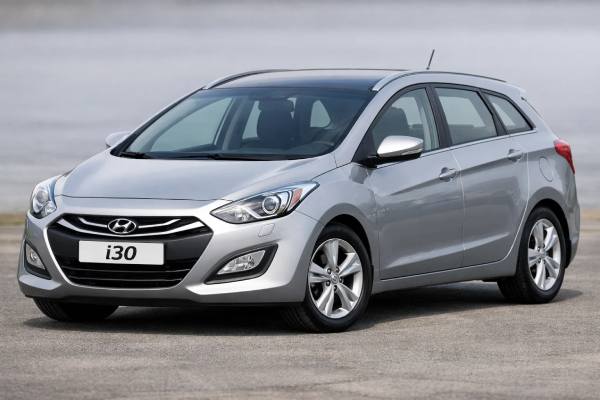
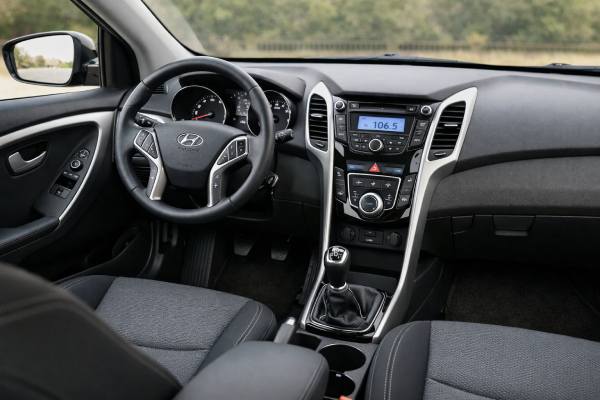
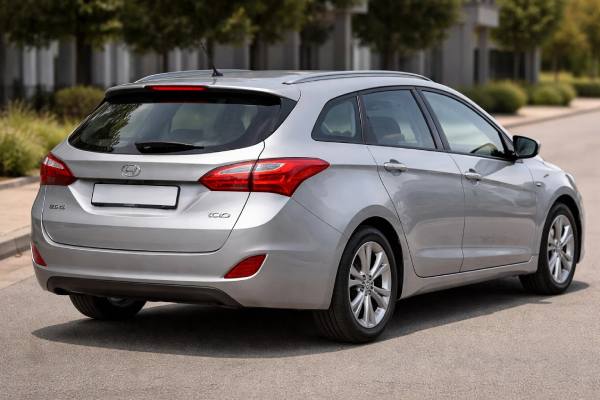
The Hyundai i30 Tourer GD 1.6 CRDi 128 hp is one of those compact estates that still looks like a smart idea years later. It takes the more mature second-generation i30 platform and adds a genuinely useful wagon body, giving buyers strong luggage space without moving up to a heavier SUV. In 128 hp diesel form, it also brings the better of the two mainstream 1.6 CRDi tunes, so the car feels more relaxed under load and more confident on the motorway than the lower-output version. That matters because this model’s appeal has always been practical rather than flashy: efficient long-distance use, a sensible six-speed transmission, good family space, and a chassis that feels more settled than many budget estates of the period. Today, those strengths still hold up well. The main caution is simple. This is now an older Euro 5 diesel estate, so DPF health, timing-chain condition, clutch wear, and honest service records matter much more than trim name alone.
Fast Facts
- The Tourer body adds a big jump in cargo space over the hatch while keeping compact exterior dimensions.
- The 128 hp 1.6 CRDi is the stronger diesel choice for mixed driving, motorway work, and carrying passengers or luggage.
- Six-speed transmissions and a 53-liter fuel tank make it an efficient long-distance family estate.
- Repeated short trips are the main ownership caveat because DPF and EGR problems are more likely on lightly used diesels.
- A sensible oil-and-filter interval is every 15,000 km or 12 months, with shorter intervals for severe use.
Explore the sections
- Hyundai i30 Tourer diesel character
- Hyundai i30 Tourer by numbers
- Hyundai i30 Tourer grades and protection
- Reliability patterns and recalls
- Service routine and used checks
- Estate-road manners
- Tourer versus wagon rivals
Hyundai i30 Tourer diesel character
The second-generation Hyundai i30 Tourer arrived at the point where Hyundai’s European compact cars had stopped feeling like outsiders and started feeling fully established in the class. That matters because the Tourer was never just a hatchback with a longer roof. Hyundai developed it as a proper estate version of the GD family, with a longer body, a much bigger load area, and a shape aimed squarely at European buyers who still wanted wagon practicality without SUV bulk. In that sense, it remains a very modern idea even now.
The best part of the package is how balanced it is. The Tourer is clearly more practical than the hatch, but it is not oversized or awkward in town. Overall length rises to 4,485 mm, yet the wheelbase remains 2,650 mm, so it still behaves like a compact car rather than a larger estate. The result is a wagon that can carry family luggage, flat-pack boxes, bikes, or dog gear without becoming annoying to park or heavy on running costs.
The 1.6 CRDi 128 hp engine gives the Tourer the kind of powertrain this body style really needs. The smaller 90 hp and 110 hp diesels can make sense in hatchback form, but once you add the estate body and start using the extra space, the stronger diesel becomes much easier to appreciate. With 260 Nm available from low revs, it pulls with enough confidence to make the car feel useful rather than merely efficient. It still is not a fast estate, but it is a much more complete one.
Hyundai’s own launch material made the Tourer’s role very clear. It shared engines and running gear with the five-door hatch, but it added a longer body and a fully flat-folding rear seat arrangement. Cargo capacity was a core part of the pitch, and the numbers still look strong today: 528 liters with the rear seats up and 1,642 liters with them folded. That is real estate-car usefulness, not just brochure optimism.
The Tourer also shows how far the i30 line had come. Hyundai designed and engineered this generation in Europe for European customers, and it feels that way. The suspension setup is not sporty in a hot-hatch sense, but it is composed, predictable, and mature. The driving position is easy to get comfortable in, the cabin feels more polished than older i30s, and the whole car gives the impression of a mainstream family estate rather than a bargain compromise.
That is why the model still works as a used buy. Buyers who want a compact diesel wagon are usually not searching for drama. They want space, economy, stable road manners, and repair costs that stay within reason. The i30 Tourer 1.6 CRDi 128 hp does all of that well. The real question now is not whether the design was good when new. It is whether the individual car has had the kind of servicing an older diesel estate requires. When the answer is yes, the Tourer still makes a very strong practical case.
Hyundai i30 Tourer by numbers
For this article, the baseline is the European-market Hyundai i30 Tourer GD with the 1.6 CRDi 128 hp diesel engine. The most representative configuration is the 6-speed manual because it best reflects the model’s combination of performance and economy, though some markets also offered a 6-speed automatic.
Powertrain and efficiency
| Item | Hyundai i30 Tourer (GD) 1.6 CRDi 128 hp |
|---|---|
| Code | D4FB |
| Engine layout and cylinders | Inline-4, 4 cylinders, DOHC, 4 valves/cyl |
| Bore × stroke | 77.2 × 84.5 mm (3.04 × 3.33 in) |
| Displacement | 1.6 L (1,582 cc) |
| Induction | Turbocharged, intercooler |
| Fuel system | Common-rail direct injection |
| Compression ratio | 17.3:1 |
| Max power | 128 hp (94 kW) @ 4,000 rpm |
| Max torque | 260 Nm (192 lb-ft) @ 1,900–2,750 rpm |
| Timing drive | Chain |
| Engine systems | Diesel particulate filter |
| Transmission | 6-speed manual or 6-speed automatic |
| Drive type | FWD |
| Differential | Open |
| Combined fuel use, manual | 4.1 L/100 km (57.4 mpg US / 68.9 mpg UK) |
| Urban, manual | 4.9 L/100 km (48.0 mpg US / 57.6 mpg UK) |
| Extra-urban, manual | 3.7 L/100 km (63.6 mpg US / 76.3 mpg UK) |
| Real-world highway @ 120 km/h | Typically about 5.2–6.0 L/100 km depending on tyres, load, wind, and DPF condition |
The official numbers show why this version is appealing. It offers the stronger diesel power output without moving to obviously high fuel use. Real-world motorway consumption will be higher than the extra-urban test figure, but still quite good for a practical estate.
Chassis, dimensions, and cargo
| Item | Hyundai i30 Tourer (GD) 1.6 CRDi 128 hp |
|---|---|
| Suspension front / rear | Fully independent MacPherson strut / fully independent multi-link |
| Steering | Motor-driven electric power steering |
| Steering wheel turns lock-to-lock | 2.85 |
| Brakes front / rear | 280 or 300 mm ventilated discs / 262 mm solid discs, depending on model |
| Wheels and tyres | 195/65 R15, 205/55 R16, or 225/45 R17 depending on trim |
| Length | 4,485 mm (176.6 in) |
| Width | 1,780 mm (70.1 in) |
| Height | 1,500 mm (59.1 in), including roof rails |
| Wheelbase | 2,650 mm (104.3 in) |
| Turning circle | 10.6 m (34.8 ft) |
| Ground clearance | about 140 mm (5.5 in) |
| Kerb weight | about 1,326 kg manual / 1,348 kg automatic (2,923 / 2,972 lb) |
| GVWR | about 1,920 kg manual / 1,940 kg automatic (4,233 / 4,277 lb) |
| Fuel tank | 53 L (14.0 US gal / 11.7 UK gal) |
| Cargo volume | 528 L (18.65 ft³) seats up / 1,642 L (57.99 ft³) seats folded |
The cargo figures are a major reason to choose the Tourer over the hatch. This is a proper estate with enough space to make a daily difference, not just a styling variation.
Performance, towing, fluids, and safety basics
| Item | Hyundai i30 Tourer (GD) 1.6 CRDi 128 hp |
|---|---|
| 0–100 km/h, manual | 11.2 s |
| Top speed, manual | 193 km/h (120 mph) |
| 0–100 km/h, automatic | 12.1 s |
| Top speed, automatic | 185 km/h (115 mph) |
| Payload | about 594 kg manual / 592 kg automatic |
| Towing capacity | Market dependent; verify by VIN and local handbook before purchase |
| Engine oil capacity | about 5.3 L (5.6 US qt) |
| Coolant capacity | about 6.9 L (7.3 US qt) |
| Oil grade | Low-SAPS diesel oil meeting the correct Hyundai and ACEA spec, commonly 5W-30 depending on climate |
| Coolant type | Hyundai-approved ethylene-glycol coolant |
| Crash rating | Euro NCAP 5 stars for the 2012 GD-generation i30 family |
| Euro NCAP scores | Adult 90%, Child 90%, Pedestrian 67%, Safety Assist 86% |
| ADAS | No AEB, ACC, BSD, or lane centering in the modern sense; core safety centers on ESC, airbags, and restraint systems |
Where open public sources are incomplete, honesty matters. Exact refrigerant charge, some gearbox fluid capacities, and critical torque values are best confirmed from VIN-specific workshop documentation rather than guessed from generic lists.
Hyundai i30 Tourer grades and protection
The i30 Tourer’s trim structure varied by country, but the pattern was familiar. Base and mid-range cars focused on value, smaller wheels, and lower operating costs. Higher trims added cabin finish, larger alloys, navigation, parking aids, and appearance upgrades that made the car feel more upscale. For a used buyer, that variation matters because the right Tourer is usually not the one with the longest option list. It is the one with the best combination of equipment, tyre size, maintenance history, and overall condition.
The 1.6 CRDi 128 hp engine often sat in the middle or upper-middle part of the range, because it was the more desirable diesel tune for buyers who actually used the estate body. That usually meant a better chance of finding cruise control, upgraded seat trim, Bluetooth or navigation, rear parking sensors, leather on key touch points, and 16- or 17-inch wheel packages. Some markets also offered Blue Drive features such as stop-start and low rolling resistance tyres to improve official fuel economy.
Wheel size changes the ownership story more than many people expect. A Tourer on 15-inch or 16-inch wheels usually rides more comfortably and costs less to maintain through tyres and suspension wear. A 17-inch car can look better and turn in more sharply, but it is also more sensitive to potholes and tyre pricing. For most used buyers, especially those focused on a diesel estate’s practical role, the smaller-wheel setup is the sweeter choice.
The Tourer also had a few useful quick identifiers. Smaller wheels, simpler seat fabrics, and more basic audio units usually point to lower trims. Better-equipped cars tend to show chrome or piano-black cabin details, larger screens or factory navigation, extra steering-wheel buttons, and added parking or lighting equipment. Country-specific trim names are less reliable than physical inspection, so the safest approach is always to verify the car you are standing in front of rather than assume a badge tells the full story.
Safety was a strong point for the GD generation. The 2012 Euro NCAP result for the i30 family was a real selling advantage, with strong adult and child occupant scores and a healthy safety-assist result for the time. That tells you the core shell, restraint systems, and stability-control setup were credible class players, not just value-car afterthoughts. The Tourer shared the same family engineering philosophy, which helps explain why it still feels reassuringly mainstream rather than bargain-basement.
That said, buyers need period context. This was a good safety story for the early 2010s, not a substitute for modern active-safety suites. There is no standard autonomous emergency braking, no adaptive cruise, no lane-centering support, and no modern blind-spot package in the way most people now expect. In daily ownership, that shifts attention back toward the fundamentals: tyres, brakes, suspension condition, working airbags, and completed recalls. A well-kept Tourer with healthy brakes and proper tyres is far more meaningful than a poorly maintained higher trim with a longer feature list.
Reliability patterns and recalls
The i30 Tourer GD 1.6 CRDi 128 hp is usually a sensible used diesel estate when it has been maintained properly. The platform is fundamentally sound, the engine is well known, and the wagon body does not introduce unusual complexity. The main risk is not a single catastrophic design flaw. It is accumulated neglect. Like many diesel family cars from this period, the Tourer stays rewarding if it gets the right kind of use and the right kind of servicing. When it does not, the problems tend to arrive in clusters.
Common, lower-to-medium cost issues
- Front suspension wear: drop links, bushes, and other front-end parts can create knocking and looseness.
- Rear brake drag: lightly used estates often suffer uneven rear brake wear or sticking hardware.
- Battery and glow-plug weakness: cold-weather starting issues are not rare as the cars age.
- Interior and load-bay wear: Tourers often worked hard, so scuffed cargo trim and tired tailgate fittings are common.
Common diesel-specific concerns
- DPF loading: frequent short trips can clog the filter, trigger warning lights, and raise fuel use.
- EGR contamination: hesitation, smoke, uneven throttle response, and stored fault codes often follow.
- Fuel filter neglect or poor diesel quality: hard starts and rough running are classic clues.
- Boost-hose or intercooler-pipe leaks: the car feels flat, breathless, and weaker than the 128 hp figure suggests.
Medium-cost ownership risks
- Clutch and dual-mass flywheel wear: shudder on take-up, heavy pedal feel, slip under load, or idle rattle point to wear.
- Injector imbalance or sealing problems: a diesel smell, rough cold idle, or over-fueling behavior deserves attention.
- Engine mounts: tired mounts can add vibration and make the car feel rougher than it really is.
- Cooling-system seepage: hoses and plastic fittings can leak gradually before the loss becomes obvious.
Less common but important
- Timing-chain wear symptoms: the D4FB avoids routine belt replacement, but not all chains last forever. Cold-start rattle, timing-correlation faults, or tensioner noise should never be ignored.
- Electronics and sensor issues: not a class-wide horror story, but ABS, airbag, or ESC warning lights must be diagnosed, not excused.
- Corrosion in harsher climates: the Tourer is not infamous for structural rust, yet rear underside areas, brake lines, subframe zones, and wheel-arch lips still deserve careful inspection.
Recall and service-campaign history is essential. The safest route is a VIN check through Hyundai’s official recall portal plus dealer or workshop records. That matters because campaign completion can vary by country, and assumptions based on internet recall lists are often unreliable.
Software updates can matter too. Diesel drivability issues and emissions-related faults are not always purely mechanical. If a car shows recurring warning lights, awkward regeneration behavior, or unexplained poor running, it is worth checking whether control-module updates were ever applied.
The practical used-car lesson is simple. A strong i30 Tourer 1.6 CRDi 128 hp should start cleanly, pull evenly, brake straight, and show no warning lights. A weak one usually reveals itself through several smaller faults at once rather than one dramatic failure. That makes patient inspection far more valuable than relying on general model reputation.
Service routine and used checks
The i30 Tourer’s maintenance needs are straightforward, but diesel ownership rewards discipline. The car does not need exotic care, yet it responds badly to stretched oil intervals, ignored filters, neglected brakes, or a driving pattern that never lets it warm up properly. The best used-car approach is to maintain it conservatively and inspect it regularly.
Practical maintenance schedule
- Engine oil and filter: every 15,000 km or 12 months for normal use; shorten for severe operation, towing, heavy city work, or repeated cold starts.
- Engine air filter: inspect at every service and replace when dirty.
- Cabin air filter: replace regularly to keep HVAC performance healthy.
- Fuel filter: replace on schedule and earlier if poor fuel quality or difficult starting appears.
- Coolant: follow the factory timing for the exact VIN, but refresh early if history is unclear.
- Brake fluid: every 24 months is a sensible preventive interval.
- Manual gearbox oil: inspect for leaks and refresh periodically on higher-mileage cars.
- Automatic transmission fluid: use only the correct Hyundai specification and verify service history carefully.
- Brakes: inspect pads, discs, caliper movement, and parking-brake action at every routine service.
- Tyre rotation and alignment: rotate tyres and investigate uneven wear quickly.
- Battery and glow plugs: test before winter once the car reaches later life.
- Timing components: chain-driven engine, so inspect for noise and timing faults rather than assuming indefinite service life.
- Belts and hoses: inspect auxiliary drive belt, pulleys, and coolant hoses for age-related wear.
Useful service data
| Item | Practical guidance |
|---|---|
| Engine oil capacity | about 5.3 L (5.6 US qt) |
| Coolant capacity | about 6.9 L (7.3 US qt) |
| Fuel tank | 53 L (14.0 US gal / 11.7 UK gal) |
| Oil type | Low-SAPS diesel oil of the correct Hyundai and ACEA specification |
| Coolant type | Hyundai-approved ethylene-glycol coolant |
| Brake fluid | DOT 4-type fluid is the normal expectation |
| Common tyre sizes | 195/65 R15, 205/55 R16, 225/45 R17 |
| Critical torque values | Confirm from VIN-specific workshop data before tightening safety-critical fasteners |
That last line is important. Public sources are helpful for capacities and planning, but wheel, suspension, brake-carrier, and injector-clamp torque values should come from the workshop manual for the exact car.
Buyer’s guide checklist
- Cold start: listen for chain noise, injector roughness beyond the normal diesel level, or unstable idle.
- DPF condition: ask about usage pattern, recent regenerations, and warning-light history.
- Clutch and flywheel: check for slip, shudder, heavy engagement, or rattle.
- Suspension and steering: listen for knocks and confirm the car tracks straight.
- Brakes: make sure it stops cleanly with no pull, vibration, or rear drag.
- Body and underside: inspect wheel arches, load-bay floor, rear underside, and exhaust condition.
- Cargo area: check for water intrusion, worn trim, and signs of heavy abuse.
- Electrics: verify climate control, parking sensors, media system, and warning lights.
- Paperwork: invoices matter more than a stamped book alone.
- Recall status: verify by VIN, not by assumption.
Long-term durability is good enough to make the Tourer worth seeking out, but only when it has the right history. The best examples are steady-mileage family cars with documented servicing, good tyres, and no unexplained dashboard warnings. The worst are urban-only diesels with vague history and obvious catch-up maintenance waiting to happen.
Estate-road manners
The i30 Tourer 1.6 CRDi 128 hp drives the way a practical diesel estate should. It does not chase excitement, but it feels tidy, composed, and mature in a way that makes daily life easy. Straight-line stability is one of its better traits. On open roads and motorways, the car settles well, and the longer estate body does not make it feel cumbersome. If anything, the Tourer often feels more planted than lighter, shorter compact hatchbacks.
The powertrain character suits the body well. The 128 hp version uses the same 260 Nm torque figure as the 110 hp diesel, but the extra power improves the way the car holds speed and recovers at higher road speeds. That matters in an estate, because owners are more likely to use the extra luggage room, carry passengers, and spend longer periods at motorway pace. Around town, throttle response is measured rather than lively, but once the turbo is in its working zone the engine feels properly useful.
The six-speed manual is the best fit for most buyers. It lets the diesel stay in its effective range and preserves the Tourer’s efficiency advantage. The six-speed automatic is easier in traffic, but it softens response and adds fuel use. That does not make the automatic a bad car, but it does make the manual the clearer match for the estate’s practical, long-distance mission.
Ride quality is generally good, especially on 15- or 16-inch wheel packages. The Tourer absorbs broken surfaces well enough to feel comfortable on longer trips without becoming floaty. On 17-inch wheels, turn-in sharpens slightly and the car can look more premium, but road noise and impact harshness rise. For many used buyers, particularly those focused on value and comfort, the smaller-wheel car is the one to choose.
Noise levels are reasonable for a diesel wagon of this era. At idle and under cold load, the 1.6 CRDi reminds you what it is. Once warm, though, the car calms down nicely at speed. Good tyres and healthy engine mounts make a bigger difference here than many buyers realize. A Tourer on worn, cheap rubber can feel much rougher and louder than the model deserves.
Real-world fuel economy remains one of its strongest qualities. The official combined figure of 4.1 L/100 km for the manual is ambitious in pure real-life terms, but the Tourer can still return impressive numbers for a useful family estate. Mixed use often lands in the low-to-mid 5s L/100 km, while steady motorway work around 120 km/h can often stay in the mid-5s if the car is healthy and not heavily loaded. Winter use, urban stop-start driving, and DPF issues will push that higher.
Performance is better described as confident than fast. A manual Tourer reaches 100 km/h in about 11.2 seconds and tops out around 193 km/h, which is enough to make it feel competent rather than strained. The stronger diesel tune gives it the flexibility an estate deserves, and that is what matters most in daily life.
Tourer versus wagon rivals
The Hyundai i30 Tourer 1.6 CRDi 128 hp sits in a crowded used-estate field, but it still holds its own very well. Its natural rivals include the Kia cee’d Sportswagon 1.6 CRDi, Ford Focus Estate 1.6 TDCi, Skoda Octavia Estate diesels, Peugeot 308 SW HDi, Opel Astra Sports Tourer diesels, and some Volkswagen Golf Variant 1.6 TDI models. Each of those cars can make a case, but the Hyundai’s strength is that it balances space, running costs, and overall mechanical sense without leaning too hard on badge image.
Against the Kia cee’d Sportswagon, the Hyundai feels like a close relative in the best sense. The decision often comes down to condition, trim, and local pricing rather than a major engineering gap. Against the Focus Estate, the Hyundai usually loses some steering feel and driver involvement, but often feels calmer as a practical purchase. Against the Golf Variant, it may give away a bit of cabin polish and perceived prestige, yet it often wins on upfront value and lower ownership anxiety.
The Skoda Octavia Estate is probably the rival practical buyers think about most seriously. The Skoda often feels slightly larger and more mature, and its liftback and estate family both make a strong rational case. The Hyundai’s answer is that it often costs less to buy while still offering genuinely useful cargo space, good long-distance manners, and strong efficiency. If the budget matters, that can be enough.
The i30 Tourer’s strongest arguments are easy to list:
- real estate-car cargo space,
- efficient diesel running costs,
- a more polished chassis than the old FD generation,
- straightforward front-wheel-drive packaging,
- and a very usable blend of size and comfort.
Its weaknesses are just as clear:
- it is still an older Euro 5 diesel with DPF ownership risks,
- the automatic dilutes the powertrain’s appeal,
- bigger-wheel trims can move it away from the comfort-and-value sweet spot,
- and it does not offer modern active-safety technology.
That leads to a clear verdict. The i30 Tourer 1.6 CRDi 128 hp is one of the more sensible used compact estates if you want a practical diesel without buying purely on brand reputation. It works best for drivers who cover enough distance to suit a diesel and who value honest family-car utility over fashion. Buy the cleanest, best-documented manual car you can find, verify recall history by VIN, and choose condition over trim. Done that way, the Tourer remains a very convincing used estate.
References
- HYUNDAI MOTOR UNVEILS NEW GENERATION I30 WAGON AT THE GENEVA MOTOR SHOW 2012 (Manufacturer Release)
- Hyundai Owners manuals 2026 (Owner’s Manual)
- Hyundai i30 – Crash Test 2012 2012 (Safety Rating)
- Home | Hyundai Recalls & Service Campaigns 2026 (Recall Database)
- Hyundai i30 II CW 1.6 CRDi (128 Hp) | Technical specs, data, fuel consumption, Dimensions 2026 (Technical Data)
Disclaimer
This article is for informational purposes only and is not a substitute for professional diagnosis or repair. Specifications, torque values, service intervals, procedures, and fitted equipment can vary by VIN, market, model year, transmission, emissions package, and trim. Always verify critical service information against the official documentation for the exact vehicle before carrying out maintenance or repairs.
If this guide helped you, please consider sharing it on Facebook, X, or another social platform to support our work.