
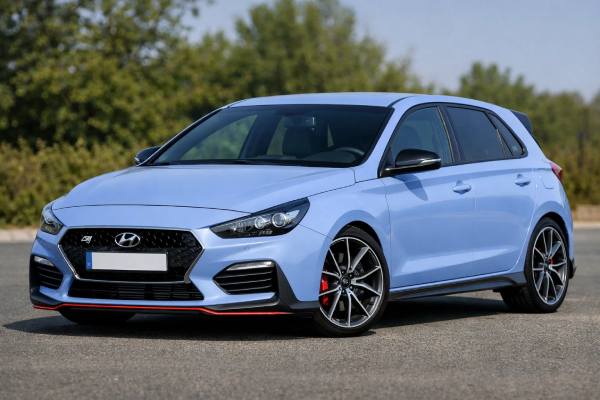
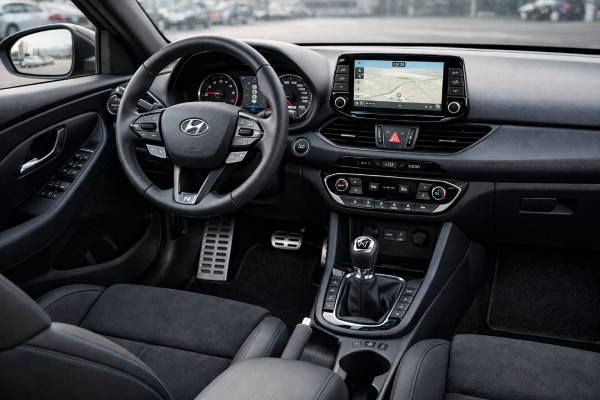
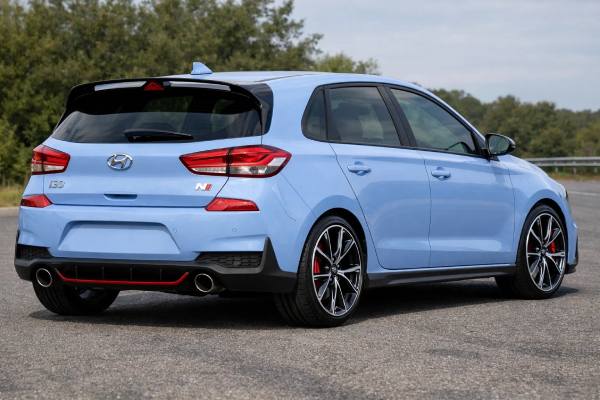
The Hyundai i30 N PD in 250 hp form is easy to misunderstand if you only look at the brochure headline. It sits below the better-known Performance Package, yet it still delivers the core i30 N idea: a manual-only front-wheel-drive hatch with a strong 2.0-litre turbo engine, adaptive dampers, serious chassis tuning, and far more daily usability than many rivals from the same era. In other words, this is not the “cheap” i30 N. It is the lighter, simpler, and often more sensible version for buyers who want the engineering character without chasing every last track-day feature. The platform itself was strong from the start, the body is practical, and Hyundai gave the car genuine driver focus rather than just visual aggression. The catch is straightforward too: condition matters more than badge. A pampered road car can be a very appealing used buy, while a neglected or heavily tracked example can become expensive quickly.
Quick Specs and Notes
- Strong front-end grip, a manual gearbox, and adaptive dampers give it real enthusiast appeal.
- The 250 hp version is usually lighter, cheaper to run, and less complex than the Performance Package.
- Hatchback practicality remains a major advantage, with a useful boot and everyday ride comfort.
- Hard-used cars can need tyres, brakes, clutch work, and suspension refresh parts sooner than expected.
- A 10,000 km or 12-month oil-service routine is a smart ownership habit.
What’s inside
- Hyundai i30 N PD character
- Hyundai i30 N 250 data
- Hyundai i30 N trims and protection
- Known weak points and campaign checks
- Service planning and buying advice
- Road feel and real pace
- Where it lands against rivals
Hyundai i30 N PD character
The 250 hp Hyundai i30 N arrived as the entry point into Hyundai’s first serious European N car, but “entry point” does not tell the full story. The standard car was engineered with the same core philosophy as the higher-output Performance Package: front-wheel drive, a 2.0-litre turbocharged four-cylinder engine, a six-speed manual, Rev Matching, launch control, adaptive dampers, and a body-and-chassis package tuned with genuine track ambition. What it did not get were the bigger brakes, the electronically controlled limited-slip differential, and the more aggressive wheel-and-tyre package that defined the Performance cars.
That distinction matters because it shapes the ownership experience. The 250 is the purer road car for many people. It rides on 18-inch wheels with 225/40 R18 tyres, avoids some of the extra cost attached to the 19-inch Performance setup, and generally feels slightly less intense without losing the i30 N’s core personality. Hyundai also positioned it as an everyday sports car, and in practice that claim fits. The cabin layout is sensible, visibility is decent, rear-seat space is usable, and the hatchback body keeps the car from feeling like a weekend-only toy. Even the boot stays practical for the class.
The engineering basics are still strong by hot-hatch standards. The 2.0 T-GDi uses a square 86.0 × 86.0 mm bore and stroke, a 9.5:1 compression ratio, chain-driven dual overhead cams with variable valve timing, and a turbocharged direct-injection setup. Official output for the standard car is 250 hp, with 353 Nm of torque, while launch material also highlighted an overboost function up to 378 Nm for a limited period. That gives the car useful real-world pace rather than just a headline number.
In simple terms, the 250 hp i30 N is a serious hot hatch, not a warmed-over trim line. It gives up some ultimate corner-exit traction and some braking hardware compared with the Performance Package, but it keeps the part of the recipe that matters most on real roads: a strong manual drivetrain, a good front axle, useful damping control, and the sort of personality that makes normal journeys interesting.
Hyundai i30 N 250 data
The cleanest way to read the 2017–2020 i30 N 250 is as a European-market, manual-only five-door hatchback. Exact numbers can vary by market, tyres, and late-run equipment, but the official open Hyundai data is consistent enough to build a solid reference picture.
Powertrain and efficiency
| Item | Hyundai i30 N 250 |
|---|---|
| Code | Theta 2.0 T-GDi gasoline |
| Engine layout and cylinders | Inline-4, DOHC, 4 valves/cyl |
| Displacement | 2.0 L (1998 cc) |
| Bore × stroke | 86.0 × 86.0 mm (3.39 × 3.39 in) |
| Induction | Turbocharged |
| Fuel system | Gasoline direct injection |
| Compression ratio | 9.5:1 |
| Max power | 250 hp (183.9 kW) @ 6000 rpm |
| Max torque | 353 Nm (260.4 lb-ft) from about 1450–4000 rpm |
| Overboost | up to 378 Nm (278.8 lb-ft) for a short duration |
| Timing drive | Chain |
| Transmission | 6-speed manual |
| Drive type | FWD |
| Differential | Open front differential |
| Rated combined efficiency | 7.7 L/100 km |
| Rated economy | about 30.5 mpg US / 36.7 mpg UK |
| Real-world highway @ 120 km/h | roughly 7.0–8.0 L/100 km in normal road use |
Chassis and dimensions
| Item | Hyundai i30 N 250 |
|---|---|
| Suspension front / rear | MacPherson strut / multi-link |
| Steering | R-MDPS; 2.14 turns lock-to-lock |
| Steering ratio | about 12.2:1 on later official EU 250 data |
| Brakes | 4-wheel discs; later EU 250 data lists 330 mm front and 300 mm rear ventilated discs |
| Wheels and tyres | 7.5Jx18 alloy with 225/40 R18 tyres |
| Length | 4335 mm (170.7 in) |
| Width | 1795 mm (70.7 in) |
| Height | 1451 mm (57.1 in) |
| Wheelbase | 2650 mm (104.3 in) |
| Turning circle | 11.6 m (38.1 ft) |
| Ground clearance | about 135 mm (5.3 in) |
| Kerb weight | 1400–1480 kg (3086–3263 lb) |
| GVWR | around 1920–1950 kg (4233–4299 lb), market-dependent |
| Fuel tank | 50 L (13.2 US gal / 11.0 UK gal) |
| Cargo volume | 381 L / 1287 L (13.5 / 45.4 ft³), VDA |
| Towing capacity | 1600 kg braked / 700 kg unbraked (3527 / 1543 lb) |
Performance and service capacities
| Item | Hyundai i30 N 250 |
|---|---|
| 0–100 km/h | 6.4 s |
| 0–62 mph | 6.4 s |
| Top speed | 250 km/h (155 mph) |
| 80–120 km/h | 5.7 s |
| Engine oil capacity | 4.8 L (5.1 US qt) incl. filter |
| Manual gearbox oil | 1.9 L (2.0 US qt) |
| Coolant | 8.5 L (9.0 US qt) |
| Official oil-change interval | 10,000 km or annually |
| Official general service interval | 30,000 km or every 2 years |
Safety and assistance headline
| Item | Hyundai i30 N 250 |
|---|---|
| Euro NCAP | 5 stars for the i30 hatchback platform |
| Euro NCAP category scores | 88% adult, 84% child, 64% vulnerable road users, 68% safety assist |
| IIHS | not applicable |
| ADAS | equipment varied by market and year; later cars added more SmartSense content |
The big takeaway is that the 250 is not underpowered or under-specced in any meaningful road-car sense. It is quick, well-sized, practical, and mechanically simpler than the headline Performance Package.
Hyundai i30 N trims and protection
For this model, trims matter because Hyundai used equipment to separate the standard 250 hp car from the Performance Package rather than changing the whole character of the vehicle. In the launch-era layout, the 250 hp i30 N already came with the elements that made the car interesting: adaptive dampers, N Grin Control, launch control, Rev Matching, sports seats, strong brake hardware, dual-zone climate control, parking aids, and a touchscreen infotainment setup. In other words, you were not buying a stripped shell.
The mechanical step to Performance trim was substantial. The Performance Package moved to 19-inch wheels, larger front brakes, an electronically controlled limited-slip differential, and a variable exhaust valve system. The standard 250 hp car kept 18-inch wheels, the smaller N brake setup, and an open differential. That makes the 250 easier to live with on rough roads and cheaper to re-tyre, while the Performance car is the stronger track choice. For a used-road-car buyer, the 250 often lands in the sweet spot.
By the later run, Hyundai also broadened the option structure. Open European equipment data shows useful factory options such as a larger 10.25-inch navigation screen with connected services, blind-spot and rear cross-traffic packages in some markets, a comfort package with more seat adjustment, and N bucket-seat options on higher trims. That means two i30 N 250s can feel quite different inside even if the engine output is identical. A simple mid-spec road car can be the most sensible choice, but well-optioned cars are easier to live with and often easier to resell.
Safety is better than many buyers expect from an early Hyundai performance model. Euro NCAP awarded the i30 hatchback platform five stars, and that matters because the i30 N benefits from the strong base-car structure even though safety-assistance fit can vary by year and market. The platform result posted 88% for adult occupant protection and 84% for child occupant protection, which remains respectable.
The passive-safety basics are strong in later published equipment lists: front, side, and curtain protection, ISOFIX on the outer rear seats, TPMS, ESC, ABS, brake assist, hill-start assist, and eCall. Driver-assistance content depends more on year and market. Some later cars gained optional blind-spot and rear cross-traffic functions, while facelift-era i30 N material broadened Hyundai SmartSense further. For used buyers, the best approach is practical: inspect the exact car, confirm the fitted packages, and do not assume every 2017–2020 i30 N 250 has the same ADAS bundle.
Known weak points and campaign checks
The i30 N 250 is not a car with one infamous universal failure that defines the ownership story. Its real risk is simpler: misuse. A standard car driven hard from cold, tracked repeatedly on old fluids, or modified badly can become expensive. A carefully maintained road car is usually a much more reassuring proposition. That is why history matters more here than it might on an ordinary commuter hatch.
The first watch area is consumable-led wear. These cars are fast, front-driven, and often owned by enthusiastic drivers. That means tyres, front pads, discs, and alignment can all tell you a lot about past use. Inner-shoulder tyre wear, steering that no longer tracks cleanly, or pulsing under braking usually points to heavy use or deferred chassis work rather than a mysterious design defect. On a manual-only 250, the clutch and flywheel also deserve a careful check. A high bite point, shudder, or poor take-up after repeated full-throttle use is not unusual on abused cars.
The second area is heat and maintenance discipline. This is a chain-driven turbo direct-injection engine with a real performance tune, so clean oil matters. Hyundai’s own open data lists 10,000 km or annual oil changes, and that is already shorter than many generic long-life schedules. On a car used for short trips, repeated hard driving, or track days, it makes sense to treat that as the ceiling, not the target. Oil neglect tends to show up first as rougher running, higher consumption, tired turbo behavior, or more general top-end wear risk.
The third area is ignition and fueling smoothness. Turbo GDI engines can become sensitive to spark plug condition, coil health, fuel quality, and intake cleanliness as mileage climbs. On this car, that normally shows up as hesitation under load, misfire under boost, or inconsistent throttle response rather than as a single official campaign item. None of that automatically makes the i30 N fragile, but it does mean cheap maintenance shortcuts tend to show up faster than they would on a softer-tuned family hatch.
Software and campaign checks also matter. Hyundai provides VIN-based recall and service-campaign lookup, and that should be part of any pre-purchase routine alongside dealer records. Because campaign coverage is market-specific, it is smarter to verify the exact VIN than to rely on forum memory or seller assurances. That is especially important on a performance model, where updates can affect safety systems, drivability, or convenience features.
For a viewing, request these basics:
- full stamped or invoiced service history
- proof of correct oil-change frequency
- evidence of brake-fluid changes if the car saw spirited use
- confirmation of completed recalls and campaigns
- tyre brand and date consistency across the axle
- signs of track-day preparation or aftermarket ECU tuning
- cold-start behavior, clutch take-up, and straight-line braking feel
On balance, the i30 N 250 looks more durable than many people expect, but only when it has been maintained like the performance car it is.
Service planning and buying advice
A sensible maintenance plan for the i30 N 250 blends Hyundai’s published intervals with the reality of how these cars are used. The official open technical sheets give you two important anchors: engine oil every 10,000 km or annually and a broader service interval every 30,000 km or 2 years. That is a good baseline, but enthusiastic use justifies a shorter leash on several items.
A practical schedule for long-term ownership looks like this:
- Engine oil and filter: every 10,000 km or 12 months at the latest; sooner after repeated track use.
- Brake fluid: every 2 years for normal road use; yearly is sensible on hard-driven cars.
- Spark plugs: inspect regularly and replace earlier than a normal family hatch if the car shows any high-load misfire or tune-related sensitivity.
- Engine air filter and cabin filter: inspect at each annual service; replace as needed.
- Manual gearbox oil: change preventively if history is unclear, especially past 60,000–80,000 km.
- Coolant: use the correct Hyundai-approved coolant and do not leave original coolant in the car indefinitely just because mileage is low.
- Drive belts and hoses: inspect from around 6 years onward.
- Brakes, tyres, alignment, and dampers: inspect every service; performance driving accelerates wear here more than on the engine itself.
- Chain drive: there is no routine belt-replacement event here, but you should still monitor for abnormal noise, timing-correlation faults, or poor service history because the engine uses a chain-driven cam setup.
Useful open capacities are unusually clear for this car. Hyundai’s technical data lists 4.8 L engine oil including filter, 1.9 L manual gearbox oil, 8.5 L coolant, and a 50 L fuel tank. Towing data is also published at 1600 kg braked and 700 kg unbraked, though towing is not the reason most people buy an i30 N.
For fluid specifications, stick to the exact Hyundai-approved oil and coolant requirements for the VIN, market, and climate. The open technical sheets do not publish every workshop-grade detail, so this is one place where the owner’s literature or dealer parts system matters more than internet shorthand.
As a used buy, the best cars are usually easy to spot. Prefer examples with stock software, matching-quality tyres, documented fluid work, and no evidence of repeated heavy modifications. Cars to approach carefully include those with mixed cheap tyres, strong stone-chipping around the front cooling pack, obvious aftermarket tuning, brake shudder, or a seller who cannot explain maintenance beyond “full history somewhere.”
The long-term outlook is good when the car is treated properly. The manual gearbox, chain-driven engine, and simpler 250-spec hardware are genuine advantages for someone who wants i30 N character without the maximum running-cost profile of the bigger-package cars.
Road feel and real pace
The i30 N 250 succeeds because it feels engineered rather than styled. Even in standard form, the front axle has enough bite to make the car feel alert, and the damping range is broad enough that you can use it every day without feeling punished for the purchase. It is firm, yes, but not constantly brittle on 18-inch wheels. That matters more than headline output on real roads.
The steering is quick and deliberate rather than ultra-talkative. Hyundai’s rack-mounted power steering setup gives the car an immediate nose, and the chassis reacts in a disciplined way to fast direction changes. There is still some front-drive reality under full power on poor surfaces, but the 250 hp model usually feels cleaner and calmer than many more aggressive front-drive hot hatches because the tyre and differential package is less extreme. That slightly softer edge is part of its appeal.
The engine character is strong rather than theatrical. Peak numbers do not tell the whole story here. What you notice is the broad shove in the middle of the rev range, the willingness to keep pulling, and the manual gearbox that suits the car’s personality. Official figures put the 250 at 6.4 seconds to 100 km/h and 250 km/h flat out, which is quick enough to feel properly serious without becoming unusable on the road. The car also backs that up with respectable 80–120 km/h pace for overtakes.
Real-world economy is reasonable rather than miraculous. The official combined figure sits around 7.7 L/100 km, but buyers should expect more in mixed real use. A careful long-distance run can land in the low-7s, while urban driving, winter weather, or enthusiastic back-road use can move the car into the 8.5–10.5 L/100 km range. In mpg terms, that means roughly 22–28 mpg US / 26–34 mpg UK in spirited mixed use and 29–34 mpg US / 35–41 mpg UK on calmer open-road journeys. The car is clearly most efficient once it is moving steadily rather than in low-speed, stop-start running.
Noise, vibration, and harshness are well judged for the class. This is not a hushed GT car, but it does not drone like a crude tuner project either. The cabin is usable on the motorway, the seats are supportive, and the hatchback layout gives the car genuine dual-purpose credibility.
For many drivers, that is the verdict in one sentence: the i30 N 250 is fast enough, fun enough, and civilised enough at the same time.
Where it lands against rivals
Against its late-2010s hot-hatch rivals, the i30 N 250 does not win by being the most powerful or the most prestigious. It wins by packaging genuine driver engineering into a car that is still practical and, in this standard 250 hp form, a little more rational than the segment’s louder stars.
Compared with a Volkswagen Golf GTI Performance or Clubsport-era alternative, the Hyundai usually feels more extroverted and more adjustable in mood, but a little less polished in cabin finish. Compared with a Honda Civic Type R FK8, it is less extreme in grip and ultimate pace, yet easier to use every day and usually cheaper to buy and tyre. Against a Peugeot 308 GTi, the i30 N feels heavier in character but often more robustly resolved as a long-term all-rounder.
The standard 250 hp version also deserves to be judged separately from its own Performance Package sibling. The bigger-package car is the better track-day tool, no question. But the 250 often makes the stronger used-road-car case:
- lower tyre and brake costs
- simpler hardware mix
- manual-only character that suits the car
- fewer expensive extras to go wrong
- still enough speed to feel special
Its weak spots next to rivals are mostly obvious:
- cabin materials are good, not class-leading
- the open differential gives away traction to the best eLSD cars
- fuel economy is fair, not exceptional
- used values depend heavily on history and condition because these cars attract enthusiastic owners
Where does that leave it? For buyers who want a modern hot hatch with real personality but do not need the ultimate spec sheet, the i30 N 250 is one of the smartest places to land. It offers enough performance to matter, enough practicality to justify itself, and enough engineering honesty to stay interesting after the first rush of ownership fades.
References
- The Hyundai i30 N Technical specification January 2019 2019 (Technical Data)
- Hyundai i30 N | Technische Daten | Stand: 1.2019 2019 (Technical Data)
- Hyundai i30 N und i30 N Fastback Ausstattungsvarianten 2021 (Equipment and Pricing)
- EuroNCAP | Hyundai i30 2017 (Safety Rating)
- Home | Hyundai Recalls & Service Campaigns 2026 (Recall Database)
Disclaimer
This article is for informational purposes only and is not a substitute for professional diagnosis, repair, or VIN-specific workshop data. Specifications, torque values, service intervals, equipment, and procedures can vary by VIN, market, model year, tyre package, and optional equipment, so always confirm the exact details against official Hyundai service documentation for the vehicle in front of you.
If you found this guide useful, please consider sharing it on Facebook, X, or another community you trust to support our work.