
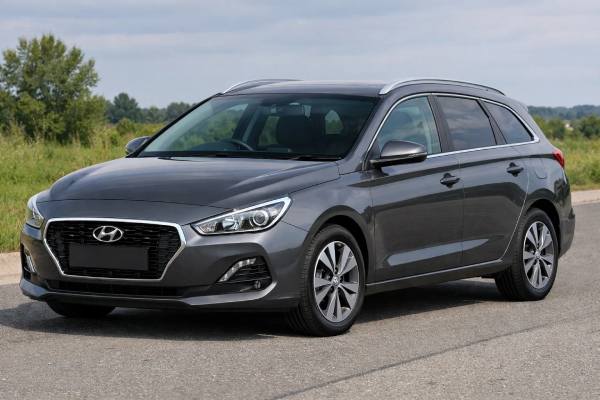
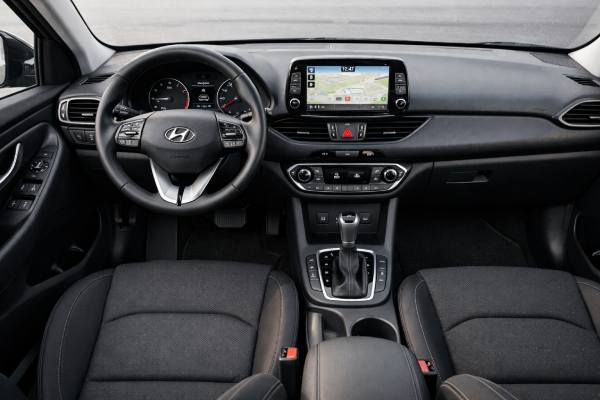
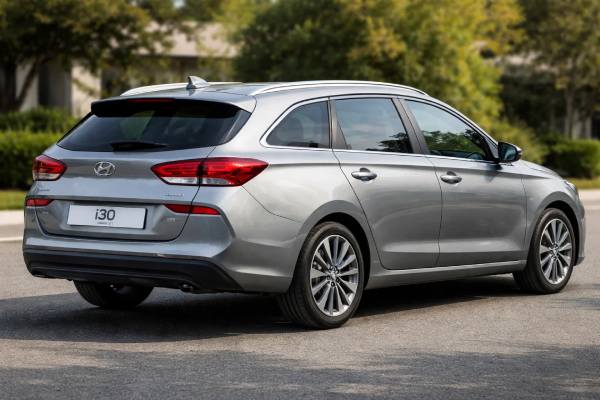
The Hyundai i30 Wagon PD with the 1.6 CRDi 136 diesel is one of the more sensible compact estates of its era. It combines a large, genuinely useful cargo area with relaxed motorway performance, low fuel consumption, and a chassis that feels mature rather than cheaply tuned. For buyers who need one car to cover commuting, family work, and long-distance travel, that balance is the point. The 2017 launch cars used Hyundai’s earlier 1.6 CRDi setup, while the 2020 facelift brought a revised 136 PS diesel with 48-volt mild-hybrid support in many European markets. That means this year range is not one single mechanical package, even if the badge looks similar. The good news is that both versions keep the same basic strengths: strong mid-range pull, stable highway manners, and one of the bigger boots in the class. The key is choosing an example whose service history and usage pattern make sense for a modern emissions-controlled diesel.
Fast Facts
- Big 602 L boot and 1,650 L with the rear seats folded make it one of the more practical compact estates.
- The 136 hp diesel has enough torque for easy overtaking and relaxed motorway cruising.
- Fuel use is a real strength, especially on longer mixed or highway drives.
- Short-trip use can lead to DPF and emissions-system headaches if the car rarely gets fully warm.
- A yearly oil service or about 15,000 km is the safer ownership habit, even where longer schedules were advertised.
Guide contents
- Hyundai i30 Wagon diesel essentials
- Hyundai i30 Wagon numbers and capacities
- Hyundai i30 Wagon grades and protection
- Trouble spots and campaign checks
- Service plan and used-buy filter
- Load comfort and diesel pace
- Estate rivals and best alternatives
Hyundai i30 Wagon diesel essentials
The i30 Wagon PD is best understood as a practical European estate first and a value-led diesel second. Hyundai gave it wagon proportions that are useful without being bulky. At 4,585 mm long, with a 2,650 mm wheelbase and 602 litres of VDA boot space, it offers the kind of luggage room that many hatchbacks and crossovers simply do not match. Fold the rear seatbacks and the space grows to 1,650 litres, which is enough for family trips, bicycles with partial disassembly, flat-pack furniture, or trade-use equipment that would force rivals into roof-box duty.
The engine story matters because 2017–2020 spans two slightly different phases. The 2017 launch-era wagon used the 1.6 CRDi 100 kW diesel with 1,582 cc, 136 PS, and up to 300 Nm with the optional DCT. By the 2020 facelift, many European-market 136 PS wagons had moved to a 1,598 cc Euro 6d setup with 48-volt mild-hybrid support, a 12 kW starter-generator, 0.44 kWh battery, and torque that could reach 320 Nm in DCT form. On the road, both versions feel more alike than different: they are tuned for usable torque, not excitement, and they suit drivers who spend more time at 80–130 km/h than they do chasing revs around town.
That makes the i30 Wagon 1.6 CRDi one of those cars that rewards honest use. It likes distance, regular warm-up cycles, and owners who do not delay routine maintenance. It is a better fit for mixed or motorway-heavy driving than for repeated two-kilometre school runs and cold city traffic. If your mileage pattern suits it, the diesel estate layout makes a lot of sense. The long roof brings real utility, the chassis does not feel clumsy when loaded, and the engine’s low-end pull means the car still feels composed with passengers or luggage aboard.
From an ownership angle, the biggest advantage is balance. It is not as expensive to buy as many German rivals, it is roomier than some fashionable crossovers, and it often avoids the image premium that inflates used prices elsewhere in the class. The main caution is equally clear: this is a modern diesel with DPF, NOx aftertreatment, and, in later cars, 48-volt hardware. Buy on condition and service evidence, not simply on badge, mileage, or trim name.
Hyundai i30 Wagon numbers and capacities
Because this article covers both pre-facelift and facelift years, the cleanest way to present the technical data is to show the shared wagon fundamentals first and then note the main diesel differences between the 2017 launch-era 136 PS car and the 2020 facelift-era 136 PS mild-hybrid version. The figures below reflect European wagon data and the most relevant official service capacities.
| Item | 2017 i30 Wagon 1.6 CRDi 136 | 2020 i30 Wagon 1.6 CRDi 136 |
|---|---|---|
| Engine layout | Inline-4, front-transverse diesel | Inline-4, front-transverse diesel |
| Code / family | 1.6 CRDi 100 kW launch-era unit | 1.6 CRDi 100 kW facelift-era 48V unit |
| Displacement | 1.6 L (1,582 cc) | 1.6 L (1,598 cc) |
| Bore × stroke | 77.2 × 84.5 mm (3.04 × 3.33 in) | 77.0 × 85.8 mm (3.03 × 3.38 in) |
| Valvetrain | DOHC, 4 valves/cyl | DOHC, 4 valves/cyl |
| Timing drive | Chain on 2017 spec sheet | Belt on 2020 facelift technical data |
| Induction | Turbo diesel, VGT, intercooler | Turbo diesel, common-rail, intercooler |
| Fuel system | Direct injection diesel | Common-rail direct injection |
| Compression ratio | not consistently published in launch sheet | 15.9:1 |
| Max power | 136 hp (100 kW) @ 4,000 rpm | 136 hp (100 kW) @ 4,000 rpm |
| Max torque | 280 Nm manual / 300 Nm DCT | 280 Nm iMT / 320 Nm DCT |
| Transmission | 6MT or 7DCT | 6iMT or 7DCT |
| Drive type | FWD | FWD |
| Differential | Open | Open |
| Chassis and dimensions | Wagon |
|---|---|
| Front suspension | MacPherson strut |
| Rear suspension | Multi-link, with simpler rear-axle layouts on some lower-output trims or markets |
| Steering | Electric rack; ratio about 13.4:1 |
| Steering turns lock-to-lock | 2.57 |
| Turning circle | 10.6 m (34.8 ft) |
| Front brakes | Ventilated discs, 280–305 mm depending on trim |
| Rear brakes | Solid discs, 272–284 mm depending on trim |
| Most common tyre sizes | 195/65 R15, 205/55 R16, 225/45 R17 |
| Ground clearance | 140 mm (5.5 in) |
| Length | 4,585 mm (180.5 in) |
| Width | 1,795 mm (70.7 in) |
| Height | 1,465 mm (57.7 in), about 1,475 mm with roof rails |
| Wheelbase | 2,650 mm (104.3 in) |
| Cargo volume | 602 / 1,650 L (21.3 / 58.3 ft³), VDA |
| Fuel tank | 50 L (13.2 US gal / 11.0 UK gal) |
| Performance and capability | 2017 136 | 2020 136 |
|---|---|---|
| 0–100 km/h | 10.5 s manual / 10.9 s DCT | 10.4 s iMT / 10.1 s DCT |
| Top speed | 198 km/h (123 mph) | 200 km/h (124 mph) |
| Braked towing | 1,500 kg (3,307 lb) | 1,500 kg (3,307 lb) |
| Unbraked towing | 650 kg (1,433 lb) | 650 kg (1,433 lb) |
| Kerb weight | varies by trim | 1,340–1,528 kg (2,954–3,369 lb) |
| GVWR | varies by trim | 1,920–1,950 kg (4,233–4,299 lb) |
| Fluids and service capacities | 2017 136 | 2020 136 |
|---|---|---|
| Engine oil | 5.3 L incl. filter | 4.4 L incl. filter |
| Oil grade | ACEA C2 or C3 for DPF-equipped diesel | low-SAPS diesel oil to VIN spec; verify market sheet |
| Coolant | 6.7 L | 7.3 L |
| Manual gearbox oil | 1.8 L | 1.6 L |
| DCT fluid | 2.0 L | 2.0 L |
| Urea / AdBlue | not listed on early sheet | 12 L |
| A/C refrigerant | R-134a or R-1234yf by market or equipment; verify under-bonnet label | verify under-bonnet label |
| Wheel nut torque | 107–127 Nm (79–94 lb-ft) | 107–127 Nm is the safe published i30 range; verify wheel package |
Official braking-distance figures were not consistently published in the Hyundai wagon data sheets I reviewed, so that number is best treated as test-dependent rather than a fixed factory spec. Real-world highway fuel use at 120 km/h usually lands around 4.8–5.6 L/100 km in a healthy car, with the later 48V version tending to do slightly better on open-road cruising.
Hyundai i30 Wagon grades and protection
Trim names changed by country, so the smartest way to shop an i30 Wagon diesel is to focus on equipment level, wheel size, and transmission rather than badge alone. Early European cars generally followed a familiar ladder from basic fleet-style grades into better-equipped mid trims and richer upper trims. The 2020 facelift then sharpened that structure further, with market names such as SE Connect, Premium, Trend, Prime, and N Line depending on region. The practical takeaway is simple: mid-spec cars are usually the best buy, while the very cheapest ones and the biggest-wheel N Line examples need a closer look.
What changes with trim?
- Wheel and tyre package. Many of the most comfortable wagons run 16-inch or 17-inch wheels. The ride gets firmer on larger packages.
- Transmission choice. The 136 diesel could be paired with a manual or dual-clutch unit, and later cars added the iMT mild-hybrid manual setup.
- Brake size. The official wagon data sheets show larger front and rear brake diameters on higher trims.
- Appearance and seat trim. N Line and upper-spec cars get more visual appeal, but that is not always the most cost-effective used choice.
- Safety and convenience technology. Adaptive cruise, blind-spot systems, camera-based lane functions, larger infotainment screens, heated seats, and better lighting tended to cluster higher up the range.
The safety story remains one of the i30 Wagon’s stronger points. Euro NCAP gave the i30 family a five-star result, with 88% adult occupant protection, 84% child occupant protection, 64% vulnerable road user protection, and 68% safety assist under the 2017 protocol. Those numbers are not current-generation benchmark figures, but they were strong for the class and still support the car’s reputation as a solid family vehicle. IIHS ratings do not really apply here because the i30 Wagon was not a North American model-line match.
On active safety, Hyundai pushed the i30 hard as a SmartSense car. Launch-era wagon material already highlighted Forward Collision-Avoidance Assist, Driver Attention Warning, High Beam Assist, Lane Keeping Assist, Smart Cruise Control with Stop and Go, Blind-Spot Collision Warning, Rear Cross-Traffic Collision Warning, and Intelligent Speed Limit Warning, though not every system was standard in every market. Facelift-era cars improved the package further in some regions with junction support, better highway-assist integration, and more digital display support. That means a later car can feel much more modern than an early diesel estate even if the badge looks almost identical.
Calibration is the part buyers often forget. If a wagon has had a windscreen replacement, a front-end repair, or a bumper repaint, ask whether any camera or radar-based systems were recalibrated. A car can be cosmetically tidy and still have poorly aligned ADAS hardware. On a used family estate, that matters more than whether it has the nicest wheel design.
Trouble spots and campaign checks
The i30 Wagon 1.6 CRDi is generally a sound long-distance car, but its weak points are the usual modern-diesel ones rather than some dramatic single design flaw. The engine is happiest when driven properly. Cars used for long commutes and regular motorway work usually age better than low-mile examples that spend their whole lives on cold urban hops. Hyundai’s own owner literature effectively says the same thing in different words: the DPF needs heat and sustained running to regenerate properly.
A practical way to sort the risks is by prevalence and cost:
- Common and usually low to medium cost: interrupted DPF regeneration, EGR soot build-up, tired 12 V batteries, worn front brakes, and tyre wear.
- Occasional and medium cost: NOx or LNT-related faults, AdBlue or SCR issues on later facelift cars, glow-plug or sensor faults, and rough low-speed behavior from poorly driven or poorly maintained DCT cars.
- Rare but expensive: turbo damage after neglected oil changes, injector trouble, prolonged driving with active emissions faults, or heavy clutch-pack work in a bad 7DCT example.
The most important known pattern is the aftertreatment system. The owner’s manual warns that repeated low-speed, short-distance use can prevent the DPF from clearing itself, leading to warning lights and eventually higher fuel use or component damage if ignored. It also notes that fuel quality affects the NOx storage system and particulate-control hardware. In real ownership terms, that means this is not the diesel to buy for a two-kilometre school run and nothing else.
Symptoms worth taking seriously:
- DPF or exhaust warning, fan running after shutdown, or rising fuel use: ask whether the car completes regeneration cycles and whether it mostly does short trips.
- Hesitation, surging, or weak response: could be EGR contamination, intake fouling, sensor drift, or a calibration issue.
- DCT shunt or jerky creeping: may be normal to a point on a dry-clutch dual-clutch unit, but strong shudder or repeated hesitation deserves inspection.
- Hard cold starts or lazy cranking: often a battery, charging, or glow system issue before it becomes anything larger.
- Uneven idle plus emissions faults on facelift cars: check SCR and AdBlue history as well as recent software updates.
As for service actions, there is no single Europe-wide headline repair that defines every i30 Wagon diesel from this period. Market-specific campaigns do exist, so the safe rule is to verify the exact VIN through Hyundai’s recall and service-campaign checker and compare the result with dealer records. On a used buy, “no warning lights” is not proof that campaigns were done. Completed campaign history is.
Pre-purchase, ask for full service records, evidence of correct oil grade, proof of recall completion, and a truthful description of how the car was used. A higher-mile motorway wagon can be a much better diesel buy than a shiny low-mile city car.
Service plan and used-buy filter
The official service schedules for these wagons can look generous, but the sensible owner schedule is more conservative. The factory data sheets list diesel service intervals around 30,000 km or two years in many European schedules, while earlier technical sheets also show 15,000 km or annual servicing depending on engine line and market. For a used diesel estate, I would not stretch to the limit unless the car is doing very regular long-distance work. Annual servicing is cheap insurance here.
A practical maintenance plan for real owners looks like this:
| Item | Practical interval |
|---|---|
| Engine oil and filter | every 12 months or 15,000 km |
| Engine air filter | inspect yearly, replace about every 30,000 km |
| Cabin filter | every 12 months or 15,000–20,000 km |
| Fuel filter | about every 30,000–60,000 km depending on market schedule and fuel quality |
| Brake fluid | every 2 years |
| Coolant | inspect yearly; replace by VIN-specific schedule or when age or history is unclear |
| Manual gearbox oil | inspect for leaks; refresh around 100,000–120,000 km is prudent |
| 7DCT fluid | follow model-specific service guidance and inspect behavior at every service |
| DPF and emissions health | monitor for frequent regenerations, warning lights, and uneven running |
| Aux belt and hoses | inspect every service |
| Brakes | inspect pads, disc condition, and rear-caliper movement every service |
| Tyres and alignment | rotate and inspect about every 10,000–15,000 km |
| 12 V battery | test yearly after age four |
| AdBlue on facelift 136 | keep topped up and investigate repeated warnings early |
Useful fluid and reference points:
- Early 136 CRDi cars list 5.3 L engine oil including filter, 6.7 L coolant, 1.8 L manual gearbox oil, and 2.0 L DCT fluid.
- Facelift 136 cars list 4.4 L engine oil including filter, 7.3 L coolant, 1.6 L manual gearbox oil, 2.0 L DCT fluid, and 12 L of urea solution.
- Wheel nut torque is published at 107–127 Nm.
For buyers, inspect in this order:
- Cold start quality.
- Service history and oil-spec evidence.
- DPF and emissions warning history.
- Clutch or DCT behavior in slow traffic.
- Underside, rear suspension, brake lines, and exhaust for corrosion in salted climates.
- Tailgate, door bottoms, and lower body seams for poor repairs.
- Air-conditioning performance and correct warning-free operation of every ADAS feature.
The best versions to seek are usually mid-spec 16-inch or 17-inch cars with full history and honest mileage. A 2020 facelift diesel wagon is attractive if you want the newest tech, but a clean 2018 or 2019 car can be the sweeter long-term value if it has simpler hardware and a better ownership record. The long-term outlook is good when maintenance is proactive and the car gets the kind of use a diesel wants.
Load comfort and diesel pace
This is where the i30 Wagon earns its keep. It drives like a well-sorted compact estate, not like a budget box with a long roof welded on. Straight-line stability is strong, the steering is light but tidy, and the car does not become floaty or nervous when it is loaded. The wagon body brings a little more calm to the way the car settles into a long trip, and that suits the diesel perfectly.
The 136 hp engine feels stronger than its headline figure when you are already moving. Low-rpm response is decent, mid-range pull is the real asset, and motorway overtakes are easier than the output number suggests because the torque arrives early. The 2017 car’s 280–300 Nm delivery gives it an easy, unfussy character. The 2020 facelift version, especially in DCT form, feels a touch fuller in the mid-range thanks to its later torque delivery and mild-hybrid support, though the difference is not night-and-day in ordinary use.
Ride and noise are well judged for the class. On 16-inch or 17-inch wheels, the i30 Wagon stays composed over rough secondary roads and does not punish rear passengers. The suspension is not plush in a French-car way, but it is controlled, and the longer body helps the car feel planted on faster roads. Road noise rises on coarser surfaces, especially with larger tyres, but cruising refinement is still one of this car’s strengths.
Real-world economy is one of the strongest reasons to buy one:
- City and short-trip use: about 5.8–7.0 L/100 km, sometimes worse in winter or with interrupted DPF regens.
- Mixed driving: about 4.9–5.8 L/100 km.
- Highway at 100–120 km/h: about 4.7–5.6 L/100 km.
- Moderate towing or a fully loaded holiday trip can raise use by roughly 15–30 percent depending on speed and terrain.
Official combined figures ranged from about 3.7–4.3 L/100 km for the early pre-facelift 136, and about 4.1–4.8 L/100 km WLTP or NEDC-related readings for facelift-era 136 mild-hybrid wagons depending on transmission, trim, and wheel package. In real driving, the important point is consistency: this is a low-fives or high-fours kind of car when healthy and used properly.
For towing and carrying weight, the i30 Wagon feels reassuring. The 1,500 kg braked towing rating is useful, and the diesel’s torque means it does not need to work hard on moderate grades. It is not a sports estate, but it is an excellent long-range working tool.
Estate rivals and best alternatives
The i30 Wagon 1.6 CRDi 136 does not try to win the class through badge prestige. It wins by being a rational, broadly capable estate that usually costs less than the best-known rivals while giving away surprisingly little in the areas that matter most. That is why it still deserves attention.
The most obvious rival is the Kia Ceed Sportswagon 1.6 CRDi. It is closely related underneath, and many buyers will end up deciding based on price, trim, and service history rather than real mechanical difference. If you find two equal cars, buy the one with the better history and more comfortable wheel package.
The Volkswagen Golf Variant diesel remains the class reference for badge image and interior polish, but it often carries a higher used price. The Hyundai counters with easier value math, a big boot, and fewer image-driven compromises. If you just want a dependable diesel estate for real work, the Hyundai often makes more financial sense.
The Ford Focus Estate diesel is the sharper driver’s car. It usually offers better steering feel and a slightly more playful front end. But the Hyundai is often the calmer motorway companion and can feel like the more relaxed all-round ownership choice.
The Peugeot 308 SW BlueHDi is another strong alternative, especially on fuel economy. Still, it is more taste-dependent in layout and driving position. The Hyundai feels more conventional, which can actually be a strength in a used family car.
The biggest non-diesel alternative is a hybrid estate or hatchback replacement, such as a Toyota Corolla Touring Sports. That is the better option if your daily life is mostly urban and suburban. But for buyers who still do real motorway mileage, frequent intercity trips, or light towing, the diesel i30 Wagon keeps a clear advantage in long-range efficiency and easy loaded performance.
So the verdict is straightforward. Choose the Hyundai if you want:
- a large and genuinely useful boot,
- strong diesel motorway manners,
- sensible used pricing,
- and a car that feels mature rather than flashy.
Skip it if your driving is almost all cold, slow, and short. In the right hands, the i30 Wagon 1.6 CRDi 136 compares very well with the main estate rivals. In the wrong use case, its diesel hardware becomes the reason to buy something else.
References
- New Generation Hyundai i30 Wagon: elegance meets versatility 2017 (Press Release)
- Hyundai i30 Kombi | Technische Daten | Stand: 9.2017 2017 (Technical Data)
- Hyundai i30 Kombi | Technische Daten | Stand: 4.2019 2021 (Technical Data)
- Euro NCAP | Hyundai i30 2017 (Safety Rating)
- Home | Hyundai Recalls & Service Campaigns 2025 (Recall Database)
Disclaimer
This article is for informational purposes only and is not a substitute for professional diagnosis, repair, or workshop guidance. Specifications, torque values, service intervals, fluids, procedures, and equipment can vary by VIN, market, trim, transmission, emissions package, and production date. Always verify details against the correct official service documentation and owner information for the exact vehicle.
If this guide was useful, please consider sharing it on Facebook, X, or another social platform to support our work.