
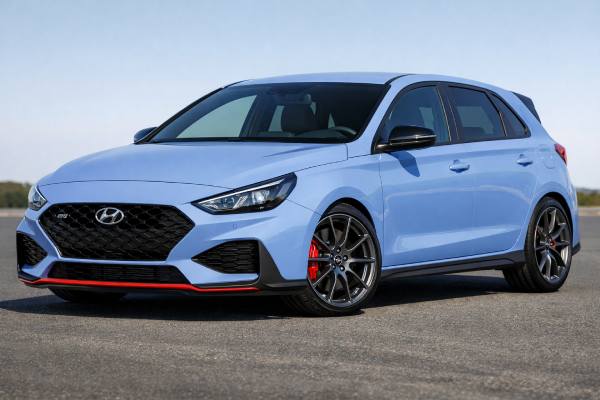
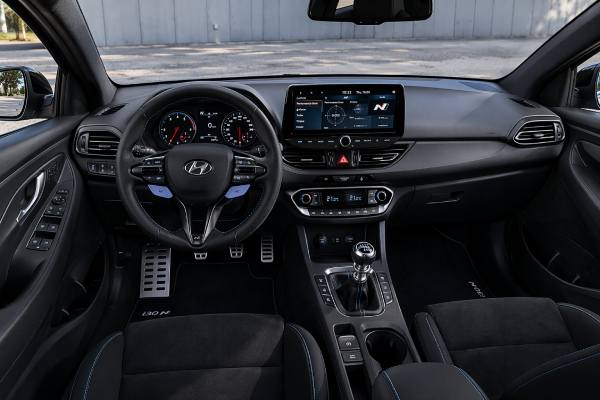
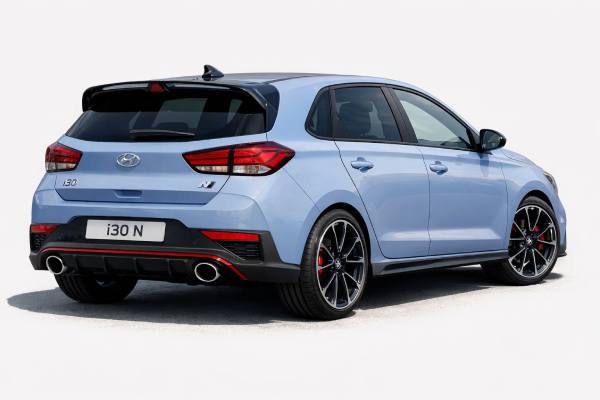
The facelifted Hyundai i30 N 250 is the purist’s version of the updated PD hot hatch. It keeps the core things that made the original i30 N interesting: a manual gearbox, a strong 2.0-litre turbo engine, adaptive dampers, a serious front axle, and a chassis that still feels like it was signed off by people who enjoy driving. What changes in this 2021 to 2024 facelift are the details. The car gained sharper styling, revised front airflow, improved digital tech, stronger cabin materials in key areas, and broader safety equipment. In 250 hp form, it also remained the more straightforward alternative to the better-known 280 hp Performance version. That distinction matters in the used market. This car is a little less headline-grabbing, but it can also be the simpler, sweeter long-term buy for drivers who want involvement rather than maximum specification. The real test is not the brochure. It is whether the car has been owned, serviced, and driven with mechanical sympathy.
Top Highlights
- The 250 hp facelift keeps the six-speed manual and delivers a more analog feel than many newer hot hatches.
- Adaptive dampers, strong brakes, and the N-specific front axle give it real chassis depth on fast roads.
- It is quick enough to feel serious, but still usable as a daily hatch with a full five-door body.
- Check carefully for modifications, hard track use, and clutch or brake wear before buying.
- A sensible oil-and-filter interval is every 10,000 km or 12 months, even if official public intervals run longer after the first service.
Contents and shortcuts
- Hyundai i30 N facelift character
- Hyundai i30 N hard data
- Hyundai i30 N trim and safety kit
- Recurring faults and fix paths
- Care schedule and used-buying
- Real-road pace and balance
- Against GTI and hot hatch rivals
Hyundai i30 N facelift character
The facelifted i30 N 250 sits in an unusual place in the modern hot-hatch market. It is not the flagship i30 N that most people talk about, because that role belongs to the 280 hp Performance version. But that is exactly why the 250 is worth a closer look. It keeps the same basic shell, the same 2.0-litre turbo four, the same broad N engineering philosophy, and much of the same feel from the driver’s seat, yet it avoids some of the extra cost and complexity attached to the higher-output specification.
For this facelift, Hyundai sharpened the i30 N’s visual identity with new headlamps, revised bumpers, a wider center grille, and cleaner airflow management at the front end. Inside, the car gained improved infotainment, a larger navigation display on many markets, broader connected functions, and updated seat and trim options. More important than the styling, though, was the way Hyundai refined the platform without softening it. The car still uses adaptive dampers, still rides on a reinforced front axle layout, and still feels far more serious than a dressed-up warm hatch.
The 250 hp version is the lighter-touch choice in the facelift range. Official technical sheets list it with a six-speed manual gearbox, 250 PS, and 353 Nm. That is enough for a 0–100 km/h time of 6.4 seconds and a 250 km/h top speed, which means it is hardly slow. The real difference is in how it deploys its performance. Unlike the 280 Performance model, the 250 does not get the electronically controlled limited-slip differential. It also uses the smaller 18-inch wheel and tyre package and the smaller front brake setup. On paper, that makes it look like the lesser car. In practice, it makes it the cleaner, more old-school choice.
That choice has consequences. The 250 is a little less explosive out of very tight corners, and it cannot put power down as cleanly on wet or bumpy exits as the e-LSD-equipped Performance pack car. But it also feels slightly more honest about its front-wheel-drive nature. There is more conversation through the steering and the front axle, and more of a sense that the driver has to work with the chassis rather than lean on a differential to tidy everything up.
This is why the facelift i30 N 250 matters. It is not just the cheaper i30 N. It is the version that keeps the core hot-hatch formula most intact: manual gearbox, straightforward spec, enough performance, and a five-door body that still works every day.
Hyundai i30 N hard data
The table below focuses on the facelifted five-door i30 N hatchback in standard 250 PS form. Because the 280 Performance package changes several mechanical details, those higher-output parts are mentioned only where they help explain what the 250 does not have.
| Powertrain and efficiency | Hyundai i30 N 250 facelift |
|---|---|
| Code | Theta 2.0 T-GDi standard trim |
| Engine layout and cylinders | Inline-4 petrol, 4 cylinders, DOHC, 4 valves per cylinder |
| Bore × stroke | 86.0 × 86.0 mm (3.39 × 3.39 in) |
| Displacement | 2.0 L (1,998 cc) |
| Induction | Turbocharged |
| Fuel system | Direct injection |
| Compression ratio | 9.5:1 |
| Max power | 250 PS / 184 kW @ 5,500–6,000 rpm, commonly marketed as 250 hp |
| Max torque | 353 Nm (260 lb-ft) @ 2,100–4,700 rpm |
| Timing drive | Chain |
| Emissions hardware | Three-way catalyst and gasoline particulate filter |
| Rated efficiency | 7.7 L/100 km WLTP combined |
| Real-world highway at 120 km/h | Roughly 8.0–9.0 L/100 km in normal conditions |
| Transmission and driveline | Data |
|---|---|
| Transmission | 6-speed manual |
| Drive type | Front-wheel drive |
| Differential | Open differential |
| Chassis and dimensions | Data |
|---|---|
| Front suspension | N Power Sense Axle, MacPherson strut, adaptive dampers |
| Rear suspension | Multi-link rear axle, adaptive dampers |
| Steering | Electric rack-and-pinion |
| Steering ratio | 12.23:1 |
| Steering lock-to-lock | 2.14 turns |
| Brakes front | Ventilated discs, 330 mm (13.0 in) |
| Brakes rear | Ventilated discs, 300 mm (11.8 in) |
| Wheels and tyres | 7.5Jx18 wheels with 225/40 R18 Michelin Pilot Sport 4 |
| Ground clearance | 135 mm (5.3 in) |
| Length | 4,340 mm (170.9 in) |
| Width | 1,795 mm (70.7 in) |
| Height | 1,444 mm (56.9 in) |
| Wheelbase | 2,650 mm (104.3 in) |
| Turning circle | 11.6 m kerb-to-kerb (38.1 ft) |
| Kerb weight | 1,400–1,485 kg (3,086–3,274 lb), depending on equipment |
| GVWR | 1,920 kg (4,233 lb) |
| Fuel tank | 50 L (13.2 US gal / 11.0 UK gal) |
| Cargo volume | 395 L seats up / 1,301 L seats down, VDA (14.0 / 45.9 ft³) |
| Performance and capability | Data |
|---|---|
| 0–100 km/h | 6.4 s |
| 0–62 mph | 6.4 s |
| 80–120 km/h | 5.7 s |
| Top speed | 250 km/h (155 mph) |
| Braking distance 100–0 km/h | 34.6 m (113.5 ft) |
| Towing capacity, braked | 1,600 kg (3,527 lb) |
| Towing capacity, unbraked | 700 kg (1,543 lb) |
| Payload | 435–520 kg (959–1,146 lb), depending on equipment |
| Fluids and service capacities | Data |
|---|---|
| Engine oil | 4.8 L incl. filter (5.1 US qt); use VIN-correct Hyundai-approved full synthetic oil |
| Coolant | 8.5 L (9.0 US qt) |
| Manual gearbox oil | 1.9 L (2.0 US qt) |
| A/C refrigerant | Verify by VIN and production date before service |
| Key torque specs | Public Hyundai technical sheets do not publish a complete VIN-safe torque table; confirm wheel, brake, and suspension values in workshop documentation |
| Safety and driver assistance | Data |
|---|---|
| Euro NCAP family rating | 5 stars for the i30 model family |
| Adult occupant | 88% |
| Child occupant | 84% |
| Vulnerable road users | 64% |
| Safety assist | 68% |
| Headlight rating IIHS | Not applicable; the i30 N was not a North American IIHS model |
| ADAS | AEB, lane keep assist, lane follow assist on later cars, fatigue warning, speed-limit assistance, TPMS, ESC, eCall depending on market year |
These numbers explain the car well. It is not just a tuned commuter. It has real brake hardware, real suspension engineering, and enough performance to justify the badge. At the same time, it is still a five-door hatch with a sensible boot, a full rear bench, and a real towing figure.
Hyundai i30 N trim and safety kit
The facelift i30 N range became simpler in some markets and more confusing in others. The easy way to understand it is this: the 250 hp car is the standard i30 N, while the 280 hp car adds the Performance Package or becomes the sole trim in some countries. That regional variation matters because many late facelift markets quickly centered on the 280 car, which means a 250 from 2023 or 2024 may be rarer depending on where you shop.
Mechanically, the 250 matters because it is not just a detuned Performance. It has its own package logic. Standard equipment included adaptive dampers, the N Grin Control System, sports seats, full LED headlamps, keyless start, dual-zone climate control, front and rear parking assistance with reversing camera, and the core N exterior treatment. It also retained the six-speed manual transmission. On the safety and braking side, the standard 250 used 330 mm front brakes rather than the 360 mm front setup of the Performance version, and it did not receive the N Corner Carving Differential. That means no electronically controlled limited-slip differential on this exact 250 hp trim.
Wheel and tyre choice is a major part of the car’s character. The 250 ran 18-inch wheels with 225/40 R18 Michelin Pilot Sport 4 tyres. That is one reason it rides a little better than the 19-inch Performance model and feels slightly less keyed-in to every camber change. It also means lower tyre bills, which is a real ownership advantage if you actually use the car rather than simply admire it.
Inside, facelift cars gained a more modern tech layer. Depending on market and options, you may find the 10.25-inch navigation system, performance data display functions, connected services, and the lighter N Light Sport Seats. Those seats look dramatic and save weight, but they are not necessarily the best choice for every owner. The regular sports seats are often easier to live with on long trips and entry-exit duty.
Safety needs a little nuance. There is no separate Euro NCAP crash test for the i30 N itself, but the underlying i30 five-door family holds a five-star Euro NCAP rating. That rating went through a facelift review in 2020 and later expired in 2024 due to age, not because the car suddenly became unsafe. For owners, the more important question is equipment. Facelift i30 N models gained the broader Hyundai SmartSense suite, which can include autonomous emergency braking, lane keep assist, lane follow assist, driver attention warning, speed-limit support, and eCall. Exact fitment depends on country and year.
For used buyers, this section comes down to one practical lesson: do not judge an i30 N only by badge or color. Ask whether it is the true 250 hp standard trim, whether it is still on the 18-inch package, whether it remains unmodified, and whether every safety feature still calibrates and works correctly after any repair work.
Recurring faults and fix paths
The facelift i30 N 250 does not have a public reputation for one catastrophic, model-defining defect. That is good news. But it is still a modern turbocharged performance hatch, and that means its problems tend to cluster around use pattern, owner behavior, and wear rate rather than one dramatic weak point.
The most common issues are the predictable ones. Brake wear, front tyre wear, and alignment sensitivity are part of normal life on these cars. Symptoms are brake vibration, reduced pedal feel, outer-edge tyre wear, or tramlining. The likely root cause is not poor design so much as enthusiastic use, repeated heat cycling, or bad alignment after potholes. The remedy is straightforward: inspect, measure, replace quality parts, and align the car properly. Cheap tyres ruin the i30 N faster than many owners expect.
Ignition and combustion-related complaints also appear often enough to matter. Misfire under load, hesitant acceleration, and engine warning lights can come from spark plugs or ignition coils, especially on cars that have been tuned, tracked, or run hard without earlier plug service. The root cause is often simple wear under higher thermal stress rather than deeper engine trouble. A stock car with the right plugs, the right oil, and good fuel is usually uncomplicated.
Direct-injection carbon build-up is a longer-term issue, not a short-term scandal. At higher mileage, especially on cars used for short trips, intake deposits can affect idle quality and throttle response. The fix is inspection and cleaning when symptoms justify it. It is not unique to Hyundai; it is part of modern DI petrol ownership.
The manual drivetrain is generally the safer long-term bet here, but that does not make it maintenance-free. Clutch wear, tired release bearings, and abused synchros show up on cars that have spent their life launching, tuning, or doing repeated aggressive downshifts without sympathy. Symptoms are slipping under load, noisy pedal operation, or a vague shift into second or third when cold. Remedy depends on what is found, but the key is to catch it before the car becomes an expensive bundle of “performance upgrades” hiding ordinary wear.
Some smaller issues are low-cost but worth mentioning:
- Exhaust flap noise or rattles.
- Interior trim buzzes.
- Camera, parking-sensor, or ADAS warnings after battery weakness or repair work.
- Uneven damper behavior if one adaptive unit is aging faster than the others.
Software and calibrations matter, but mostly in a routine modern-car sense. Dealer-level updates are more likely to affect infotainment, connectivity, and assistance-system behavior than to cure a famous engine fault. That said, a car with complete dealer or specialist records is still preferable because it proves the owner did not ignore warning lights.
The smartest used-car filter is simple: buy the most standard, least modified, best-documented example. Many i30 Ns are loved. Some are merely used hard. Those are not the same thing.
Care schedule and used-buying
Hyundai’s public technical data shows an initial service at 10,000 km or one year, then broader maintenance intervals of 30,000 km or two years. That may look fine on paper, but for a performance turbo petrol, it is too relaxed if you care about long-term mechanical condition. The i30 N 250 responds much better to earlier oil service and more frequent checks.
A practical schedule looks like this:
| Item | Practical interval |
|---|---|
| Engine oil and filter | Every 10,000 km or 12 months |
| Engine air filter | Inspect yearly, replace around 20,000 to 30,000 km sooner in dusty use |
| Cabin filter | Every 12 months or about 15,000 to 20,000 km |
| Spark plugs | Around 40,000 to 60,000 km, sooner on tuned or track-driven cars |
| Brake fluid | Every 2 years, or annually for repeated track use |
| Coolant | Inspect yearly; replace by VIN-specific Hyundai schedule |
| Manual gearbox oil | Inspect for leaks and shift quality each service; refresh earlier than lifetime marketing claims if the car is driven hard |
| Brake pads and rotors | Inspect every service |
| Tyre rotation and wear check | About every 8,000 to 10,000 km if wear pattern allows |
| Wheel alignment | Check yearly or after pothole impacts |
| Timing chain | No routine replacement interval; inspect if noisy or if timing-correlation faults appear |
| 12V battery test | Annually after year 4 |
The i30 N is also a car where fluid choice matters. Use the correct Hyundai-approved oil specification for the exact VIN, not a generic “performance” oil chosen by guesswork. The same logic applies to coolant and gearbox oil. Hot hatches often suffer from enthusiastic ownership combined with casual servicing. That is avoidable.
For buyers, the inspection checklist should be strict:
- Confirm the car is truly the 250 hp standard trim and not a modified Performance car.
- Ask whether it has ever been tuned, mapped, or had pops-and-bangs calibration.
- Check for full service invoices, not just stamps.
- Cold-start the engine and listen for chain noise, exhaust rattle, and unstable idle.
- Test the clutch under full load in a high gear.
- Inspect front tyres and brake discs closely for abuse.
- Check alignment clues by looking for steering wheel offset and uneven wear.
- Verify every drive mode, camera, sensor, and assistance system works properly.
- Look for accident repair around the nose, radiator pack, and front wings.
- Check whether the stiffness bar is present if boot-volume expectations matter to you.
The best used example is usually a stock car on the factory 18-inch package with careful servicing and moderate, honest mileage. A car that has done some spirited driving is not necessarily a problem. A car that has been modified, poorly aligned, and fed the cheapest tyres almost certainly is.
Real-road pace and balance
On the road, the facelift i30 N 250 feels more serious than its raw figures suggest. A 6.4-second 0–100 km/h time is fast, but not shockingly fast by modern standards. What makes the car memorable is the way it delivers that pace. The engine has a broad, muscular middle range, and the manual gearbox keeps the driver involved in a way many newer hot hatches no longer do. Rev matching is useful rather than gimmicky, the clutch weight is manageable, and the shift action feels mechanical enough to suit the car’s character.
The front axle is the headline act. Hyundai’s N Power Sense Axle gives the i30 N a planted, keyed-in nose, especially on fast B-roads and long sweepers. Turn-in is more positive than many buyers expect from a five-door hatch with a usable rear seat. The steering is not a masterclass in delicate feedback, but it is direct, stable, and consistent. The car always feels like it knows what its front tyres are doing.
Ride quality is better than the badge suggests. In its softer damper settings, the 250 is firm but not punishing, and its 18-inch wheel package helps. That matters because this is one of the hot hatches that can still cover distance without feeling like a track special on the wrong road. In the stiffer modes, body control tightens noticeably, and the car becomes more alert, but the real beauty of the setup is that it still has a usable everyday side.
Braking feel is strong and easy to trust. The 330 mm front brakes are not as dramatic as the 360 mm setup on the Performance car, but on the road they are more than sufficient. Repeated hard use will still punish them, and track work can bring fade sooner than on the higher-spec version, but for real-road driving the balance is well judged.
The one place where the 250 shows its place in the range is traction on tight exits. Without the electronically controlled limited-slip differential, the car cannot claw itself out of slow, damp corners with the same authority as the 280 Performance model. On bumpy roads, you feel more inside-wheel scrabble and a little more need for throttle discipline. Some drivers actually prefer that because it makes the car feel more interactive. Others will simply wish for the e-LSD.
Real-world economy is acceptable for the class, not miraculous. Expect roughly 9.0 to 11.0 L/100 km in city-heavy use, around 8.0 to 9.0 on a true 120 km/h motorway cruise, and about 8.5 to 10.0 in mixed everyday driving depending on weather, tyres, and enthusiasm. Cold starts, short trips, and constant sport-mode use move the number quickly.
Against GTI and hot hatch rivals
The facelift i30 N 250 competes less as a raw numbers car and more as a personality choice. Against the Volkswagen Golf GTI, it usually feels more manual, more extroverted, and less polished in the final details. The GTI wins on cabin calm, brand strength, and effortless maturity. The Hyundai wins on sense of occasion, steering response, and the feeling that it was tuned by enthusiasts rather than a committee.
Against the Ford Focus ST, the picture is closer. The Ford offers stronger torque and a big-engine shove that feels effortless. It can also feel more aggressive in the mid-range. The Hyundai answers with better damping sophistication, a more disciplined body, and a cleaner sense of chassis tuning. The Focus is the bruiser. The i30 N 250 is the more rounded driver’s tool.
The Honda Civic Type R sits above both in outright front-axle brilliance and circuit intent, but it also costs more, draws more attention, and is less subtle in daily life. The i30 N 250 does not try to beat the Type R at maximum attack. It tries to give you more of the fun, more of the feel, and less of the theatre for less money.
The Renault Megane RS is another natural comparison, especially in older used-market cross-shopping. The Renault has its own chassis magic, but the Hyundai usually wins on cabin usability, five-door practicality, and simpler ownership logic. Hyundai’s long warranty reputation also helped the i30 N build trust quickly in markets where buyers were not yet fully convinced by the N badge.
Where does the 250 fit inside this group? It is the hot hatch for someone who wants to row their own gears, wants strong chassis hardware, and does not need every trick differential and top-spec badge. It is a little less complete than the 280 Performance model, but it can also feel more straightforward and slightly lighter on its feet in everyday use.
That makes the facelift i30 N 250 a very specific kind of recommendation. It is not the best option for buyers who want the quickest i30 N. It is the best option for drivers who want the simpler i30 N and understand why that can be the more satisfying one to own.
References
- The new Hyundai i30 N: enhanced for maximum driving fun 2020 (Press Kit)
- Hyundai i30 N | Technical specifications 2021 (Technical Data)
- Hyundai_i30_N_Facelift_3_Technische_Daten_0621 2021 (Technical Data)
- EuroNCAP | Hyundai i30 2017 (Safety Rating)
- Home | Hyundai Recalls & Service Campaigns 2026 (Recall Database)
Disclaimer
This article is for informational purposes only and is not a substitute for professional diagnosis, repair, or VIN-specific workshop guidance. Specifications, torque values, intervals, software actions, fluid approvals, and repair procedures can vary by VIN, market, trim, and production date, so always verify the exact details against official Hyundai service documentation before buying, servicing, or repairing the vehicle.
If this guide was useful, please consider sharing it on Facebook, X, or another social platform to support our work.