
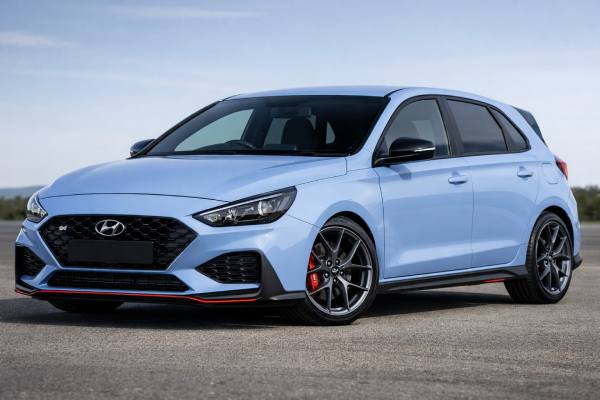
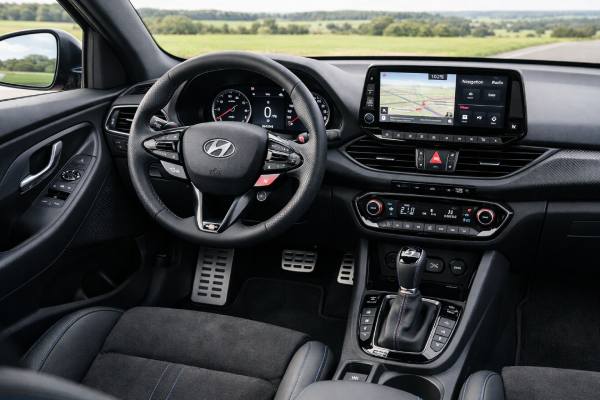
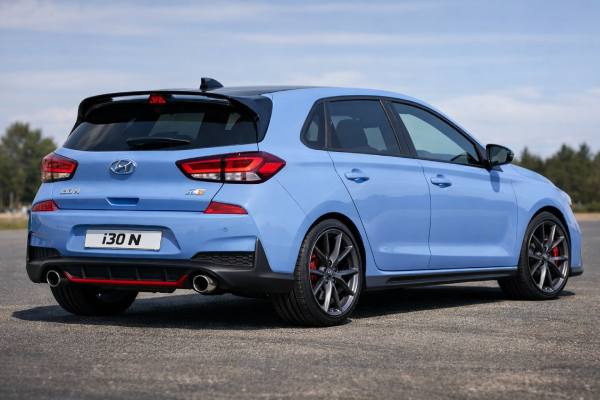
The 2021–2024 facelifted Hyundai i30 N 280 is the version that turned Hyundai’s first serious hot hatch into a more complete performance car. It kept the ingredients that made the original believable to enthusiasts — a 2.0-liter turbocharged four-cylinder, front-wheel drive, a mechanical-style electronically controlled limited-slip differential, adaptive damping, big brakes, and a manual gearbox — while adding sharper styling, more power, better safety technology, and, crucially, the wet eight-speed N DCT option. That matters in ownership because the facelift car feels broader in its abilities. It can still handle track work and fast-road use, but it is also easier to live with every day than many buyers expect. The trade-off is just as clear: this is a hard-driven, high-output direct-injection turbo hatch, so tyre quality, service history, tune status, and evidence of overheating or repeated abuse matter more than mileage alone. A good one is special. A neglected one can get expensive quickly.
At a Glance
- The facelift i30 N 280 adds meaningful upgrades, including more power and the optional wet 8-speed N DCT.
- Standard performance hardware includes e-LSD, adaptive suspension, rev matching, and large 19-inch tyres.
- The hatchback body remains genuinely practical, with up to 395 L of boot space without the stiffness bar.
- Cheap modified cars are risky because tyres, brakes, clutch wear, and hard-use history matter more than cosmetic condition.
- A strong real-world service baseline is engine oil and filter every 10,000 km or 12 months.
Section overview
- Hyundai i30 N Facelift Identity
- Hyundai i30 N Facelift Numbers
- Hyundai i30 N Facelift Equipment
- Failure Patterns and Campaigns
- Servicing Logic and Buying Filters
- Track-Day Pace and Road Manners
- Golf R, Type R and Cupra Leon
Hyundai i30 N Facelift Identity
The facelifted Hyundai i30 N 280 is best understood as the point where Hyundai stopped being the ambitious outsider and became a proper hot-hatch contender on merit. The original i30 N already had the right engineering values: strong front-end bite, a serious differential, tough brakes, and enough adjustability to feel like a car built by people who actually cared about how it drove. The 2021 facelift improved that formula rather than replacing it. Power rose to 280 PS, torque rose to 392 Nm, the cabin became more modern, and the safety package expanded. Most importantly for many buyers, Hyundai added the wet eight-speed N DCT alongside the six-speed manual.
That gearbox broadened the car’s appeal. The pre-facelift i30 N was excellent, but it was still aimed very squarely at the manual-only enthusiast crowd. The facelifted 280 made the car easier to use in traffic, quicker from a standstill, and more competitive against dual-clutch rivals without giving up the aggressive character that defined the N badge. Hyundai also added the N Power Shift, N Grin Shift, and N Track Sense Shift software functions on DCT versions, which made the automatic model feel purpose-built rather than like a compromise.
The hatchback body remains part of the appeal. Unlike some dramatic performance cars, the i30 N still works as an only car. It has useful rear doors, sensible visibility, and a luggage area that can genuinely handle daily life. In VDA terms, the hatch offers 381 L with the rear stiffness bar fitted or 395 L without it, and 1,287 L or 1,301 L with the seats folded depending on that setup. That is not class-leading space, but it is enough to make the i30 N more usable than its performance image suggests.
The facelift also sharpened the visual identity without overdoing it. The front grille, bumper treatment, wheel design, and lighting became cleaner and more confident, while the interior gained a larger screen and more digital feel. The overall effect is that the 2021–2024 car feels newer than a simple power bump would suggest. It is still recognisably an i30 N, but it looks less like an experiment and more like a fully mature product.
That maturity is important in the used market. Buyers are not just choosing between fast hatches. They are choosing between different kinds of ownership experience. The facelift i30 N 280 offers genuine driver engagement, respectable practicality, and a level of equipment that makes it easy to live with. The caution is simple: the same qualities that make it attractive also make it a magnet for hard driving, tuning, and track use. A carefully owned car is a real asset. A badly used one can absorb money very quickly. That is why the facelift 280 is not just about performance figures. It is about buying the right example.
Hyundai i30 N Facelift Numbers
For the 2021–2024 hatchback, the key technical story is clear: front-wheel drive, a 2.0-liter turbo four, standard performance hardware, and a choice of six-speed manual or wet eight-speed N DCT. The figures below focus on the facelift hatchback 280 PS version rather than the earlier 250 PS car or the Fastback body.
Powertrain and efficiency
| Item | Hyundai i30 N facelift 280 |
|---|---|
| Code | Theta 2.0 T-GDi gasoline |
| Engine layout and cylinders | Inline-4, DOHC, 16 valves |
| Bore × stroke | 86.0 × 86.0 mm (3.39 × 3.39 in) |
| Displacement | 2.0 L (1,998 cc) |
| Induction | Turbocharged |
| Fuel system | Direct injection |
| Compression ratio | 9.5:1 |
| Max power | 280 PS (206 kW) @ 5,500–6,000 rpm |
| Max torque | 392 Nm (289 lb-ft) @ 2,100–4,700 rpm |
| Timing drive | Verify by VIN-specific workshop data before parts ordering |
| Rated efficiency | 8.0 L/100 km WLTP combined (6MT), 8.4 L/100 km WLTP combined (N DCT) |
| Real-world highway @ 120 km/h | About 7.8–8.8 L/100 km in steady driving |
Transmission and driveline
| Item | Hyundai i30 N facelift 280 |
|---|---|
| Transmission | 6-speed manual or wet 8-speed N DCT |
| Drive type | FWD |
| Differential | Electronically controlled limited-slip differential |
| Extra DCT functions | N Power Shift, N Grin Shift, N Track Sense Shift |
Chassis and dimensions
| Item | Hyundai i30 N facelift hatchback |
|---|---|
| Suspension front | MacPherson strut with electronic control suspension |
| Suspension rear | Multi-link with electronic control suspension |
| Steering | Rack-mounted motor-driven power steering |
| Steering ratio | 12.27 (@360°) for the 280 PS hatch in the EU technical sheet |
| Lock-to-lock turns | 2.14 |
| Turning circle | 5.83 m radius, about 11.66 m kerb-to-kerb |
| Front brakes | 360 mm front discs |
| Rear brakes | 314 mm rear discs |
| Wheels and tyres | 8.0J × 19 alloy wheels, 235/35 R19 tyres |
| Ground clearance | 136 mm (5.35 in) |
| Length | 4,340 mm (170.87 in) |
| Width | 1,795 mm (70.67 in) |
| Height | 1,445 mm (56.89 in) |
| Wheelbase | 2,650 mm (104.33 in) |
Weights and capacities
| Item | Hyundai i30 N facelift 280 |
|---|---|
| Kerb weight | About 1,419–1,499 kg (3,128–3,304 lb) manual / 1,455–1,535 kg (3,208–3,384 lb) N DCT |
| GVWR | 1,940 kg manual / 1,970 kg N DCT |
| Fuel tank | 50 L (13.21 US gal / 11.0 UK gal) |
| Cargo volume | 381 L with stiffness bar / 395 L without it; 1,287 L seats folded with bar / 1,301 L without |
| Towing capacity | 1,600 kg (3,527 lb) braked, 700 kg (1,543 lb) unbraked in the UK spec sheet |
| Payload | About 441–521 kg depending on spec basis |
Performance and service data
| Item | Hyundai i30 N facelift 280 |
|---|---|
| 0–100 km/h | 5.9 s manual / 5.4 s N DCT with Launch Control |
| Top speed | 250 km/h (155 mph) |
| 50–75 mph | 5.6 s manual / 3.3 s N DCT |
| Braking distance | 34.6 m from 62–0 mph (about 113.5 ft) |
| Fuel type | Super unleaded / premium petrol per market spec |
| Engine oil | Use Hyundai-approved full-synthetic oil for the exact VIN and market |
| Coolant | Ethylene-glycol coolant suitable for aluminum systems |
| Brake fluid | High-quality DOT 4 is the sensible road baseline |
| A/C refrigerant | Verify from under-hood label and VIN-specific workshop data |
Safety and driver assistance
| Item | Hyundai i30 N facelift |
|---|---|
| Euro NCAP basis | i30 family 5-star rating, with facelift review logged in 2020 |
| Adult Occupant | 88% |
| Child Occupant | 84% |
| Vulnerable Road Users | 64% |
| Safety Assist | 68% |
| ADAS availability | FCA, LFA, LVDA, HBA, LKA, Intelligent Speed Limit Warning, plus some trim-specific blind-spot and rear cross-traffic features |
The figures that really shape the verdict are the 392 Nm torque output, the 5.4-second DCT launch figure, the 19-inch wheel and tyre package, and the fact that this car still offers genuinely usable hatchback cargo space.
Hyundai i30 N Facelift Equipment
On the facelifted i30 N hatchback, the trim story is simpler than on most ordinary family cars. The exact article topic here is the 280 hp facelift model, so the focus is not on the old 250 PS standard trim. It is on the Performance-grade car that most enthusiasts actually want. In many markets, that version arrived effectively as the real N specification, with the important hardware already included and only a small number of comfort or cosmetic options left to choose from.
That matters because the headline equipment is not decorative. The 280 PS car brings the parts that define how it drives: the electronically controlled limited-slip differential, electronically controlled suspension, launch control, active variable exhaust, rev matching, rear stiffness bar, reinforced brakes, and the full 19-inch performance tyre package. Hyundai also gave it the N drive-mode architecture that lets the driver alter throttle, dampers, steering, stability systems, exhaust sound, and differential behavior. Those systems are not gimmicks. They are the reason the car can feel civil one moment and extremely focused the next.
In market specification sheets, the facelift hatchback also gained useful cabin and tech upgrades. UK-market material lists a 10.25-inch navigation touchscreen with Bluelink, Apple CarPlay and Android Auto, a 4.2-inch supervision cluster, wireless phone charging, heated front seats, faux-suede and leather seat trim, keyless entry, and dual-zone climate control. The same source also shows N Light Sport Seats as an option, which matters in the used market because those seats are a visible clue that the car may have been configured by an enthusiastic first owner rather than bought off the shelf.
Quick identifiers that help on a used car
- 19-inch 235/35 R19 tyres are part of the 280 hatch’s standard performance identity.
- The rear stiffness bar in the luggage area is a genuine N clue, not a styling flourish.
- N buttons on the steering wheel and the performance data screens should be present and functional.
- DCT cars add N Grin Shift, N Power Shift, and N Track Sense Shift.
- Optional N Light Sport Seats are worth noting because they change the cabin feel and used appeal.
Safety equipment is stronger on the facelift than on the pre-facelift car. Hyundai’s N-specific material lists Forward Collision-Avoidance Assist with vehicle and pedestrian detection, Lane Following Assist, Leading Vehicle Departure Alert, High Beam Assist, Lane Keeping Assist, and eCall. UK material also lists Autonomous Emergency Braking, Intelligent Speed Limit Warning, Driver Attention Alert, and, for the hatchback, Blind Spot Collision Warning. Some of the blind-spot and rear cross-traffic assist features depend on transmission or market, so buyers should still verify the actual car rather than assume all 280 cars are identical.
The Euro NCAP position is also worth explaining carefully. There is no separate N-only crash-test entry. Instead, the i30 family’s official Euro NCAP file remains the relevant safety baseline, and that file shows a facelift review in 2020 before the rating expired under time-based rules in January 2024. For a used buyer, the practical meaning is straightforward: the facelift i30 N still sits on a strong family-car safety platform, but active-safety fitment and calibration should be checked one car at a time.
The best equipment strategy is not simply “buy the most options.” It is “buy the cleanest 280 with the hardware and comfort items you will actually use, and make sure they all still work correctly.”
Failure Patterns and Campaigns
The facelift i30 N 280 does not suffer from one single universal defect that defines the model. That is good news. But it is also not a cheap car to neglect. The biggest reliability difference between a good i30 N and a bad one usually comes from usage, tuning, and service discipline rather than from a dramatic factory design flaw. That is why the reliability section needs to focus on patterns rather than myths.
| Area | Prevalence | Severity and cost tier | What to watch for |
|---|---|---|---|
| Front tyres and alignment | Common | Medium | Inner-edge wear, tramlining, mixed tyre brands, steering pull |
| Front brakes and pads | Common | Medium to high | Vibrations, heavily lipped discs, overheating signs, uneven pedal feel |
| Clutch wear on manuals | Occasional | Medium to high | Slip in higher gears, weak bite, shudder |
| DCT behavior on abused cars | Occasional | Medium to high | Jerky shift quality, repeated heat-related hesitation, poor launch behavior |
| Plugs, coils, and misfire under load | Occasional | Medium | Hesitation, flashing engine light, rough high-boost running |
| Intake deposits and oily intake tract | Occasional | Medium | Lumpy idle, loss of crispness, reduced part-throttle smoothness |
| Suspension fatigue on hard-used cars | Occasional | High | Knocks, leaking dampers, loose body control, strange mid-corner reactions |
| Software and campaign status | Limited but important | Medium to high | Missing updates, incomplete recalls, warning messages, disabled assists |
The first ownership truth is that consumables tell the story. An i30 N on cheap tyres is not just a cheaper car to buy. It is usually a warning sign. This chassis is sensitive enough that tyre quality changes the verdict dramatically. The same applies to brakes. A car can look smart in photos and still be one set of discs, pads, and tyres away from a large initial bill.
The second truth is that modifications matter. A remap is not an automatic reason to walk away, but it changes the standard of proof you should demand. So do aftermarket intakes, louder exhausts, and deleted emissions hardware. The 2.0 T-GDi responds well to tuning, but the more the car has been pushed, the more important it becomes to see hard evidence of careful servicing, quality fluids, and informed ownership.
The third truth is that not every issue is a mechanical disaster. Misfires under load, coil-related running faults, tired spark plugs, battery problems, and occasional infotainment glitches are usually easier to fix than a worn clutch or damaged wheel. What matters is catching them early. On a performance turbo car, small faults become expensive when ignored because heat, boost, and hard use amplify everything.
In terms of official actions, the safest approach is VIN-first rather than rumor-first. Hyundai’s recall and service campaign checker is essential for any used N. The wider i30 PDE family has had campaign activity in recent years, and the facelift i30 N also depends on correct software and module calibration for its driver-assistance features and transmission behavior. Buyers should not assume “no dashboard warning” means “fully up to date.” Dealer service history and campaign proof matter.
For a pre-purchase inspection, ask for five things:
- A full service history with invoices, not just stamps.
- A cold start and a proper test drive.
- A fault-code scan for engine, transmission, and ADAS modules.
- Proof that the car is standard, or detailed paperwork for any modifications.
- Confirmation of campaign and recall completion through Hyundai.
The safest i30 N is not the cheapest one. It is the one with the least uncertainty.
Servicing Logic and Buying Filters
Maintaining the facelift i30 N 280 well is less about doing exotic things and more about respecting what the car is. It is a performance hatch, not just a quick i30, so the best service plan is closer to enthusiast practice than bare-minimum family-car servicing. Hyundai’s own service documentation varies by market, but in real ownership a 10,000 km or 12-month oil interval is the sensible baseline even for lightly used cars. On tuned or tracked cars, shorter intervals are a good idea.
Practical maintenance schedule
| Item | Sensible real-world interval |
|---|---|
| Engine oil and filter | Every 10,000 km or 12 months |
| Engine air filter | Inspect every service, replace sooner after repeated dusty or track use |
| Cabin air filter | Check yearly and usually replace annually |
| Spark plugs | Inspect early on used cars; 30,000–40,000 km is a sensible checkpoint on hard-used examples |
| Coolant | Check yearly; earlier refresh is sensible on track-driven cars |
| Manual transmission fluid | Proactive renewal around 60,000–80,000 km is sensible on hard-used cars |
| N DCT fluid and behavior | Inspect and monitor shift quality closely; earlier service makes sense on abused cars |
| Brake fluid | Every 2 years for road use, sooner for regular track use |
| Brake pads and discs | Inspect every service and before any track session |
| Tyres | Inspect often, check pressures regularly, and confirm alignment frequently |
| Auxiliary belt and hoses | Inspect every service |
| Timing components | Investigate start-up noise or timing-correlation faults immediately |
| 12V battery | Test yearly from about year 4 onward |
Useful fluid and operating guidance
- Engine oil: use a Hyundai-approved full-synthetic oil suitable for the exact VIN and market.
- Brake fluid: DOT 4 is the practical minimum for road use.
- Coolant: use the correct Hyundai-compatible ethylene-glycol coolant.
- Fuel: use premium unleaded as specified for the region.
- Tyres: quality matters more than price on this chassis.
For used buyers, the inspection checklist should focus on the hard costs. Look at tyre age, brand, and even wear. Inspect wheel rims for cracks, bends, and poor repairs. Check the front brake discs carefully because this car can consume them if driven hard. Test the clutch in a higher gear at lower rpm on manual cars. On DCT cars, test parking-speed creep, repeated stop-start transitions, and full-throttle kickdown once warm.
Also look closely at the cabin and load area. A worn driver’s bolster or scuffed steering wheel is not a disaster, but a rough luggage area, missing trim around the stiffness bar, or evidence of amateur wiring for aftermarket hardware may tell you more about the car’s life than polished bodywork ever will.
The best examples are usually lightly modified or completely standard cars with clear service records, matched premium tyres, recent brake work, and no unresolved warning messages. The years to target are mostly a condition question rather than a magic facelift split within the facelift. A clean 2022–2024 car can offer the strongest mix of freshness and equipment, but a well-kept 2021 is still an excellent buy. The cars to avoid are the ones with obvious budget consumables, vague tune history, or sellers who speak more about pops and bangs than about invoices.
Long-term durability is good when the i30 N is maintained like the performance car it is. The problems usually come from shortcuts, not from the concept itself.
Track-Day Pace and Road Manners
The facelift i30 N 280 earns its reputation because it feels engineered, not improvised. From the first fast corner, the front axle tells you this is a serious hot hatch. Turn-in is quick, the differential helps the car tighten its line under power, and the body control stays disciplined enough to encourage commitment rather than caution. The car does not just feel fast. It feels like the chassis was designed to exploit its power properly.
That chassis breadth is what separates it from many quick family cars with sporty branding. In its softer settings, the i30 N is firm but usable. On ordinary roads it can still commute, deal with long journeys, and carry passengers without constantly reminding them they are in a weekend toy. Switch to the more aggressive N settings, though, and the car becomes much more locked down. Damping tightens, throttle response sharpens, the exhaust gets louder, and the whole car starts to feel more purposeful. The adjustment range is one of the reasons the facelift version works so well as an only car.
The engine has strong character too. The 2.0 T-GDi is not just about headline output. The 392 Nm torque spread gives the car real mid-range force, and the facelift’s extra power over the older 275 car helps it feel stronger at higher rpm. The manual still suits the car’s personality well, especially with rev matching enabled. But the N DCT is the bigger story for many owners. It is faster, more dramatic under launch, and noticeably easier in daily traffic. Hyundai’s N Grin Shift, N Power Shift, and N Track Sense Shift functions also give the DCT car a distinct identity rather than making it feel like a generic automatic.
Real-world fuel use reflects how you drive it.
| Use case | Real-world expectation |
|---|---|
| Steady motorway run | Around 7.8–8.8 L/100 km |
| Mixed everyday driving | Around 8.8–10.2 L/100 km |
| Dense city use | Around 10.5–12.5 L/100 km |
| Fast-road or track driving | Easily much higher |
Those figures are not surprising for a 280 PS front-drive hatch on 235-section tyres. Buyers who worry constantly about fuel should not buy this car. Buyers who understand the trade will usually accept it.
Noise and comfort are better than the N’s image suggests, but there is no hiding the car’s intent. Tyre roar is real on rough surfaces, the 19-inch setup can feel sharp over broken tarmac, and the active exhaust keeps the personality lively. Still, by hot-hatch standards, the i30 N remains impressively livable. That is a major part of its appeal. It is quick enough for track days, focused enough for enthusiastic road driving, and still sensible enough to do normal hatchback work during the week.
As a performance car, the facelift 280 feels complete. As a daily car, it feels better than many of its numbers suggest.
Golf R, Type R and Cupra Leon
The facelift Hyundai i30 N 280 sits in a fascinating spot among rivals because it does not try to mimic just one of them. Against the Volkswagen Golf R, it gives up all-wheel-drive traction and some of the Golf’s more polished, premium feel. But it fights back with a more mechanical front-drive character, stronger steering involvement, and a more transparent sense of what the chassis is doing. The Golf R is often the easier all-weather point-and-shoot car. The i30 N is the more interactive one.
Against the Honda Civic Type R, the Hyundai takes the more moderate route. The Honda remains the sharper front-drive benchmark for many enthusiasts, but it is also more visually extreme and, in some generations, less discreet to own. The i30 N feels like the hot hatch for someone who wants real ability without making every journey look like an event. It is still serious, but it is easier to blend into daily life.
Against the Cupra Leon, the Hyundai often wins on personality. The Cupra can be quick and appealing, especially in DSG form, but the i30 N tends to feel more obviously engineered for enthusiastic driving. The configurable chassis systems, the differential behavior, the performance pages, and the way the car reacts under load all reinforce that impression. The Hyundai may not have the same brand cachet, but it does not feel like an imitation product.
Where the i30 N is weaker is also easy to define. It is not the quietest hot hatch. Its fuel use is ordinary for the class rather than impressive. And the front-drive layout, while brilliantly exploited, cannot match the all-weather traction of a Golf R. The used market also needs careful filtering because N cars attract modifiers, track-day owners, and people who enjoy the louder side of car culture.
Still, the strengths are substantial:
- Genuine performance hardware as standard on the 280.
- Strong manual and DCT choices.
- Real hatchback practicality.
- Excellent front-end engagement.
- A more mature and usable character than its reputation suggests.
That is why the facelift i30 N 280 remains one of the smartest enthusiast buys of its period. It is not the most premium, not the most extreme, and not the most anonymous. It is the one that often feels most honest about what it is: a serious hot hatch engineered to be driven hard, but flexible enough to live with every day.
If you want a performance hatch that still feels special after the launch numbers stop mattering, the facelift Hyundai i30 N 280 deserves to be on the shortlist.
References
- Hyundai i30 N | Technical specifications 2021 (Technical Specifications)
- i30 N | Features 2026 (Features and Specifications)
- EuroNCAP | Hyundai i30 2017 (Safety Rating)
- Home | Hyundai Recalls & Service Campaigns 2026 (Recall Database)
- Hyundai Owners manuals | Hyundai Motor UK 2026 (Owner’s Manual)
Disclaimer
This article is for informational purposes only and is not a substitute for professional diagnosis or repair. Specifications, torque values, service intervals, procedures, recall applicability, and equipment can vary by VIN, market, transmission, trim, and production date, so always verify critical details against official Hyundai service documentation and dealer records before servicing, repairing, towing, or buying a vehicle.
If this guide was useful, please consider sharing it on Facebook, X, or another social platform to support our work.