
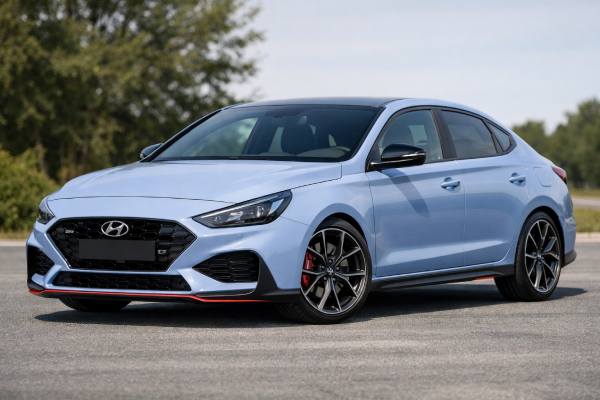
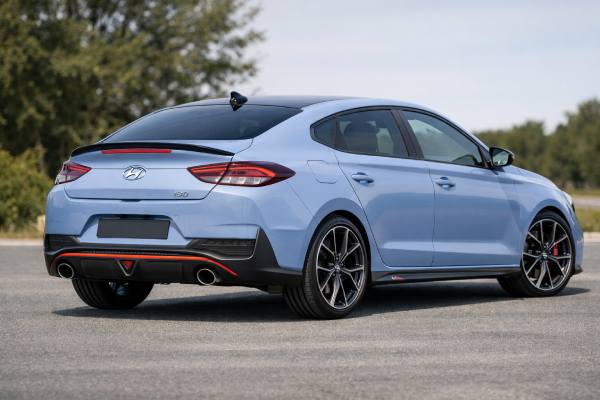
The facelift Hyundai i30 Fastback N is the more mature-looking side of Hyundai’s performance-car story. It keeps the core N formula intact, but wraps it in a sleeker body with a larger boot and a more understated shape than the hatchback. In 280 hp form, this is effectively the facelift-era high-output Fastback N: a front-wheel-drive performance car with a 2.0-litre turbocharged engine, adaptive damping, an electronic limited-slip differential, serious brakes, and a choice of six-speed manual or wet eight-speed N DCT transmission.
That mix is what makes it interesting. The Fastback N is quick enough to feel special, yet practical enough to be used every day. It is also more than a styling exercise. The facelift brought more power, more torque, new transmission options, updated tech, and broader safety equipment. The main ownership trade-off is predictable: this is a high-performance front-wheel-drive car, so tyres, brakes, alignment, and maintenance discipline matter much more than they do on an ordinary i30.
Top Highlights
- The 280 hp Fastback N blends genuine performance hardware with a 450 L boot and a more discreet shape than the hatchback.
- The wet 8-speed N DCT adds real performance features, not just convenience, and the manual remains a strong enthusiast choice.
- The eLSD, adaptive suspension, and strong factory brake package give the car real track-capable engineering.
- Tyres, brake wear, and poorly maintained tuned examples are the biggest ownership risks.
- A careful oil and filter service every 10,000 to 15,000 km or 12 months is a sensible real-world baseline.
Start here
- Hyundai i30 Fastback N facelift basics
- Hyundai i30 Fastback N specs and data
- Hyundai i30 Fastback N trims and safety
- Reliability, issues, and service actions
- Maintenance plan and buying guide
- Driving feel and real-world performance
- How it compares with rivals
Hyundai i30 Fastback N facelift basics
The facelift Fastback N sits in a very specific place in the i30 family. It is not a warm trim and it is not just a styling package. It is a full N model built around Hyundai’s high-performance recipe: a turbocharged 2.0-litre four-cylinder engine, front-wheel drive, adaptive suspension, a dedicated steering setup, launch control, rev matching, and performance software built to make the car feel alive on road or track. In facelift form, the big news was the move to the 280 PS output for the higher-performance version, which is commonly rounded to 280 hp in used-car listings.
That output matters, but it is only part of the story. Hyundai also introduced the wet 8-speed N DCT, which changed the car’s personality more than a simple automatic option usually does. This transmission brought N-specific functions such as N Power Shift, N Grin Shift, and N Track Sense Shift. In other words, the DCT version was not designed as the softer choice. It was designed as another performance path. Buyers who prefer full driver involvement can still make a strong case for the six-speed manual, but the facelift DCT is a real performance feature, not just a commuter convenience add-on.
The Fastback body changes the ownership experience in useful ways. It is longer than the hatchback and has a more elegant roofline, but it does not lose its identity as an N car. It still looks aggressive, but in a more restrained way. More importantly, it gains luggage flexibility. Hyundai’s technical data lists 450 litres of VDA boot space without the optional stiffness bar, or 436 litres with it. Seats folded, that becomes 1,351 litres without the bar or 1,337 litres with it. That is enough to make the Fastback N a realistic one-car solution for many owners.
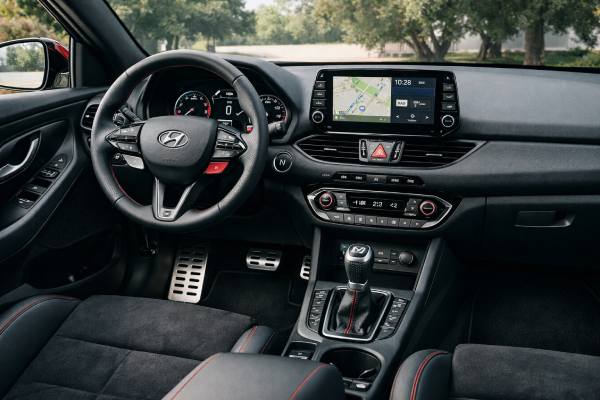
The facelift also sharpened the design. Hyundai reworked the front bumper, added V-shaped LED lighting signatures, improved aerodynamic details, and introduced 19-inch forged wheels for the 280 PS configuration. Interior technology stepped forward too, with updated infotainment, optional N Light Seats, and a more developed digital performance environment. Safety and driver assistance also improved, though the exact feature mix depends on body type, transmission, and market.
The most important buying context is this: the facelift Fastback N 280 is effectively the performance-spec car. Early pre-facelift Fastback Ns could be found with a lower-output 250 PS version, but the facelift era focused more heavily on the 280 PS output. In some markets, the facelift Fastback N was effectively sold only in the stronger form. That is why buyers should identify the car by VIN, wheel package, transmission, and factory equipment rather than assuming every seller description is accurate.
Hyundai i30 Fastback N specs and data
The facelift Fastback N’s technical package is one of its strongest selling points because it feels like a complete engineering upgrade rather than a simple power bump. Hyundai’s 2021 technical sheets lay out the hardware clearly.
| Powertrain and efficiency | Specification |
|---|---|
| Engine family | Theta 2.0 T-GDi |
| Engine layout and cylinders | Inline-4, DOHC, 16 valves |
| Displacement | 2.0 L (1,998 cc) |
| Bore × stroke | 86.0 × 86.0 mm (3.39 × 3.39 in) |
| Induction | Turbocharged |
| Fuel system | Direct injection |
| Compression ratio | 9.5:1 |
| Max power | 280 PS (206 kW) @ 5,500–6,000 rpm |
| Max torque | 392 Nm (289 lb-ft) @ 2,100–4,700 rpm |
| Overboost torque | 378 Nm (278.8 lb-ft) @ 1,750–4,200 rpm |
| Timing drive | Chain |
| Fuel type | Premium petrol, market-specific octane requirement |
| WLTP combined economy | 8.0 L/100 km (29.4 mpg US / 35.3 mpg UK) manual, 8.4 L/100 km (28.0 mpg US / 33.6 mpg UK) N DCT |
| Real-world highway at 120 km/h | Typically around 7.8–8.8 L/100 km, depending on traffic, tyres, and temperature |
| Transmission and driveline | Specification |
|---|---|
| Transmission | 6-speed manual or 8-speed wet N DCT |
| Drive type | FWD |
| Differential | N Corner Carving Differential, electronic limited-slip differential |
| Launch Control | Yes |
| Rev Matching | Yes |
| Chassis and dimensions | Specification |
|---|---|
| Front suspension | Electronic Control Suspension / MacPherson strut |
| Rear suspension | Electronic Control Suspension / Multi-link |
| Steering | Rack-mounted motor-driven power steering |
| Steering ratio | 12.27:1 |
| Lock-to-lock turns | 2.14 |
| Turning circle | 11.66 m (38.3 ft) diameter |
| Front brakes | 360 mm ventilated discs |
| Rear brakes | 314 mm solid discs |
| Tyres | 235/35 R19 |
| Wheels | 19-inch forged alloy wheels |
| Ground clearance | 135 mm (5.3 in) |
| Length | 4,455 mm (175.4 in) |
| Width | 1,795 mm (70.7 in) |
| Height | 1,419 mm (55.9 in) |
| Wheelbase | 2,650 mm (104.3 in) |
| Kerb weight | 1,431–1,511 kg manual / 1,474–1,554 kg N DCT |
| GVWR | 1,950 kg manual / 1,980 kg N DCT |
| Fuel tank | 50 L (13.2 US gal / 11.0 UK gal) |
| Cargo volume | 450 L seats up / 1,351 L seats down without stiffness bar |
| Performance and carrying ability | Specification |
|---|---|
| 0–100 km/h | 5.9 s manual / 5.4 s N DCT with Launch Control |
| 0–62 mph | 5.9 s manual / 5.4 s N DCT with Launch Control |
| Top speed | 250 km/h (155 mph) |
| 50–75 mph | 5.6 s manual / 3.3 s N DCT |
| Braking distance 62–0 mph | 34.6 m |
| Towing capacity | 1,600 kg braked / 700 kg unbraked |
| Payload | 441–521 kg |
| Fluids and service capacities | Practical note |
|---|---|
| Engine oil | Use the exact Hyundai-approved oil specification and viscosity for the VIN and climate |
| Engine oil capacity | Verify by VIN in the official owner or workshop manual before service |
| Coolant | Use Hyundai-approved long-life coolant to the official specification |
| Coolant capacity | Verify by VIN before service |
| Transmission fluid | VIN-specific fluid for 6MT or wet 8-speed N DCT |
| A/C refrigerant | Verify by VIN and model year |
| Key torque values | Wheel, brake, spark plug, and suspension fastener torque should be checked against the official service information |
The main takeaway from the numbers is that this is a fully developed performance car, not a lightly uprated compact fastback. Big brakes, adaptive chassis hardware, a real eLSD, fast gearing, and serious power delivery all change the verdict.
Hyundai i30 Fastback N trims and safety
The facelift Fastback N range is simpler than many mainstream model lines, but buyers still need to understand how the specification structure works. In practical terms, the 280 hp Fastback N is the higher-output facelift version, and in many markets it was effectively tied to the stronger performance-oriented configuration. That means the most important buying differences are usually not engine output, but transmission, seat choice, wheel package, and year-specific equipment.
The six-speed manual remains the purist’s choice. It gives the car a slightly lighter feel, preserves the most traditional hot-hatch interaction, and avoids the extra complexity of the dual-clutch system. The 8-speed N DCT, however, is not merely an ease-of-use option. Hyundai specifically engineered it for N duty, with N Power Shift, N Grin Shift, and N Track Sense Shift. That makes the DCT version faster in objective terms and often easier to exploit in short bursts. Used buyers should choose based on driving preference and service history, not on assumptions that one version is automatically better.
The seat and wheel choices also matter more than they seem. Standard seats are perfectly usable, but optional N Light Seats are more supportive and make the cabin feel more special. They are also lighter, which suits the car’s purpose. On the outside, the forged 19-inch wheels are part of the facelift 280 package and look excellent, but they also mean higher tyre costs and less pothole tolerance than an 18-inch setup on an earlier car.
Technology improved meaningfully with the facelift. Hyundai added a 10.25-inch touchscreen, Bluelink connectivity, improved smartphone integration, and a richer N performance display environment. The cockpit feels more modern than the earlier Fastback N, and the updated controls fit the car’s dual nature well. It still feels driver-focused, but it is no longer a sparse or purely analog-feeling performance hatch derivative.
Safety equipment also improved. The i30 family carries a five-star Euro NCAP result, with strong adult and child protection scores for the class. For the facelift N family, Hyundai expanded SmartSense features such as Forward Collision-avoidance Assist with vehicle and pedestrian detection, Lane Following Assist, and Leading Vehicle Departure Alert. Some blind-spot and rear cross-traffic functions depended on transmission type and body style, so Fastback buyers should verify exact equipment on the specific car rather than assuming every N has the same ADAS package.
This matters because a late-run 2023 or 2024 registered Fastback N can feel richer in technology and safety than an early 2021 example, even when the basic chassis and powertrain remain the same. The best used examples are usually not the highest-spec ones on paper, but the ones with the cleanest history, best tyres, and least compromised ownership story.
Reliability, issues, and service actions
The facelift Fastback N is not known for one universal fatal weakness, but it is a car that punishes poor ownership more quickly than an ordinary i30. The right way to judge reliability is by use case. A well-serviced road car with sensible warm-up habits can be very good. A heavily modified or repeatedly tracked example with vague maintenance can become expensive fast.
The most common ownership costs are not failures in the dramatic sense. They are consumables and wear. Front tyres disappear quickly on badly aligned or aggressively driven cars. The inner shoulders deserve close inspection. Brake discs and pads can wear faster than casual buyers expect, especially if the car has seen track days or repeated hard mountain-road use. None of this means the car is unreliable. It means the car’s performance is real enough to consume parts at a higher rate than a normal compact fastback.
Ignition and air-path issues are another common first step when something feels wrong. Symptoms usually include misfire under load, hesitation, or a check-engine light when boost arrives. The likely root causes are spark plugs, coils, intake leaks, or sensor issues rather than catastrophic engine failure. On a direct-injection turbo engine, neglected oil changes or poor fuel can also contribute to long-term trouble. Carbon build-up is not unique to this car, but it is a realistic long-run concern on any hard-used direct-injection performance engine.
The transmission choice shapes the risk profile. The manual gearbox is generally robust, but clutch wear varies hugely with launch abuse, sticky tyres, and power modifications. A high bite point, slip in higher gears, or drivetrain thump on take-up deserves attention. The wet N DCT is strong, but it adds complexity. Low-speed shunt, warning lights, lazy shifts, or poor hot behaviour are reasons for proper diagnosis, not for guesswork. DCT cars that have been serviced properly and left close to standard are far less worrying than aggressively tuned ones.
Heat management matters here. Cars that have done repeated track work should be inspected for tired brake fluid, cracked or heat-cycled tyres, oil seepage, mount wear, and cooling-system condition. The Fastback N was engineered for track-capable use, but it still depends on fresh fluids and proper inspection intervals. Owners who treat it like a track car without track-car maintenance will eventually pay for that mismatch.
Chassis wear is broadly typical for a performance front-driver. Suspension bushes, top mounts, drop links, wheel bearings, and brake hardware become inspection points as mileage rises. Cars from salty climates should also be checked underneath for corrosion on subframes, exhaust fasteners, brake lines, and suspension hardware. Electronics are usually manageable, but weak 12V batteries can still trigger nuisance warnings on modern Hyundais.
For recalls, campaigns, and calibrations, the safest approach is a VIN-based Hyundai check and dealer records. Software updates matter more than some buyers think, because drivability, infotainment behaviour, and driver-assistance operation can all improve through routine dealer-level updates.
Maintenance plan and buying guide
The smartest way to maintain a Fastback N is to ignore the idea that performance cars can be run on minimum effort. The car responds best to disciplined, conservative servicing. Even if a market handbook allows longer intervals in theory, real-world enthusiastic use justifies shorter ones.
| Maintenance item | Practical interval |
|---|---|
| Engine oil and filter | Every 10,000–15,000 km or 12 months |
| Engine air filter | Inspect every service, replace around 20,000–30,000 km |
| Cabin filter | Every 15,000–20,000 km or 12–24 months |
| Spark plugs | Inspect earlier on tuned or tracked cars; replace on schedule from the official manual |
| Coolant | Check yearly, replace to the official schedule or sooner if history is unclear |
| Brake fluid | Every 2 years minimum; yearly for frequent hard driving |
| Manual gearbox | Inspect for leaks and shift feel every service |
| N DCT | Check operation, leaks, and software status every service |
| Brake pads and discs | Inspect every service |
| Tyres and alignment | Inspect often; align whenever wear pattern changes |
| Timing chain | No routine public replacement interval; inspect if noisy or if timing faults appear |
| Auxiliary belts and hoses | Inspect every service |
| 12V battery | Test yearly after year 4 |
The key principle is simple: the harder the car’s life, the shorter the interval. A Fastback N that only sees relaxed commuting can probably live comfortably on the longer end of those ranges. A car that sees back-road driving, repeated launch-control use, or even occasional track sessions should be maintained more aggressively.
Fluid accuracy matters too. Use Hyundai-approved engine oil for the exact VIN and climate, not a generic “close enough” choice. The same applies to coolant and N DCT fluid. Public technical sheets are good for broad specifications, but the official owner or workshop manual should always be the final check before any refill or major service.
As a used buy, the best cars are usually lightly modified or unmodified examples with excellent paperwork. A thick folder of dealer or specialist invoices is worth real money on this model. Cars to be cautious about are the predictable ones: aggressive remaps with no matching maintenance story, mismatched premium tyres, heavily heat-marked brake discs, poor alignment wear, or sellers who cannot clearly explain service history.
The inspection checklist should be practical:
- cold-start cleanly with no major rattle,
- idle steadily,
- build boost smoothly,
- show no clutch slip or transmission shunt,
- brake straight with no steering vibration,
- ride quietly over rough edges,
- and show even tyre wear across the front axle.
Then inspect the underside and the service file. On a car like this, the invoice history often tells the truth before the seller does. Long-term durability is good when the car is respected. When neglected, it becomes an expensive lesson in deferred maintenance.
Driving feel and real-world performance
The facelift Fastback N 280 feels quick in a way that still matters on modern roads. It has enough power to feel serious, but it is the calibration and chassis tuning that make it memorable. The engine pulls hard through the middle of the rev range, stays strong at the top, and feels more urgent than the raw numbers alone suggest. The 280 hp output and 392 Nm torque figure give the car genuine pace, while the eLSD and adaptive suspension help it deploy that pace with more order than many powerful front-drivers manage.
The manual version feels like the more traditional enthusiast car. The six-speed shift action is direct, and the car rewards a driver who wants to manage weight transfer, gear choice, and rev matching personally. The N DCT, however, is often the faster road car. Launch Control makes the headline number easier to achieve, and the N-specific shift logic gives the transmission more character than most dual-clutch systems. In real use, the DCT car feels especially strong in short bursts and rolling acceleration.
Ride quality depends heavily on mode and road surface. In softer settings, the car is more livable than its reputation suggests. It is firm, but not automatically punishing. In the sharper modes, it becomes more serious, and on broken roads the 19-inch tyres make themselves known. That is why some owners love the car for the way it changes character. It can commute without drama, then feel completely different on a good road.
Steering is direct and quick, though not hyper-communicative in the old-school hydraulic sense. Body control is strong, front-end grip is serious, and the rear remains stable and reassuring rather than playful to the point of unpredictability. Braking feel is another strength. A healthy car has firm pedal action and repeated-stop confidence that supports the Fastback N’s track-capable image.
Real-world fuel economy is exactly what you would expect from a 280 hp performance fastback. It is acceptable when driven calmly and thirsty when driven hard. A steady motorway run can return numbers in the high-7s or low-8s L/100 km. Mixed use is often closer to the official WLTP figures. Hard driving quickly pushes consumption higher. That is not a flaw; it is simply the cost of meaningful performance.
The Fastback body also earns its keep here. The car feels slightly more mature in long-distance use than some shorter hot hatches, and the boot makes it more realistic as a daily companion. That dual nature is really the point. It can be civil, practical, and comfortable enough for normal life, but still feels special when you give it the road it wants.
How it compares with rivals
Against the Volkswagen Golf GTI Clubsport, the Fastback N offers a more unusual body style, a stronger sense of mechanical drama, and a more distinct identity per dollar or euro spent. The Volkswagen often feels more polished inside and slightly more refined in its responses. The Hyundai feels more individual and more obviously engineered around fun.
Against the Honda Civic Type R, the Hyundai is the subtler car. The Honda remains the sharper benchmark if the sole goal is ultimate front-wheel-drive performance. But it is also more visually extreme and often more expensive to enter. The Fastback N appeals to buyers who want serious pace without the same level of visual aggression.
The Renault Mégane R.S. is a closer philosophical rival, especially in the way it combines everyday use with real chassis intent. The Renault can feel more exotic in certain dynamic details, but the Hyundai often wins on ownership confidence, tech integration, and the sense that it was engineered to be used hard without becoming temperamental.
The Ford Focus ST is another natural comparison. It is a very talented all-rounder and often the better-value everyday performance car. But the Hyundai counters with a more special-feeling performance identity, more distinctive styling in Fastback form, and a more memorable performance-car cabin atmosphere.
The real strength of the facelift Fastback N 280 is that it does not need to dominate every isolated category to make sense. It wins by combination. It offers strong real-world pace, a big enough boot, real chassis hardware, an available performance DCT, and a more mature silhouette than the usual hot hatch shape. For buyers who want a performance car that feels engineered rather than merely marketed, it remains one of the most interesting choices in the class.
References
- Hyundai i30 N | Technical specifications 2021 (Technical Data)
- The new Hyundai i30 N: focused on dynamic performance 2021 (Press Information)
- Hyundai Owners manuals | Hyundai Motor UK 2026 (Owner’s Manual Portal)
- EuroNCAP | Hyundai i30 2017 (Safety Rating)
Disclaimer
This article is for informational purposes only and is not a substitute for professional diagnosis, repair, or factory service information. Specifications, torque values, intervals, procedures, software content, and equipment can vary by VIN, market, model year, transmission, and trim, so always verify the exact vehicle against official Hyundai service documentation before servicing, repairing, or purchasing a car.
If this guide helped you, please consider sharing it on Facebook, X, or another platform to support our work.