
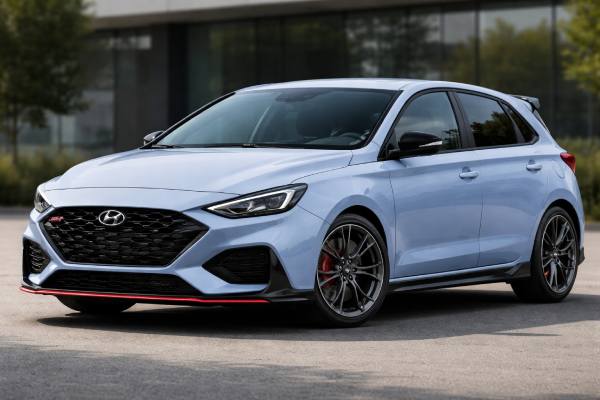
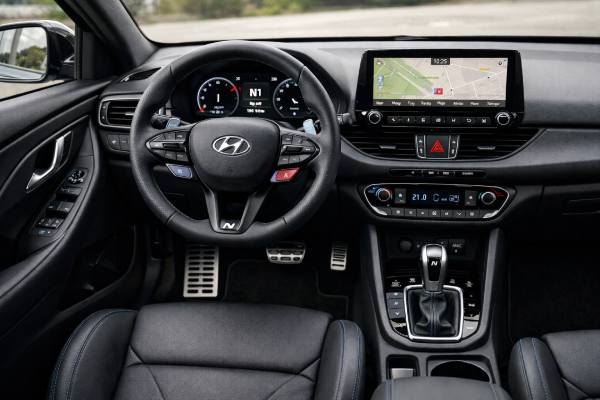
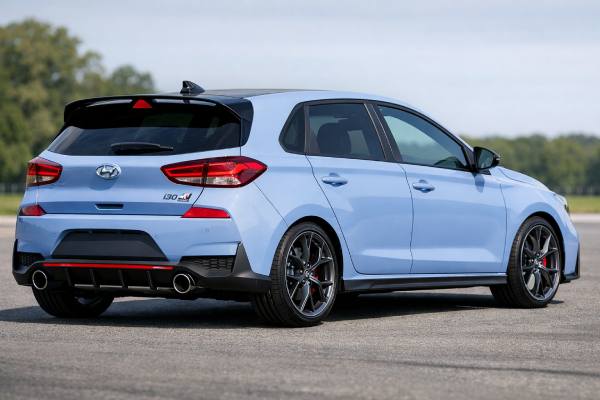
The facelift Hyundai i30 N PD in 280 hp form is the point where the regular i30 platform turns into a serious performance car without losing its hatchback usefulness. The 2021 update brought more than a styling refresh. Hyundai raised output, introduced the eight-speed wet N DCT alongside the manual, revised suspension and steering settings, and sharpened the car’s braking, tyre, and differential hardware in the Performance Package version that effectively became the core offering in many markets. The result is a front-wheel-drive hot hatch that feels engineered rather than simply tuned. It is fast enough for track work, yet still practical enough for commuting and long trips. That balance is the reason the facelift i30 N remains so appealing in the used market. The ownership caution is straightforward: this is a high-load turbocharged performance hatch, so tyres, brakes, clutch or DCT behavior, and service quality matter far more than on an ordinary family i30.
At a Glance
- The facelift 280 hp version adds stronger performance, sharper chassis tuning, and the option of the wet eight-speed N DCT.
- An electronically controlled limited-slip differential, adaptive dampers, and big brakes give it real track-capable hardware.
- The hatchback body is still genuinely practical, with useful cargo space and everyday usability.
- Poorly maintained or heavily tracked cars can need tyres, brakes, suspension refresh work, and drivetrain attention sooner than expected.
- Fresh oil every 10,000 km or 12 months is a sensible long-term rule for this engine.
Quick navigation
- Hyundai i30 N facelift profile
- Hyundai i30 N 280 data
- Hyundai i30 N 280 equipment and safety
- Wear points and campaign checks
- Maintenance routine and buyer strategy
- Real driving and real pace
- How it compares with rivals
Hyundai i30 N facelift profile
The facelift i30 N is best understood as the moment Hyundai’s first serious hot hatch moved from promising outsider to fully mature performance car. The pre-facelift model already had the essential ingredients: a strong 2.0-litre turbo engine, front-wheel drive, a clever electronically controlled limited-slip differential in higher trim, adaptive damping, and a chassis developed with real Nürburgring intent. The 2021 update did not rewrite that formula. It refined it, tightened it, and made it easier to recommend to a wider group of buyers.
The biggest single change is the powertrain spread. In many European markets, the facelift centered on the 280 PS Performance Package car, which is the version most people now mean when they say “facelift i30 N.” The 2.0 T-GDi received a mild output lift and stronger torque, and Hyundai paired it not only with the familiar six-speed manual but also, for the first time, with the eight-speed wet N DCT. That gearbox matters because it broadens the car’s personality. The manual remains the purist choice, but the N DCT makes the i30 N quicker, easier to use in daily traffic, and more accessible to buyers who want track-capable performance without a clutch pedal.
The chassis upgrades are just as important. Hyundai revised suspension settings, increased negative camber, fitted new dampers, new springs, and new bump stops, and retuned the steering to suit both transmissions. The facelift also leaned more heavily into lightweight 19-inch wheel design in the Performance Package and kept the large brake setup that gives the car real thermal capacity when driven hard. This is not a warm hatch dressed up with trim pieces. The i30 N uses hardware changes that materially affect grip, braking, and repeatability.
Yet the i30 N still works as a normal car. That is one of its best qualities. The hatchback shape remains practical, the rear seat is usable, visibility is decent, and the cabin layout is conventional enough that you do not need to learn the car. The facelift also improved infotainment and digital displays, which helps the interior feel less like a first attempt and more like a finished product.
The car’s character is therefore unusually broad. It can be playful and loud in the right mode, but it can also settle down and behave like a very competent everyday hatch. That is why the facelift 280 hp version matters so much. It is not merely the more powerful i30 N. It is the version where the whole package feels complete.
Hyundai i30 N 280 data
The most useful public technical baseline for the facelift hatchback is Hyundai’s May 2021 i30 N technical specification sheet. That document clearly separates the 250 PS standard trim from the 280 PS Performance Package and lists the hatchback in both six-speed manual and N DCT form. The figures below focus on that 280 hp facelift hatchback.
Powertrain and efficiency
| Item | Hyundai i30 N 280 6MT | Hyundai i30 N 280 N DCT |
|---|---|---|
| Code | Theta 2.0 T-GDi gasoline | Theta 2.0 T-GDi gasoline |
| Engine layout and cylinders | Inline-4, DOHC, 4 valves/cyl | Inline-4, DOHC, 4 valves/cyl |
| Displacement | 2.0 L (1998 cc) | 2.0 L (1998 cc) |
| Bore × stroke | 86.0 × 86.0 mm (3.39 × 3.39 in) | 86.0 × 86.0 mm (3.39 × 3.39 in) |
| Induction | Turbocharged | Turbocharged |
| Fuel system | Direct injection | Direct injection |
| Compression ratio | 9.5:1 | 9.5:1 |
| Max power | 280 PS (206 kW, commonly marketed as 280 hp) @ 5500–6000 rpm | 280 PS (206 kW, commonly marketed as 280 hp) @ 5500–6000 rpm |
| Max torque | 392 Nm (289 lb-ft) @ 2100–4700 rpm | 392 Nm (289 lb-ft) @ 2100–4700 rpm |
| Timing drive | Chain | Chain |
| Rated combined efficiency | 8.0 L/100 km | 8.4 L/100 km |
| Rated economy | 29.4 mpg US / 35.3 mpg UK | 28.0 mpg US / 33.6 mpg UK |
| Real-world highway @ 120 km/h | roughly 7.5–8.5 L/100 km | roughly 7.8–8.8 L/100 km |
Transmission and driveline
| Item | 6MT | N DCT |
|---|---|---|
| Transmission | 6-speed manual | 8-speed wet dual-clutch |
| Clutch type | Dry single plate | Wet friction clutch |
| Drive type | FWD | FWD |
| Differential | Electronic limited-slip differential | Electronic limited-slip differential |
Chassis and dimensions
| Item | Hyundai i30 N 280 hatchback |
|---|---|
| Suspension front / rear | MacPherson strut / multi-link |
| Steering | Rack and pinion, R-MDPS |
| Steering ratio | 12.27:1 |
| Steering lock-to-lock | 2.14 turns |
| Turning radius | 5.83 m radius, about 11.66 m kerb-to-kerb |
| Brakes | Front vented discs 360 mm; rear vented discs 314 mm |
| Wheels and tyres | 8.0Jx19 with 235/35 R19 |
| Ground clearance | 136 mm (5.4 in) |
| Length / Width / Height | 4340 / 1795 / 1445 mm |
| Wheelbase | 2650 mm (104.3 in) |
| Kerb weight | about 1419 kg 6MT; about 1455 kg N DCT |
| GVWR | 1940 kg 6MT; 1970 kg N DCT |
| Payload | about 521 kg 6MT; about 515 kg N DCT |
| Fuel tank | 50 L (13.2 US gal / 11.0 UK gal) |
| Cargo volume | 381 L with stiffness bar or 395 L without; 1287 L with stiffness bar or 1301 L without |
| Towing capacity | not a headline use case and not clearly published in the open EU i30 N spec sheet |
Performance and service-capacity overview
| Item | 6MT | N DCT |
|---|---|---|
| 0–100 km/h | 5.9 s | 5.4 s with launch control |
| Top speed | 250 km/h (155 mph) | 250 km/h (155 mph) |
| Engine oil | verify by VIN and market; commonly around 4.8–5.0 L with filter for this engine family | |
| Coolant | verify by VIN and market | |
| Transmission fluid | verify by VIN and transmission code | |
| A/C refrigerant and compressor oil | verify by VIN and service documentation | |
| Key torque specs | wheel nuts commonly published in the wider i30 family around 107–127 Nm; verify for exact wheel package |
Safety and driver-assistance headline
| Item | Hyundai i30 family benchmark |
|---|---|
| Euro NCAP | 5 stars |
| Adult / child / vulnerable road users / safety assist | 88% / 84% / 64% / 68% |
| IIHS | not applicable in this market context |
| ADAS | FCA, LKA, and broader SmartSense availability depending on year and market |
The specifications tell the same story the car does on the road: the facelift i30 N 280 is a genuine high-performance hatch, not simply a trim-level exercise.
Hyundai i30 N 280 equipment and safety
Trim and equipment on the facelift i30 N are more important than they may look at first glance, because Hyundai used them to sharpen the car’s role. In many markets, the 280 PS Performance Package became the effective mainstream i30 N offering, rather than a niche add-on. That means the facelift 280 usually arrives with the core performance hardware already in place: 19-inch wheels, larger 360 mm front brakes, the electronically controlled limited-slip differential Hyundai calls the N Corner Carving Differential, adaptive suspension, launch control, variable exhaust character, and the full N drive-mode suite.
That hardware is what separates the facelift 280 from a merely fast compact hatchback. The bigger brakes are not just for brochure value. They materially improve repeated stop performance and track resistance to fade. The eLSD changes the way the car exits corners, especially in second- and third-gear work, and makes the front axle feel much more serious than an open-differential hot hatch. The revised suspension geometry and damping also matter. Hyundai itself highlighted more negative front camber, new springs, new dampers, new bump stops, and a retuned steering system. Those are engineering decisions, not styling flourishes.
The facelift also modernized the cabin. Depending on year and market, buyers could get the 10.25-inch touchscreen with navigation and connected services, a larger digital instrument cluster with N-specific graphics, heated seats, heated steering wheel, keyless entry, front and rear parking assistance, and distinctive N sport seats or optional lightweight bucket seats. The N DCT cars additionally gained the three N transmission functions that Hyundai pushed heavily in launch materials: N Power Shift, N Grin Shift, and N Track Sense Shift. Some of that sounds theatrical, but it does change how the car delivers its performance.
Safety is stronger than many people expect from an enthusiast-focused model. The i30 platform carries a five-star Euro NCAP result, and Euro NCAP’s public record specifically notes the 2020 facelift review and mild-hybrid variants added to the family coverage. That means the facelift i30 N benefits from a crash structure and safety baseline that stayed current through the facelift cycle, even if Euro NCAP eventually marked the original rating as expired by time rather than by a poor result.
Driver-assistance content depends on market and exact year, but the facelift i30 family broadened SmartSense availability significantly. Features such as Forward Collision-Avoidance Assist, Lane Keep Assist, lane-centering support in some trims, blind-spot warning, rear cross-traffic warning, speed-limit recognition, and parking support all became more common. The i30 N did not always match the ordinary i30 premium trims feature for feature, because performance identity remained part of the brief, but it was no stripped track special either.
For used buyers, the best balance often depends on what you want from the car. A well-kept manual 280 is the purist choice. A well-specced N DCT car is the easier everyday performance tool. Both are serious cars, and both deserve close inspection of the exact hardware fitted.
Wear points and campaign checks
The facelift i30 N 280 is not defined by one notorious design defect. Its main risk is simpler and more familiar: performance use amplifies wear, and bad maintenance shows up quickly. A carefully owned road car can age very well. A repeatedly tracked, poorly warmed-up, cheaply serviced example can become expensive faster than the badge suggests.
The first area to watch is consumable wear, and on this car consumables are a serious clue to past use. The i30 N loads its front tyres and front brakes heavily, especially on the 19-inch Performance setup. A car with uneven inner-edge tyre wear, tired front dampers, steering shake under braking, or a rear axle that feels less settled than it should has usually been driven hard or aligned poorly. None of that makes it a bad car, but it does change the cost of putting it right.
The second area is the powertrain under heat. This is a 2.0-litre turbo direct-injection engine making nearly 400 Nm, and the facelift car is quicker than the earlier model. It wants clean oil, correct warm-up habits, and sensible cooldown after hard use. Neglected examples may show rougher running, increased oil use, weaker turbo response, or noisy cold starts. The engine uses a chain rather than a belt, which is good, but chain-driven engines are not immune to poor oil history.
The third area is manual clutch or wet DCT condition. On manual cars, a high bite point, shudder, or slipping under full load points to expensive clutch work rather than minor adjustment. On N DCT cars, pay close attention to low-speed engagement, reverse, hill starts, and hot behavior after a longer drive. The wet dual-clutch box is more robust than a dry small-car DCT, but it is still a performance transmission that benefits from careful driving and clean fluid history.
The fourth area is brake and suspension thermal life. Many owners buy these cars for spirited road use or occasional track days. That does not make them bad buys. It simply means you should inspect them like performance machinery. Look for heat cracking in front rotors, mismatched pads, uneven tyre ages, wheel damage, top-mount noises, and clunks over broken surfaces. A car that has seen hard work but received equally serious maintenance can still be a good purchase. A hard-used car on cheap consumables is much riskier.
Software and calibration also matter. Hyundai introduced the N DCT, new N display logic, and broader safety-tech integration during the facelift. A car with dealer or specialist history, updated infotainment, and properly calibrated driver-assistance systems is more valuable than one that only looks clean in photos.
Finally, always do a VIN-based recall and service-campaign check through Hyundai and ask for dealer records. Campaign coverage is market-specific, and that is exactly why broad internet summaries are less useful than the actual VIN.
Maintenance routine and buyer strategy
Maintenance on the facelift i30 N 280 should be planned with its use in mind. This is not a delicate car, but it is a performance hatch that deserves more conservative servicing than a basic commuter i30. Owners who follow that logic are usually rewarded with a durable and satisfying car.
A sensible routine looks like this:
- Engine oil and filter: every 10,000 km or 12 months. On cars that see track days or repeated hard road use, sooner is reasonable.
- Brake fluid: every 2 years for normal road driving, but yearly is sensible for enthusiastic use.
- Spark plugs: inspect regularly and replace sooner than you would in an ordinary family hatch if the car shows hesitation or misfire under load.
- Engine air filter and cabin filter: inspect annually and replace as required.
- Manual gearbox or N DCT fluid: if history is unclear, plan a preventive fluid service rather than waiting for symptoms.
- Coolant: keep to the correct Hyundai-approved coolant and do not treat low mileage as a reason to ignore age.
- Tyres, alignment, pads, and discs: inspect at every service. These items drive the feel of the car as much as the engine does.
- Drive belts and hoses: inspect from the mid-life years onward.
- Timing chain: there is no routine belt-change event, but cold-start noise, timing faults, or poor oil history deserve attention.
Because open press data does not publish every workshop figure, some critical details remain VIN-sensitive: exact oil specification, coolant standard, DCT fluid specification, refrigerant charge, and torque values for many chassis fasteners. That is normal. It simply means anyone maintaining the car properly should verify against the correct service documentation.
As a used buy, the best cars are easy to describe. They are stock or lightly, sensibly modified. They have matching premium tyres. They have documented brake-fluid and oil history. They do not hide warning lights. They start cleanly from cold, track straight under braking, and feel tight rather than noisy over sharp edges.
The checklist I would use is straightforward:
- full service history with invoices, not just stamps
- proof of frequent oil changes
- cold-start inspection for smoke, chain noise, and idle quality
- smooth manual clutch or healthy N DCT engagement
- even tyre wear and good tyre brand consistency
- straight braking with no pedal judder
- functioning adaptive dampers and no suspension knocks
- working infotainment, cameras, and driver aids
- VIN recall and service-campaign confirmation
The long-term outlook is good when the car is maintained as performance machinery. The facelift 280 is not inherently fragile. It simply magnifies the difference between careful ownership and careless ownership.
Real driving and real pace
The facelift i30 N 280 is one of those cars that feels right within the first few corners. The front axle bites hard, the steering reacts quickly, and the rear end stays disciplined enough to inspire confidence without killing adjustability. Hyundai’s suspension revisions for the facelift gave the car a more resolved front-end attitude, and the eLSD remains central to its personality. You can feel the car put power down in a way many ordinary front-drive hot hatches never quite manage.
The engine has more substance than drama. It is not especially charismatic at idle, but under load it delivers a strong, wide shove that suits the car perfectly. The facelift 280 version feels muscular from the middle of the rev range and keeps pulling convincingly toward the top end. Turbo lag exists, but it is modest for a 2.0-litre performance turbo. What matters more is the consistency of the delivery. The engine feels ready, not peaky.
Transmission choice changes the verdict. The six-speed manual is still the emotional choice. It keeps the car feeling lighter, more interactive, and a little more old-school. The N DCT is the objectively quicker option and the broader everyday tool. It shifts hard when requested, works well with launch control, and makes the car brutally effective point to point. It also introduces more complexity and a slightly more processed feel. Which is better depends on whether you value interaction or maximum pace.
Ride quality is firm, especially on the 19-inch setup, but not unusable. In softer modes the car settles better than many rivals with similar intent. Straight-line stability is strong, braking feel is serious, and cabin noise is acceptable for the class, though this is never a hushed GT. It remains a hot hatch first.
Real-world fuel use is predictable for a 280 hp front-drive hatch. Expect roughly 10.0–12.5 L/100 km in hard mixed driving, 7.5–8.8 L/100 km on a steady motorway run, and around 8.8–10.5 L/100 km in normal mixed use. In mpg terms, that is about 19–24 mpg US / 23–29 mpg UK when driven hard, 27–31 mpg US / 32–38 mpg UK on the highway, and 22–27 mpg US / 27–32 mpg UK mixed. DCT cars tend to be slightly thirstier in comparable use.
The official figures explain why the facelift matters. Hyundai quotes 5.9 seconds to 100 km/h for the manual and 5.4 seconds with launch control for the N DCT, both with a 250 km/h top speed. Those are properly fast numbers, but the road impression is even more persuasive. The car feels alert, planted, and repeatable. That is why it still stands out.
How it compares with rivals
Against its main rivals, the facelift i30 N 280 wins by combining genuine hardware depth with everyday usefulness. A Volkswagen Golf GTI Clubsport is often more polished in small details and badge prestige. A Honda Civic Type R is more extreme and arguably more incisive at the limit. A Renault Mégane RS has its own chassis sophistication and French eccentricity. What the Hyundai does unusually well is sit between those cars without feeling like a compromise.
Compared with the Golf GTI or Clubsport, the Hyundai usually feels more overtly mechanical and more playful in the way it talks to the driver. The Golf counters with a richer cabin and a slightly calmer default personality. Compared with the Civic Type R, the i30 N is less extreme in both appearance and limit behavior, which many buyers will see as a virtue. Against a Focus ST, the Hyundai usually feels more complete as a track-capable package, especially in braking and differential behavior.
The facelift 280 also compares well against its own earlier version. The pre-facelift 275 had the right bones, but the 2021 update brought a more resolved engine output, sharper suspension detail, more mature tech, and the option of the N DCT. In simple terms, the facelift feels like Hyundai finishing the job it started in 2017.
Its strongest advantages are easy to summarize:
- real performance hardware, not just power
- strong front-axle traction and eLSD behavior
- manual or very capable wet DCT choice
- practical hatchback body
- strong value in the used market versus some rivals
Its weaker points are just as easy to recognize:
- ride can be firm on poor surfaces
- cabin materials are good rather than class-leading
- consumable costs reflect genuine performance ability
- used examples vary hugely depending on owner behavior
That last point is the most important. The facelift i30 N 280 is one of the best value modern hot hatches when you buy the right car. It is not the best if you buy the wrong one. Condition, tyre choice, brake history, software support, and honest service records matter more here than on many less serious rivals.
Overall, the facelift i30 N 280 remains one of the smartest enthusiast buys of its era. It is fast enough, practical enough, and well engineered enough to stay interesting long after the launch headlines fade.
References
- Hyundai i30 N | Technical specifications 2021 (Technical Data)
- The new Hyundai i30 N: enhanced for maximum driving fun 2021 (Press Kit)
- Hyundai announces New i30 N prices and specifications 2021 (Specifications)
- EuroNCAP | Hyundai i30 2017 (Safety Rating)
- Home | Hyundai Recalls & Service Campaigns 2026 (Recall Database)
Disclaimer
This article is for informational purposes only and is not a substitute for professional diagnosis, repair, or VIN-specific workshop documentation. Specifications, torque values, service intervals, procedures, and even some capacity figures can vary by VIN, market, transmission, and equipment, so always verify details against official Hyundai service documentation for the exact vehicle.
If this guide helped you, please consider sharing it on Facebook, X, or another community you trust to support our work.