
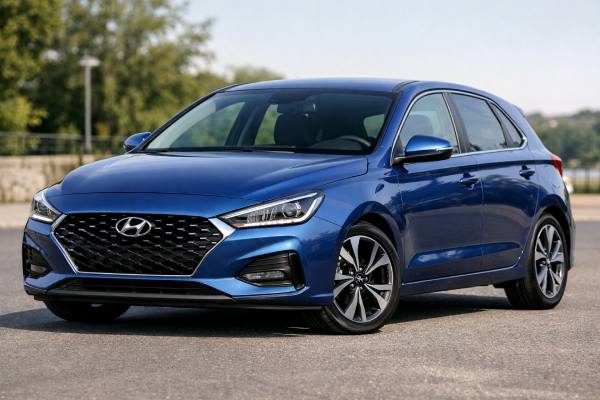
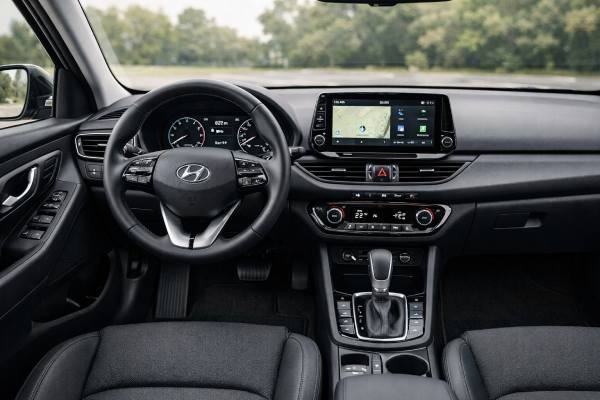
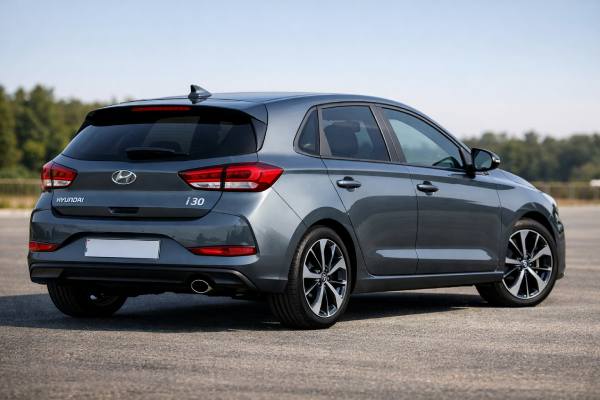
The 2024 update keeps the Hyundai i30 relevant by focusing on the details owners actually notice: cleaner design, better standard lighting, improved connectivity, more standard safety kit, and a powertrain that still makes sense for drivers who want a normal compact hatchback rather than a crossover. In the version covered here, the key attraction is the 1.5 T-GDi 48V mild-hybrid engine. It gives the i30 stronger mid-range torque than the base 1.0-liter car, smoother stop-start operation, and better flexibility on faster roads, while still avoiding the weight and price of a full hybrid. This is not the simplest i30 in the range, because turbocharging, direct injection, a 48-volt system, and the optional dual-clutch gearbox all add complexity. But for buyers who want a current-shape i30 with enough performance for everyday motorway and family use, it is one of the most complete versions. This article uses the current UK-spec hatchback as the baseline, because exact engines and trims now vary by market.
Fast Facts
- The 1.5 T-GDi 48V gives the facelifted i30 a useful jump in torque and everyday pace over the smaller petrol engines.
- The 2024 update adds stronger standard safety and better cabin tech without changing the i30’s easy-to-use layout.
- Multi-link rear suspension on this powertrain helps the car feel more settled than lower-spec versions.
- The trade-off is extra long-term complexity from the turbo, direct injection, 48V system, and optional 7-DCT.
- A practical ownership plan is an annual service, with engine oil and filter done every 12 months or about 15,000 km.
Contents and shortcuts
- Hyundai i30 2024 refresh explained
- Hyundai i30 1.5 48V hard data
- Hyundai i30 trim ladder and aids
- Reliability patterns and campaign checks
- Maintenance planning and buyer advice
- Road character and fuel use
- Rival choices and best fit
Hyundai i30 2024 refresh explained
The current-shape i30 is not an all-new model. It is a carefully updated version of Hyundai’s long-running PD-generation compact hatch, and that matters because the car’s strengths are already well understood. It has tidy proportions, good visibility, straightforward controls, and packaging that still works well for everyday family use. The 2024 refresh focuses on keeping that core recipe competitive rather than reinventing it.
Outside, the changes are subtle but worthwhile. Hyundai revised the grille pattern, refreshed the bumper treatment, and made LED headlights and taillights standard rather than optional in the broader European update. Inside, the improvements matter more. The cabin now benefits from updated trim textures, extra USB-C charging points, improved connectivity, Over-the-Air map updates where fitted, and a stronger safety feature set. This is the kind of facelift that makes the car feel newer in daily use without altering its basic character.
The 1.5 T-GDi 48V is the most interesting mainstream powertrain in the current hatchback lineup. It uses Hyundai’s 1,482 cc turbocharged four-cylinder with direct injection and a 48-volt mild-hybrid system. In the current UK-spec technical data, this version is rated at 140 PS and 253 Nm. The mild-hybrid system is not there to turn the i30 into an electric car. Its job is to support start-stop operation, improve responsiveness in some phases of driving, and reduce wasted energy through recuperation and electrical assistance. In practice, it makes the car feel a little smoother and more relaxed rather than dramatically different.
This engine also gets the more sophisticated rear suspension layout. For buyers, that is an important engineering detail because it improves the i30’s composure over broken surfaces and makes the car feel more mature at speed than cheaper compact hatchbacks with simpler rear-axle hardware. Combined with the stronger torque output, it gives this variant a more complete feel than the smaller-engine alternatives.
There is, however, a market-specific wrinkle. Hyundai’s wider European i30 range now differs by country. Some Hyundai Europe pages emphasize a 1.6 T-GDi 150 DCT configuration, while the current UK-spec hatchback continues with the 1.5 T-GDi 140 PS 48V mild-hybrid engine. That is why buyers need to verify exact local trim and engine details by VIN and original market rather than relying on one generic i30 description.
Overall, the 2024-present i30 1.5 T-GDi 48V remains appealing because it feels current where it counts. It is still a conventional hatchback, but it has enough torque, enough technology, and enough chassis maturity to stay relevant in a market that increasingly pushes buyers toward taller, heavier alternatives.
Hyundai i30 1.5 48V hard data
The figures below focus on the current Hyundai i30 hatchback with the 1.5 T-GDi 48V mild-hybrid engine in the current UK-spec range. Exact numbers can shift slightly by trim, tyre package, gearbox, and market.
| Powertrain and efficiency | Data |
|---|---|
| Code | Public market documents do not consistently publish the engine code; verify by VIN |
| Engine layout and cylinders | Inline-4, DOHC, 4 valves per cylinder |
| Bore × stroke | 71.6 × 92.0 mm (2.81 × 3.62 in) |
| Displacement | 1.5 L (1,482 cc) |
| Induction | Turbocharged |
| Fuel system | Direct injection |
| Compression ratio | 10.5:1 |
| Max power | 140 PS class, about 138 hp (103 kW) @ 5,500 rpm |
| Max torque | 253 Nm (186.6 lb-ft) @ 1,500–3,500 rpm |
| Timing drive | Chain |
| Mild-hybrid motor type | 48V belt starter-generator |
| Electric motor max power | 16 PS / 11.8 kW |
| Battery chemistry | LiPD lithium-polymer |
| Battery capacity | 0.46 kWh |
| System voltage | 48 V |
| Rated efficiency | About 5.8–6.7 L/100 km depending on trim and transmission |
| Real-world highway @ 120 km/h | About 5.8–6.6 L/100 km (40.6–35.6 mpg US / 48.7–42.8 mpg UK) |
| Transmission and driveline | Data |
|---|---|
| Transmission | 6-speed manual / 6iMT or 7-speed DCT, depending on market and trim |
| Drive type | Front-wheel drive |
| Differential | Open differential |
| Chassis and dimensions | Data |
|---|---|
| Front suspension | MacPherson strut |
| Rear suspension | Multi-link |
| Steering | Motor Driven Power Steering |
| Steering ratio / turns | 2.57 turns lock-to-lock |
| Turning circle | About 10.6 m (34.8 ft) kerb-to-kerb |
| Brakes | Disc front and rear |
| Common wheel and tyre sizes | 205/55 R16, 225/45 R17, 225/40 ZR18 |
| Most common tyre size | 225/45 R17 on mainstream higher trims |
| Ground clearance | About 140 mm (5.51 in) |
| Length / Width / Height | 4,340 / 1,795 / 1,455 mm (170.9 / 70.7 / 57.3 in) |
| Wheelbase | 2,650 mm (104.3 in) |
| Kerb weight | 1,280–1,407 kg manual / 1,312–1,439 kg DCT (2,822–3,103 lb / 2,893–3,172 lb) |
| GVWR | 1,840 kg manual / 1,870 kg DCT (4,056 lb / 4,122 lb) |
| Fuel tank | 50 L (13.2 US gal / 11.0 UK gal) |
| Cargo volume | 395–1,301 L (13.95–45.94 ft³), VDA |
| Performance and capability | Data |
|---|---|
| 0–100 km/h / 0–62 mph | About 9.6 s manual / 9.7 s DCT |
| Top speed | 209 km/h (130 mph) |
| Braking distance | Public Hyundai market sheets do not consistently publish a 100–0 km/h number for this trim |
| Towing capacity | 1,200 kg (2,646 lb) braked / 600 kg (1,323 lb) unbraked |
| Payload | Varies by trim; verify on VIN plate |
| Roof load | 80 kg (176 lb) |
| Fluids and service capacities | Data |
|---|---|
| Engine oil | 4.2 L (4.44 US qt) including filter |
| Engine oil specification | API SN Plus / SP or ILSAC GF-6 |
| Engine oil viscosity | SAE 0W-20 |
| Manual transmission fluid | 1.5–1.6 L (1.6–1.7 US qt) |
| Manual transmission fluid spec | API GL-4, SAE 70W |
| DCT fluid | 1.9–2.0 L (2.0–2.1 US qt) |
| DCT fluid spec | API GL-4, SAE 70W |
| Coolant | 6.6 L (6.98 US qt) |
| Coolant type | Ethylene-glycol with phosphate-based coolant for aluminium radiator |
| Brake/clutch fluid | 0.7–0.8 L (0.74–0.85 US qt) |
| Brake fluid spec | DOT 4 / DOT 4LV |
| A/C refrigerant | 500 g (17.63 oz), R-1234yf for Europe |
| A/C compressor oil | 110 ± 10 g (3.88 ± 0.35 oz), PAG |
| Wheel lug nut torque | 107–127 Nm (79–94 lb-ft) |
| Safety and driver assistance | Data |
|---|---|
| Euro NCAP | 5 stars for the i30 family |
| Adult Occupant | 88% |
| Child Occupant | 84% |
| Vulnerable Road Users | 64% |
| Safety Assist | 68% |
| IIHS | Not applicable |
| ADAS | FCA/AEB, lane keep assist, lane follow assist, speed limit assist, TPMS, eCall, and more depending on trim |
The biggest spec story here is balance. The current 1.5 T-GDi 48V i30 is not a hot hatch, but it is no longer the slow, basic middle ground either. With 253 Nm, a multi-link rear axle, and a modern mild-hybrid support system, it lands in a very useful sweet spot.
Hyundai i30 trim ladder and aids
For the current 2024-present hatchback, trim structure matters almost as much as the engine choice. In the current UK-spec lineup, the i30 hatchback with this powertrain is offered in Advance, Premium, N Line, and N Line S forms. That gives buyers a clear ladder from sensible everyday value to sportier appearance and higher convenience content.
Advance is the practical entry point. It pairs the 1.5 T-GDi 48V with 16-inch alloy wheels, body-coloured exterior details, a leather-wrapped steering wheel, cloth trim, rear camera support, cruise control, and the core safety package. For buyers who want the lowest running costs, the softest ride, and the least expensive tyres, it is often the smartest trim in the range.
Premium adds the convenience features many private buyers now expect. In the current UK material, that means 17-inch alloys, privacy glass, powered driver-seat adjustment, heated front seats, heated steering wheel, dual-zone climate control, keyless entry, and a stronger version of Hyundai’s Forward Collision Avoidance Assist with Junction support. It is usually the best all-round trim if you want a current-feeling hatch without the styling emphasis of N Line.
N Line changes the character more than the brochure language suggests. It adds the N Line exterior design package, 18-inch wheels, black mirror caps, different seat trim with red stitching, and a more assertive visual stance. That does not make it an N car, but it does make the i30 feel more purposeful. N Line S builds further with a panoramic roof and upgraded seat trim, and in some markets it becomes the hatchback’s flagship short of an actual N model.
Safety is strong, but buyers need to understand what is standard and what rises with trim. Hyundai’s 2024 update added more standard Smart Sense content. Depending on trim and market, you can expect Forward Collision Avoidance Assist, Lane Keep Assist, Lane Follow Assist, Intelligent Speed Limit Assist, eCall, and tyre-pressure monitoring as standard. Higher trims add or broaden blind-spot warnings, rear cross-traffic functions, safe-exit warning, and more advanced FCA functions such as Junction support. In the current UK material, Lane Follow Assist and Intelligent Speed Limit Assist are part of the richer trim story rather than universal base equipment.
The i30 family still benefits from a 5-star Euro NCAP result, though it is important to be precise. That rating belongs to the wider i30 family rather than this exact 2024-trimmed hatchback alone, and the protocol is older than today’s newest safety tests. Even so, it remains meaningful because the i30 continues to offer a solid passive-safety structure and a more comprehensive active-safety package than many budget-leaning rivals.
Quick trim identifiers are simple to spot in the used market: 16-inch Advance wheels, 17-inch Premium wheels, 18-inch N Line wheels, heated-seat controls, digital cluster size, roof glass on N Line S, and the depth of the safety menus in the instrument display. On a current i30, buying by actual equipment is smarter than buying by badge alone.
Reliability patterns and campaign checks
The current 2024-present i30 1.5 T-GDi 48V is still too new to have a fully mature long-term failure record. That is the first thing to say honestly. There is not yet enough age or mileage across the market to make strong claims about deep, high-mileage durability trends in the way you can with an older generation. What you can do is look at the engine family, the known ownership profile of turbo direct-injection Hyundai petrols, and the early-use issues that matter most.
Common, low-cost or low-risk watchpoints
- 12 V battery weakness and voltage-related warnings: Mild-hybrid cars still depend on a healthy conventional battery for many normal functions. Low voltage can trigger strange warning messages, erratic stop-start behavior, or infotainment complaints.
- Brake corrosion on lightly used cars: This is common across many modern cars and still applies here, especially on cars that do short urban trips.
- Tyre wear and alignment: The i30 is not unusually fragile, but 17- and 18-inch wheel cars will show poor alignment more quickly through steering pull and shoulder wear.
Occasional, medium-cost issues
- 7-DCT low-speed shunt or hesitation: On DCT cars, test creep behavior, parking-speed operation, and hot stop-start use carefully. Some dual-clutch behavior is normal; roughness or repeated hesitation is not.
- Turbo and boost-hose leaks: The 1.5 T-GDi is generally strong in everyday use, but any turbo petrol can develop hose, clamp, or pressure-control issues over time.
- Direct-injection intake deposits: This is a longer-term ownership concern rather than an early failure pattern. Cars that live on repeated short trips are more exposed.
Electrified-system watchpoints
- 48V battery or belt starter-generator warnings: The current data do not suggest a widespread public defect pattern, but mild-hybrid warnings should never be ignored.
- Software and calibration issues: On a new or nearly new car, odd powertrain, cluster, or assistance-system behavior is often more likely to be software-related than hard-parts failure. Dealer update history is valuable.
Rare but important
- ADAS calibration after glass or front-end repairs
- Neglected oil service on a turbocharged DI engine
- Poor aftermarket tuning or cheap intake and exhaust parts
For recalls and service campaigns, the safest approach is VIN-based verification rather than rumor. At the time of writing, there is no single public 2024-specific campaign that defines this exact current 1.5 T-GDi 48V hatchback in the way some older i30 campaigns did. That is good news, but it is not the same as saying every car is clear. Hyundai’s official campaign lookup remains essential, especially on dealer demonstrators, pre-registered cars, and nearly new used examples.
Pre-purchase or early-ownership checks should therefore focus on condition and documentation: campaign status, first-service history, correct tyre brand and size, smooth cold start, no stored fault codes, and fully working cameras and sensors. The early reliability outlook looks positive, but it is still an early outlook.
Maintenance planning and buyer advice
Because this is a turbocharged direct-injection mild-hybrid petrol rather than a basic naturally aspirated engine, a conservative maintenance plan makes sense. Hyundai’s official schedules vary by market and usage profile, but for real ownership the right strategy is simple: keep the oil clean, keep the cooling system healthy, and do not wait for minor drivability issues to become expensive ones.
A practical plan looks like this:
| Maintenance item | Practical interval |
|---|---|
| Engine oil and filter | Every 12 months or about 15,000 km |
| Engine air filter | Inspect every service, replace about 30,000 km sooner in dusty use |
| Cabin air filter | Every 15,000–20,000 km or 12 months |
| Spark plugs | Around 60,000 km, sooner for hard use |
| Coolant | Inspect yearly, replace by official Hyundai schedule |
| Manual gearbox oil | Inspect for leaks; preventive replacement around 90,000 km is reasonable |
| DCT fluid | Follow Hyundai schedule; earlier fluid refresh is sensible on heavy urban use |
| Brake fluid | Every 2 years |
| Brake pads and rotors | Inspect at every service |
| Tyre rotation and alignment | Every 10,000–15,000 km or whenever uneven wear appears |
| Timing chain | Inspect for noise or timing-correlation faults; replace only when symptomatic or out of spec |
| Auxiliary belts and hoses | Inspect at each service |
| 12 V battery | Test yearly after year 3 |
| 48V system check | At service whenever stop-start or charging warnings appear |
The key service specs are clear:
- engine oil: 4.2 L, API SN Plus / SP or ILSAC GF-6, SAE 0W-20
- manual transmission fluid: 1.5–1.6 L, API GL-4 SAE 70W
- DCT fluid: 1.9–2.0 L, API GL-4 SAE 70W
- coolant: 6.6 L, phosphate-based coolant for aluminium radiator
- brake fluid: DOT 4 / DOT 4LV
- wheel nuts: 107–127 Nm
For buyers, trim choice matters. Advance is the easiest car to live with if you value ride comfort, tyre cost, and simple long-term ownership. Premium is the best all-round pick for most private owners because it adds worthwhile comfort and safety features without forcing the 18-inch N Line aesthetic. N Line and N Line S make sense if you care about appearance and a sharper cabin mood, but they bring slightly firmer ride quality and higher tyre cost.
The inspection checklist is short but important:
- full service and campaign history
- smooth cold start and steady idle
- no hybrid or transmission warning lights
- even tyre wear
- no brake judder or heavy corrosion
- all cameras, parking sensors, and safety systems working normally
- no obvious front-end repair signs around bumper, grille, windscreen, and headlights
The long-term outlook is promising, but still early. Mechanically, this i30 should age well if oil changes stay conservative and owners treat the 48V, turbo, and DCT elements as systems worth maintaining rather than ignoring.
Road character and fuel use
On the road, the current 1.5 T-GDi 48V i30 feels more complete than the numbers alone suggest. A 140 PS compact hatchback does not sound exciting in today’s market, but 253 Nm delivered early changes the experience. The car pulls more cleanly from low and middle revs than the smaller-engine versions, and that makes it better suited to passengers, luggage, hills, and faster roads.
The main strength is flexibility. In normal driving, the i30 does not need constant downshifts to feel awake. The turbocharged engine gives it the kind of easy mid-range response that suits commuting and overtaking without turning it into a nervous or overpowered car. The manual version feels slightly more connected, while the 7-DCT is more relaxed in traffic and smoother in stop-start use when driven calmly. Neither turns the i30 into a sports model, but both give it enough pace to feel properly modern.
Ride and handling are strong points for this engine. Because the 1.5 T-GDi 48V uses the multi-link rear axle, the car feels more composed than cheaper compact hatchbacks over broken surfaces and mid-corner bumps. Steering is accurate rather than chatty, and the car stays stable at highway speed. Smaller-wheel trims ride best, while N Line and N Line S look sharper but pass more road texture into the cabin.
Noise, vibration, and harshness are well judged. At low speed, the mild-hybrid support helps make stop-start behavior less abrupt than on a plain turbo petrol. At motorway pace, the i30 remains calm and easy to settle into for longer trips. It is not class-leadingly quiet, but it is refined enough for the job it is built to do.
Real-world fuel use depends strongly on trim and transmission. Hyundai’s official figures show that the lighter, smaller-wheel cars are clearly the efficiency leaders. Realistically, drivers can expect something like this:
- City: about 6.8–8.0 L/100 km
- Highway at 100–120 km/h: about 5.8–6.6 L/100 km
- Mixed driving: about 6.1–7.0 L/100 km
Cold weather, heavy traffic, bigger wheels, and repeated short trips can push those numbers upward. Manual cars may be slightly more efficient on paper in some trims, while the DCT can be more consistent for some drivers in real traffic. Either way, this is an efficient turbo petrol hatchback, not a full hybrid. Buyers who do mostly city mileage and care most about fuel economy should still cross-shop the Toyota Corolla hybrid.
The i30’s real advantage is not headline speed or class-leading economy. It is the way it blends enough pace, enough refinement, and enough comfort into one very normal, very usable hatchback.
Rival choices and best fit
The current i30 1.5 T-GDi 48V sits in a very competitive part of the market, and its best rivals depend on what kind of owner you are.
Against the Volkswagen Golf 1.5 eTSI:
The Golf still carries the premium badge strength and often feels a little more polished in the cabin. The Hyundai usually fights back on value, standard equipment, and long-term simplicity in the interface.
Against the Kia Ceed 1.5 T-GDi:
This is the closest competitor in spirit. Both cars deliver sensible packaging and useful turbo torque. The Hyundai feels slightly more conservative and mature, while the Kia can feel a bit more overtly youthful. Condition and equipment matter more than the badge.
Against the Skoda Scala 1.5 TSI:
The Scala often gives you big cabin value and a slightly more minimalist, rational ownership case. The i30 counters with richer trim choices and a slightly more premium-feeling chassis in this engine specification.
Against the Mazda3 2.0 petrol:
The Mazda often feels more upscale inside and more naturally polished to steer. The Hyundai answers with stronger low-rpm torque, better rear packaging, and more straightforward ergonomics.
Against the Toyota Corolla 1.8 hybrid:
This is the key alternative for urban buyers. The Corolla is the better car for heavy city use and stop-start fuel economy. The Hyundai is better for buyers who prefer a more conventional driving feel, stronger mid-range turbo pull, and a broader trim ladder.
That comparison leads to a simple verdict. The current Hyundai i30 1.5 T-GDi 48V is best for buyers who still want a conventional hatchback that feels current without becoming complicated in the wrong ways. It gives you meaningful torque, a modern safety package, sensible practicality, and enough trim choice to tailor the car to your priorities. It is not the cheapest i30 to maintain, and it is not the pure efficiency answer if you only drive in town. But if you want a balanced all-round compact hatch that still feels like a car first and a gadget second, this version remains one of the stronger choices in the class.
References
- New i30 2024 (Technical Data)
- Hyundai Motor UK has confirmed pricing and specification for the new i30, with new top-level N Line S trim available on Hatchback 2024 (Pricing and Equipment)
- Bolder and more high-tech: i30 gets update 2024 (Press Release)
- EuroNCAP | Hyundai i30 2017 (Safety Rating)
- Home | Hyundai Recalls & Service Campaigns 2026 (Recall Database)
Disclaimer
This article is for informational purposes only and is not a substitute for professional diagnosis, repair, or VIN-specific service information. Specifications, torque values, intervals, procedures, equipment, and campaign applicability can vary by VIN, market, model year, transmission, and trim. Always verify critical details against official Hyundai service documentation and dealer records before servicing, repairing, or purchasing a vehicle.
If this guide helped you, please consider sharing it on Facebook, X, or another social platform to support our work.