


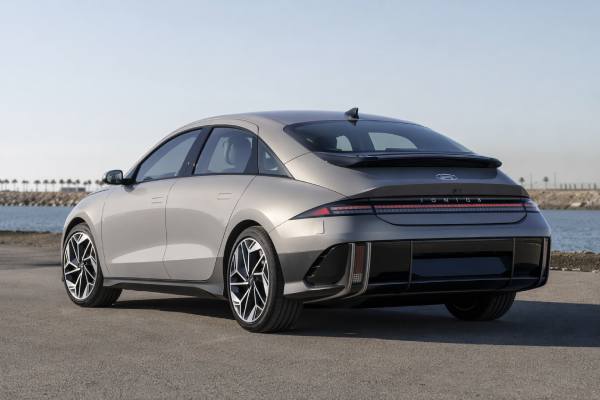
The 2023–2025 Hyundai IONIQ 6 (CE) with the 168 kW rear electric motor is the long-range, rear-wheel-drive version that best captures what this car does well. It pairs a slippery, low-drag body with Hyundai’s E-GMP electric platform, a 77.4 kWh battery, and an 800-volt charging system that can make long trips noticeably easier than in many similarly priced EVs. With 225 hp and 350 Nm, it is not the fastest IONIQ 6, but it is usually the most sensible one for owners who value efficiency, highway range, and lower running costs over extra straight-line punch. It also delivers a calm, refined driving character that suits daily commuting and distance work especially well. The key ownership story is less about the battery pack itself and more about software status, charging-system history, 12-volt support hardware, and making sure campaign and recall work has been completed on any used example.
Quick Specs and Notes
- Very efficient for a mid-size electric sedan, especially on 18-inch wheels.
- Fast DC charging is one of its standout strengths on longer trips.
- Rear-wheel drive gives it a smooth, balanced feel without sacrificing range.
- The main ownership caution is ICCU and 12-volt charging history, not widespread battery-pack failure.
- Brake fluid and cabin filter service typically falls due every 30,000 km or 24 months.
Explore the sections
- Hyundai IONIQ 6 CE overview
- Hyundai IONIQ 6 CE specifications
- Hyundai IONIQ 6 CE trims and safety
- Reliability, common issues and service actions
- Maintenance and buyer’s guide
- Driving and performance
- How Hyundai IONIQ 6 compares to rivals
Hyundai IONIQ 6 CE overview
The rear-drive 168 kW IONIQ 6 is the efficiency-led version of Hyundai’s electric sedan. It uses a single rear permanent-magnet motor, a floor-mounted long-range battery, and a single-speed reduction gear, all wrapped in one of the most aerodynamic shapes in the class. That combination defines the car. Rather than trying to feel like a disguised combustion saloon, the IONIQ 6 leans into EV strengths: instant response, quiet progress, low running effort, and charging performance that can make regular long-distance use easier than buyers might expect from the price point.
In official specification, this version produces 225 hp and 350 Nm, reaches 100 km/h in around 7.4 seconds, and can deliver especially strong WLTP range figures when fitted with the smaller wheel package. Those numbers only tell part of the story. What matters more is how consistently the car uses its energy. The IONIQ 6 does not need a giant battery to feel capable because its aerodynamic efficiency works for it at urban speeds and, more importantly, at motorway pace. That gives this single-motor version a clear advantage over heavier dual-motor alternatives if range and charging convenience matter more than outright acceleration.
From an ownership perspective, this is also the version that usually makes the most sense in the used market. It avoids the added weight and complexity of the dual-motor setup while preserving the same platform strengths: rapid DC charging potential, a modern cabin, a strong safety suite, and a refined everyday driving experience. It is not perfect. Rear headroom is tighter than in more upright EVs, the boot opening is less practical than a hatchback’s, and some buyers will prefer the punchier feel of all-wheel-drive rivals. Even so, the 168 kW rear-drive IONIQ 6 is often the most rounded member of the line-up.
Its real market position is best understood as a long-distance electric sedan rather than a pure style statement. The car’s low nose, tapered roofline, and carefully managed airflow are not just for showroom effect. They contribute directly to the model’s real-world identity as a quiet, stable, range-conscious EV. For drivers who spend a lot of time on fast roads, that matters more than a few tenths in a sprint time.
The key thing for buyers is to separate platform strengths from ownership watchpoints. The strengths are clear: efficiency, charging speed, ride comfort, and strong safety credentials. The watchpoints are mostly electronic and support-system related, especially software status, ICCU history, charge-port condition, and the health of the 12-volt system. If those are in order, the IONIQ 6 can be one of the more convincing mainstream EV sedans of its generation.
Hyundai IONIQ 6 CE specifications
Powertrain, battery and efficiency
| Motor type | Permanent magnet synchronous motor |
|---|---|
| Motor layout | Single rear motor |
| Drive type | Rear-wheel drive |
| System voltage | 697 V |
| Battery chemistry | Lithium-ion polymer |
| Traction battery capacity | 77.4 kWh gross |
| Battery layout | Floor-mounted |
| Battery cooling | Liquid-cooled |
| Max power | 225 hp (168 kW) |
| Max torque | 350 Nm (258 lb-ft) |
| Official test standard | WLTP |
| Rated efficiency | 14.3 kWh/100 km |
| Rated range | 614 km (381 mi) |
| Real-world highway efficiency at 120 km/h | 19.7 kWh/100 km (317 Wh/mi) |
| Real-world highway range at 120 km/h | 381 km (237 mi) |
Driveline and charging
| Transmission | Single-speed reduction gear |
|---|---|
| Rear ratio | 2.263 |
| Final gear ratio | 4.471 |
| AC connector | Type 2 |
| DC connector | CCS Combo 2 |
| Charging port location | Right rear quarter |
| Onboard AC charger | 10.5 kW |
| DC fast-charge peak | Over 235 kW |
| Typical 10–80% DC average power | 193 kW |
| DC 10–80% charging time | 18 min |
| Vehicle-to-load output | 3.6 kW |
| Battery preconditioning | Available with supported thermal management package |
Performance, chassis and dimensions
| 0–100 km/h | 7.4 s |
|---|---|
| Top speed | 185 km/h (115 mph) |
| Front suspension | MacPherson strut |
| Rear suspension | Multi-link |
| Steering | Rack-mounted motor-driven power steering |
| Front brakes | 325 mm ventilated discs |
| Rear brakes | 325 mm solid discs |
| Tyres | 225/55 R18 |
| Length | 4,855 mm |
| Width | 1,880 mm |
| Height | 1,495 mm |
| Wheelbase | 2,950 mm |
| Ground clearance | 141 mm |
| Turning circle | 11.82 m |
| Kerb weight | Approx. 1,930 kg |
| Cargo volume | 401 L rear / 45 L front |
| Towing capacity | 1,500 kg braked / 750 kg unbraked |
Safety and service data
| Euro NCAP rating | 5 stars |
|---|---|
| Euro NCAP adult occupant | 97% |
| Euro NCAP child occupant | 87% |
| Euro NCAP vulnerable road users | 66% |
| Euro NCAP safety assist | 90% |
| IIHS headlight rating | Acceptable |
| IIHS award | Top Safety Pick+ |
| Battery warranty | 8 years / 160,000 km in many markets |
| Brake fluid interval | 30,000 km or 24 months |
| Cabin air filter interval | 30,000 km or 24 months |
| Wheel fastener torque | 108–127 Nm |
Hyundai IONIQ 6 CE trims and safety
For CE-market buyers, the IONIQ 6 range was usually structured around a familiar formula: a well-equipped base or mid trim that already carried the essential EV hardware and safety systems, followed by higher trims that added comfort, appearance, camera technology, and parking assistance. The important point is that the 168 kW rear-drive long-range version kept its core mechanical identity across trims. You were not choosing between dramatically different driving fundamentals so much as deciding how much equipment, wheel size, and convenience technology you wanted around the same efficient powertrain.
That matters because the best-value used buy is not automatically the highest trim. Lower and mid-level cars with the smaller wheel package often give the strongest real-world range and the lowest tyre replacement cost, while still retaining the main safety and charging features that define the model. Higher trims can add useful everyday features such as surround-view monitoring, upgraded seat functions, richer cabin materials, remote parking support, blind-spot camera display, and stronger audio or infotainment equipment. Those upgrades improve ownership satisfaction, but they do not change the underlying reason many people choose this version: range-friendly efficiency and strong charging performance.
The safety story is one of the IONIQ 6’s biggest selling points. Euro NCAP results were especially strong, with very high adult-occupant protection and solid safety-assist scoring. That lines up with the model’s positioning as a modern, technology-led EV rather than a style-led niche product. In U.S. testing, later examples also performed well in IIHS evaluations, making newer cars particularly appealing for buyers who care about detailed crash-test outcomes rather than headline star ratings alone.
The assistance package is broad and, in most trims, impressively complete. Depending on market and year, the car offers forward collision avoidance with pedestrian, cyclist, and junction support, adaptive cruise control, lane keeping, lane following, blind-spot collision warning or intervention, rear cross-traffic alert, intelligent speed-limit support, and highway-focused assistance. On higher trims, camera-based and parking-based systems become more extensive. This is good for daily usability, but it creates one practical ownership rule: any windscreen replacement, front bumper repair, alignment change, or accident repair should be followed by proper calibration where required. On a used car, that paperwork matters.
There were also year-to-year equipment differences that can affect both value and real-world use. Heat pump availability, battery preconditioning support, and certain convenience features were not always identical from one region to another. Two cars that appear similar in photos can differ in winter performance, fast-charging consistency, and comfort equipment. That is why VIN-specific confirmation matters more than trim-name assumptions.
For visual and practical identification, smaller-wheel rear-drive cars are often the range-maximising variants, while higher trims tend to be easier to spot through upgraded lighting details, more visible camera equipment, richer interior finishes, and extra seat or parking functions. If the priority is the best ownership blend rather than the most impressive brochure spec, a well-kept rear-drive long-range car with smaller wheels, complete safety-system calibration history, and full campaign completion is usually the smartest target.
Reliability, common issues and service actions
The IONIQ 6’s main reliability discussion is not centred on a widespread early traction-battery failure pattern. Instead, the model’s most important watchpoints sit in the charging-support and control-hardware area, especially the integrated charging control unit, known widely as the ICCU. This matters because the ICCU supports 12-volt battery charging and related electrical functions. When it fails, symptoms can include warning messages, charging-system faults, 12-volt discharge, and in some cases reduced-power operation. For many buyers, this is the single most important recall and service-history item to verify on a 2023–2025 car.
In prevalence terms, ICCU-related issues are best treated as occasional but serious. They are not the sort of low-cost nuisance you ignore until the next service. If a car has had warning messages related to charging, unexplained 12-volt battery problems, or strange electrical behaviour, buyers should assume the issue needs proper diagnosis rather than simple battery replacement guesswork. The official remedy path has generally involved software updates, inspection, and replacement of affected ICCU-related parts or fuses where necessary. On a used car, proof of completed campaign work is worth more than a verbal assurance that the problem was “sorted.”
A second tier of issues includes charge-port hardware concerns, trim attachment faults around the charging area, and the usual EV ownership checks around seal condition and repeated public-charger use. These are generally lower-cost than a failed charging-control unit, but they matter because they directly affect daily usability. Damage or wear around the charge-port door, latch, sealing surfaces, or surrounding trim can also point to poor-quality prior repairs or careless handling.
There are also safety-related service actions beyond the charging system. Seat-belt anchoring and related repair-sensitive issues deserve proper attention, especially on used vehicles that may have had interior, seat, or body work. This type of problem can be more difficult for a buyer to spot casually because the car may appear completely normal during a short viewing. That makes paperwork and VIN-based recall verification essential.
Away from formal recall items, the usual heavy-EV wear points still apply. Brake discs can corrode or develop poor contact surfaces on lightly used cars because regenerative braking reduces friction-brake use. Wheel bearings, suspension bushings, steering joints, and underbody shields should be checked like they would be on any modern, relatively heavy vehicle. Drive-unit or reduction-gear noises should never be dismissed casually. A faint EV whine can be normal, but obvious pitch changes, vibration, grinding, or noise under load deserve investigation.
Moisture ingress is another area to take seriously. Charge-port seals, exposed connectors, underbody fasteners, and lower body seams can all suffer if the car has seen harsh winters, repeated road salt, or rough repair work. That does not mean the model is unusually corrosion-prone, but it does mean a low-slung, aero-focused EV benefits from careful inspection underneath.
The good news is that the underlying battery reputation is not dominated by a pack-failure narrative. That does not remove the need for a battery health check, but it changes the tone of the inspection. Buyers should focus on state-of-health reporting, charging behaviour, software status, and fault-code history rather than assuming the battery itself is the first weak link. In most cases, a well-documented car with completed service actions is a much safer purchase than an apparently tidy car with vague history and no proof of campaign completion.
Maintenance and buyer’s guide
The IONIQ 6 has lower routine mechanical service needs than an internal-combustion car, but it still rewards a disciplined maintenance approach. Owners should think in terms of inspection cycles, fluid condition, brake health, tyre management, thermal-system integrity, and software status rather than engine oil changes. A simple real-world service plan starts with annual inspections of tyres, steering, suspension, brake wear, underbody condition, and 12-volt battery health. From there, the main routine service items usually include brake fluid and cabin filter replacement every 30,000 km or 24 months, with closer attention to reduction-gear fluid condition, alignment, and braking hardware as mileage climbs.
A practical schedule looks like this:
- Every 15,000 km or 12 months: inspect tyres, brakes, steering, suspension, underbody covers, and 12-volt battery condition.
- Every 30,000 km or 24 months: replace brake fluid and cabin air filter, and inspect charge-port sealing, latch action, and cable condition.
- Every 60,000 km: inspect reduction-gear fluid condition and check for leaks, abnormal noise, or contamination.
- Severe-use operation: shorten inspection intervals for brakes, tyres, alignment, and driveline noise if the car sees frequent DC fast charging, steep grades, towing, repeated high-speed driving, or harsh winter use.
- Coolant-system service: follow the official interval strictly and confirm that the correct EV-approved coolant type has been used.
The buyer’s guide starts with the battery, but not in the way many first-time EV shoppers expect. A healthy used IONIQ 6 should show sensible state-of-health results, stable range estimation, and normal charging behaviour on both AC and DC. Ask for a battery health report if available, but also ask more practical questions: does the car fast-charge normally, does it precondition correctly if equipped, and has it ever shown charging-system or 12-volt warnings? On the test drive, watch consumption behaviour, regen smoothness, and any signs of power limitation or warning messages.
Then inspect the charging hardware itself. The charge-port door should open and close cleanly. The latch, seals, and surrounding trim should not feel loose, broken, or poorly aligned. If the car includes charging cables or adapters, check that they are present and in good condition. A neglected charging area can reveal a lot about how carefully the whole car has been used.
Next, check the cooling and thermal-management side. Evidence of correct coolant service matters. So does normal operation of heating and, where fitted, heat-pump-supported climate control. A weak heater, unexplained thermal warnings, noisy cooling fans, or signs of past leak repair deserve follow-up questions. EVs hide much of their complexity beneath the floor and under the front compartment, so service records often matter more than what you can see at a glance.
The chassis inspection is just as important. Check tyre wear carefully because uneven wear can point to alignment issues, pothole damage, or suspension wear. Look for corrosion or damage on subframes, fasteners, lower covers, and battery-protection panels. On the road, listen for wheel-bearing hum, drive-unit whine, and any knocking over broken surfaces. Also test the friction brakes properly. On some EVs, heavily regen-led use leaves discs and pads in worse condition than buyers expect.
The best years and trims to seek are usually the rear-drive long-range cars with smaller wheels, complete recall history, and documented charging-system updates. They give the strongest efficiency case and usually the lowest ownership compromise. Cars to avoid are not defined by trim name so much as by weak paperwork: missing ICCU campaign proof, repeated 12-volt issues, vague charging complaints, or signs of cheap accident repair. Long term, the outlook is good if the car is maintained properly. Expect normal tyre wear, periodic brake attention despite regen, occasional 12-volt replacement, and the possibility that expensive electronics rather than the battery pack will define the rare big repair bill.
Driving and performance
The 168 kW rear-drive IONIQ 6 is not the most exciting EV in its class in a dramatic sense, but it is one of the most complete in daily use. Step-off response is immediate without being abrupt, and the rear-drive layout helps the car feel natural and tidy rather than heavy-handed. That character suits the car well. Hyundai did not tune this version as a hard-edged sports sedan. Instead, it feels like an efficient, refined electric cruiser that happens to have enough torque to make normal driving easy and relaxed.
Straight-line performance is strong enough for the class. A 0–100 km/h time in the mid-seven-second range is plenty for real traffic, and the car’s instant mid-range response matters more than the headline sprint time once you are actually using it. It is especially good at motorway merging and quick overtakes from moderate speeds. The power delivery is smooth and clean, not theatrical, which makes the car feel more polished on a daily basis than some EVs that deliver their torque in a more aggressive way.
Ride quality is another strong point. The IONIQ 6 tends to feel settled and well damped, especially compared with firmer EV rivals on larger wheels. The low battery mass helps body control, but the chassis still leans toward comfort over sharpness. That makes it a very easy long-distance car. On rougher roads, tyre choice and wheel size matter more than many buyers realise. The smaller-wheel cars usually ride better, generate less road noise, and preserve more range. Larger wheels can sharpen visual appeal, but they tend to chip away at the calm, efficient character that suits the car best.
Noise levels are generally low, particularly at urban and suburban speeds. At motorway pace, wind and tyre noise are well managed for the segment, helped by the car’s aerodynamic shape. That contributes directly to fatigue reduction on longer trips. The cabin is not silent on coarse surfaces, but it is consistently refined enough to feel like a step above many mainstream rivals.
The braking system deserves special mention because Hyundai has done a good job with regen integration. The transition between regenerative and friction braking is generally smoother than in many EVs, which helps confidence in stop-start traffic and during harder deceleration. Drivers can also adapt the regen behaviour to taste, which makes the car easy to learn whether you prefer a stronger one-pedal feel or a more natural coasting setup.
Real-world efficiency is where the verdict really lands in the IONIQ 6’s favour. In city and mixed use, the car can return excellent consumption if temperatures are reasonable and the driver is not leaning heavily on high speeds. At 100–120 km/h, it remains impressively efficient for its size, though cold weather, larger wheels, and cabin heating can pull the numbers down as expected. This is still one of those EVs where the official efficiency story is backed up by everyday experience more often than not.
Charging performance reinforces that point. On home AC charging, overnight replenishment is straightforward and suits typical daily use. On DC fast charging, the car’s 800-volt architecture is a real asset. Under the right conditions, it can take very high power and keep enough average charging speed across the useful part of the session to make stops short and practical. As with any EV, battery temperature and starting state of charge matter. A warm, preconditioned battery makes a clear difference. Drivers who rely on public infrastructure should therefore think of preconditioning and route planning as part of getting the best from the car, not as optional extras.
Overall, this is a car that wins on balance rather than flash. It rides well, uses energy intelligently, charges quickly, and feels refined at speed. For many owners, that combination is more valuable than a faster acceleration figure or a heavier dual-motor setup.
How Hyundai IONIQ 6 compares to rivals
The IONIQ 6’s nearest obvious rival is the Tesla Model 3. Tesla still offers excellent range, strong software integration, and a charging ecosystem advantage in many regions. The Hyundai answers with a more distinctive design, a calmer ride, and an 800-volt charging architecture that can be highly effective on suitable infrastructure. The Tesla usually feels more software-led and more aggressively minimalist, while the Hyundai feels more like a refined electric grand-tourer in compact executive dimensions. Buyers who prioritise ecosystem and packaging may still lean Tesla. Buyers who care more about comfort, cabin atmosphere, and charging performance on paper and in practice often find the IONIQ 6 more appealing.
Against the Kia EV6, the comparison is almost philosophical because the two cars share so much engineering underneath. The EV6 offers more practical hatchback-style usability and a more crossover-like seating position. The IONIQ 6 counters with stronger aerodynamic efficiency and a more focused long-distance-sedan character. If you need easier loading, more flexible cargo use, or a taller seating position, the Kia makes strong sense. If your life is built around commuting and motorway work, the Hyundai often feels like the cleaner solution.
The BMW i4 eDrive40 plays a different game. It brings a premium badge, a more traditional performance-saloon feel, and a cabin that many buyers will see as richer and more mature. It is also quicker in comparable single-motor form. The IONIQ 6 pushes back with more modern EV-first packaging logic, very competitive charging ability, and usually better value once equipment and running costs are considered. The BMW is the more premium-feeling car. The Hyundai is often the more rational EV.
The Polestar 2 is another close alternative. It offers strong design, a solid cabin, and a more upright body style that some buyers prefer. The IONIQ 6 is usually the better efficiency tool, especially in rear-drive long-range form, and it leans harder into the idea of low-drag, long-distance EV use. In everyday terms, the Polestar feels a little more conventional and upright, while the Hyundai feels more purpose-shaped around electric range.
That is the core of the IONIQ 6’s position. It does not dominate every rival in every category. Instead, it offers one of the best blends of efficiency, charging capability, safety, comfort, and mainstream pricing in the segment. The 168 kW rear-drive version is the strongest expression of that formula because it captures the platform’s strengths without taking on the extra weight, tyre cost, and range penalty of the faster dual-motor variants.
References
- Hyundai 2023 IONIQ 6 SE Long Range RWD Achieves EPA-Estimated Driving Range of 361 Miles 2023
- Hyundai IONIQ 6 | Pricing, spec and tech | April 2023 2023
- Hyundai IONIQ 6 2022 (Safety Rating)
- Part 573 Safety Recall Report 24V-868 2024 (Recall Database)
- 2025 Hyundai Ioniq 6 4-door sedan 2025 (Safety Rating)
Disclaimer
This article is for informational purposes only and is not a substitute for professional diagnosis, repair, or official service information. Specifications, torque values, service intervals, charging data, and repair procedures can vary by VIN, market, model year, software level, and equipment, so always verify against the correct official service documentation for the exact vehicle.
If this guide helped you, please share it on Facebook, X, or another social platform to support our work.