
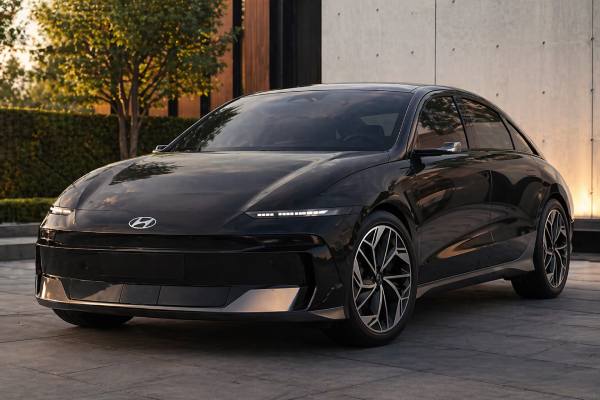

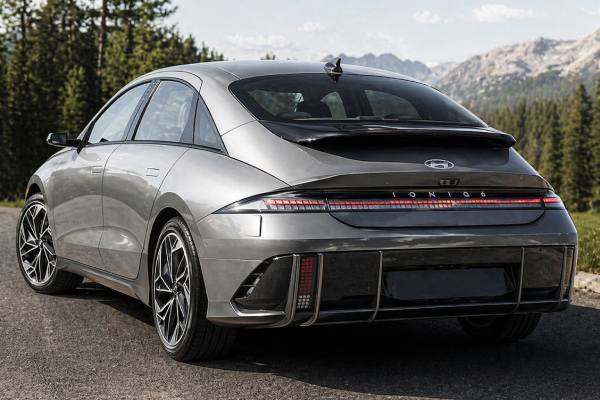
The facelifted Hyundai IONIQ 6 with the 168 kW rear motor is the cleaner, more mature version of an already very efficient electric sedan. For CE-market buyers, the key change is not just the styling refresh. Hyundai has paired the revised body with a larger 84 kWh battery, sharper software and charging logic, and a longer official range that now reaches the upper end of the mainstream EV-saloon class. In rear-wheel-drive form with 229 hp, this is still the range-led, ownership-smart IONIQ 6 rather than the showpiece performance version. That matters, because it keeps the car’s core appeal intact: low energy use, fast 800-volt charging, calm motorway manners, and enough pace to feel effortless without carrying the extra mass of dual motors. The main caution is that this facelift is still new, so long-term reliability data is limited. Buyers should therefore judge it through a mix of early facelift improvements and the known service history of the earlier CE-platform car.
Essential Insights
- The 84 kWh rear-drive setup is the strongest range and efficiency version of the facelift line-up.
- Ultra-fast 800-volt charging remains a major advantage for long-distance use.
- The revised interior and physical climate controls improve daily usability more than the styling changes suggest.
- Long-term facelift-specific reliability data is still limited, so inherited E-GMP charging-system history still matters.
- Cabin filter replacement typically falls due every 30,000 km or 24 months.
Start here
- Hyundai IONIQ 6 facelift in context
- Hyundai IONIQ 6 facelift data
- Hyundai IONIQ 6 facelift trims and protection
- Fault patterns and recall watch
- Ownership schedule and buying advice
- On-road character and charge use
- Where facelift IONIQ 6 sits among rivals
Hyundai IONIQ 6 facelift in context
The facelifted IONIQ 6 does not rewrite the original car’s formula so much as sharpen it. Hyundai has kept the same basic identity: a low, aerodynamic electric sedan built around the E-GMP platform, rear-wheel drive in its efficiency-focused form, and an 800-volt charging system meant to make long trips easier than they are in many rival EVs. What changes with the 2025-present facelift are the details that affect both ownership and perception. The battery grows to 84 kWh, the official range stretches further, the design becomes visually cleaner, and the cabin takes a step toward greater day-to-day usability with a revised console and more sensible physical climate controls.
That matters because the original IONIQ 6 was already one of the strongest mainstream electric sedans when judged as a road car rather than as a design statement. It was efficient, quiet, stable, and unusually good at regaining range quickly on powerful chargers. The facelifted 168 kW rear-drive version keeps those qualities while addressing some of the original car’s weaker talking points. The new front end looks tidier, the rear treatment is cleaner, and the cabin feels less dependent on layered digital control. Those changes sound modest, but they make the car easier to live with and, in market terms, easier to justify against fresher competition.
The rear-drive 229 hp model remains the smart choice in the range. It is not the quickest IONIQ 6, but it is the version that most directly serves buyers who care about real EV ownership rather than headline acceleration. Hyundai quotes 0–100 km/h in 7.4 seconds, which is comfortably quick in normal traffic. More important is the combination of range and charging speed: up to 680 km WLTP in the most efficient configuration, a claimed 10–80 percent DC charge in 18 minutes, and charging recovery that remains a genuine strength of the E-GMP platform. Those are the numbers that shape the car’s everyday value.
There is also a broader point here. The facelift arrives in a market that is more demanding than the one the original car entered. Buyers now expect long range, fast charging, strong software, and a safer-looking ownership story. Hyundai’s updates respond directly to that pressure. The new IONIQ 6 adds broader OTA capability, updated ccNC infotainment, improved route planning, and more mature trim differentiation, including the new N Line. It still is not the most practical EV for cargo or rear headroom, because its body shape remains sedan-first and aero-driven. But it is now a more complete product.
For CE-market shoppers, another detail matters: availability and specification can vary more than the headlines suggest. Hyundai unveiled the facelift in 2025, but regional rollout and final equipment differ by country. That means buyers should treat this car as a market-sensitive model rather than assume every facelifted 229 hp rear-drive IONIQ 6 is identical. Even so, the central idea is clear. This is the long-range, lower-compromise version of Hyundai’s electric streamliner, and it remains the one most likely to satisfy owners who want strong real-world EV usability instead of just bold styling.
Hyundai IONIQ 6 facelift data
Powertrain, battery and efficiency
| Spec | Value |
|---|---|
| Motor type | Permanent magnet synchronous motor |
| Motor layout | Single rear motor |
| Drive type | Rear-wheel drive |
| System voltage | 697 V |
| Battery chemistry | Lithium-ion polymer, NMC cathode |
| Traction battery capacity | 84.0 kWh gross / 80.0 kWh usable |
| Battery layout | Floor-mounted pouch-cell pack |
| Cell count and pack configuration | 384 cells, 192s2p |
| Max power | 229 hp (168 kW) |
| Max torque | 350 Nm (258 lb-ft) |
| Thermal management | Liquid-cooled battery and power electronics |
| Heat pump | Standard |
| Official efficiency test | WLTP |
| Rated efficiency, 18-inch | 13.5 kWh/100 km |
| Rated efficiency, 20-inch | 14.7 kWh/100 km |
| Rated range, 18-inch | 680 km (423 mi) |
| Rated range, 20-inch | 624 km (388 mi) |
Driveline and charging
| Spec | Value |
|---|---|
| Transmission | Single-speed reduction gear |
| Drive architecture | E-GMP 800 V |
| Differential | Open rear differential with brake-based control functions |
| AC charging connector | Type 2 |
| DC charging connector | CCS Combo 2 |
| Charging port location | Right rear quarter |
| Onboard AC charger | 11 kW |
| AC 0–100% | 8 h 45 min |
| DC fast-charge peak | 263 kW |
| Typical DC 10–80% average | 196 kW |
| DC 10–80% | 18 min |
| DC 10–80% at 150 kW charger | 25 min |
| DC 10–80% at 50 kW charger | 71 min |
| Battery preconditioning | Automatic via navigation |
| Plug and Charge | Yes, ISO 15118-2 |
| V2L output | 3.6 kW |
Performance and capability
| Spec | Value |
|---|---|
| 0–100 km/h | 7.4 s |
| Top speed | 185 km/h (115 mph) |
| Towing capacity, braked | 1,500 kg (3,307 lb) |
| Towing capacity, unbraked | 750 kg (1,653 lb) |
| Payload | 495 kg (1,091 lb) |
| Kerb weight | 2,000 kg (4,409 lb) |
| GVWR | 2,420 kg (5,335 lb) |
Chassis and dimensions
| Spec | Value |
|---|---|
| Front suspension | MacPherson strut |
| Rear suspension | Five-link |
| Steering | Motor-driven electric power steering |
| Front brakes | Ventilated disc |
| Rear brakes | Disc |
| Parking brake | Electric |
| Wheels and tyres, efficiency setup | 18-inch |
| Wheels and tyres, higher-spec setup | 20-inch |
| Length | 4,925 mm (193.9 in) |
| Width | 1,880 mm (74.0 in) |
| Height | 1,495 mm (58.9 in) |
| Wheelbase | 2,950 mm (116.1 in) |
| Cargo volume | 401 L (14.2 ft³) |
| Front trunk | 45 L (1.6 ft³) |
| Roof load | 80 kg (176 lb) |
Safety and service data
| Spec | Value |
|---|---|
| Euro NCAP rating | 5 stars |
| Euro NCAP adult occupant | 97% |
| Euro NCAP child occupant | 87% |
| Euro NCAP vulnerable road users | 66% |
| Euro NCAP safety assist | 90% |
| IIHS small overlap front | Good |
| IIHS updated moderate overlap front | Good |
| IIHS side | Good |
| IIHS headlight rating | Acceptable |
| Airbags | 7 |
| Cabin filter interval | 30,000 km or 24 months |
| EV service interval guidance | 15,000 km or 12 months, depending on plan |
| Battery warranty | 8 years or 160,000 km |
Hyundai IONIQ 6 facelift trims and protection
The facelifted CE-market IONIQ 6 line is defined less by mechanical fragmentation than by equipment, wheel choice, and design theme. The key distinction for this article is between the standard rear-drive long-range car and the sportier N Line presentation built around the same broader facelift family. Hyundai’s own material makes it clear that the rear-drive long-range car is still the efficiency-led core model, while the N Line adds visual aggression and market appeal rather than changing the basic mission of the 168 kW rear-drive layout. For buyers, that is useful. It means the smartest ownership choice is still driven mainly by range, wheels, and equipment rather than by dramatic drivetrain differences.
In practice, that pushes the 18-inch rear-drive version to the front of the queue for rational buyers. It carries the strongest WLTP range and the lowest official consumption. The 20-inch configurations look sharper and can feel a little more premium in showroom terms, but they give away some of the very advantage that makes the IONIQ 6 special. This is one of those cars where the most sensible trim is also the one that best expresses the engineering brief. A buyer who chooses the smaller-wheel rear-drive setup gets the clearest benefit from the facelift’s bigger battery and aerodynamic refinement.
The cabin and feature story are more important this time than they were on the original car. Hyundai has moved to the newer ccNC environment, expanded OTA capability beyond simple infotainment tasks, and revised the centre console and climate-control interface so the car feels easier to use without study. That is a meaningful improvement because one of the easiest ways to age a modern EV badly is to bury frequent functions in slick but fussy digital layers. The facelifted IONIQ 6 feels more mature in that respect. The practical technology also remains strong: route planning with charging stops, remote charging and preconditioning through Bluelink, Digital Key 2, and a broader Plug and Charge framework are all useful ownership features rather than brochure filler.
Safety remains a major selling point. Euro NCAP awarded the IONIQ 6 five stars, with especially strong scores for adult occupant protection and safety assist. The facelift has not fundamentally changed the car’s platform identity, so that result still matters. More usefully for current shoppers, IIHS now says its small overlap and side ratings apply across 2023–26 models, and its updated moderate overlap test applies to 2025–26 cars. IIHS also notes that Hyundai improved the rear seat belts beginning with 2025 models to improve rear-occupant protection in the updated moderate-overlap front test. That is a concrete improvement rather than a marketing line, and it makes the facelifted and later cars easier to recommend for buyers who look closely at safety detail.
The ADAS package is also competitive. Hyundai Smart Sense covers the expected core systems, but the facelift broadens the sense that the IONIQ 6 is a technology-first car without becoming distracting. Depending on market and trim, features can include Highway Driving Assist 2 or 3, navigation-based cruise control, blind-spot view monitor, surround-view monitor, parking collision avoidance, and Remote Smart Parking Assist 2. The bigger ownership point is calibration. Cars this sensor-heavy need proper post-repair setup. Windscreen replacement, bumper repair, suspension work, or even poor alignment can affect how well the assistance systems perform.
For trim identification, buyers should think in three layers. First comes powertrain and battery, which in this case means the 84 kWh rear-drive car covered here. Second comes wheel and efficiency choice, which has the biggest practical effect on range. Third comes design and equipment theme, where the standard body and N Line create the clearest separation. For most owners, the best answer remains the same: take the long-range rear-drive car, keep wheel size reasonable, and buy the equipment level that gives you the comfort and camera features you actually use.
Fault patterns and recall watch
The most honest way to talk about facelift reliability in 2026 is to separate what is genuinely known from what is still emerging. The facelift itself is too new to have a fully mature fault map. That means any serious buyer should treat the reliability picture as a blend of early facelift observations and inherited E-GMP history from the earlier CE-platform IONIQ 6. That is not a weakness in itself. It is simply the right way to assess a new-model update whose long-term field data is still building.
The most important inherited watchpoint remains the integrated charging control unit, or ICCU. On earlier IONIQ 6 models, ICCU issues could interrupt 12-volt charging support and trigger warning messages, reduced-power behaviour, or charging-system faults. Symptoms could include a low-voltage battery that will not stay charged, a sequence of dashboard warnings, charging refusal, and eventual fail-safe operation as the 12-volt side discharges. The reason this matters on the facelift is not that the new car has already shown a separate, facelift-specific wave of failures. It matters because smart buyers of any E-GMP Hyundai should still ask direct questions about charging-system software level, ICCU history, and whether the car has had any unexplained 12-volt incidents.
A useful way to map the risk is by prevalence and cost.
- Common, lower-cost: brake-disc corrosion from heavy regen use, tyre wear, minor alignment drift, underbody shield damage, and trim or seal wear around the charge-port area.
- Occasional, medium-cost: 12-volt battery weakness, charging-port latch or sealing issues, parking-sensor and camera faults, and ADAS calibration problems after repair work.
- Occasional, high-cost: ICCU-related failure, charge-control faults, or more serious module-level electronics replacement tied to charging or low-voltage support.
- Rare but important: moisture-related electrical faults, deeper high-voltage isolation warnings, and hardware damage after poor accident repair or incorrect service work.
Software matters more here than in a conventional car. Hyundai now supports broader OTA capability, which is good, but it also means the car’s behaviour can improve or change over time as battery-management logic, route planning, charging routines, and convenience features evolve. Buyers should therefore view software history as part of service history. If a nearly new facelifted car has spent long periods unused, has not been updated, or has unexplained charging oddities, that deserves proper diagnosis rather than hopeful assumptions.
Battery durability itself is not the main anxiety point. Hyundai continues to back the battery with an 8-year or 160,000 km warranty in Europe, and the facelift’s pack uses the same broad thermal-management philosophy that has helped E-GMP cars avoid the kind of early, widespread pack-failure reputation that haunts some other EVs. That said, battery health should still be checked through state-of-health reporting, real charging behaviour, and thermal consistency. A healthy pack is not just one that still shows good range; it is one that charges predictably, balances well, and does not generate repeated warnings.
Chassis and driveline concerns are more conventional. Listen for wheel-bearing hum, clunks from suspension joints, or driveline noise under strong regen or acceleration. Check the lower body carefully for corrosion starting points, damaged covers, trapped road debris, and battered fasteners, especially on cars used year-round in wet or salted conditions. The battery case and underbody aero panels deserve the same visual attention buyers used to give to exhausts and sump guards on combustion cars.
The final point is simple: the facelift is promising, but it is still new. That makes paperwork unusually valuable. On a used or nearly new example, a clean diagnostic history, complete campaign status, strong charging behaviour, and evidence of careful ownership matter more than cosmetic condition alone.
Ownership schedule and buying advice
The facelifted IONIQ 6 is not maintenance-free. It simply shifts maintenance away from oil changes and toward inspection discipline, fluid condition, brake preservation, tyre management, software status, and electrical-system health. Hyundai’s EV guidance still points to service planning around annual or two-year intervals depending on distance and maintenance plan, with routine EV items such as battery checks, brake inspections, and cabin filtration forming the core of ownership care.
A practical maintenance schedule for this model looks like this:
- Every 15,000 km or 12 months: inspect tyres, brake pads and discs, steering and suspension joints, underbody covers, charging-port seals, and 12-volt battery condition.
- Every 30,000 km or 24 months: replace the cabin filter, replace brake fluid, and check brake-hardware condition closely on cars that mostly use strong regenerative braking.
- At regular annual inspection points: check alignment, tyre wear pattern, coolant condition and any evidence of leaks around battery or power-electronics thermal circuits.
- Under severe use: shorten tyre, brake, and alignment checks if the car sees repeated motorway work, heavy loads, rough roads, towing, or frequent high-power DC charging.
- Long-term battery care: use state-of-health checks, charge-behaviour checks, and software updates as part of ownership, not just as pre-sale tasks.
There are not many serviceable fluids compared with a combustion car, but the ones that remain matter. Brake fluid age still matters because consistent pedal feel and corrosion resistance still matter. Coolant quality matters because this is a thermally managed EV with charging and performance tied directly to stable battery and power-electronics temperatures. Washer fluid is obvious but still important on a low, fast-road car that depends on cameras and visibility. Reduction-gear lubrication is less of a routine owner job, but any seepage, abnormal noise, or contaminated fluid in service inspection should be treated seriously.
For nearly new and used buyers, the inspection strategy should start with charging behaviour, not bodywork. Ask for battery state-of-health data if available. Confirm the car charges normally on AC and that it can fast-charge without repeated taper complaints, unexpected warnings, or obvious thermal throttling. A healthy EV is one that behaves consistently. If possible, inspect the car with a meaningful state of charge, not just when it has been freshly charged to make the display look flattering.
Then inspect the charge-port area closely. The door should operate cleanly, the seals should be intact, and the latch should feel precise rather than tired or loose. Check supplied charging cables and adapters. Damage here often says more about everyday use than a polished exterior does. Also confirm whether Plug and Charge and navigation-linked preconditioning are functioning as intended if those features matter in your region.
Cooling and thermal management are next. Look for service history that shows the correct coolant and proper workshop familiarity with Hyundai EVs. The heat pump, where fitted, is a real ownership asset in colder climates because it helps winter efficiency and cabin comfort. Make sure heating performance is normal, fans sound healthy, and there are no unexplained thermal warnings. A cheap workshop that understands ordinary suspension but not EV cooling is not the same as a workshop that truly understands this car.
The chassis check is still essential. Inspect tyre shoulders, inner tread wear, and signs of pothole damage. Check the lower body and battery-protection areas for scrapes or bent covers. Test the friction brakes deliberately because regen-heavy EVs can carry more brake-hardware neglect than buyers expect. During the road test, listen for bearing hum, suspension clunks, and any drivetrain noises under lift-off or moderate acceleration.
The best versions to seek are the 84 kWh rear-drive cars on the smaller wheel package, with complete software and recall history and no unresolved charging complaints. The cars to avoid are the ones with vague electrical stories, weak paperwork, and evidence of poor repair or missed calibration after bodywork. Over the long term, the facelifted IONIQ 6 should age well if cared for properly. Expect tyres, brake attention, and the occasional 12-volt replacement to be the routine costs. The rare expensive bills are more likely to come from electronics and charging hardware than from the battery pack itself.
On-road character and charge use
The facelifted 168 kW rear-drive IONIQ 6 still feels like the adult choice in the line-up. It is quick enough to feel strong in any normal driving, but its real gift is how calmly it covers distance. Hyundai’s E-GMP platform already gave the original car a low centre of gravity, good stability, and clean rear-drive balance. The facelift does not turn the car into something radically different. Instead, it feels more polished, with a more mature steering response and a stronger sense that the car is happiest eating motorway miles rather than playing at being a sports sedan.
Step-off response is immediate and smooth, as expected in a well-tuned rear-drive EV. With 350 Nm available from low speed, the car moves off effortlessly and has no trouble with real-world overtakes or slip-road merging. The official 0–100 km/h time of 7.4 seconds tells the basic story, but it undersells the ease of the powertrain. Like many EVs, the IONIQ 6 feels more decisive in rolling acceleration than the headline sprint figure suggests. It is not dramatic, but it is always ready.
Ride quality remains one of the car’s strongest qualities. The IONIQ 6 does not chase nervous sharpness. It feels planted and composed, and the five-link rear suspension helps it settle well over longer undulations and higher-speed road surfaces. The low battery mass controls body movement neatly, but the car still reads as comfort-first rather than sport-first. That is exactly right for this powertrain. The smaller-wheel efficiency setup is likely to remain the best everyday choice because it preserves the car’s calm ride while also protecting range.
Noise, vibration, and harshness are well judged. Around town, the car is very quiet. At motorway speed, wind and tyre noise are present but well contained for a car with such a low profile. The facelift’s tidier body treatment and continued focus on aerodynamics help the sense that this is a serious long-distance EV rather than just a stylish one. On rougher surfaces, the main variation comes from wheel and tyre choice. The 20-inch cars will almost certainly look better to some buyers, but they tend to introduce more road noise and a slightly firmer edge without giving enough back in dynamic involvement.
Real-world efficiency is where the car makes its strongest case. Officially, the 18-inch rear-drive version reaches 680 km WLTP and 13.5 kWh/100 km. In practice, that translates into a car that should be very efficient in mixed use and still notably strong at sustained road speeds. Weather and speed still matter, of course. High motorway speeds, winter temperatures, and aggressive HVAC use will pull the usable range down, just as they do in any EV. But the IONIQ 6 starts from a strong enough efficiency base that it remains competitive even when conditions are less than ideal.
Charging performance is still a headline strength. The 800-volt architecture allows very high DC power on suitable chargers, with a claimed peak of 263 kW and a typical 10–80 percent session in 18 minutes. Just as important is the average charging power across the useful window. That helps the car feel quick in real road-trip use instead of merely impressive in a brochure. On AC charging, the 11 kW onboard system suits normal home and workplace use well, and a full overnight refill is straightforward.
Preconditioning is part of the ownership experience here, not a niche extra. Buyers who rely on public fast charging will get the best results by using the navigation system so the battery arrives at the charger in the right temperature range. Do that, and the IONIQ 6 remains one of the easier mainstream EVs to live with on long trips. Ignore it, and the car can still charge well, but not always at its best. In short, the facelifted rear-drive IONIQ 6 drives the way its shape suggests it should: smooth, stable, efficient, and notably good at turning electricity back into useful distance.
Where facelift IONIQ 6 sits among rivals
The facelifted IONIQ 6 enters a tougher field than the original did, but it still has a clear identity. Against the Tesla Model 3, the Hyundai counters with a more distinctive shape, a more relaxed ride, and an 800-volt charging system that remains a real competitive asset. Tesla still wins on software depth, charging-network simplicity in some regions, and overall packaging efficiency. In current European form, the Model 3 also remains extremely efficient and in some versions offers even longer official range. The Hyundai’s answer is refinement and charging ease with a more unusual sense of style. Buyers who want the calmer, more comfort-led car will often prefer the IONIQ 6.
Against the Kia EV6, the difference is more about format than fundamentals. Both cars now use the newer 84 kWh battery in long-range form and both retain Hyundai Motor Group’s strong 800-volt charging performance. The EV6 is easier to recommend to drivers who want hatchback-style practicality, easier loading, and a slightly more crossover-like driving position. The IONIQ 6 is the purer efficiency play. It looks and feels lower, more streamlined, and more obviously built to stretch range on fast roads. If your use case is motorway commuting and long-distance work rather than family-hauling flexibility, the Hyundai makes the sharper argument.
The BMW i4 eDrive40 remains the premium-brand alternative. It offers stronger straight-line pace, a more traditional executive-car image, and the richer badge appeal that still matters to many buyers in this class. It also brings the liftback practicality the Hyundai lacks. But the IONIQ 6 fights back with lower official consumption in efficient trims, faster peak charging capability, and usually a more EV-native cabin and platform concept. The BMW feels more familiar to drivers moving from premium combustion cars. The Hyundai feels more purpose-built around electric ownership.
The Polestar 2 is another meaningful rival because it offers a similarly design-conscious alternative to Tesla without the same minimalism. In current form it has strong range and a more upright fastback shape that some buyers will find easier to live with. The IONIQ 6 counters with a slipperier body, stronger charging credentials, and in this rear-drive facelift form, a clearer long-range identity. The Polestar has a more squared-off, rational aesthetic. The Hyundai feels more like a specialised electric streamliner.
That brings us to the facelifted IONIQ 6’s real market role. It is not trying to be the fastest, most luxurious, or most spacious option. It is trying to be one of the most complete. The larger 84 kWh battery, revised aerodynamics, improved cabin usability, and strong charging performance give it a persuasive blend of traits that many rivals only partly match. It is especially compelling for buyers who value motorway efficiency, fast public charging, and a more composed driving character over raw performance.
The 168 kW rear-drive facelift is also the most coherent version of the range. It avoids the efficiency loss and tyre-cost increase that often come with the more powerful variants, yet it still feels properly quick and technologically current. That makes it the trim that best exploits Hyundai’s engineering strengths. In a crowded EV field, that clarity matters. The facelifted IONIQ 6 is not simply a stylish oddball any more. It is one of the segment’s more convincing long-range electric sedans.
References
- The new Hyundai IONIQ 6 2025
- Maintenance & Service. 2026
- Hyundai IONIQ 6 2022 (Safety Rating)
- 2026 Hyundai Ioniq 6 2026 (Safety Rating)
- Part 573 Safety Recall Report 24V-868 2024 (Recall Database)
Disclaimer
This article is for informational purposes only and is not a substitute for professional diagnosis, repair, or official service guidance. Specifications, torque values, service intervals, charging behaviour, and repair procedures can vary by VIN, market, software version, and equipment, so always confirm details against the correct official Hyundai service documentation for the exact vehicle.
If this guide was useful, please consider sharing it on Facebook, X, or another social platform to support our work.